

Deal intelligence turns scattered buyer signals, competitive activity, and CRM behavior into one verified read on whether a deal will close. The real payoff isn't more data. It's catching competitive threats and stalled deals early enough to actually do something about them. Some platforms package this into a workflow small revenue teams can run without a data team.
TL;DR:
- Most platforms rely on verified signals, confidence scoring, and seamless integrations to ensure alerts are actionable within existing workflows.
- Narrowing focus to one or two use cases, such as renewal risk or competitor defense, improves signal relevance and reduces false positives.
- A small pilot involving 15 to 20 targeted accounts and measuring influenced pipeline or deals saved offers the most reliable validation of deal intelligence tools.
- Effective deal intelligence shifts forecasting from gut feeling to evidence-based insights, enabling more accurate pipeline and quota management.
- Starting with CRM or Slack alerts for a limited account list and clear metrics maximizes value and prevents teams from drowning in noise.
Table of Contents
- What Deal Intelligence Is and How Modern Platforms Build It
- How GTM Teams Use Deal Intelligence Day to Day
- Selection Checklist: What to Require From a Deal Intelligence Solution
- Signal Engine: A Practical Entry Point for SMB Revenue Teams
- Case Studies Showing Deal Intelligence in Action
- Where Deal Intelligence Pays Off First, and Where Teams Get It Wrong
- Ready to Move From Guesswork to Verified Signals
- [Ready to Stop the Revenue Leak? Signal Engine gives small and local businesses 31 AI-powered tools to score leads by buying intent, predict churn before it happens, auto-generate email and SMS campaigns, and recover missed calls automatically — all in one dashboard starting at $49/month. Start your free 7-day trial — no credit card required. Setup takes 5 minutes.](#ready-to-stop-the-revenue-leak-signal-engine-gives-small-and-local-businesses-31-ai-powered-tools-to-score-leads-by-buying-intent-predict-churn-before-it-happens-auto-generate-email-and-sms-campaigns-and-recover-missed-calls-automatically-all-in-one-dashboard-starting-at-49month-start-your-free-7-day-trialhttpssignalenginesolutionsauthhtml-no-credit-card-required-setup-takes-5-minutes)
- Sources
- FAQ
What Deal Intelligence Is and How Modern Platforms Build It
Deal intelligence is the practice of combining buyer engagement data, competitor movements, and CRM activity into a single, verified signal about deal health. It's a step beyond raw intent data, which tells you a company might be researching a category. Deal intelligence tells you which deal, which stakeholder, and how confident the platform is that the signal is real.
Building that confidence requires a pipeline, not a single data feed. Signals get ingested from multiple sources, then enriched with firmographic and role data, then checked against verified identities before anything lands in front of a rep. That verification step is what separates deal intelligence from a noisy alert feed.
A typical architecture looks like this:
- Signal ingestion: web activity, email engagement, call transcripts, third-party intent feeds
- Enrichment: adding company size, industry, tech stack, and buying-committee role
- Identity and role verification: confirming the person behind the signal actually has budget or influence
- CRM matching: tying the signal to an existing open opportunity or account record
- Confidence scoring: assigning a trust level so reps know which alerts deserve immediate action
That last piece matters more than most teams realize. Without confidence metadata, sellers get flooded with alerts and start ignoring the tool within weeks. AI-driven drafting and enrichment can cut turnaround on deal materials by 40 to 60 percent when paired with senior human review, which is the model most credible platforms now follow: machine speed, human judgment at the decision point.
Delivery generally happens through one of three channels: a direct API feed into a data warehouse, native CRM sync that writes fields onto the opportunity record, or Slack and webhook alerts that ping a rep the moment something changes. Most SMB teams do best starting with CRM sync and Slack alerts, since that meets reps where they already work instead of asking them to check a new dashboard.
How GTM Teams Use Deal Intelligence Day to Day
Revenue teams that use deal intelligence well aren't checking a new dashboard every morning. They're getting specific, timed nudges that change what a rep does in the next hour.
- Detect competitive intrusion: when a named competitor gets accepted outreach or a demo on an open deal, the rep gets a battlecard and a suggested talk track automatically, not a generic "watch this account" note.
- Recover closed-lost deals: signals like a champion changing jobs, new funding, or renewed content engagement flag accounts worth re-approaching, often 60 to 90 days before a renewal review would have caught it anyway.
- Flag renewal risk early: a drop in product usage combined with a single point of contact going quiet is a stronger churn predictor than any single metric alone.
- Prioritize by buying window, not by list size: reps spend their limited outreach hours on the accounts showing active signals, not the next name in a spreadsheet.
- Sharpen forecasting and pipeline reviews: instead of a rep's gut-feel "I think this closes," the pipeline review gets an evidence-backed brief showing engagement trend, competitive exposure, and stakeholder coverage.
The forecasting shift is the one most sales leaders underrate going in. A pipeline review built on verified signals instead of rep optimism turns "commit" into a category with actual evidence behind it, which changes how a VP allocates quota relief or reassigns a struggling territory. Deal intelligence, applied consistently, moves forecasting from a confidence exercise to something closer to an audit.
Selection Checklist: What to Require From a Deal Intelligence Solution
Before signing anything, run the vendor through a short list of non-negotiables. Most platforms will claim broad coverage; fewer can back it up with verification and clear integration paths.
- Does the platform verify signals with confidence metadata, or just surface raw activity?
- Can it sync natively with your CRM, calendar, and meeting platform, plus push alerts to Slack or via webhook?
- Does it generate battlecards or playbook actions automatically, or just flag a risk and leave the response up to the rep?
- Is there a defined pilot structure with measurable ROI targets, like new pipeline sourced or win-rate lift?
- Is the vendor transparent about where signals come from, and does it meet basic data privacy standards for the regions you sell into?
| Evaluation Area | What to Look For | Why It Matters |
|---|---|---|
| Signal verification | Confidence scores, source transparency | Cuts false positives, builds rep trust |
| Integration readiness | Native CRM sync, Slack/webhook support, API access | Determines whether reps actually use it |
| Actionability | Auto-generated battlecards, playbook triggers | Turns alerts into rep behavior, not just notifications |
| Pilot and ROI design | 30-day pilot, named account list, defined metrics | Lets you validate value before a full rollout |
| Privacy and compliance | Documented sources, data handling policy | Protects your team from downstream compliance risk |
A short pilot run against your actual named account list, rather than a generic demo dataset, is the most reliable way to judge signal relevance before committing budget. You'll also want to check integration cadence during that pilot. Release notes from platforms like Salesloft show how refresh cycles and sync frequency directly affect whether an alert is still useful by the time a rep sees it.
Signal Engine: A Practical Entry Point for SMB Revenue Teams
Most deal intelligence platforms are built for enterprise revenue teams with dedicated ops staff. Some deal intelligence platforms are built for businesses without a dedicated ops staff. It runs behavior scoring, churn prediction, and competitor monitoring on the same accounts you're already tracking, and feeds the results straight into a pipeline view instead of a separate report nobody opens. Tools start at $49 a month, with a demo available for teams that want to see the alerts before committing.
If you're testing the waters, here's a 30-day playbook worth running:
- Pick two use cases only: renewal risk and open-deal defense against competitors.
- Select 15 to 20 named accounts, not your entire book.
- Wire alerts directly into your CRM and Slack, not a new dashboard.
- Track one number at the end: pipeline influenced or deals saved, against a control group of accounts you didn't touch.
Small, measurable, and done in a month, not a quarter.
Case Studies Showing Deal Intelligence in Action
The strongest examples of deal intelligence paying off share a common shape: a team narrows focus to a small set of accounts, wires alerts into existing tools, and measures one outcome instead of ten.
A recurring pattern shows up in renewal-risk recovery. A team notices a champion has gone quiet and a competitor's name shows up in call transcripts on an account marked "healthy" in the CRM. Because the signal reached the rep inside their existing workflow rather than a report reviewed monthly, the rep re-engages before the renewal date instead of after the cancellation notice arrives. That timing gap, catching the risk weeks before the review instead of during it, is where most of the measurable savings show up.

The competitive-defense pattern looks similar but runs earlier in the funnel. When a named competitor's outreach gets accepted by a stakeholder on an open deal, a rep armed with an automatically generated battlecard can address pricing or feature objections in the next call rather than finding out secondhand that the deal went cold. AI-assisted drafting tools that generate these deal-specific briefs in minutes rather than hours are part of why this pattern has become repeatable rather than a lucky catch.
The common denominator across working examples is not the sophistication of the AI. It's the discipline of narrow scope: one or two use cases, a defined account list, and a single metric that proves the signal was worth acting on.
Where Deal Intelligence Pays Off First, and Where Teams Get It Wrong
The biggest mistake I see is teams treating deal intelligence like a dashboard project instead of a workflow change. A beautiful report that nobody checks between pipeline reviews delivers zero revenue impact. The value shows up when alerts land inside the tools reps already have open all day: their CRM, their Slack, their inbox.
Start narrow. Pick your top 20 to 50 accounts and one outcome metric, not five. Teams that try to instrument their entire pipeline on day one usually drown in false positives and abandon the tool within a quarter.
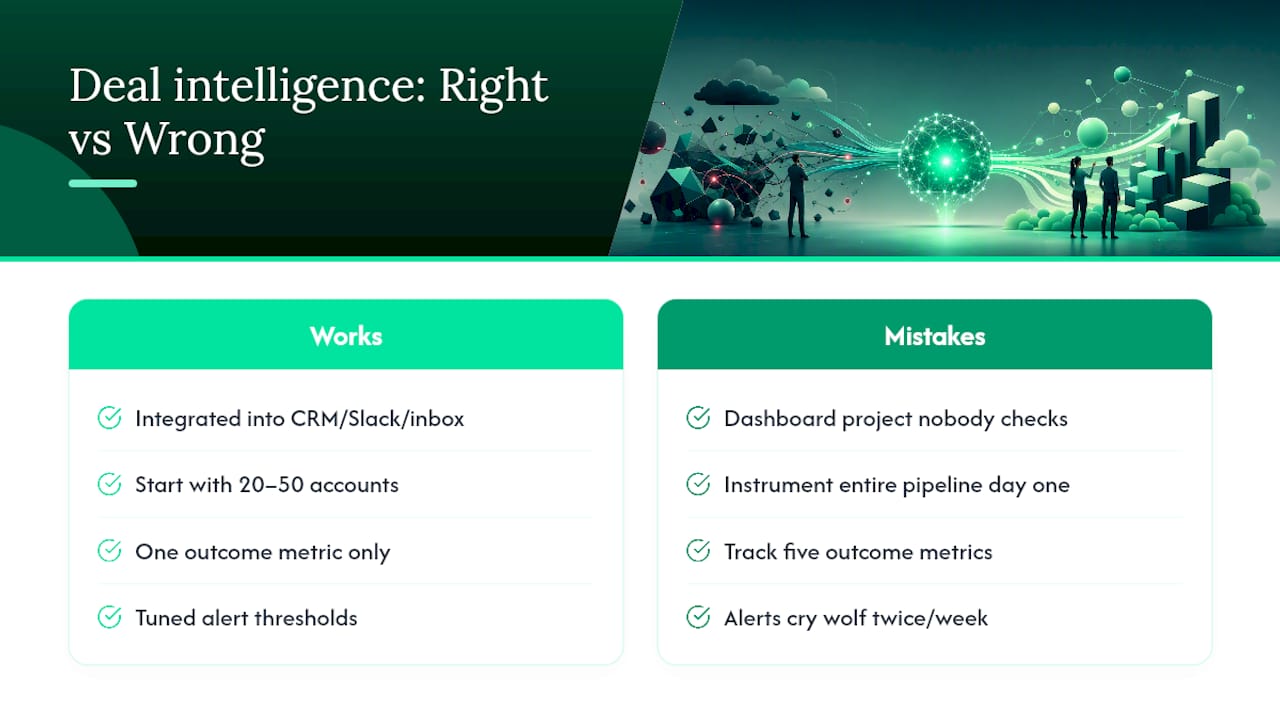
Threshold tuning deserves more attention than it gets. An alert system that cries wolf twice a week trains reps to ignore it permanently, and trust doesn't come back easily once it's gone.
Measure lift honestly: track influenced pipeline and win rate against a control group that didn't get the signals. Without that comparison, you're just guessing whether the tool worked or the market got easier that quarter.
— Bernard
Ready to Move From Guesswork to Verified Signals
You've seen the checklist: verified signals, real integrations, battlecards that write themselves, and a pilot you can measure in 30 days. Signal Engine Growth was built around exactly that checklist, priced for teams that don't have a data science budget behind them.
Instead of stitching together a CRM export, a competitor alert tool, and a separate churn model, Signal Engine puts behavior scoring, competitor monitoring, and pipeline tracking into one dashboard your reps already check. You can book a live demo to see the alerts in action, or go straight to the Signal Engine Growth pricing page and start the 30-day pilot described above against your own named accounts this week.
Ready to Stop the Revenue Leak? Signal Engine gives small and local businesses 31 AI-powered tools to score leads by buying intent, predict churn before it happens, auto-generate email and SMS campaigns, and recover missed calls automatically — all in one dashboard starting at $49/month. Start your free 7-day trial — no credit card required. Setup takes 5 minutes.
Sources
Not every signal carries the same weight, and treating them equally is how teams end up chasing noise instead of revenue. Here's the hierarchy worth knowing:
The reason timing-based signals outperform volume-based lists comes down to math: only about 2% of accounts are actively in a buying window at any given moment.
Pro Tip: Set your confidence threshold high for the first 30 days of any new signal source. It's easier to loosen filters once reps trust the alerts than to win back trust after a flood of bad ones.
Verification is what makes the difference between a signal worth acting on and a false positive. A platform that flags "competitor mentioned" without confirming the mention came from a real decision-maker, on a real call, tied to a real open deal, is just generating anxiety, not intelligence; companies looking for practical implementations can find workflows and case examples at AddBack's blog.
FAQ
Can You Give an Example of Decision Intelligence in Sales?
A rep getting an automatic alert that a champion changed jobs, paired with a suggested re-engagement email and a list of new stakeholders to contact, is decision intelligence in practice: the system doesn't just flag a risk, it recommends the next action.
What Are the Stages of Business Intelligence Most Deal Platforms Follow?
Most platforms move through data collection, enrichment, verification, analysis, and action delivery, with the last stage (pushing insights into a rep's actual workflow) being the step that determines whether the intelligence gets used at all.
What Does Market Intelligence Do for a Sales Team?
Market intelligence tracks competitor moves, industry shifts, and external events like funding rounds so a team can prioritize accounts and time outreach, rather than treating every prospect as equally ready to buy.
What Is Retail Intelligence and How Does It Relate to Deal Intelligence?
Retail intelligence applies similar signal tracking to consumer buying patterns, foot traffic, and inventory trends. Deal intelligence applies the same core logic (verified signals, confidence scoring, timed action) to B2B pipeline and account-level decisions instead of storefront behavior.