

Missed call text back automatically sends an SMS to anyone whose call you don't answer, so the lead stays warm instead of dialing your competitor. In a study of 14,354 messages sent across home service businesses, nearly one in three generated a reply, and many of those replies arrived within a few minutes. If you run a trade business and aren't sending one, turn it on this week, or test it with a phone-level app before you scale to a platform.
TL;DR:
- Automated missed call texts can generate replies within minutes, with 74% arriving in five minutes, increasing the chance for immediate engagement.
- Proper setup requires matching ring timeout settings with call abandonment thresholds and implementing cooldowns to prevent spammy repeated messages.
- Keep messages short, personalized, and contain a clear next step, with opt-out language included to comply with regulations and ensure higher reply rates.
- Using a platform that integrates lead scoring and follow-up automation yields better revenue results than standalone texting apps.
- Costs vary from low-cost apps to more expensive integrated systems, with the best choice depending on call volume and the need for tracking recovery-to-revenue.
Table of Contents
- How Does Missed Call Text Back Work?
- How Do You Set Up Missed Call Text Back?
- What Should a Missed Call Text Actually Say?
- What Compliance Rules Apply to Automated Texts?
- Phone App, Platform, or Integrated System: Which Fits Your Business?
- Why an Integrated System Beats a Standalone Text Tool at Scale
- What Does Missed Call Text Back Cost?
- How Do the Top Missed Call Text Back Options Compare?
- How Do You Measure Whether It's Actually Working?
- What Goes Wrong and How Do You Fix It?
- What Actually Matters Here
- Ready to Stop the Revenue Leak?
- Sources
- FAQ
How Does Missed Call Text Back Work?
The mechanics are simple: a call comes in, nobody picks up, and an automated text fires to that caller's number within seconds. What trips people up is the difference between a missed call and an abandoned call. Most systems, including CallRail's automated response tools, won't trigger a text-back if the caller hangs up before roughly 15 seconds, since that's treated as an abandoned dial rather than a real missed opportunity. That threshold matters when you're setting ring timeouts.
Speed is the entire game here. The same 99Calls study found 74% of replies arrived within five minutes of the text going out, which means the caller is often still sitting in their driveway or scrolling other contractors when your message lands. Wait an hour and that window closes.
Here's what the flow typically looks like once it's built:
- Call rings unanswered past your set timeout (usually 4 to 6 rings).
- Trigger fires and an SMS goes out from the same or a tracked business number.
- Caller replies, and that reply either opens a two-way text thread, hands them a booking link, or routes straight into your CRM or inbox.
- A human (you, a dispatcher, or a sales rep) picks up the conversation from there.
Where you build this depends on your stack. Solo operators often run it straight from a phone app. Small teams with a VoIP system or CRM usually wire it into their existing call routing so replies land in one shared inbox instead of a personal cell phone.
How Do You Set Up Missed Call Text Back?
You can have this running inside an hour if you follow the steps in order instead of jumping around.
- Pick your deployment path. A phone app works for a one-truck operation. A VoIP or CRM platform makes more sense once you have more than one person answering calls, since it centralizes replies.
- Get your number ready. Either forward your existing business line into the platform or use the tracking number the platform assigns, so the automation actually sees the missed call happen.
- Build the trigger and write the text. Set the rule to fire on "no answer," then draft a message that names your business and gives one clear next step, like a link or a reply prompt.
- Set a cooldown. Decide how long the system waits before texting the same number again, so three quick redials don't turn into three separate texts.
- Run staged test calls. Call your own line during business hours, after hours, and with a call you hang up on in under 10 seconds. Confirm the text fires correctly (or correctly doesn't, for that fast hang-up) and that replies show up where you expect.
Pro Tip: Call your own number from a friend's phone and hang up at exactly 12 seconds, then again at 20 seconds. If your automation should treat the first as abandoned and the second as missed, this test tells you in under two minutes whether your ring timeout actually matches that behavior.
Once replies start coming in, check where they're landing. A text that fires perfectly but drops replies into a phone nobody monitors defeats the purpose.
What Should a Missed Call Text Actually Say?
Every guide on this topic agrees on one thing: keep it short, human, and give the caller one easy next step. Anything longer than a text message should be doesn't get read on a job site.
Four templates that cover most scenarios:
- General acknowledgment: "Hi, this is [Business Name]. Sorry we missed your call! Reply here and we'll get right back to you."
- Booking-focused: "Thanks for calling [Business Name]! Grab a spot on our schedule here: [link]. Or reply and we'll call you back."
- After-hours: "You reached [Business Name] after hours. We'll call you back first thing tomorrow, or reply now and we'll see it."
- Emergency flag: "Sorry we missed you! If this is urgent, reply URGENT and we'll call you back immediately."
A few hard rules make these work. Stay under 160 characters so the message sends as one SMS segment instead of splitting into an awkward multi-part text. Always name the business, since a text from an unknown number gets ignored or reported as spam. Include exactly one next step, not three. And add opt-out language ("Reply STOP to unsubscribe") on the first message or in your welcome flow.
Personalization helps when you have caller ID data to work with. Dropping in a first name ("Hi John, sorry we missed you") tends to lift replies slightly, but only use it when you're confident the data is accurate. A wrong name kills trust instantly.
What Compliance Rules Apply to Automated Texts?
Getting the operational rules right protects both your reply rate and your business from complaints. A few settings do most of the work.
- Cooldown window: Cap repeat texts to the same number within a 20 to 60 minute window, so someone who calls three times in ten minutes gets one text, not three.
- Ring timeout tuning: Since calls under roughly 15 seconds often get classified as abandoned rather than missed, adjust your forwarding timeout so genuine missed calls still trigger the text reliably.
- Opt-out language: Every automated text should include a way to stop future messages, and you should keep logs of what was sent and when.
- Landline awareness: Landlines can't receive SMS. If a chunk of your inbound calls come from landlines, those callers will never see your text, so don't assume 100% coverage just because the automation fired.
The 32.7% overall reply rate from the 99Calls study held up across home service verticals, and more than 1,600 of those reply conversations turned into billable leads during the study period. That's the number that should justify the setup time.
None of this is legal advice, and message consent rules vary by how you collected the number in the first place, so if you're texting numbers you didn't get direct consent from, get that reviewed before you scale volume.
Phone App, Platform, or Integrated System: Which Fits Your Business?
The right deployment depends less on preference and more on how many calls you're missing and what you want to do with the data afterward.
- Phone apps are the fastest way to start. Tools like Auto TextBack for missed calls or an IFTTT applet set up in minutes and cost little to nothing. The tradeoff is no CRM sync and almost no analytics, so you can't see which texts actually turned into jobs.
- Workflow or VoIP platforms add real routing. Calls can forward to a team inbox, replies sync to a shared CRM, and you get some reporting on reply rates. This is the right tier for a small team of two to five people fielding calls.
Before picking a lane, count your monthly missed calls, decide whether you actually need analytics on reply-to-booking conversion, and set a budget. A five-truck HVAC company missing 40 calls a month has very different needs than a solo landscaper missing four.
Why an Integrated System Beats a Standalone Text Tool at Scale
A standalone auto-text app solves the acknowledgment problem. It doesn't solve what happens next. Layering in a system that qualifies the reply rather than just sending it turns a one-off text into a tracked pipeline.
An integrated revenue intelligence platform handles the auto text-back the moment a call goes unanswered, and then does what a phone app never will:
- Feeds every recovered lead into a unified capture system instead of a scattered text thread.
- Scores the lead automatically based on how they respond and what they're asking for.
- Triggers follow-up campaign automation across email and SMS without you writing another message.
- Reports on which recovered calls actually became revenue, not just replies.
What Does Missed Call Text Back Cost?
Pricing splits roughly three ways, and the cheapest option on paper isn't always the cheapest in practice.
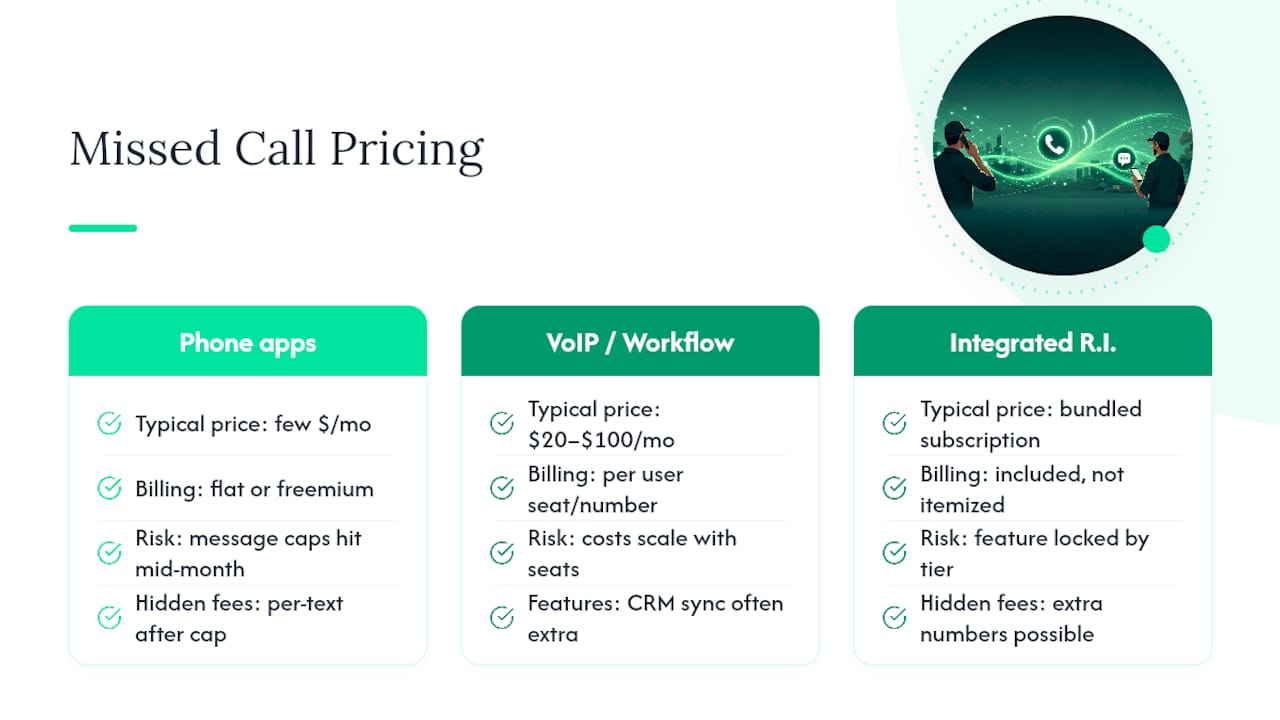
Phone-level apps often charge a flat few dollars a month or run on a freemium model with message caps, which is fine until you outgrow the cap and get bounced back to manual replies mid-month. Workflow and VoIP platforms typically bill per user seat or per number, often in the $20 to $100 monthly range depending on call volume and features like CRM sync. Integrated revenue intelligence platforms bundle the text-back into a broader subscription, so you're not paying for missed-call recovery as an isolated line item.
The number to actually track isn't the subscription fee, it's cost per recovered lead. If your automation costs $40 a month and helps close even one extra job that would have gone to a competitor, the tool pays for itself many times over in a single month. Most contractors underestimate how many missed calls represent real, ready-to-book customers rather than telemarketers or wrong numbers, and that miscalculation is why the ROI on this feature tends to run high.
Watch for hidden costs too: per-text fees that scale with volume, extra charges for additional phone numbers, or a "sync to CRM" feature locked behind a higher tier. Ask any provider for a total monthly estimate based on your actual call volume before you commit, not their advertised starting price.
How Do the Top Missed Call Text Back Options Compare?
Rather than naming a winner, it's more useful to compare deployment categories against what actually matters for a contractor.
| Deployment Method | Setup Time & Skill | Message Customization | Cost Model | CRM/Calendar Integration |
|---|---|---|---|---|
| Phone app | Minutes; no technical skill needed | Basic templates, limited personalization | Flat low fee or free with caps | None or minimal |
| Workflow/VoIP platform | Hours; some configuration required | Full template control, cooldown rules | Per-seat or per-number monthly fee | Often syncs with popular CRMs |
| Integrated revenue intelligence | Under an hour with guided setup | Full personalization plus lead scoring | Flat subscription, tiered by features | Built-in, centralized dashboard |
The pattern is consistent: the more integrated the platform, the less manual work you do stitching tools together later. A phone app answers the call. A platform routes the reply. An integrated system tells you what that reply was worth.
How Do You Measure Whether It's Actually Working?
Two numbers matter more than any others: reply rate and time-to-reply. If most of your replies aren't coming in within five minutes, something about your message or timing needs adjusting, since caller intent fades fast after that window.
Track these on a simple monthly basis:
- Reply rate: replies divided by texts sent. Anything meaningfully below 30% suggests your message copy or timing needs work.
- Time-to-first-reply: how fast callers respond. This tells you whether your window for human follow-up is still open.
- Conversion-to-booking: how many reply conversations actually became scheduled jobs or sales.
- After-hours performance: evening and weekend sends often perform close to daytime reply rates, so don't assume after-hours texts are wasted effort.
If you're running a phone app with no reporting, you're flying blind on all four. That's the strongest argument for stepping up to a platform once your call volume justifies it, since you can't fix what you can't see.
What Goes Wrong and How Do You Fix It?
Most failures trace back to a handful of repeatable mistakes. The text never fires because the ring timeout is set shorter than the platform's abandoned-call threshold, so genuine missed calls get miscategorized and skipped. Fix it by testing with staged calls at different disconnect times and nudging the timeout up.
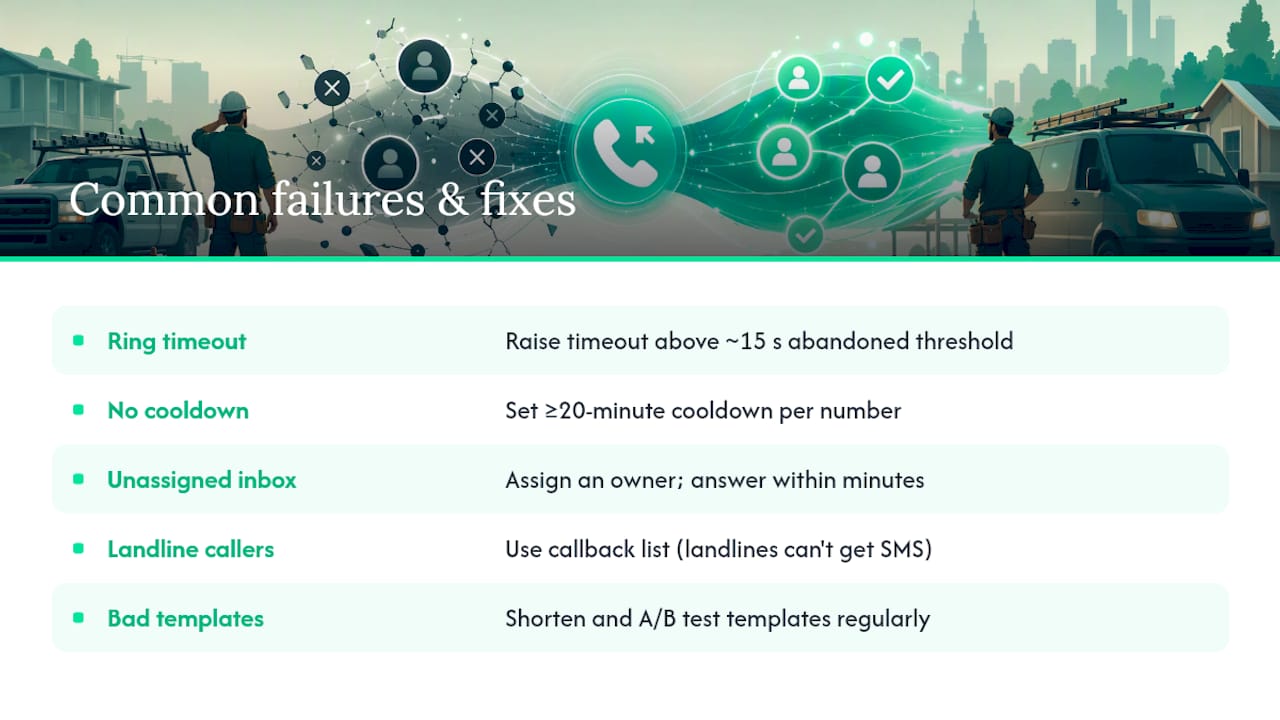
Callers get texted two or three times in a row because there's no cooldown configured. This is the fastest way to get flagged as spam. Set a cooldown of at least 20 minutes per number.
Replies pile up in a channel nobody checks, usually because the text was set up quickly and nobody assigned ownership of the reply inbox. Every automated text needs a named person or team responsible for answering within minutes, not hours.
Landline numbers never respond, and teams assume the automation is broken. It isn't broken, landlines simply can't receive SMS, so that segment of missed calls needs a different follow-up method, like a callback list.
Finally, messages get too long, too vague, or too salesy, and reply rates quietly drop. Revisit your templates every few months and watch which ones actually get replies instead of setting them once and forgetting them.
What Actually Matters Here
The industry oversells the technology and undersells the discipline. Any app can send a text after a missed call. What separates a business that recovers real revenue from one that just looks automated is whether someone answers the reply fast, whether the cooldown stops annoying repeat callers, and whether the ring timeout actually matches the platform's abandoned-call logic instead of silently skipping real leads.
Most advice treats missed call text back like a set-and-forget feature. It isn't. The 32.7% reply rate from the home service study is an average, not a guarantee, and it moves based on your message copy, your speed, and whether replies land somewhere a human actually watches.
Where most small businesses go wrong is stopping at the acknowledgment text and calling it done. The text is the opener, not the close. If you want the recovered lead scored, followed up automatically, and tracked through to revenue, the text-back needs to plug into something bigger than a standalone app. Start simple if you're solo. But the moment you're missing more than a handful of calls a week, the manual patchwork stops paying for itself.
— Bernard
Ready to Stop the Revenue Leak?
Signal Engine gives small and local businesses 31 AI-powered tools to score leads by buying intent, predict churn before it happens, auto-generate email and SMS campaigns, and recover missed calls automatically — all in one dashboard starting at $49/month.
If you've been running a phone app or a bare-bones platform just to send an acknowledgment text, you already know the gap: replies come in, but nothing scores them, follows up on them, or tells you which ones turned into jobs. Signal Engine's missed call recovery closes that gap by pairing the auto text-back with lead scoring and campaign automation, so every recovered caller moves through a tracked pipeline instead of sitting in a text thread nobody revisits. Check current plans and pricing to see which tier matches your call volume.
Start your free 7-day trial — no credit card required. Setup takes 5 minutes.
Sources
- Does Missed Call Text Back Actually Work?
- Automated responses for missed calls – CallRail Help Center
- Missed Call Text Back: Complete Guide (2026)
FAQ
How do you text back when you missed a call?
You set up an automation, either a phone app, a VoIP platform, or an integrated system, that detects the missed call and sends a pre-written SMS within seconds, without you touching your phone.
What is the missed call text back feature?
It's an automated system that sends an SMS to a caller the moment their call goes unanswered, so the lead gets an instant acknowledgment instead of silence. Platforms like Signal Engine's missed call recovery tool also score and route that reply into a broader follow-up workflow.
Is missed call text back legal?
Sending automated texts falls under SMS marketing and communication rules that vary by how the number was obtained, so include opt-out language like "Reply STOP" and keep records of what you send. Check current guidance for your situation rather than relying on general practice alone.
How do I set up missed call text back in a CRM or workflow platform?
Forward your business number or use the platform's assigned tracking number, build a "no answer" trigger, write a short auto-text naming your business with one next step, set a cooldown of 20 to 60 minutes, and test with staged calls before going live.