

Your pipeline looks healthy. Deals are closing. Revenue is growing. Yet somehow, profits keep falling short of projections. The problem is almost certainly hidden revenue losses, and most business leaders never find them because they’re looking in the wrong places. Revenue leakage costs businesses 1-5% of EBITDA annually, which translates to $3 million gone on a $100M revenue base. The ways to find hidden revenue losses aren’t obvious, and that’s exactly what makes them so dangerous.
Table of Contents
Key takeaways
| Point | Details |
|---|---|
| Leakage spans the full lifecycle | Hidden losses occur from planning through collections, not just in billing errors. |
| Data integration is non-negotiable | Disconnected CRM, billing, and finance systems create blind spots that mask leakage. |
| Prioritize by dollar impact | Focus your audit on the top three leakage areas by estimated loss to drive results fast. |
| Continuous monitoring beats one-off audits | Periodic reviews miss ongoing leaks; real-time dashboards catch them as they form. |
| Quantify before you escalate | Leadership acts on dollar estimates, not process complaints. |
Ways to find hidden revenue losses: foundational requirements
Before you can start detecting revenue leaks, your data environment needs to be audit-ready. Most organizations skip this step and wonder why their findings don’t hold up under scrutiny.
The single biggest structural risk is disconnected systems creating blind spots. When your CRM, billing platform, contract management system, and finance tools don’t talk to each other, revenue data fragments across silos. A deal closed in the CRM may never reconcile with what actually gets invoiced. A contract amendment processed in legal may never reach finance. These gaps are where money disappears quietly.
Here’s what your foundational system stack needs to look like before a meaningful revenue loss audit:
| System | Purpose | Key leakage risk if missing |
|---|---|---|
| CRM (e.g., Salesforce) | Tracks deals, stages, and customer data | Missed follow-ups, unqualified pipeline inflation |
| Contract lifecycle management | Manages terms, renewals, and pricing | Expired discounts billed, missed rate increases |
| Billing and invoicing platform | Generates and tracks invoices | Pricing errors, underbilling on usage |
| ERP or finance system | Records revenue and cash application | Unapplied payments, recognition delays |
| Revenue intelligence tool | Cross-system analysis and alerting | Leakage that spans multiple systems undetected |
Executive sponsorship matters just as much as technology. A revenue loss audit that lives only in the finance team will miss sales-stage and planning-stage leakage entirely. You need cross-functional ownership spanning sales ops, finance, legal, and customer success. Without it, findings get siloed and fixes never get implemented.
Pro Tip: Before starting any leakage analysis, run a data completeness check. If more than 10% of your CRM records are missing contract values or close dates, your findings will be unreliable. Fix the data first.
Detecting revenue leaks across the revenue lifecycle
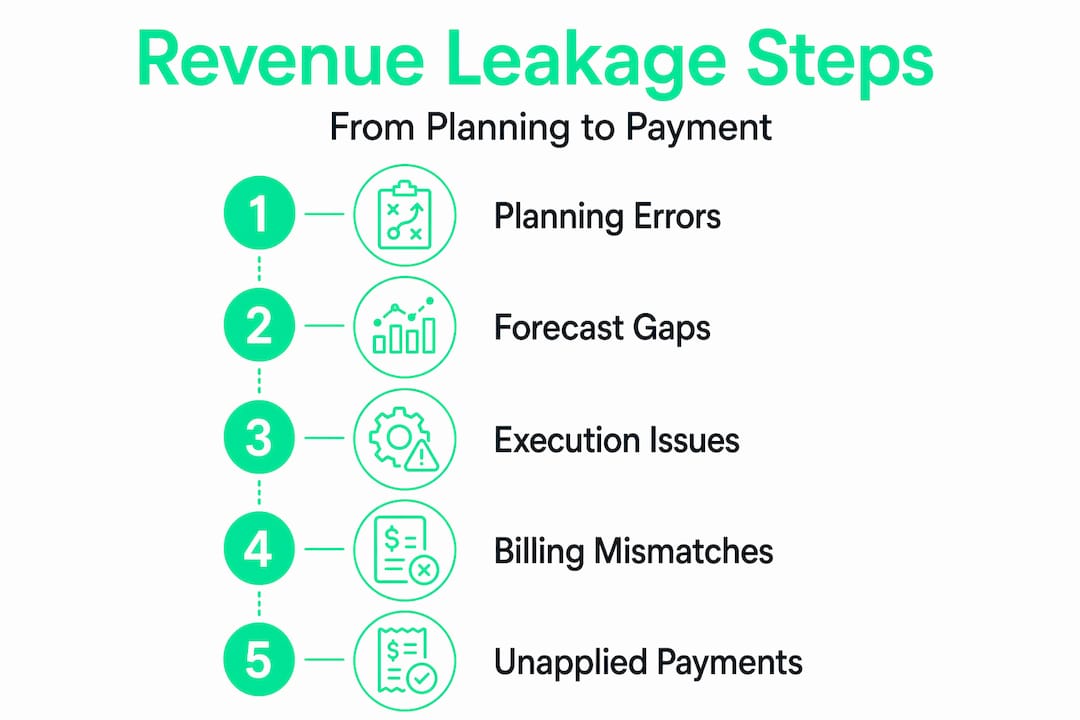
Revenue leakage occurs systemically across the entire revenue lifecycle, not just in post-sale billing. Here’s how to find it at each stage.
1. Planning and territory design
Misaligned territories and unrealistic quotas create leakage before a single deal is worked. When reps are assigned overlapping accounts or territories with unequal potential, you get coverage gaps and sandbagging. Neither shows up on an invoice audit.
To detect planning-stage leakage, analyze quota attainment distribution. If more than 20% of your reps are hitting over 120% while another 20% are below 60%, your territory design is likely the cause, not rep performance. Cross-reference account potential data against actual revenue generated by territory.
2. Forecasting accuracy
Forecasting inaccuracies cause resource misallocation and missed hiring decisions, both of which increase downstream revenue risk. Track forecast accuracy by rep and region over rolling 90-day windows. Deal slippage rates above 15% per quarter signal that your pipeline is being inflated with deals that aren’t moving.
3. Execution: discounts, pricing, and approval delays
This is where most organizations find their largest single leakage source. Incorrect pricing on 4% of quotes caused nearly $2.7M in annual leakage at one company audited in a quote-to-cash review. That’s roughly 6% of total revenue gone from a problem that looked minor in isolation.
Run a discount distribution analysis. Pull every deal closed in the last 12 months and plot discount percentages by rep, deal size, and product line. Outliers above your approved discount threshold are your first red flags. Then check approval logs. Deals that bypassed the standard approval workflow often carry unauthorized discounts that compound over multi-year contracts.
4. Contract and billing alignment
Thousands of active contracts can hide misaligned pricing, billing errors, and missed renewal obligations. The fix is systematic contract-to-invoice reconciliation. Pull your active contract list and compare contracted rates against what’s actually being billed. Pay special attention to:
-
Contracts with annual price escalation clauses that were never applied
-
Expired promotional discounts still active in the billing system
-
Renewal dates that passed without an updated order form
5. Usage-based billing reconciliation
If you bill based on consumption, delayed or incomplete usage data combined with disconnected systems creates recurring underbilling that rarely surfaces in summary financials. The problem often comes down to billing-cycle cutoffs that run before usage data is fully collected. Your billing rules must validate data completeness before finalizing any invoice.

Run a reconciliation between your usage data platform and your billing system for the last six months. Flag any billing period where usage records were incomplete at invoice generation time.
6. Payment application and commission reconciliation
Unapplied payments sitting in suspense accounts for over 30 days are a direct revenue recognition problem. If your unapplied payment total exceeds 1% of monthly revenue, you have a cash application process failure. These payments distort your cash flow reporting and delay revenue recognition, creating a false picture of customer health.
Here’s a comparison of detection approaches across the lifecycle:
| Lifecycle stage | Key signal | Detection method | Primary tool |
|---|---|---|---|
| Planning | Quota attainment spread | Territory and capacity analysis | CRM analytics |
| Forecasting | Deal slippage rate | Pipeline aging report | CRM or BI tool |
| Execution | Discount outliers | Discount distribution analysis | CPQ or ERP |
| Contracts | Billing vs. contract mismatch | Contract-to-invoice reconciliation | CLM + billing |
| Usage billing | Underbilling on consumption | Usage-to-invoice data match | Billing platform |
| Payment application | Unapplied cash balances | Suspense account aging report | ERP |
Pro Tip: Start your audit at the execution and billing stages. That’s where dollar-quantifiable leakage is fastest to identify and easiest to present to leadership for immediate action.
Common mistakes when analyzing revenue losses
Even experienced finance teams make avoidable errors when conducting a revenue loss audit. These mistakes don’t just slow you down. They cause you to miss the most significant leakage entirely.
-
Auditing only invoices and ledgers. This is the most common failure mode. Auditing only invoices misses upstream leakage in planning and forecasting entirely. If your audit starts at the invoice, you’re already too late to catch 40-60% of potential losses.
-
Treating fragmented systems as acceptable. Manual reconciliation between disconnected systems introduces errors at every handoff. Measuring how many systems house revenue data and how much time your team spends on manual reconciliation gives you a direct proxy for structural leakage risk.
-
Relying on memory-based processes. An audit of 30 startups found that most lacked structured lead qualification and follow-up automation, leading to consistent revenue loss at the top of the funnel. Processes that depend on individual reps remembering to follow up are processes that leak.
-
Running one-off audits instead of continuous monitoring. A point-in-time audit tells you what was leaking six months ago. It doesn’t tell you what started leaking last week. Real-time monitoring dashboards catch new leakage as it forms.
-
Chasing every leak at once. Focusing on the top three leakage areas by estimated dollar loss drives better outcomes than trying to fix everything simultaneously. Prioritize by financial impact, not operational convenience.
Pro Tip: When you find a leakage pattern, don’t just fix the instance. Trace it back to the process or system that allowed it to happen. One billing error is a mistake. Fifty billing errors with the same root cause is a process failure.
Verifying findings and tracking recovery over time
Finding leakage is only half the work. Verifying your findings and tracking recovery impact is what turns a one-time audit into a sustainable revenue assurance program.
-
Quantify estimated leakage in dollar terms. For each leakage type identified, calculate an annualized dollar estimate. Leadership responds to numbers, not process descriptions. Leadership needs quantified dollar estimates to prioritize fixes and secure resources for remediation.
-
Build a leakage monitoring dashboard. Set up KPIs for each leakage category you’ve identified: discount compliance rate, contract-to-invoice match rate, unapplied payment aging, and usage billing completeness. Review these weekly, not quarterly.
-
Integrate detection with prevention. Technology fixes alone are insufficient without process changes. For each leakage source, document the process change required alongside the system fix. Assign ownership to a named individual, not a team.
-
Communicate ROI to stakeholders. Once you’ve recovered revenue, document it explicitly. Show the delta between pre-audit and post-audit performance in each leakage category. This builds organizational support for ongoing revenue assurance investment and makes the next audit easier to fund.
My take on why most leakage audits fail
I’ve worked through enough revenue audits to know that the biggest mistake organizations make isn’t technical. It’s scope. Most teams start with billing because billing feels concrete and auditable. You can pull a report. You can find the error. You can fix the line item. It feels like progress.
But in my experience, billing errors are usually symptoms of problems that started much earlier. A pricing error on an invoice traces back to a discount approved outside the standard workflow six months ago. An underbilled usage account traces back to a data pipeline that was never properly validated. Fixing the invoice without fixing the upstream process means the same error will appear again next quarter.
What I’ve seen work is treating revenue leakage as a lifecycle-wide problem rather than a billing problem. That means connecting your planning data, your execution data, and your payment data into a single analytical view. When you can see the full chain, patterns emerge that no invoice audit would ever surface.
The organizations that recover the most revenue aren’t the ones that run the most thorough one-time audits. They’re the ones that build continuous detection into their operations. That’s not a project. It’s a capability.
— Bernard
Find what your pipeline is silently losing
If the leakage patterns described in this article sound familiar, you’re not alone. Most businesses are losing revenue they don’t know about yet.
Signalengine’s AI-powered free revenue leakage audit analyzes your pipeline, billing, and customer data to pinpoint exactly where income is slipping away. No lengthy onboarding. No upfront cost. The average business uncovers $38K in recovery potential in the first month. See what Signalengine costs to keep that detection running continuously, or start your free audit right now and get your 30-day recovery playbook.
---
> Signal Engine detects exactly this type of revenue leak automatically. See what your business is losing in under 60 seconds — [run your free revenue scan →](https://signalengine.solutions)
---
FAQ
What are the most common ways to find hidden revenue losses?
The most effective methods include contract-to-invoice reconciliation, discount distribution analysis, usage billing data matching, and unapplied payment audits. Starting at the execution stage typically surfaces the highest-dollar leakage fastest.
How much revenue do businesses typically lose to leakage?
Revenue leakage costs 1-5% of EBITDA annually, meaning a $100M business may lose $1M to $5M each year to preventable leakage across its revenue lifecycle.
Why do invoice audits miss so much revenue leakage?
Invoice audits only capture post-sale errors. Auditing only invoices misses upstream leakage in planning, forecasting, and sales execution, which can account for the majority of total leakage by dollar value.
How do unapplied payments cause revenue loss?
Unapplied payments in suspense accounts delay revenue recognition and distort cash flow reporting. When balances exceed 1% of monthly revenue and sit unapplied for over 30 days, it signals a significant cash application process failure.
How often should a business run a revenue loss audit?
A point-in-time audit should be conducted at least annually, but continuous monitoring dashboards tracking discount compliance, billing accuracy, and payment application are far more effective at catching leakage before it compounds.
Recommended
Article generated by BabyLoveGrowth
---
Stop losing revenue to problems you can't see.
Signal Engine gives small and local businesses 31 AI-powered tools to score leads by buying intent, predict churn before it happens, auto-generate email and SMS campaigns, and recover missed calls automatically — all in one dashboard starting at $49/month.
[Start your free 7-day trial →](https://signalengine.solutions/auth.html)
No credit card required. Setup takes 5 minutes.
---