

Most consultants walk into client engagements armed with spreadsheets, CRM exports, and gut instinct. That worked a decade ago. Today, the gap between what your client thinks is happening in their pipeline and what is actually happening can cost them six figures a quarter. Understanding why consultants need revenue intelligence is not an academic exercise. It is the difference between delivering a recommendation that changes behavior and handing over a slide deck that collects dust. This article breaks down what revenue intelligence actually is, where client revenue bleeds out, and how you can use it to deliver results that stick.
Table of Contents
Key takeaways
| Point | Details |
|---|---|
| Revenue intelligence goes beyond dashboards | It connects real-time signals to automated workflows that trigger execution, not just reporting. |
| Leakage starts earlier than billing | Revenue loss begins at quota assignment and forecast stages, long before invoices are sent. |
| Forecast accuracy is fixable | AI-enabled execution intelligence can push forecast accuracy to 94%, up from the industry norm below 75%. |
| Insight without action is wasted | Prescriptive, role-specific next steps are what drive client revenue improvement, not data alone. |
| Unified systems outperform layered tools | Integrating planning, CRM, and commissions into one operating system eliminates lag and execution errors. |
Why consultants need revenue intelligence now
Revenue intelligence is not a fancier name for a sales dashboard. The distinction matters enormously when you are advising a client on where their growth is stalling.
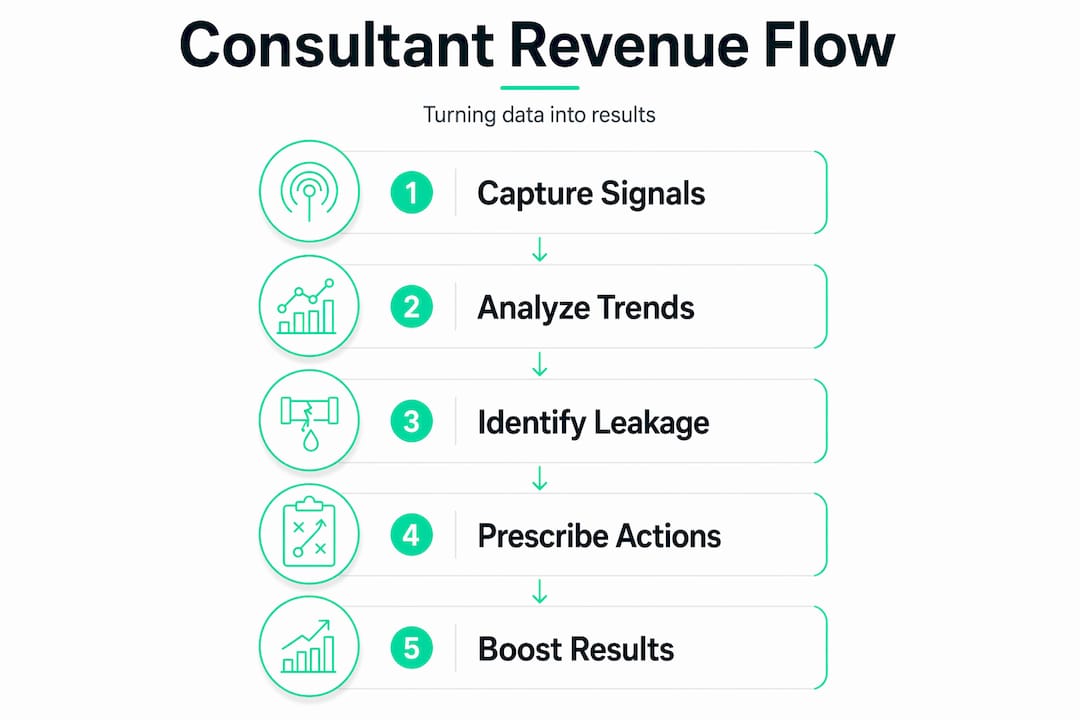
At its core, revenue intelligence is the practice of collecting, analyzing, and acting on signals across the entire revenue lifecycle. That includes sales activity data, customer engagement signals, pipeline movement, forecast accuracy, and commission alignment. The more advanced version, often called revenue execution intelligence, goes one step further. It connects planning, forecasting, and execution into a single operating system rather than leaving each function in its own silo.
Here is what separates it from traditional analytics:
-
Traditional analytics tells you what happened. A deal slipped. A rep missed quota. A segment underperformed.
-
Revenue intelligence tells you why it happened and triggers a response. A champion went quiet. Procurement stalled. The territory was misaligned from the start.
-
Revenue execution intelligence goes further still. It automates the next step. A coaching trigger fires. A deal intervention gets flagged. A territory adjustment is proposed in real time.
The AI layer is what makes this possible. Machine learning models process signals across CRM data, email activity, call transcripts, and external intent data simultaneously. No human analyst can do that at scale across a client’s entire pipeline.
Pro Tip: When scoping a new client engagement, ask specifically whether their CRM data and planning tools are connected or whether their RevOps team is manually reconciling reports. That gap alone tells you where the biggest leakage risk lives.
The practical implication for consultants is significant. You are no longer limited to advising based on historical data your client pulls together for a quarterly review. You can work with live signals that reflect what is happening in deals right now.
Where client revenue actually leaks out
This is the section most consultants skip over in their discovery process, and it is where the real money is hiding.
Revenue leakage is not just about billing errors or discount abuse. Leakage occurs across the full revenue lifecycle, and the most expensive leaks happen long before a contract is signed or an invoice is sent. Here is a breakdown of where it shows up:
| Leakage Stage | Common Causes | Business Impact |
|---|---|---|
| Planning | Misaligned territories, flawed quota models | Reps working unwinnable books of business |
| Forecasting | Stale CRM data, rep sandbagging, no signal weighting | Leadership making investment decisions on bad numbers |
| Execution | Missed follow-ups, no deal coaching, champion loss | Deals stalling or dying without intervention |
| Commission | Payout errors, clawbacks, misaligned incentives | Rep disengagement, turnover, sandbagging |
The financial damage is only part of the story. Revenue leakage creates compounding costs across four dimensions: direct revenue loss, operational time spent firefighting, poor strategic decisions made on bad data, and cultural damage when sales teams lose trust in the system. That last one is the hardest to fix.

The strategic case for early detection is clear. Catching a territory misalignment in January costs your client almost nothing to fix. Catching it in October means nine months of a rep working the wrong accounts, a distorted forecast, and a comp plan that rewarded the wrong behavior. Most audits happen after the fact. Revenue intelligence shifts that to proactive detection.
Pro Tip: When you identify revenue leakage for a client, always quantify it across all four cost dimensions, not just the direct revenue number. The operational and cultural costs often exceed the direct loss and make the business case for change far more compelling.
The most overlooked leakage point is the forecast-to-execution gap. A client can have a reasonable forecast model and still bleed revenue because the execution layer does not respond to changes in deal signals. A champion leaves a prospect account. Nobody notices for three weeks. The deal stays green in the CRM. That is pure leakage, and it is invisible without real-time intelligence.
Turning revenue data into client results
This is where the consulting value proposition sharpens. Knowing that leakage exists is not enough. Your clients need you to tell them exactly what to do about it, and revenue intelligence gives you the signal layer to do that with precision.
Modern revenue intelligence platforms track dynamic, real-time signals that static CRM reports cannot capture:
-
Champion strength shifts. When a key internal sponsor at a prospect account goes quiet or changes roles, deal risk spikes immediately.
-
Procurement activity patterns. Procurement engagement signals buy-readiness. Absence of it signals stall risk.
-
Multithreading depth. Deals with only one contact are far more fragile than deals with three or more engaged stakeholders.
-
Email and call engagement velocity. Slowing response times are a leading indicator of disengagement before it shows up in pipeline movement.
The difference between these signals and a standard CRM report is that forward-looking intelligence generates prescriptive next steps rather than historical summaries. Instead of telling a sales manager “this deal slipped,” the system tells them “re-engage the economic buyer this week using this specific message.”
For consultants, this changes the nature of your deliverable. You are not presenting a diagnosis. You are presenting a playbook with specific, timed actions tied to real signals in the client’s pipeline.
Forecast accuracy is one of the most visible ways this pays off. Fewer than 20% of sales teams achieve forecast accuracy above 75% using traditional methods. AI-enabled execution intelligence can reach 94% accuracy by unifying planning, forecasting, and execution. When you can show a client’s leadership team that their forecast confidence has moved from 60% to 90%, that is a career-defining engagement for you.
Customer intelligence also transforms raw data into targeted strategies that improve customer lifetime value and loyalty. For consultants working on retention or expansion revenue, this is the signal layer that tells you which accounts are at risk before they churn and which are ready for an upsell conversation.
How to operationalize revenue intelligence for clients
Understanding the theory is one thing. Getting it to work inside a real client organization is another. Here is a practical sequence that works:
-
Audit the current revenue operating system. Map every tool touching planning, CRM, forecasting, and commissions. Identify where data is manually reconciled. That is where lag time and errors live. Most revenue organizations face execution delays specifically because of disconnected systems.
-
Connect the data layer before building the intelligence layer. Revenue intelligence built on top of fragmented data produces fragmented insights. Consolidate first. This usually means integrating the planning tool with the CRM and ensuring commission data flows from the same source of truth.
-
Define the execution triggers. Work with the client’s RevOps and sales leadership to specify what signals should trigger what actions. Champion goes quiet for 10 days? Flag for manager review. Forecast variance exceeds 15%? Trigger a pipeline review meeting. AI-triggered workflows only work when the trigger conditions are defined and owned.
-
Align sales, RevOps, and leadership around shared playbooks. The most common failure mode is a RevOps team that builds great dashboards nobody acts on. Sales teams disengage when insights do not lead to immediate, role-specific actions. Build the playbook alongside the intelligence layer, not after it.
-
Measure execution, not just outcomes. Track whether the triggered actions are being taken. A deal intervention that fires but gets ignored tells you something about culture or change management, not the tool.
The organizations that get the most from revenue intelligence are those that embed it into their operating systems rather than layering it on top of broken processes. That is the consulting insight most clients need to hear before they spend a dollar on a new platform.
My take: stop treating intelligence as reporting
I have sat in enough client war rooms to know the pattern. A RevOps leader pulls up a beautiful dashboard. Everyone nods. Nobody changes anything by Friday.
The dashboards are not the problem. The assumption that seeing the data is the same as acting on it is the problem. In my experience, the clients who get real results from revenue intelligence are the ones who treat it as an operational system, not a reporting system. The moment you wire a signal to a workflow, you have crossed from analytics into execution. That is where the money is.
What I have learned from working with growth-stage B2B clients is that the insight-to-action gap is almost always a process problem, not a technology problem. The tool fires the right signal. Nobody owns the response. You can find the root causes of revenue leakage in almost every client’s operation within the first two weeks if you know where to look. The harder work is building the accountability structure that turns that signal into a closed deal or a saved account.
AI-powered workflows are reshaping what consulting deliverables look like. A 90-day roadmap is no longer enough. Clients expect you to wire up the system, define the triggers, and show them the first recovery before the engagement ends. That is the new bar. Revenue intelligence is the tool that lets you meet it.
— Bernard
See your client’s revenue leakage in 30 days
You now know what revenue intelligence is, where leakage hides, and how to operationalize it inside a client business. The next step is running the numbers on a real account.

Signalengine gives consultants a free revenue leakage audit that identifies exactly where a client’s pipeline is losing money, from misaligned territories to missed renewal signals. The platform’s AI-powered analysis surfaces an average recovery potential of $38K in the first month, with a 30-day recovery playbook built in. No lengthy onboarding. No sign-up required to get started. Whether you are working with a SaaS company, a marketing agency, or a growing B2B business, Signalengine turns raw customer data into a specific, timed action plan your client can execute immediately. Start with a free revenue audit and bring your next client a number, not just a narrative.
---
> Signal Engine detects exactly this type of revenue leak automatically. See what your business is losing in under 60 seconds — [run your free revenue scan →](https://signalengine.solutions)
---
FAQ
What is revenue intelligence for consultants?
Revenue intelligence for consultants is the practice of using AI-powered tools to collect and act on real-time signals across a client’s revenue lifecycle, from pipeline health to forecast accuracy to commission alignment. It goes beyond reporting to trigger specific operational responses that recover lost revenue.
How does revenue intelligence differ from a CRM dashboard?
A CRM dashboard shows historical data about what happened. Revenue intelligence analyzes live signals like champion strength, procurement activity, and engagement velocity to generate prescriptive next steps before a deal is lost.
Where does revenue leakage most commonly occur?
Revenue leakage occurs across all stages of the revenue lifecycle, including quota planning, forecasting, deal execution, and commission payouts. The most expensive leaks happen during planning and execution, not just at billing.
Can revenue intelligence actually improve forecast accuracy?
Yes. Traditional methods leave fewer than 20% of sales teams hitting 75% forecast accuracy. AI-enabled revenue execution intelligence, which unifies planning, forecasting, and execution data, can reach 94% accuracy.
How quickly can consultants show ROI from revenue intelligence?
With the right platform, consultants can identify and quantify revenue leakage within the first two to four weeks of an engagement. Signalengine’s free audit surfaces recovery opportunities in the first month, giving consultants a concrete financial case to present to client leadership. ⚡
Recommended
Article generated by BabyLoveGrowth
---
Stop losing revenue to problems you can't see.
Signal Engine gives small and local businesses 31 AI-powered tools to score leads by buying intent, predict churn before it happens, auto-generate email and SMS campaigns, and recover missed calls automatically — all in one dashboard starting at $49/month.
[Start your free 7-day trial →](https://signalengine.solutions/auth.html)
No credit card required. Setup takes 5 minutes.
---