

Forecast risk signals are AI-generated indicators that tell you which customers or deals are likely to churn or fail, and when, so you can prioritize outreach that saves revenue. Instead of waiting for a cancellation email or a deal gone quiet, you get an early warning while there's still time to act. For small and local teams without a data department, turnkey options bring this capability within reach fast.
TL;DR:
- Small teams should prioritize tracking engagement persistence, financial behavior, and conversational signals, as they are most predictive of churn and deal failure.
- Using simple models and focusing on key data points can deliver rapid results without requiring a dedicated data scientist or extensive engineering.
- Regularly retraining models every three months and monitoring drift helps maintain forecast accuracy in dynamic customer environments.
- Leveraging AI-driven tools like Signal Engine Starter allows teams to automate scoring, outreach, and account prioritization quickly and cost-effectively.
- Relying solely on CRM data overlooks behavioral signals that significantly improve early risk detection and intervention success.
Table of Contents
- How forecast risk signals work under the hood
- Which specific signals should you track first?
- A 4-step roadmap to put signals to work
- How to prioritize accounts and prove the impact
- Quick wins and pitfalls to avoid
- Why we treat risk signals as ongoing hygiene, not a project
- Getting started with Signal Engine Starter
- FAQ
- Sources
- Ready to Stop the Revenue Leak?
How forecast risk signals work under the hood
Forecast risk signals draw from the data you already generate every day: product usage logs, digital engagement, sales conversations, billing history, and support tickets. Feed that into the right model and you get a forecast, not just a snapshot.
Most systems combine two model families. Ensemble classifiers, like Random Forests and XGBoost, score who is likely to churn and can hit high accuracy on medium-term forecasts when the input features are solid, empirical studies in subscription markets show. Survival (time-to-event) models add the timing layer, estimating hazard rates so you know when risk peaks, not just whether it exists, according to a recent comparison of survival modeling approaches. Explainability tools like SHAP keep the output usable by your sales team, not just your data scientist.
Trade-offs you'll hit quickly:
- More data volume supports more complex models, but small teams often do better starting simple.
- Class imbalance (few churners versus many healthy accounts) skews naive models toward false confidence.
- Concept drift means a model trained last year can quietly go stale.
Which specific signals should you track first?
Not every data point is worth watching. These five categories carry the most predictive weight for small and local revenue teams.
- Engagement persistence: recency, frequency, and the trend line matter more than raw activity volume, since steady or rising engagement separates healthy accounts from ones drifting away.
- Onboarding and feature adoption: customers who haven't touched a core feature in 30 to 60 days are flashing an early warning most teams miss.
- Financial behavior: late payments, plan downgrades, and shrinking order values are concrete, hard-to-fake risk markers.
- Conversational signals: stalled negotiations, negative sentiment in emails or calls, and unanswered follow-ups often surface before any contract data does.
- Deal activity: stalled approvals and declining buying signals inside your CRM flag pipeline risk the same way engagement data flags churn risk.
Research on subscription services finds that engagement persistence beats raw usage volume as a predictor, warning against "spurious loyalty," where a customer looks active right up until they cancel, according to a study on churn risk in subscription services.
A 4-step roadmap to put signals to work
You don't need a data team to get started — leveraging AI-powered sales agency and pipeline tools can simplify buyer matching and outreach automation. Here's a path built for small and local teams working in 30, 60, and 90-day windows.
- Weeks 0 to 2, inventory your data: pull together usage logs, billing records, support tickets, and CRM notes. You're looking for what's already there, not building new pipelines.
- Weeks 2 to 4, pick a pragmatic model and timeframe: a short-horizon classifier works for fast-moving transactional businesses, while a survival model fits longer sales or service cycles where timing precision pays off.
- Weeks 4 to 6, build a risk score with priority bands: combine churn or deal-failure probability with revenue at stake so your team knows who to call first.
- Weeks 6 to 12, automate the response: set up outreach templates, escalation rules, and one-click approvals so flagged accounts get action, not just attention.
Pro Tip: Start with one signal category, like engagement persistence, prove it moves outcomes, then layer in financial and conversational signals.
Pragmatic, signal-driven forecasting consistently beats forecasts built only on rep-entered CRM fields, which tend to reflect optimism more than reality, Winning by Design's research on pipeline management shows.

How to prioritize accounts and prove the impact
A risk score only helps if it tells you who to call first. Multiply risk probability by revenue at stake to get a priority number, then sort your list from there.
Track these KPIs to know if outreach is working:
- Retention lift among flagged accounts versus a holdout group
- Saved-deal revenue, measured in dollars recovered per quarter
- Cost per retention, so you know if the outreach is worth the effort
- Model precision and recall, so false alarms don't burn out your team
A systematic review of churn prediction research across 2020 through 2024 found that ensemble methods remain the dominant approach, while interpretability, class imbalance, and concept drift remain the field's persistent challenges, according to a review published in MDPI's journal. That drift risk is why retraining cadence matters: plan to refresh your model quarterly at minimum, and run simple A/B tests comparing outreach-triggered accounts against a control group before declaring victory.
Quick wins and pitfalls to avoid
A few moves pay off fast without any engineering lift:
- Trigger onboarding nudges the moment a new customer skips a key feature in week one.
- Set missed-payment alerts to fire the same day, not at month's end.
- Build a call-to-action trigger for any account whose engagement drops two weeks in a row.
Three pitfalls trip up most small teams. Relying only on CRM-entered fields misses the behavioral signals that actually predict risk. Chasing every possible data source before launching anything delays results for no added accuracy. Skipping explainability means your sales team won't trust or act on the scores you give them.
Pro Tip: Before trusting any signal, check your data hygiene: consistent timestamps, canonical customer IDs, and event-driven logs instead of batch exports.
Why we treat risk signals as ongoing hygiene, not a project
We've come to see forecast risk signals less as a one-time initiative and more as an operational habit, the same way you'd treat bookkeeping or inventory counts. Teams that check signals quarterly and call it done tend to miss the accounts that slip between check-ins. The ones that win treat signal monitoring as a standing routine built into weekly revenue reviews, not a dashboard they glance at occasionally.
— Bernard
Getting started with Signal Engine Starter
We offer a solution designed to carry small and local teams through the exact roadmap above without hiring a data scientist or writing a line of code. Here's what it includes:
- Lead and account scoring that combines churn risk with revenue impact, so your priority list builds itself.
- Churn flags that surface the moment engagement, billing, or conversation signals shift.
- One-click actions that turn a flagged account into an outreach email or call task instantly.
- Vertical-specific onboarding built for industries from day one, with a custom mode available if a business doesn't fit a standard category.
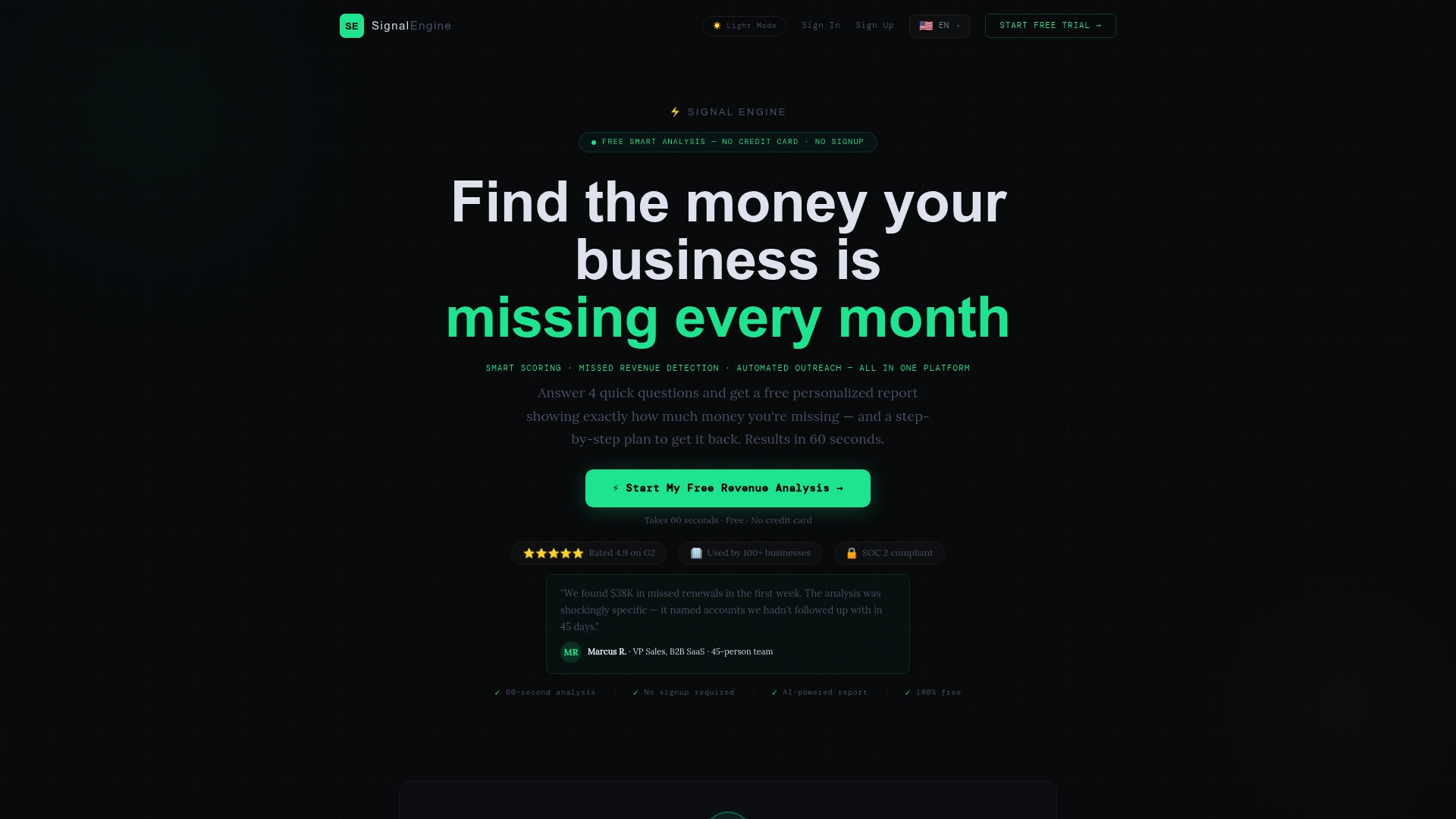
Setup takes minutes, not weeks: connect your existing tools, and we handle the inventory, scoring, and action steps from there. Pricing details for Starter and our other plans are on our pricing page, and you can see the full picture before committing to anything.
FAQ
What exactly counts as a forecast risk signal?
A forecast risk signal is any data point, like a drop in product usage, a late payment, or a stalled sales conversation, that an AI model uses to estimate the likelihood and timing of churn or deal failure. The goal is to flag risk early enough that a human can still intervene.
How far in advance can these signals predict churn?
Timing depends on the model: survival analysis approaches estimate hazard rates that can flag risk windows well before a cancellation happens, giving teams a scheduling edge over simple yes-or-no churn scores, survival modeling research shows. Short-horizon classifiers tend to focus on the next 30 to 90 days.
Do I need a data science team to use forecast risk signals?
No. Pragmatic ensemble models and SMB-ready platforms, including Signal Engine Starter, are designed so a small team can inventory data, generate scores, and automate outreach without specialized engineering support.
What's the biggest mistake businesses make with risk signals?
Relying only on CRM-entered fields is the most common mistake, since those fields reflect what a rep believes, not what the customer is actually doing. Pairing behavioral signals like engagement persistence with financial and conversational data gives a far more honest picture.
How often should a risk model be retrained?
Quarterly retraining is a reasonable baseline for most small teams, since concept drift can make even a good model stale within months, a challenge flagged across recent churn prediction research. Pair retraining with ongoing drift monitoring rather than treating the model as a one-time build.
Sources
- 2211.09970 Estimating defection in subscription‐type markets: empirical analysis from the scholarly publishing industry
- AI-Powered Pipeline Management | Winning by Design Research
- Survival-analysis study comparing CPH and Aalen additive models for churn prediction
- Systematic review of ML and DL approaches for churn prediction (2020–2024)
- Identifying Customer Churn Risk in Subscription-Based Digital Services
Ready to Stop the Revenue Leak?
Signal Engine gives small and local businesses 31 AI-powered tools to score leads by buying intent, predict churn before it happens, auto-generate email and SMS campaigns, and recover missed calls automatically, all in one dashboard starting at $49/month.
Start your free 7-day trial, no credit card required. Setup takes 5 minutes.