

TL;DR:
- Revenue leakage is the difference between contract revenue and actual earnings caused by failures in the quote-to-cash process.
- Businesses need shared definitions, automated checks, root cause analysis, and clear ownership to track and prevent revenue loss effectively.
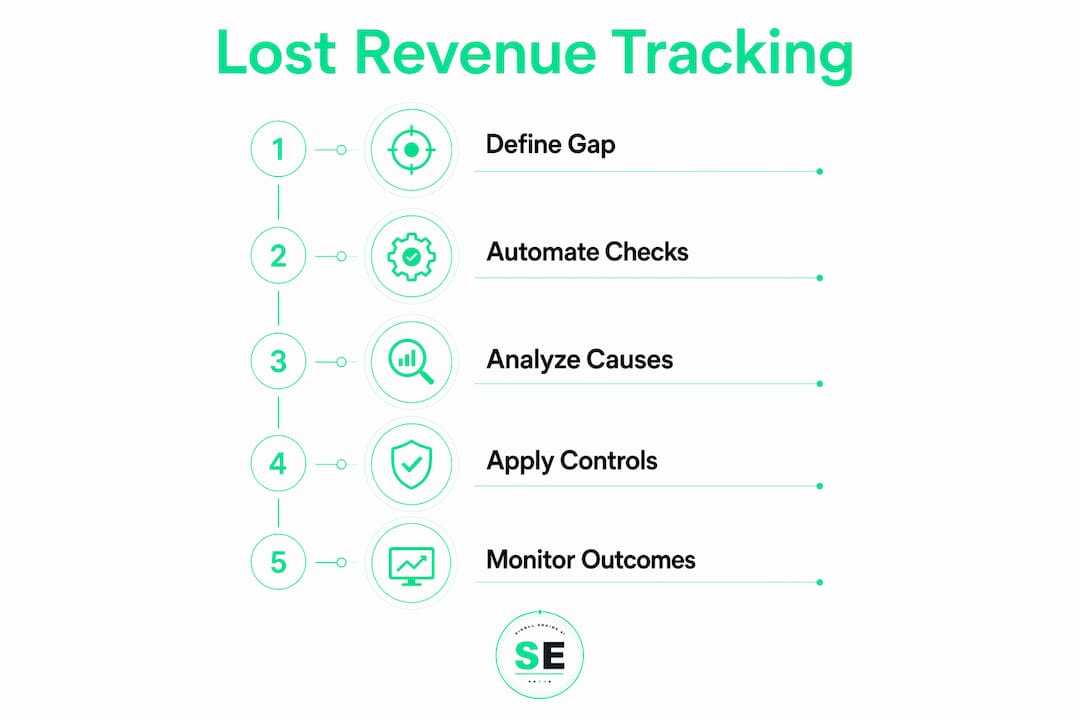
Revenue leakage is a measurable variance between committed contract revenue and actual financial recognition, caused by systemic failures across your quote-to-cash process. Most business owners discover it too late, buried in a quarterly report. To track lost revenue sources systematically, you need a recurring four-phase capability: define the gap, quantify it, trace root causes, and remediate with prevention controls. This is not a one-time audit. It is an ongoing discipline that ties your CRM, billing system, payment processor, and general ledger into a single, accountable picture of where money stops flowing.
What systems and data sources do you need before tracking revenue loss?

Before you can identify revenue loss systematically, you need clean definitions and connected systems. The most common failure point is not a missing tool. It is a missing shared model.
Start by defining your four canonical revenue states and assigning an owner to each:
- Booked revenue: closed deals recorded in your CRM (owned by Sales)
- Billed revenue: invoices generated in your billing system (owned by Finance)
- Recognized revenue: revenue recorded in your general ledger per accounting rules (owned by Accounting)
- Collected revenue: cash actually received from your payment processor (owned by Finance/Collections)
Each state lives in a different system. CRM and ERP systems frequently disagree because both are technically correct within their own data models. The disagreement signals a gap in your shared definitions, not a software bug.
Your reconciliation rhythm matters as much as your tools. Run automated daily checks between your CRM and billing system. Conduct weekly reviews of billing versus collections. Run quarterly audits of recognized versus collected revenue. This cadence catches drift before it compounds.
| Reconciliation Layer | Frequency | Systems Compared | Owner |
|---|---|---|---|
| Booked vs. Billed | Daily (automated) | CRM vs. Billing | RevOps |
| Billed vs. Collected | Weekly | Billing vs. Payment Processor | Finance |
| Recognized vs. Collected | Quarterly | General Ledger vs. Bank | Accounting |
| Pricing Drift Check | Quarterly | Rate Cards vs. Active Invoices | Finance |
Pro Tip: Set a 0.5% match tolerance between booked and billed revenue as your baseline threshold. Anything above that number is a signal worth investigating, not explaining away.
How to systematically identify and quantify lost revenue across your lifecycle
The revenue gap is the difference between what you expected to collect and what you actually collected. Expected revenue comes from your contracts, rate cards, and usage data. Actual revenue comes from your payment processor or bank. The distance between those two numbers is your leakage measurement.
Use this numbered process to run a full lifecycle diagnostic:
- Pull contracted revenue from your CRM. This is your baseline. Every closed deal with a dollar value and a close date belongs here.
- Compare it to billed revenue in your billing system. Gaps here reveal unbilled work, missed renewals, or pricing mismatches.
- Compare billed to collected. Gaps here reveal payment failures, disputed invoices, or dunning process breakdowns.
- Calculate your revenue realization rate. Divide collected by contracted. A rate below 95% signals a material problem worth a root cause investigation.
- Apply time-weighted revenue loss. Multiply the gap amount by the number of days it has been outstanding. This converts a vague "we're missing some money" into a specific dollar figure with urgency attached.
Pricing drift is the largest single leak category, responsible for approximately 38% of leakage. It is caused by stacked discounts, grandfathered rates, and inactive promotions that continue running in your billing system long after they should have expired. A quarterly pricing drift query compares every active invoice rate against your current rate card and flags every mismatch.
Lead-to-revenue leakage requires a different lens. Forensic analysis answers why and where losses occur across your go-to-market lifecycle, not just what the dashboard shows. Map each stage: lead intake, qualification, deal execution, post-close billing, and renewal. Assign a dollar value to the drop-off at each stage. That is where your revenue operations team should focus first.
| Leakage Category | Detection Method | Typical Root Cause |
|---|---|---|
| Pricing drift | Quarterly rate card audit | Stacked discounts, expired promos |
| Unbilled work | CRM vs. billing reconciliation | Manual billing gaps, missed milestones |
| Payment failure | Collections aging report | Failed cards, lapsed ACH |
| Renewal miss | Subscription audit | No auto-renewal, no outreach trigger |
| Post-close scope creep | Contract vs. invoice comparison | Undocumented change orders |
Pro Tip: Run your pricing drift query in the first week of each quarter. Catching a $200 monthly undercharge on 50 accounts recovers $120,000 annually before you spend a dollar on new customer acquisition.
What remediation and prevention controls stop future revenue leakage?
Detection without action is just expensive reporting. Once you find a gap, you need two types of fixes: tactical corrections for the current loss and structural controls to prevent recurrence.
Tactical fixes address the immediate dollar gap:
- Correct mispriced invoices and reissue them with a clear explanation to the customer
- Update contracts where scope has drifted beyond the original terms
- Recover missed charges through a formal credit memo or supplemental invoice process
- Restart failed payment collection with an automated dunning sequence
Structural fixes address the process that allowed the gap to form:
- Build automated webhooks that fire every time a price change is made in your billing system
- Add approval workflows for any discount above a defined threshold (for example, 15%)
- Create ticketing rules so that any reconciliation gap above your tolerance threshold generates an assigned ticket with a named owner and a resolution deadline
- Link your operational events (deal closed, contract signed, service delivered) directly to accounting triggers so billing happens automatically, not manually
Explicit action thresholds and ownership are what separate passive monitoring from active revenue recovery. A subscription drift above 5% should trigger a webhook. A reconciliation gap above your tolerance should create a ticket. Without those rules written into your system, the monitoring produces reports that nobody acts on.
Proactive diagnostics like forecast accuracy variance and quota attainment gaps reveal planning-stage leakage before it reaches your billing system. Most businesses focus their audit energy on post-close failures. The bigger opportunity is catching misalignment between sales commitments and operational capacity before a deal closes.
Pro Tip: Treat your revenue operations function as a revenue investigative unit, not a reporting team. Assign forensic questions to each stage of your pipeline: "Why did this deal close at 20% below rate card?" That question, asked consistently, builds a pattern library that prevents future drift.
What common mistakes break systematic lost revenue tracking?
The most common failure is not a missing tool. It is a missing owner. Continuous reconciliation without assigned accountability produces dashboards that everyone sees and nobody acts on.
Watch for these specific mistakes:
- Timing mismatches between systems. Your CRM records a deal as closed in march. Your billing system invoices in april. Your reconciliation flags a gap that is not actually leakage. Fix this by aligning your revenue recognition timing rules across systems before you run comparisons.
- Ignoring planning-stage leakage. Most audits focus on post-close billing failures. Leakage accumulates across the entire lifecycle, and the most preventable losses happen earlier, during quota setting and forecasting.
- Over-relying on manual monthly audits. Monthly reviews catch losses after they have already compounded. Daily automated reconciliations catch them while they are still recoverable.
- No living entity map. Your canonical revenue entities (booked, billed, recognized, collected) need to be documented and updated every time a system changes. A stale entity map produces false positives that erode trust in your data.
- Skipping webhook automation. Manual validation of price changes fails at scale. Every price change event should fire an automated check against active invoices.
"Revenue operations works best as a revenue-investigative unit rather than just reporting, employing forensic questioning and stage-level analysis to uncover true leakage causes." — Lead-to-Revenue Leakage Analysis
The deeper problem is cultural. When sales, finance, and operations each trust only their own system's numbers, reconciliation becomes a political argument instead of a diagnostic process. Building a shared data model with agreed definitions is the prerequisite that most teams skip because it requires cross-functional alignment, not just a software purchase.
Key Takeaways
Tracking lost revenue sources systematically requires four connected disciplines: shared definitions, automated reconciliation, forensic root cause analysis, and ownership-linked action thresholds.
| Point | Details |
|---|---|
| Define canonical revenue states | Assign booked, billed, recognized, and collected revenue to named owners across Sales, Finance, and Accounting. |
| Set reconciliation cadences | Run daily automated checks, weekly billing reviews, and quarterly pricing drift audits to catch gaps early. |
| Quantify with realization rate | Divide collected by contracted revenue; anything below 95% signals a material leak worth investigating. |
| Fix pricing drift first | Pricing drift causes approximately 38% of leakage; a quarterly rate card audit is the highest-ROI detection step. |
| Embed action thresholds | Gaps above your tolerance threshold must auto-generate a ticket with a named owner and a deadline. |
Why most revenue tracking systems fail before they start
Revenue leakage is not a finance problem. It is a cross-functional discipline that requires sales, operations, and finance to agree on what "revenue" means before anyone can measure what is missing. That sounds obvious. In practice, most businesses skip it entirely.
I have seen companies invest in expensive revenue intelligence platforms and still miss six-figure leakage because their CRM used a different close date definition than their billing system. The technology was fine. The shared model was absent. The result was a reconciliation process that produced more arguments than answers.
The insight that changes how you approach this: small drifts are more dangerous than large ones. A $50 monthly undercharge on a single account is easy to dismiss. Multiply it across 200 accounts over 18 months and you have recovered $180,000 without a single new sale. Daily attention to small variances is worth more than quarterly hunts for big failures.
The businesses that get this right treat their revenue leakage process the same way a manufacturer treats quality control. It is not a project with an end date. It is a standing operational function with metrics, owners, and a continuous improvement cycle. The technology supports that function. It does not replace the discipline.
— Bernard
How Signalengine helps you monitor lost revenue channels in real time
Your revenue tracking system is only as good as the signals it catches. Signalengine watches your customers, scores their behavior automatically, and flags who is about to leave before they do.

Built for SMBs across 12 verticals including HVAC, logistics, dental, and real estate, Signalengine gives you AI-powered revenue intelligence tools that score leads by buying intent, predict churn before it costs you a contract, auto-generate email and SMS recovery campaigns, and recover missed calls automatically. All of it runs in one dashboard. You get real-time visibility into where revenue is slipping, with automated plays that fire without you asking. Pricing starts at $49/month. Setup takes under five minutes.
FAQ
What does it mean to track lost revenue sources systematically?
Systematic lost revenue tracking is a recurring four-phase process: define the gap between expected and collected revenue, quantify it, trace root causes, and remediate with prevention controls. It is an ongoing operational discipline, not a one-time audit.
What is a revenue realization rate?
Revenue realization rate is collected revenue divided by contracted revenue. A rate below 95% signals material leakage that warrants a root cause investigation across your billing, collections, and pricing processes.
What causes the most revenue leakage in small businesses?
Pricing drift is the largest single leak category, responsible for approximately 38% of leakage. It is caused by stacked discounts, grandfathered rates, and inactive promotions that continue running in billing systems after they expire.
How often should you reconcile revenue data across systems?
Run automated daily checks between your CRM and billing system, weekly reviews of billing versus collections, and quarterly audits of recognized versus collected revenue. Daily reconciliation catches recoverable discrepancies before they compound into material losses.
Why do CRM and accounting systems show different revenue numbers?
Both systems can be correct within their own data models while still disagreeing. The fix is a shared revenue model with aligned definitions for close dates, recognition timing, and billing triggers, combined with a documented reconciliation rhythm across teams.
Ready to Stop the Revenue Leak?
Signal Engine gives small and local businesses 31 AI-powered tools to score leads by buying intent, predict churn before it happens, auto-generate email and SMS campaigns, and recover missed calls automatically — all in one dashboard starting at $49/month.
Start your free 7-day trial — no credit card required. Setup takes 5 minutes.