

TL;DR:
- A revenue leak audit systematically identifies gaps in the contract-to-cash cycle to prevent revenue losses. Regular, prioritized reviews and automation of key handoffs are essential for sustained revenue recovery and pipeline protection. Maintaining recurring audits and leveraging AI tools significantly enhances detection, response, and overall revenue integrity.
A revenue leak audit is a systematic process that identifies and closes gaps in your revenue lifecycle, from contract execution through cash collection, before those gaps compound into permanent losses. The formal industry term is revenue leakage analysis, and it covers every point where earned revenue fails to reach your bank account. Done correctly, a revenue leak audit step by step delivers 15 to 30% improvements in pipeline conversion and retention. The tools that make it work include CRM platforms like Salesforce or HubSpot, contract intelligence software, and automated billing reconciliation systems. This guide walks you through every stage.
What you need before starting a revenue leak audit
The revenue audit process fails before it begins when teams skip the prerequisites. You need clean, accessible data from four sources: your CRM, your invoicing system, your signed contracts, and your payment and collections records. Without all four, you are auditing a partial picture.
Cross-functional collaboration is not optional. Revenue leakage is a systemic problem found where departments fail to coordinate. Sales owns contract terms. Finance owns billing. Marketing owns renewal triggers. If those three teams are not in the same room at the start, you will miss the handoff gaps that cause the most damage.
Here is the minimum toolkit for an effective audit:
- CRM data export (Salesforce, HubSpot, or Pipedrive): closed-won deals, contract values, renewal dates
- Invoicing and billing records: issued invoices, payment status, aging reports
- Contract repository: signed agreements, pricing schedules, discount terms
- Payment processor data: failed charges, retry logs, refund history
- ERP or accounting system: recognized revenue vs. billed revenue
| Data Source | What to Pull | Why It Matters |
|---|---|---|
| CRM | Closed-won deals, renewal dates | Identifies missed renewals and upsell gaps |
| Invoicing system | Issued vs. paid invoices | Surfaces billing errors and aging receivables |
| Contract repository | Pricing, discount terms | Catches expired discounts still being applied |
| Payment processor | Failed charges, retry logs | Reveals dunning failures and ghost subscriptions |
Pro Tip: Assign a named owner for each data source before the audit starts. Audits stall when no one knows who pulls the billing export. One owner per system, one deadline, no ambiguity.
Define your audit cadence upfront. Quarterly audits yield the strongest results because significant losses accumulate after six months without review. Set the schedule before you run the first audit, not after.
How to run a revenue leak audit step by step
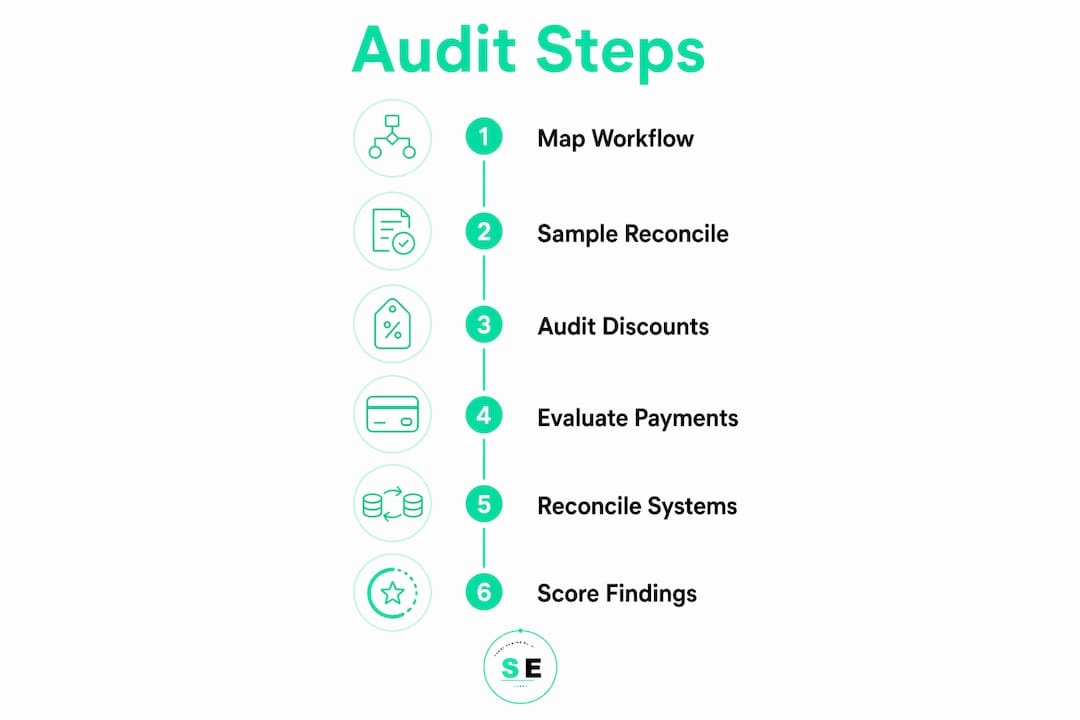
This is the core of the revenue leakage analysis. Follow these six steps in order. Skipping steps creates blind spots.
Step 1: Map your contract-to-cash workflow

Draw the full revenue lifecycle on paper or in a tool like Miro or Lucidchart. Start at contract signature and end at cash receipt. Mark every system handoff: where does contract data move into your billing system? Where does usage data feed into invoicing? Where do payment failures trigger a collections sequence? These handoffs are where most leakage lives.
Step 2: Sample and reconcile contracts, invoices, and payments
Pull a sample of 50 to 100 invoices and validate each against contracts. Check pricing, quantities, and terms. A single pricing error on a high-volume account can cost tens of thousands annually without anyone noticing. Flag every discrepancy, even small ones. Small errors at scale are large losses.
Step 3: Audit discount expirations, pricing errors, and compliance
Pull every active discount from your billing system and cross-reference it against contract terms. Expired promotional pricing that was never turned off is one of the most common and most overlooked leaks. Also check for manual overrides in your billing platform that were applied during a sales negotiation and never reversed.
Step 4: Identify failed payments and evaluate your dunning process
Export every failed payment from the past 90 days. Categorize by failure type: expired card, insufficient funds, bank decline. Then audit your dunning sequence. Dunning automation that includes email, Slack alerts, and account manager notifications recovers more failed payments than standard processor retries alone. If your current process is a single retry and a generic email, you are leaving money on the table.
Step 5: Cross-system reconciliation of CRM, billing, and ERP data
Compare closed-won deal values in your CRM against invoiced amounts in your billing system, then against recognized revenue in your ERP. Gaps between any two of these systems indicate a leak. Common causes include manual data entry errors, contract amendments that were not updated in billing, and usage-based charges that were metered incorrectly.
Step 6: Score findings by impact, urgency, and fix effort
Not all leaks are equal. A priority scoring system using impact, urgency, and effort on a scale of 1 to 125 prevents you from chasing low-impact easy fixes while critical high-impact leaks go unaddressed. Items scoring 60 or above get immediate attention. Everything below goes to the backlog. This single discipline separates audits that recover real revenue from audits that produce a long to-do list no one acts on.
Pro Tip: Run Step 6 as a team exercise with sales, finance, and operations in the room. Each team scores findings from their own perspective. The combined score is more accurate than any single department's view.
Common mistakes that kill audit accuracy
Most revenue audit failures share the same root causes. Knowing them in advance saves weeks of wasted effort.
- Auditing once and stopping. Revenue systems drift. New contracts introduce new pricing structures. Billing platforms get updated. A one-time audit is a snapshot, not a system. Embedding audits into RevOps culture is what produces sustained profitability.
- Ignoring ghost subscriptions. Accounts that are unpaid for over 30 days but still consuming server resources or support capacity are ghost subscriptions. They reduce revenue and inflate operational costs simultaneously. Automated systems rarely flag them without a manual scrub.
- Relying on monthly reporting. Monthly reports miss early signals of leakage. By the time a problem appears in a monthly summary, three weeks of recovery time are already gone. Weekly monitoring of payment failure rates and invoice error rates is the standard that works.
- Chasing quick wins over high-impact fixes. Fixing a $200 billing error feels productive. Ignoring a $40,000 contract-to-invoice translation gap because it requires engineering effort is a strategic mistake. The priority scoring framework from Step 6 exists precisely to prevent this.
"The highest ROI from revenue leak audits comes from focusing on broken handoffs and data reconciliation rather than surface-level error fixes." — The Complete RevOps Audit Checklist
For a deeper look at where hidden revenue losses tend to concentrate in business operations, the patterns are consistent across industries.
How to implement and monitor fixes after the audit
Finding leaks is half the job. Closing them permanently is the other half.
-
Separate quick wins from strategic fixes. Quick wins are fixes that take less than one week and score above 60 on your priority matrix. Address these in the first two weeks. Strategic fixes require system changes, engineering work, or contract renegotiation. Schedule these with clear owners and deadlines.
-
Automate the three critical handoffs. The three handoffs that cause the most leakage are contract-to-invoice translation, usage metering reconciliation, and dunning sequences. Automating these eliminates the manual errors that reintroduce leaks after every audit. Tools like Zuora, Chargebee, or custom API integrations between your CRM and billing platform handle this at scale.
-
Set threshold alerts for leading indicators. Configure alerts in your billing system or BI tool for payment failure rates above 3%, invoice error rates above 1%, and aging receivables over 45 days. These thresholds catch new leaks before they appear in monthly reports. For SaaS teams, tracking these metrics weekly is the difference between early recovery and late damage control.
-
Run quarterly focus audits and an annual comprehensive audit. Quarterly audits target the highest-risk areas identified in the previous cycle. The annual audit covers the full contract-to-cash workflow from scratch. This cadence keeps your revenue integrity tight without overwhelming your team.
-
Document every fix with a before-and-after revenue impact. This creates the business case for continued investment in audit infrastructure and gives your team a clear record of what was recovered.
Pro Tip: Build a shared dashboard in Tableau, Looker, or even Google Sheets that tracks your five leading indicators in real time. When a metric crosses a threshold, the alert goes to a named owner, not a group inbox. Group inboxes are where alerts go to die.
Why most audits underdeliver (and how to fix that)
I have reviewed revenue audit processes across dozens of SaaS companies and marketing agencies, and the pattern is almost always the same. The audit itself is thorough. The follow-through is not.
Teams spend three weeks identifying every leak in their system, produce a detailed report, and then prioritize the fixes that are easiest to explain to leadership rather than the ones that recover the most revenue. A $5,000 billing correction gets fixed in a day because it is visible and simple. A $60,000 gap in contract-to-invoice translation sits in a backlog for six months because it requires a conversation between sales, engineering, and finance that nobody wants to schedule.
The discipline that separates high-performing revenue teams is not the quality of their audit. It is the rigor of their prioritization. The priority scoring framework is not a nice-to-have. It is the mechanism that forces the right conversation. When a finding scores 95 out of 125, it cannot be deprioritized without a documented reason. That accountability changes behavior.
The other shift I advocate for is treating the audit as a cultural practice, not a project. Projects end. Revenue leakage does not. The companies that recover the most revenue are the ones where the RevOps team runs a standing 30-minute weekly review of leading indicators, flags anomalies immediately, and owns the fix process from identification to resolution. That is not a heavy lift. It is a habit.
Combining that habit with AI-powered detection tools changes the math entirely. Human auditors catch what they know to look for. AI catches the patterns humans miss, including the slow drift in discount application rates that no one notices until it has been running for eight months.
— Bernard
How Signalengine detects and recovers revenue leaks automatically
Running a manual revenue leakage analysis every quarter is the right practice. Automating the detection layer is what makes it sustainable.
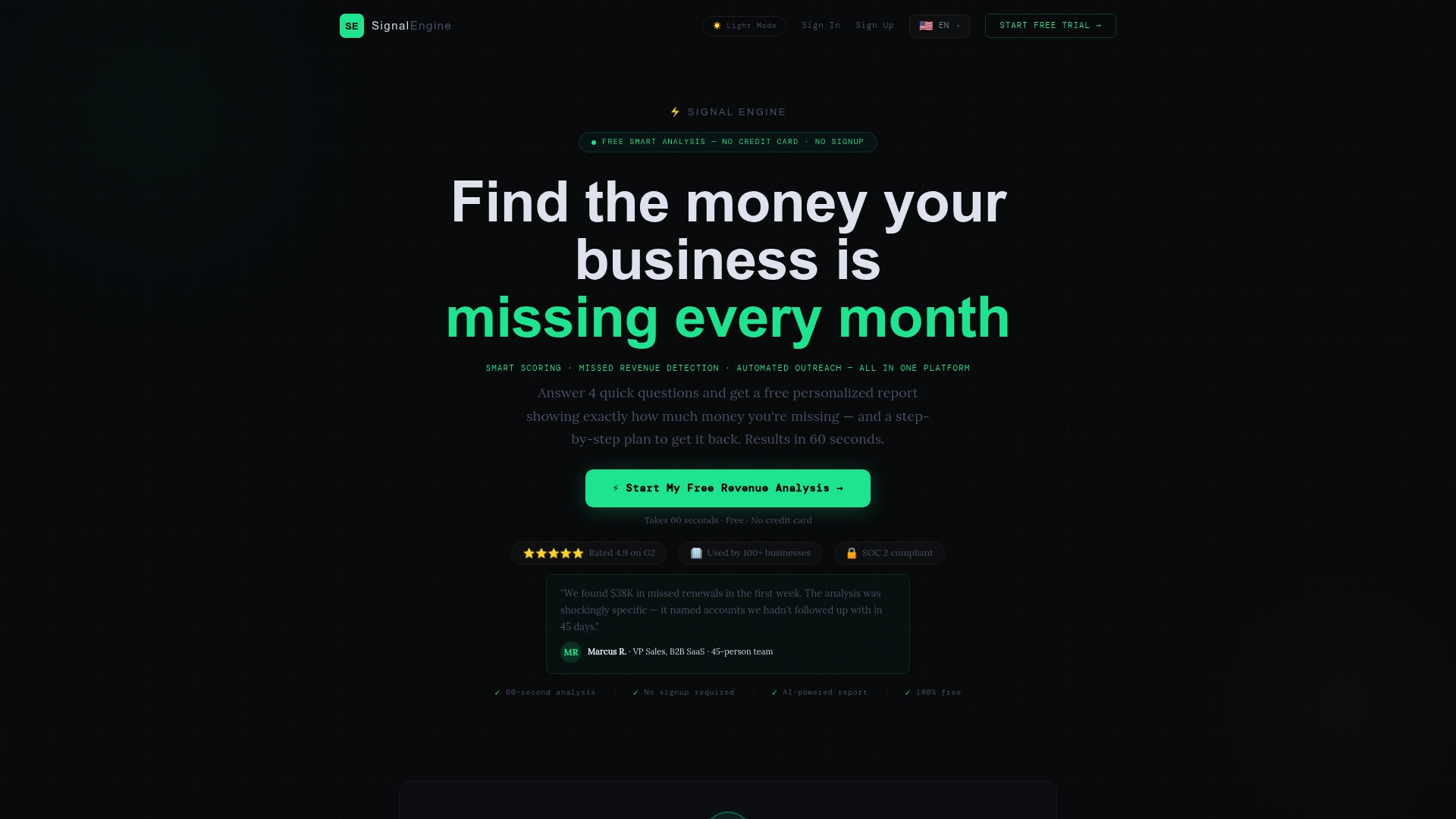
Signalengine's revenue leakage software uses AI-driven analysis to surface churn risks, missed renewals, ghost subscriptions, and billing gaps before they compound. The platform connects to your existing CRM and billing data, scores every account by revenue risk, and generates a 30-day recovery playbook with specific fixes ranked by impact. Features include real-time lead scoring, automated outreach sequences, and payment recovery workflows. Setup takes minutes, not weeks. Plans start at $49/month, and the average user identifies $38K in recoverable revenue in the first month. No lengthy onboarding. No guesswork.
Ready to Stop the Revenue Leak?
Signal Engine gives small and local businesses 31 AI-powered tools to score leads by buying intent, predict churn before it happens, auto-generate email and SMS campaigns, and recover missed calls automatically — all in one dashboard starting at $49/month.
Start your free 7-day trial — no credit card required. Setup takes 5 minutes.
Key takeaways
A structured revenue leak audit, run quarterly and followed by disciplined prioritization, is the most direct path to recovering lost revenue and protecting future pipeline.
| Point | Details |
|---|---|
| Start with four data sources | Pull CRM, invoicing, contracts, and payment data before touching anything else. |
| Audit handoffs first | Contract-to-invoice translation, usage metering, and dunning sequences cause the most leakage. |
| Score every finding | Use a 1-125 priority matrix so high-impact leaks get fixed before easy low-value ones. |
| Monitor weekly, not monthly | Monthly reports miss three weeks of recovery time; set threshold alerts for real-time detection. |
| Make audits a recurring practice | One-time audits produce one-time results; quarterly cadence produces sustained profitability. |
FAQ
What is a revenue leak audit?
A revenue leak audit is a structured review of your contract-to-cash workflow that identifies where earned revenue is lost before collection. It covers billing errors, failed payments, expired discounts, and cross-system data gaps.
How often should you run a revenue leak audit?
Quarterly audits are the recommended standard, with a comprehensive annual review covering the full revenue lifecycle. Significant losses accumulate after six months without an audit.
What are the most common revenue leaks in SaaS?
Ghost subscriptions, expired discounts still being applied, failed payments without proper dunning, and contract-to-invoice translation errors are the most frequent and highest-impact leaks in SaaS businesses.
How do you prioritize fixes after a revenue leak audit?
Use a priority scoring system that multiplies impact, urgency, and fix effort on a scale of 1 to 125. Findings that score 60 or above get immediate attention. Lower scores go to the backlog.
Can revenue leak audits be automated?
The detection layer can be largely automated using AI-powered platforms like Signalengine, which continuously monitors CRM and billing data for anomalies. Human review remains necessary for contract interpretation and cross-departmental decisions.