

TL;DR:
- A client revenue leakage audit identifies hidden revenue losses caused by billing errors, misaligned contracts, and process gaps. It focuses on system handoffs and recurring patterns, emphasizing proactive, ongoing reviews to prevent future leakage. Technology such as AI and integrated systems significantly reduce manual errors, ensuring consistent revenue recovery and operational efficiency.
Your business isn't losing money to bad sales reps or a weak product. It's losing money quietly, through billing errors, missed invoices, and contract misalignments nobody caught. A client revenue leakage audit is the systematic process of finding exactly where that silent drain is happening. Revenue leakage accounts for 1% to 5% of EBITDA annually, caused by misaligned territories, inaccurate forecasts, and disconnected systems. For a $10M business, that's up to $500K gone. Not to competitors. Not to churn. Just gone.
Table of Contents
- Key Takeaways
- What is a client revenue leakage audit?
- Common signs of revenue leakage in client accounts
- The client revenue audit process, step by step
- Turning audit results into lasting revenue protection
- Technology's role in modern revenue audits
- My take on why most audits fail to deliver
- How Signalengine finds your revenue gaps automatically
- FAQ
- Ready to Stop the Revenue Leak?
Key Takeaways
| Point | Details |
|---|---|
| Audit scope is client-focused | A client revenue leakage audit examines billing, contracts, and service delivery tied specifically to client accounts. |
| Leakage differs from churn | Revenue leakage stems from process failures and errors, not customers leaving or planned discounts. |
| Proactive audits outperform reactive ones | Structural audits run before losses accumulate catch systemic issues that one-time reviews miss. |
| Technology reduces error rates significantly | Integrated billing and ERP systems cut manual entry errors by up to 30%, directly reducing leakage. |
| Audit cadence sustains revenue integrity | Annual full audits paired with quarterly focused reviews prevent compounding losses over time. |
What is a client revenue leakage audit?
A client revenue leakage audit is a structured evaluation of every revenue-related process that touches your client relationships. The goal is to find where money you earned never made it to your bank account. That includes billing inaccuracies, contract terms that were never enforced, services delivered but never invoiced, and payments collected late or not at all.
This is not the same as a general financial audit. A standard financial review confirms that your books are accurate. A client revenue leakage audit goes further. It interrogates the processes that feed those books, asking where money slipped out before it was ever recorded.
The typical scope covers four core areas:
- Billing accuracy: Are invoices reflecting the correct rates, quantities, and terms for every client?
- Contract compliance: Are clients being charged according to agreed terms, including rate escalations and scope changes?
- Service delivery capture: Are all billable services, deliverables, and hours actually being invoiced?
- Payment collection: Are there patterns of late payment, partial payment, or silent non-payment going unaddressed?
For business leaders and financial managers, this audit is the closest thing to finding free money. You've already done the work. The revenue exists. You're just not capturing it.
Pro Tip: Don't assume your billing software catches everything. The most common leakage points live in the handoff between your CRM, your project management tool, and your billing system. That's where billable work disappears.
Common signs of revenue leakage in client accounts
Revenue leakage often stems from process inefficiencies and billing errors rather than deliberate discounts or customers leaving. The distinction matters. If you misread leakage as churn, you try to win customers back. You should be fixing your billing workflow instead.
Here are the most common leakage sources that surface during a revenue leakage assessment:
- Missed or delayed invoicing. Billable work completes, but the invoice never goes out because the project team didn't flag it or the billing cycle was off.
- Billing rate errors. Clients get charged last year's rates because the CRM was never updated after a contract renewal.
- Scope creep not captured. Additional services are delivered informally without a change order or updated SOW, so they're never billed.
- Contract misalignment. Minimum commitment clauses, usage thresholds, or auto-escalation terms aren't enforced because nobody is tracking them.
- Manual entry mistakes. Hours, quantities, or service codes are entered incorrectly, consistently underbilling specific accounts.
- Recurring denial patterns. In industries like healthcare, 70% of rework costs come from just 2 to 3 denial codes, meaning a small set of systemic errors drives the majority of revenue loss.
The warning signs show up as patterns. Inconsistent invoice totals for similar clients. Month-over-month revenue that doesn't match delivery volume. Client accounts with unusually low average billing relative to their contract value. These are not random. They're signals.
Revenue audits must focus on system handoff points like sales-to-finance and contract-to-billing. That's where leakage originates and compounds over time. A single missed handoff early in the process can mean months of underbilling before anyone notices.

Pro Tip: Pull a list of your top 20 clients by contract value, then compare it to your top 20 clients by actual billed revenue. The gap between those two lists is where you start your audit.
The client revenue audit process, step by step
The most effective client revenue audit process separates reactive auditing from proactive auditing. Reactive audits look backward at completed transactions to find errors already baked in. Proactive audits look at your current systems and processes to find structural problems before they generate more losses. Both matter. But proactive audits identify structural issues before revenue loss happens and treat leakage as a systemic problem, not a collection of one-off mistakes.
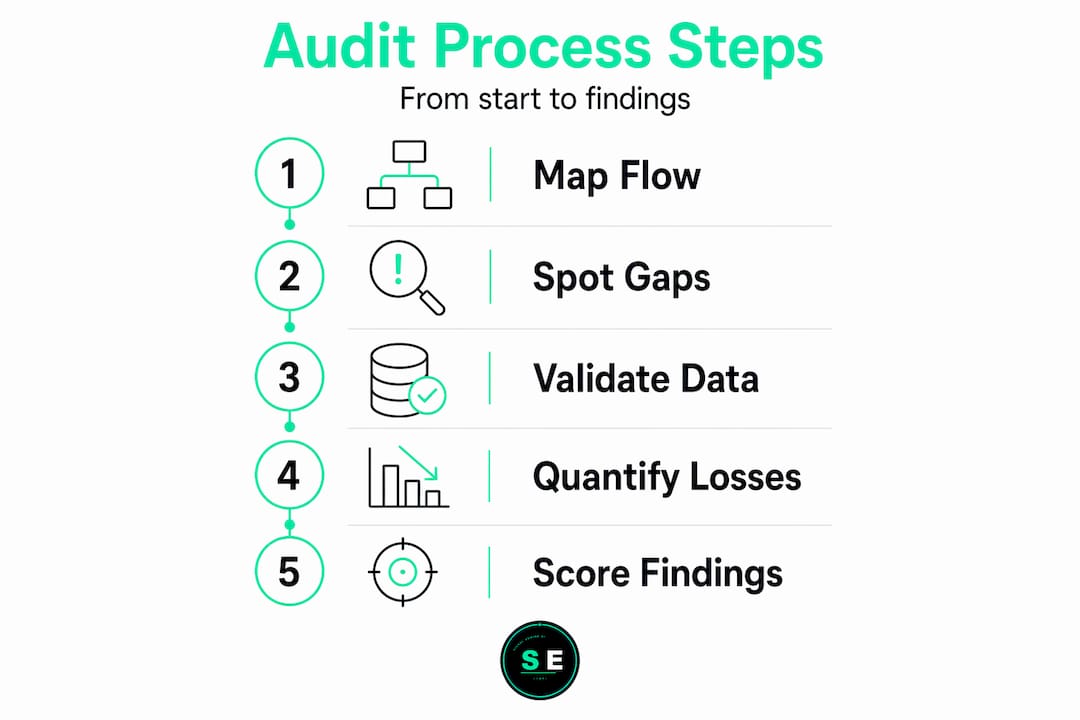
Here's how a well-run audit unfolds:
| Phase | Reactive Audit | Proactive Audit |
|---|---|---|
| Trigger | Discovered billing discrepancy or revenue shortfall | Scheduled review or system change |
| Scope | Past transactions, specific accounts | Processes, system integrations, workflows |
| Output | Corrections to historical records | Structural fixes, new controls |
| Timeline | Weeks | Months (ongoing) |
| Best for | Recovering already-lost revenue | Preventing future leakage |
A thorough audit for client revenue gaps moves through these stages:
- Data collection. Pull billing records, contracts, project delivery logs, and payment history for the audit period. Cross-reference across systems, not just your accounting software.
- Process mapping. Document how revenue flows from client agreement to invoice to payment. Identify every handoff point between teams and systems.
- Gap analysis. Compare what was agreed in contracts to what was billed. Compare what was delivered to what was invoiced. Quantify the delta.
- Root cause identification. Determine whether each gap is a technology failure, a process gap, a training issue, or a controls problem. This step separates leakage from fraud.
- Scoring and prioritization. Effective audits prioritize fixes by impact, urgency, and effort, avoiding low-impact quick fixes that waste resources when bigger issues stay unaddressed.
The output should never be a generic slide deck. It needs to be a prioritized scorecard with specific findings, dollar impact estimates, assigned owners, and realistic deadlines. Anything less is an observation, not a recovery plan. You can explore hidden revenue loss frameworks that complement this process for SaaS and tech businesses.
Turning audit results into lasting revenue protection
Finding leakage is step one. Stopping it from coming back is the harder work. Most organizations run a single audit, fix the obvious problems, and assume the issue is resolved. Six months later the same patterns return because the underlying systems were never changed.
The right approach treats audit findings as inputs to a permanent operational upgrade.
- Build a prioritized scorecard. Rank every finding by annual revenue impact. Focus your first 30 days on the top five items. Small fixes on high-volume billing errors often recover more money than large fixes on rare edge cases.
- Assign clear ownership. Every finding needs a named owner and a deadline. Without ownership, findings sit in a document while leakage continues.
- Fix the system, not just the symptom. If billing errors trace back to a manual handoff between your CRM and your invoicing tool, automate that handoff. Don't just correct the bad invoices already sent.
- Set an audit cadence. Companies should run a full 12-category audit annually and focused 4-category reviews quarterly to prevent compounding leakage. Revenue systems develop drift over time. What worked last year may be misaligned today.
- Embed prevention into culture. Train the teams responsible for client delivery on what constitutes a billable activity. Make it easy to flag scope changes. Create a process that captures revenue at the moment it's earned, not weeks later when someone tries to reconstruct it.
Pro Tip: After your first audit, set a calendar reminder for a 90-day check-in. Pull the same client gap comparison you used to start the audit. If the same patterns are reappearing, the root cause hasn't been fixed yet.
Tracking the right metrics for lost revenue detection makes these quarterly reviews faster and more focused.
Technology's role in modern revenue audits
Manual audits are slow and incomplete. The more clients you have, the more contracts are active, and the harder it becomes to catch every discrepancy through human review. Technology changes that equation substantially.
| Technology | Primary Benefit | Impact on Leakage |
|---|---|---|
| Automated billing validation | Catches invoice errors before they're sent | Reduces underbilling and rate mismatches |
| CRM-ERP integration | Syncs contract terms directly to billing | Eliminates manual re-entry errors |
| AI-assisted claim scrubbing | Flags anomalies in billing patterns | Surfaces recurring errors across accounts |
| Audit trail software | Logs every transaction change with timestamps | Separates accidental errors from fraud |
| Analytics dashboards | Visualizes revenue patterns over time | Identifies drift before it compounds |
Real-time eligibility verification reduces 20 to 30% of avoidable denials, while integrated systems cut manual entry errors by up to 30%. Those are not incremental improvements. That's a fundamental shift in how much revenue actually reaches your income statement.
Automated validation systems produce immutable audit trails that help distinguish accidental errors from fraudulent activity. That distinction matters enormously for how you respond. A billing team making systematic data entry mistakes needs retraining and better tools. A vendor inflating rebate claims needs a different response entirely.
When selecting technology for your audit program, prioritize tools that integrate with your existing billing and CRM systems rather than requiring parallel data entry. The goal is to reduce human touchpoints in the revenue capture process, not add more dashboards to manage.
My take on why most audits fail to deliver
I've seen organizations invest real time and money into revenue leakage audits, then watch the findings collect dust. The audit itself wasn't the problem. The execution model was.
In my experience, the single biggest mistake is treating leakage as a one-time problem to solve rather than an ongoing property of complex systems. Revenue systems develop drift. Processes that were tight twelve months ago develop gaps as teams change, contracts evolve, and software gets updated without proper configuration.
What changed outcomes for the clients I've worked with wasn't better audits. It was building the expectation that auditing is continuous. Companies that institutionalize a quarterly review cadence, even a focused one covering just a few categories, consistently outperform those that run a comprehensive audit every few years and wonder why leakage returns.
The other misconception worth addressing: audits are not just for large enterprises. I've worked with mid-sized businesses billing $3M to $8M annually where a single audit cycle recovered $150K or more in previously uncaptured revenue. The math on B2B revenue leakage at that scale is impossible to ignore.
See the audit as an investment with a measurable return, not a compliance exercise. Run it with that mindset and the ROI becomes clear fast.
— Bernard
How Signalengine finds your revenue gaps automatically
You now understand what a client revenue leakage audit is and how the process works. The next question is how fast you can run one on your own business.

Signalengine's AI-powered platform runs a free revenue leakage audit on your client data and surfaces exactly where money is slipping through. No lengthy onboarding. No consultants. No waiting weeks for a report. The average business uncovers $38K in recovery potential in the first month. The platform flags churn risks, missed renewals, billing anomalies, and under-engaged accounts in one dashboard. If you want the full technical walkthrough of the audit tools and setup, the Signal Engine Help & Docs page covers everything. ⚡ Get your revenue gaps identified today before another billing cycle closes without them fixed.
FAQ
What does a client revenue leakage audit actually find?
A client revenue leakage audit identifies missed invoices, billing rate errors, unbilled scope changes, unenforced contract terms, and payment gaps tied to specific client accounts. These findings are quantified and prioritized by revenue impact.
How is revenue leakage different from customer churn?
Revenue leakage comes from process failures like billing errors and missed invoicing, while churn refers to clients actively ending their relationship with you. Leakage stems from process inefficiencies, not customer decisions, which means it's recoverable without changing your sales strategy.
How often should you run a revenue leakage assessment?
Run a full audit annually and focused category reviews quarterly to catch compounding drift before it grows. Revenue systems change continuously, and a once-per-year approach leaves too much time for new gaps to widen.
Can small businesses benefit from a client revenue audit process?
Yes. The dollar amounts are smaller, but the percentage impact is often higher in smaller businesses because fewer controls exist. A single audit frequently uncovers five to six figures in recoverable revenue for businesses billing between $1M and $10M annually.
What is the first step to identify revenue leakage in my business?
Start by comparing your top clients by contract value against your top clients by billed revenue. The accounts where those two rankings diverge most are your highest-probability leakage points. Then trace why the gap exists using your billing records and contract terms.
Ready to Stop the Revenue Leak?
Signal Engine gives small and local businesses 31 AI-powered tools to score leads by buying intent, predict churn before it happens, auto-generate email and SMS campaigns, and recover missed calls automatically — all in one dashboard starting at $49/month.
Start your free 7-day trial — no credit card required. Setup takes 5 minutes.