

Aim to contact high-intent inbound leads within five minutes, and mid-intent leads within an hour. The single best action to get there fast: put routing and automation in front of your reps today, so every lead gets an instant, engaging touch instead of waiting in a queue. Teams that make this one change consistently see qualification rates jump within weeks, not quarters.
TL;DR:
- Response time should be measured from the lead action timestamp, not CRM entry, to accurately reflect true speed.
- Contacting high-intent leads within five minutes can result in a 21% conversion rate versus 1-2% after 30 minutes.
- Automating routing, acknowledgments, and initial qualification reduces delays and makes hitting response SLAs feasible without increasing headcount.
- Response targets should be tiered by lead type, with demo requests and pricing inquiries under five minutes and content downloads under one hour.
- Automation tools like webhooks, multichannel outreach, and AI intake agents are key to consistently achieving rapid responses at scale.
Table of Contents
- What Speed to Lead Actually Means
- The Research Behind Why Speed to Lead Matters
- Realistic Response Time Targets By Lead Type
- Your 10-Step Playbook to Compress Response Time
- Measuring Speed to Lead the Right Way
- The Technical Fixes That Actually Move the Number
- Building SLAs Your Team Will Actually Follow
- The ROI Math: What Faster Response Is Actually Worth
- What SMBs Get Wrong About Speed to Lead
- Ready to Stop the Revenue Leak.
- Sources
- FAQ
What Speed to Lead Actually Means
Speed to lead is the system your business runs to make sure inbound leads get contacted fast. Lead response time is the metric that tells you whether that system is working. The two terms get used interchangeably, but they're not the same thing. One is a process. The other is a number on a dashboard.
Here's where most teams get the number wrong. The clock should start at the moment a lead takes action, typically the form submission timestamp, a chat session start, or a demo request, not when the lead lands in your CRM. It should stop at first meaningful contact, meaning a real conversation, a qualifying question answered, or a booked meeting. Not an autoresponder email. Not a "thanks for reaching out" text blast. Those are automated acknowledgments, and counting them as a response is the most common way teams fool themselves into thinking they're faster than they are.
CRM sync delays make this worse. A lead can sit for 5 to 30 minutes between form submission and the moment it actually appears in a rep's queue, depending on how your CRM integration is built. If you're measuring from "time lead entered CRM" instead of "time lead was created," you're baking a silent delay into every single measurement. Your reported average might say 12 minutes when the lead actually waited 35.
The fix is simple: anchor your start timestamp to the source system, whether that's your form platform, your chat widget, or your call tracking tool, not to whatever timestamp your CRM assigns after syncing. Get this wrong and every benchmark you compare yourself against becomes meaningless, because you're not measuring the same thing they are.
The Research Behind Why Speed to Lead Matters
The evidence here isn't new, and that's part of what makes it convincing. A Harvard Business Review analysis found that companies contacting leads within an hour were dramatically more likely to qualify them than companies that waited longer. That finding has held up across more than a decade of follow-up research, and the newer data makes the case even sharper.
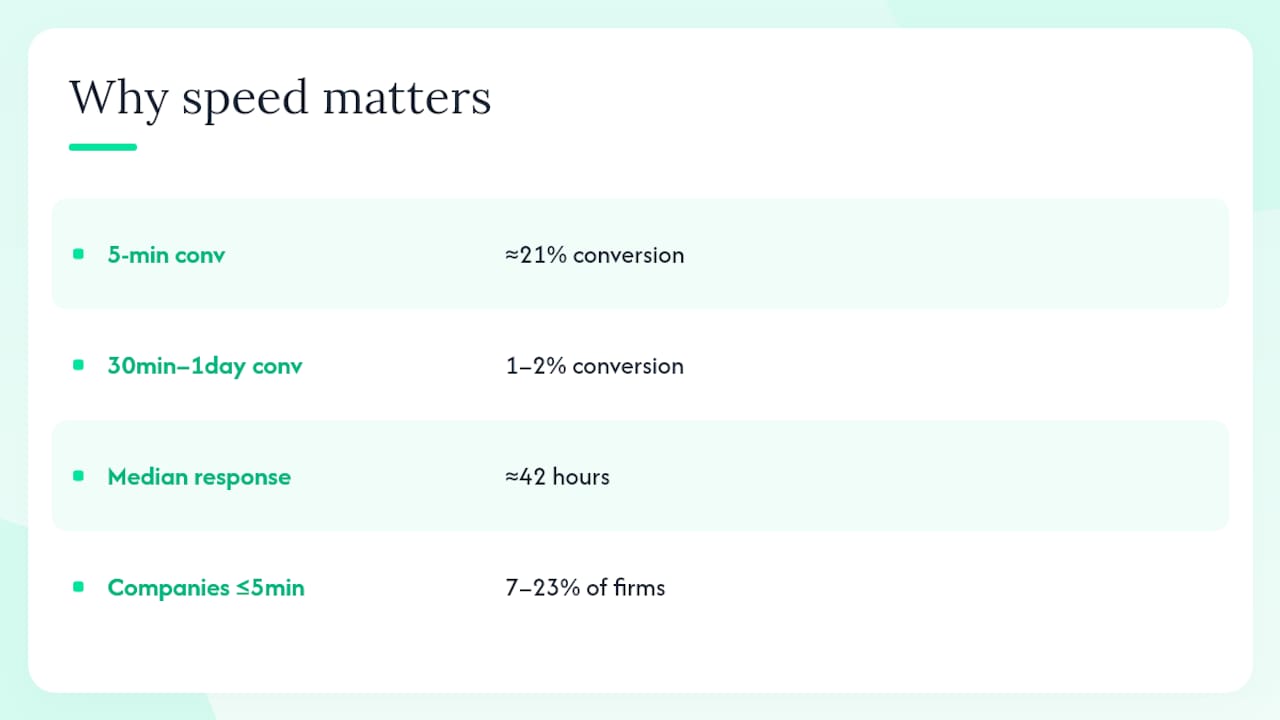
The Five-Minute Rule: Leads contacted within five minutes convert at roughly 21%, compared to just 1 to 2% when contact happens after 30 minutes to a day has passed. That's not a marginal edge. That's the difference between a lead source that pays for itself and one that quietly bleeds budget.
Part of why the five-minute window matters so much is the first-responder advantage. Buyers comparing multiple vendors tend to engage seriously with whoever reaches them first, and often stop actively evaluating competitors once that first substantive conversation happens. Show up second, even by twenty minutes, and you're often negotiating against a decision the buyer has already started making in someone else's favor.
Now compare that to what actually happens across most B2B teams. Median first-response times commonly land around 42 hours in recent benchmark studies, and only somewhere between 7% and 23% of companies manage to respond within five minutes at all, depending on which study you look at. A meaningful share of companies never respond to a lead, period.
That gap is where the opportunity lives. If your competitors are averaging 42 hours and you can reliably hit under an hour, you're not competing on price or features anymore. You're winning on being the only vendor the buyer actually talked to while the problem was still top of mind. The pipeline math here is almost boring in its simplicity: faster response doesn't just improve your close rate on existing leads, it changes which leads even make it to a real conversation before they've mentally moved on to someone else.
Realistic Response Time Targets By Lead Type
Not every lead deserves the same urgency, and treating them all identically is a mistake in both directions. A demo request from a decision-maker at a target account and a whitepaper download from an anonymous visitor are not the same signal, and your SLA should reflect that.
Here's a practical tiering structure:
| Lead type | Target response window | Why |
|---|---|---|
| Demo or sales call request | Under 5 minutes | High buying intent, comparing vendors right now |
| Pricing page inquiry | Under 5 minutes | Strong purchase signal, often mid-decision |
| Live chat conversation | Under 60 seconds | Visitor is actively on your site, waiting |
| Trial signup | Under 1 hour | Wants to see value fast; drop-off is steep |
| Content download (guide, webinar) | Under 1 hour | Lower intent, still worth a fast human touch |
Median versus P90 matters more than most teams realize when setting these targets. Your median tells you how your typical lead is treated. Your P90, the response time for the slowest 10% of leads, tells you where your system actually breaks. A team with a 4-minute median and a 6-hour P90 doesn't have a speed problem on paper. It has a coverage gap, probably after-hours or during a routing failure, that's quietly costing deals every single week.
If your team is currently averaging hours rather than minutes, don't try to jump straight to five minutes. The research on this is consistent: the largest share of the conversion gain comes from closing the gap between multi-hour delays and under one hour. Get there first. Then push toward 30 minutes. Then chase sub-5-minute performance once your never-responded rate is close to zero and your handoffs consistently carry real qualified context, not just a fast "hello."
Your 10-Step Playbook to Compress Response Time
You don't need to hire a bigger team to fix this. Most of the gain comes from configuration, not headcount. Here's the order that works.
- Audit your current numbers first. Pull your last 90 days of leads and calculate both median and P90 response time, measured from the source timestamp, not the CRM timestamp. You can't fix what you haven't measured honestly.
- Tier your leads and assign SLAs to each tier. Use the benchmarks above as a starting point, then adjust based on which lead types actually convert for your business.
- Connect your forms directly to your routing system with webhooks. Skipping the CRM sync step eliminates the 5 to 30 minute delay that's silently inflating your numbers.
- Fire parallel contact attempts, not sequential ones. A call, a text, and an email going out at the same moment beats waiting to see if the call gets picked up before trying anything else.
- Set up an AI intake layer for after-hours and overflow volume. A conversational AI agent that captures context during the visitor's session turns the form submission itself into the first qualified contact, rather than an event waiting on a rep. Tools like Signal Engine's real-time scoring can flag which of those captured leads deserve a human follow-up first.
- Build round-robin assignment with automatic fallback. If the first assigned rep hasn't responded within a set window, say two minutes for a hot lead, the system should reassign automatically rather than let it sit. A round-robin CRM setup with escalation rules removes the single point of failure that a busy or absent rep creates.
- Push instant mobile alerts, not just email notifications. Reps checking email every 20 minutes will never hit a five-minute SLA. Push notifications tied to a dialer or messaging app close that gap.
- Write short, ready-to-send first-touch scripts. A rep scrambling to figure out what to say costs precious minutes. A tested 30-second opener, personalized with one detail from the form, moves faster and converts better than an improvised one.
- Automate booking for off-hours coverage. If a lead comes in at 9 p.m., an AI-driven scheduling flow that books a call for the next morning beats silence until someone logs in.
- Review SLA adherence weekly and coach on quality, not just speed. Track connect-to-qualified-conversation rate alongside raw response time, then A/B test routing rules and channel mixes to see what actually moves the needle for your specific lead sources.
Pro Tip: Don't roll out all ten steps at once. Fix your measurement (step 1) and your webhooks (step 3) first. Those two changes alone typically expose and fix the biggest hidden delays before you touch anything else.
Measuring Speed to Lead the Right Way
Bad measurement produces false confidence, and false confidence is worse than no data at all. Get the recipe right before you report a single number to leadership.
- Start the clock at form submission, chat initiation, or call request, whichever channel generated the lead, never at "date added to CRM."
- Report median AND P90 together. A clean median with an ugly P90 means leads are falling through the cracks somewhere specific, usually after-hours or a routing misfire.
- Track time to qualified context (TTQC) alongside raw response time. A fast callback that never establishes budget, timeline, or need isn't a win, it's a wasted attempt logged as a success.
- Measure connect-to-qualified-conversation rate, not just connect rate. Picking up the phone and having a real conversation are two different outcomes.
- Segment everything by lead source, by rep, and by hour of day. A 4-minute average can hide a lead source converting at 90 minutes and dragging your real performance down where nobody's looking.
- Exclude autoresponders and automated acknowledgment texts from your "first contact" calculation. They feel like a response. They are not a conversation.
- Log sync delays separately so you can see the gap between "lead created" and "lead visible to rep," and fix the plumbing instead of blaming the rep.
A simple weekly dashboard pulling median response time, P90 response time, and connect-to-qualified-conversation rate, segmented by source, gives most sales leaders everything they need without building a data science project. If you're querying this from a database directly, group by lead_source and DATE_TRUNC by day, then calculate the percentile functions your CRM's reporting layer supports for the median and 90th percentile columns. The goal isn't a beautiful report. It's catching the leak before it costs you the next quarter's pipeline.
The Technical Fixes That Actually Move the Number
Most speed-to-lead problems aren't people problems. They're plumbing problems, and plumbing is fixable without adding a single headcount line to your budget.
Webhooks beat CRM sync, every time. Standard CRM syncing can add 5 to 30 minutes before a lead becomes actionable in a rep's queue. A direct webhook from your form or landing page to your routing tool skips that delay entirely, firing the moment the lead is created rather than whenever the next sync cycle runs.
Round-robin routing needs a fallback rule or it will fail you. Simple round-robin assignment sounds fair, but it breaks the moment your top performer is on vacation or in back-to-back calls. Pair it with an automatic timeout, if no action within a defined window, the lead reassigns to the next available rep rather than sitting untouched.
Fire on multiple channels at once, not one after another. A call attempt, a text message, and an email hitting simultaneously dramatically improve the odds of an actual pickup compared to trying the phone first and only texting if that fails. A multichannel follow-up sequence built this way captures leads who screen calls from unknown numbers but read texts within seconds.
AI intake agents collapse the gap between form and conversation. Instead of a lead filling out a form and waiting for a human, a conversational AI layer can ask qualifying questions during that same session, capturing budget, timeline, and need before a rep ever gets involved. That doesn't just speed things up. It means the rep's first touch is already informed, which shortens the whole sales cycle downstream.

Fix pickup rates, not just dial speed. A five-minute SLA does nothing if the call lands in a spam-flagged voicemail box. Branded caller ID and number reputation management matter as much as raw speed, because a fast call nobody answers converts at the same rate as no call at all: zero.
Pro Tip: If your reps are calling from a number that isn't registered with major carriers as a business line, you may be getting flagged as "Spam Likely" without knowing it. Check your number's reputation before you invest another dollar in speeding up the dial.
Building SLAs Your Team Will Actually Follow
Speed without structure just produces fast, sloppy responses that annoy leads instead of converting them. The governance layer is what makes the speed sustainable.
Assign each SLA tier to a named owner, not a generic team inbox. "Someone on the sales team" is not accountability. "Maria owns all demo-request leads between 8 a.m. and 4 p.m., with James as backup" is accountability, and it's the difference between an SLA that gets hit and one that quietly slips every Friday afternoon.
Tiered SLAs work better than a single flat rule applied to every lead, because they match urgency to actual buying signal instead of treating a whitepaper download the same as a pricing page visit. Build overlapping shift coverage around your highest-volume hours, and don't leave after-hours leads to sit until the next business day. Even a basic automated acknowledgment paired with a next-morning callback booking beats total silence until 9 a.m.
Quality metrics have to travel alongside speed metrics, or you'll train your team to rush. Track connect-to-qualified-conversation rate, not just how fast the phone got picked up. Track handoff completeness, meaning does the next person in the sales process actually get the context the first rep gathered, or does the lead have to repeat their whole situation from scratch.
Coaching and incentives should reward both halves of this equation. A scorecard that only measures speed produces reps who dial fast and qualify poorly. A scorecard that only measures qualification produces reps who take their time "getting it right" while the lead cools off and starts talking to a competitor instead. Build both into the same review, weekly if you can manage it, and watch which reps consistently hit both bars. Those are the reps whose process you should be replicating across the team.
The ROI Math: What Faster Response Is Actually Worth
The pipeline math behind speed to lead is straightforward once you see it laid out. The formula is: additional qualified conversations = (leads per week) × (contact rate improvement) × (qualification rate). Each variable compounds, which is why small percentage gains in contact rate translate into outsized revenue gains downstream.
Here's a conservative worked example for a team handling 100 leads per week, moving from a multi-hour average response time down to under one hour:
That's 12 additional qualified conversations per month from a contact rate improvement alone, holding your qualification skill constant. Run your own numbers with your actual contact and qualification rates. The math scales, but the direction never changes: faster contact means more of your existing lead volume actually turns into a real conversation.
What SMBs Get Wrong About Speed to Lead
Most of the speed-to-lead advice floating around treats this as a discipline problem, something you fix by nagging reps to check their phone more often. That's backwards, and it's why so many well-intentioned SLA policies fail within a month. The problem is almost never that your rep is lazy. It's that your system makes speed dependent on a human noticing a lead in real time, which is a fragile plan the moment that human is in a meeting, at lunch, or asleep.
The teams that actually hit five-minute response times aren't the ones with the most disciplined reps. They're the ones who removed the human from the critical first step entirely, routing, acknowledgment, and initial qualification happen automatically, and the rep gets looped in once there's already a real, informed conversation started. That's the lesson SMBs implementing this keep relearning the hard way: modest configuration changes, a webhook here, a routing rule there, an AI intake flow running after hours, consistently beat throwing another headcount line at the problem.
Real-time lead scoring plays a specific role in this that often gets overlooked. Speed for its own sake isn't the goal. Speed toward the right leads is. A system that scores buying intent as leads come in lets you route your fastest response paths to the leads most likely to close, instead of treating a demo request from a decision-maker identically to a downloaded checklist from someone doing early research. Missed-call recovery closes a related gap: a huge share of "lost" leads aren't lost to a competitor, they're lost to a call that rang out and never got a callback within the window that mattered.
None of this requires a bigger team. It requires the right automation sitting in front of the team you already have.
— Bernard
Ready to Stop the Revenue Leak.
Signal Engine gives small and local businesses 31 AI-powered tools to score leads by buying intent, predict churn before it happens, auto-generate email and SMS campaigns, and recover missed calls automatically — all in one dashboard starting at $49/month.
Every fix covered above, instant routing, real-time intent scoring, missed-call recovery, automated follow-up, is built into Signal Engine Growth as one connected system instead of five separate tools you'd have to stitch together yourself. That matters most for SMB teams who don't have an ops person whose full-time job is wiring webhooks between a form platform and a CRM. You get the plumbing already built, plus the lead scoring that tells you which leads deserve your five-minute response and which can wait for the one-hour tier.
Start your free 7-day trial — no credit card required. Setup takes 5 minutes.
Sources
- Lead response time is the duration between when a lead is created and when a sales rep makes first contact. (EmailAnalytics)
- Lead Response Time in 2026: Benchmarks, the Five-Minute Rule, and What Actually Converts | Perspective AI
- What is speed to lead and how to do it in 2026 - Guideflow Blog
FAQ
What does speed to lead mean?
Speed to lead is the system a business uses to make sure inbound leads get contacted quickly, measured by lead response time, the gap between when a lead is created and when a rep makes meaningful first contact.
How important is speed to lead really?
It's one of the highest-leverage levers in sales. Leads contacted within five minutes convert at roughly 21%, compared to 1 to 2% after 30 minutes to a day, and most companies never get close to that window.
What is a good speed to lead benchmark to aim for?
Target under 5 minutes for high-intent leads like demo requests, under 60 seconds for live chat, and under 1 hour for lower-intent leads like content downloads. If you're currently averaging hours, aim for under one hour first before chasing five minutes.
Why is my measured response time inaccurate?
The most common cause is measuring from the CRM timestamp instead of the source timestamp, which hides 5 to 30 minutes of sync delay, or accidentally counting an autoresponder as a real response.
Can automation actually replace faster hiring for this?
Yes, in most cases. Routing rules, webhooks, and AI intake agents that qualify leads during the initial session, the kind of automation built into platforms like Signal Engine, typically close more of the speed gap than adding reps, because the bottleneck is usually the handoff process, not headcount.