

TL;DR:
- Revenue intelligence uses AI to unify and analyze customer and sales data, enabling real-time revenue decisions. It connects prospecting, pipeline management, and churn prevention, moving beyond traditional reporting for proactive growth strategies. A strong data foundation is essential for reliable insights and effective deployment of revenue intelligence tools.
Revenue intelligence is defined as the AI-powered process of capturing, analyzing, and activating sales and customer data to deliver actionable insights that improve revenue decisions and forecast accuracy. Unlike traditional reporting, it unifies CRM data, buyer signals, and conversation insights into a single operational view your revenue teams can act on immediately. Platforms like Salesforce, Gong, and Signalengine all approach this differently, but the core promise is the same: replace scattered data and gut-feel forecasting with evidence-based decisions. If you lead a sales, operations, or customer success team, understanding revenue intelligence explained in practical terms is the fastest way to close the gap between the data you have and the growth you want.
What is revenue intelligence and how does it differ?
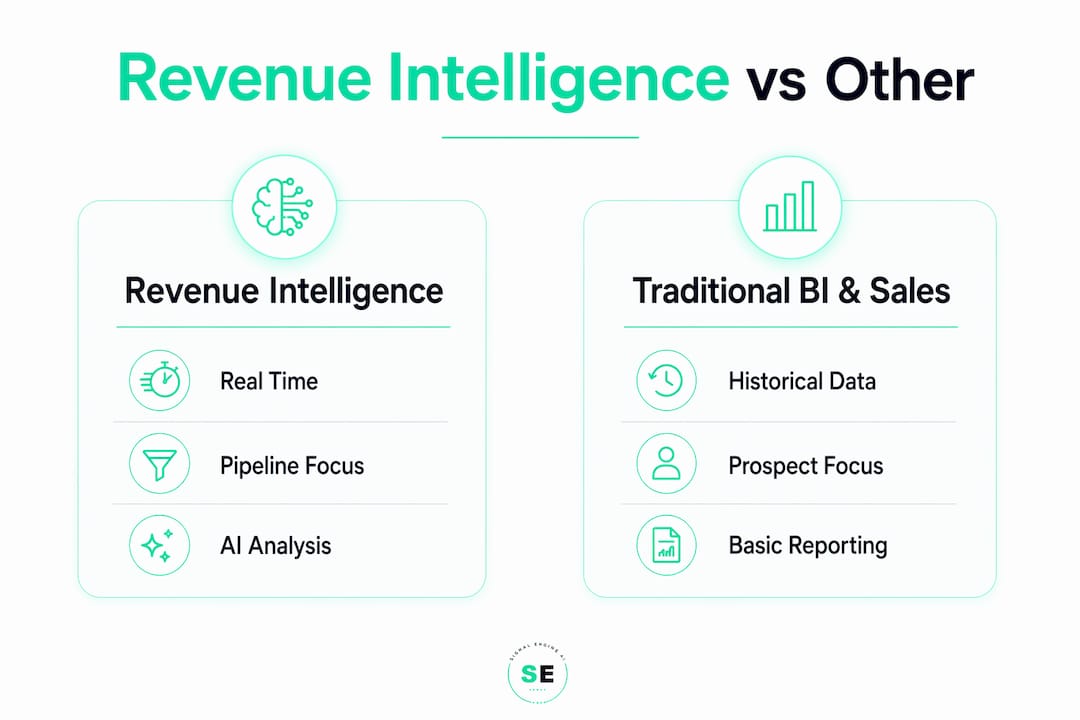
Revenue intelligence is not the same as sales intelligence or business intelligence, even though all three terms get used interchangeably in vendor marketing. The distinctions matter because they determine which tool solves which problem.

Sales intelligence focuses on identifying and prioritizing prospects. Tools in this category help reps find the right companies to call, score leads by fit, and surface buying signals before outreach. The data is mostly external: firmographics, technographics, and intent signals from third-party sources.
Business intelligence analyzes company-wide historical data. Think dashboards in Tableau or Power BI that show last quarter's revenue by region. BI answers "what happened?" It does not tell you what to do next.
Revenue intelligence sits at the intersection of both. It focuses on pipeline health and revenue decisions in real time, not historical summaries. It answers "what should we do right now to protect and grow revenue?"
| Intelligence Type | Primary Focus | Primary Users | Core Purpose |
|---|---|---|---|
| Sales Intelligence | Prospect identification | SDRs, AEs | Find and prioritize leads |
| Business Intelligence | Historical performance | Executives, analysts | Report on outcomes |
| Revenue Intelligence | Pipeline health, real-time signals | RevOps, sales leaders | Drive next best actions |
The table above shows why revenue intelligence is the operational layer the other two types lack. It does not replace BI or sales intelligence. It connects them into a decision engine.
How does revenue intelligence work?
Revenue intelligence works as an end-to-end loop from data capture to activation, not a static dashboard you check once a week. Here is how that loop runs in practice:
- Data capture. The system automatically pulls in calls, emails, meetings, CRM activity, support tickets, and product usage data. True revenue intelligence platforms capture data passively, without requiring reps to manually log every interaction.
- Data unification. Raw inputs from CRM platforms like Salesforce, marketing automation tools, customer success software, and billing systems get merged into one governed data layer.
- AI analysis. Machine learning models scan the unified data to surface patterns, score deal risk, flag churn signals, and predict outcomes. The AI reasons over complete context, not isolated fragments.
- Insight generation. The system converts unstructured sales conversations into structured qualification data mapped to deal outcomes and forecasting frameworks like MEDDPICC.
- Activation. Recommendations and alerts surface inside the workflows your teams already use, not in a separate tool they have to remember to open.
Pro Tip: Before deploying any revenue intelligence tool, build a unified data foundation first. AI is only as reliable as the data it reasons over. Centralizing ARR trends, sales history, support data, and product usage before you flip the switch will produce far better results than connecting AI to fragmented sources.
The technology stack behind revenue intelligence typically includes conversation intelligence, CRM enrichment, predictive analytics, and workflow automation. Signalengine, for example, combines all of these into one platform built specifically for SMBs that cannot afford a five-tool stack.
What are the benefits of revenue intelligence for sales teams?
The benefits of revenue intelligence show up fastest in pipeline visibility and forecast confidence. When your forecast is built on rep estimates and CRM field updates, it reflects what reps believe, not what buyers are actually doing. Revenue intelligence grounds deal understanding in buyer interaction evidence, which makes forecasts defensible and surprises rare.
Here are the top benefits sales and RevOps leaders report:
- Pipeline visibility. See which deals are active, stalled, or at risk based on actual engagement data, not rep status updates.
- ⚠️ Deal risk detection. AI flags deals where buyer engagement has dropped, key stakeholders have gone silent, or competitive threats have appeared.
- Rep coaching at scale. Managers get AI-driven alerts tied to specific calls or deal moments, so coaching is precise rather than generic.
- Forecast defensibility. Every forecast number links back to evidence from buyer interactions, making it easier to defend in board reviews.
- RevOps alignment. Revenue intelligence powers the technology layer that connects sales, marketing, and customer success around shared pipeline data.
- ️ Territory and quota management. Leaders can spot coverage gaps and reallocate resources before the quarter is lost.
Revenue optimization strategies built on this kind of data move faster and hit harder than those built on spreadsheets. The difference is not effort. It is signal quality.
Pro Tip: Do not wait for a missed quarter to adopt revenue intelligence. The best time to instrument your pipeline is when things are going well. You build the baseline that makes anomalies visible before they become problems.
How revenue intelligence reduces churn and improves retention
Customer retention is where the importance of revenue intelligence becomes most urgent for business leaders outside pure sales roles. Most churn is visible in the data weeks before a customer cancels. The problem is that the signals live in separate systems: support tickets in one tool, product usage in another, billing history in a third.
Revenue intelligence solves this by centralizing ARR trends, call transcripts, Salesforce history, support tickets, and product usage into a unified platform. AI then scans that combined picture to generate account-level risk narratives and early warning signals. You move from reactive churn analysis to proactive retention intervention.
The signals that matter most for churn prediction include:
- Declining product usage or login frequency
- Rising support ticket volume or unresolved issues
- Negative sentiment in call transcripts or email replies
- Missed or delayed payments and billing friction
- Reduced engagement with your sales or success team
Fivetran's implementation of AI-powered churn detection demonstrates what combining multi-source signals into one platform enables: proactive intervention before a customer reaches the cancellation decision. Signalengine applies the same logic for SMBs, automatically scoring customer behavior and flagging who is about to leave so your team can act first.
| Retention Signal | Data Source | Risk Indicator |
|---|---|---|
| Product usage drop | Product analytics | High churn probability |
| Support ticket spike | Help desk / CRM | Dissatisfaction signal |
| Payment delays | Billing system | Financial friction |
| Email disengagement | Marketing platform | Reduced commitment |
| Negative call sentiment | Conversation intelligence | Relationship at risk |
The role of CRM in customer retention is foundational here. Without a CRM feeding clean data into your revenue intelligence layer, the AI has nothing reliable to analyze. Integration quality determines prediction quality.
Key takeaways
Revenue intelligence is the operational decision layer that connects your data to your revenue outcomes, and businesses that deploy it stop forecasting from gut feel and start acting on evidence.
| Point | Details |
|---|---|
| Core definition | Revenue intelligence captures, unifies, and activates sales and customer data using AI to drive better decisions. |
| Distinct from BI and sales intelligence | It focuses on real-time pipeline health and next best actions, not historical reports or prospect lists. |
| Churn prevention | Centralizing support, billing, and usage data enables AI to flag at-risk accounts before they cancel. |
| Forecast accuracy | Grounding forecasts in buyer interaction evidence makes them defensible and reduces end-of-quarter surprises. |
| Data foundation first | Unified, governed data is the prerequisite for reliable AI analysis in any revenue intelligence deployment. |
Revenue intelligence is an operating system, not a feature
I have watched a lot of business leaders buy a conversation intelligence tool, call it revenue intelligence, and wonder why their forecast accuracy did not improve. The mistake is treating call recording as the end product rather than one input into a much larger system. Raw call archives without signal extraction are just expensive storage.
The businesses that get real value from revenue intelligence treat it as an operating system for their revenue function. Every data source feeds in. Every insight feeds out into a workflow. Nothing sits in a dashboard waiting to be discovered.
The second mistake I see is skipping the data foundation work. Leaders want AI insights on day one, but they have not connected their billing system, their support tool, or their product analytics. The AI then reasons over incomplete context and produces unreliable outputs. Garbage in, garbage out is not a cliché here. It is a precise description of what happens.
My honest advice: before you evaluate any revenue intelligence tools, audit your data sources first. Know what you have, where it lives, and how clean it is. That audit will tell you more about your readiness than any vendor demo. Signalengine is built to make this easier for SMBs by handling the integration layer automatically, but the principle holds regardless of which platform you choose.
The businesses winning with revenue intelligence in 2026 are not the ones with the most sophisticated tools. They are the ones that committed to a complete data picture and then let AI do the heavy lifting.
— Bernard
See revenue intelligence in action with Signalengine
If you are ready to move from scattered data to a clear revenue picture, Signalengine is built for exactly that.
Signalengine is the revenue intelligence platform for small businesses that scores leads by buying intent, predicts churn before it happens, auto-generates email and SMS campaigns, and flags competitor opportunities automatically. It covers 12 verticals including HVAC, logistics, dental, real estate, and landscaping. Setup takes 5 minutes. Pricing starts at $49/month. You can also see it live in a demo before you commit to anything. No credit card required for the free 7-day trial.
Ready to stop the revenue leak?
Signal Engine gives small and local businesses 31 AI-powered tools to score leads by buying intent, predict churn before it happens, auto-generate email and SMS campaigns, and recover missed calls automatically — all in one dashboard starting at $49/month.
Start your free 7-day trial — no credit card required. Setup takes 5 minutes.
FAQ
What is revenue intelligence in simple terms?
Revenue intelligence is the process of using AI to automatically collect and analyze sales, buyer, and customer data, then surface specific recommendations that help your team close more deals and retain more customers.
How does revenue intelligence differ from a CRM?
A CRM stores data. Revenue intelligence analyzes that data alongside signals from calls, emails, support tickets, and product usage to generate predictions and next best actions your CRM cannot produce on its own.
What revenue intelligence tools do small businesses use?
Signalengine is built specifically for SMBs and covers lead scoring, churn prediction, and campaign automation starting at $49/month. Larger enterprise options include Gong and Salesforce Revenue Cloud, though both are priced and scoped for enterprise teams.
Why is revenue intelligence important for customer retention?
Revenue intelligence centralizes signals from billing, support, product usage, and sales history so AI can detect churn risk weeks before a customer cancels, giving your team time to intervene proactively.
What data does revenue intelligence require to work?
Effective revenue intelligence requires unified data from your CRM, conversation records, marketing platform, support system, and billing tool. The more complete the data foundation, the more reliable the AI predictions.