

TL;DR:
- Revenue attribution links marketing actions to actual revenue, helping agencies demonstrate ROI and optimize budgets. Most agencies struggle with data integration, CRM access, and accurate cross-channel measurement, which diminishes their credibility and profitability. Building standardized processes and using platform-agnostic tools enhances attribution accuracy, enabling agencies to become revenue drivers and competitive leaders.
Revenue attribution is defined as the practice of connecting specific marketing actions to actual closed revenue, giving agencies a precise view of which campaigns, channels, and touchpoints drive real business outcomes. Without it, agencies operate on vanity metrics: clicks, impressions, and lead counts that tell clients almost nothing about return on investment. Agencies using multi-touch attribution report up to 30% year-over-year revenue growth with only a 7% increase in ad spend. That gap between spend and growth is exactly what revenue attribution unlocks. Yet only 32% of marketers can effectively measure media impact today, which means most agencies are flying blind when it matters most.
Why agencies need revenue attribution to stay competitive
The industry term for what most agencies call "tracking marketing performance" is multi-touch revenue attribution. It goes far beyond last-click reporting or platform dashboards. Revenue attribution maps every touchpoint in the customer journey to a dollar amount, from the first paid search ad a prospect clicks to the sales call that closes the deal.
Agencies that cannot connect their work to revenue are perceived as cost centers. That perception is fatal in a market where clients scrutinize every line item. When you can show a client that their LinkedIn campaign influenced 40% of pipeline in Q2 while their Google Ads drove 55% of closed revenue, you are no longer defending your retainer. You are presenting evidence.
The importance of revenue attribution extends beyond marketing measurement. It creates a shared language across marketing, sales, and finance, aligning all three teams around the same revenue goals. For agencies managing multiple clients, this alignment is what separates long-term partnerships from short-term contracts.
What is revenue attribution and how does it work?
Attribution models are the frameworks agencies use to assign credit to marketing touchpoints. Each model tells a different story:
- Last-click attribution gives 100% of credit to the final touchpoint before conversion. Simple, but it ignores every earlier interaction that built awareness and intent.
- First-touch attribution credits the channel that first introduced the prospect. Useful for measuring top-of-funnel reach, but blind to what closed the deal.
- Linear attribution distributes credit equally across all touchpoints. More balanced, but treats a brand awareness ad the same as a high-intent demo request.
- Time-decay attribution weights touchpoints closer to conversion more heavily. Strong for short sales cycles.
- Data-driven attribution uses machine learning to assign credit based on actual conversion patterns. The most accurate model, but requires significant data volume to function reliably.
Using multiple attribution models in parallel gives agencies a more complete picture than relying on any single framework. Think of it as triangulating a position rather than trusting one compass reading.
CRM integration is the backbone of accurate attribution. Without pipeline data, agencies can only track leads, not revenue. Connecting Google Analytics 4, ad platforms, and a CRM like Salesforce or HubSpot into a unified data layer closes the loop between marketing activity and actual sales outcomes.

Pro Tip: Build your attribution stack around platform-agnostic tools like Northbeam, Rockerbox, or Triple Whale rather than relying solely on Google Ads or Meta's native reporting. Platform-native data consistently overstates conversions because each platform claims credit independently.
How attribution solves the agency's biggest business problems
Agencies face a specific set of pressures that make revenue attribution non-negotiable. Here are the five core reasons it matters operationally:
-
Client retention depends on proof. Clients who cannot see clear ROI cancel contracts. Agencies with accurate attribution data retain clients longer because they can demonstrate measurable impact on revenue, not just activity.
-
Budget allocation becomes defensible. When you know which channels drive closed revenue, you can reallocate spend with confidence. Without attribution, budget decisions are educated guesses dressed up as strategy.
-
Fee justification gets easier. Attribution data turns the conversation from "what did we spend?" to "what did we earn?" That shift makes premium retainers far easier to defend.
-
Analyst time shifts to strategy. Automated attribution dashboards free analysts from manual reporting, giving them time to interpret data and advise clients rather than compile spreadsheets.
-
Competitive differentiation increases. Agencies that deliver revenue-linked reporting stand apart from those still presenting click-through rates and cost-per-lead as primary KPIs.
65.7% of marketers cite data integration as the top barrier to effective attribution. This means the agencies that solve the integration problem first gain a structural advantage over competitors still wrestling with disconnected data sources.
What challenges do agencies face with attribution implementation?
Attribution sounds straightforward in theory. In practice, agencies hit the same walls repeatedly.
Platform-native inflation is the most damaging problem. Platform-reported conversions routinely exceed actual sales because Meta, Google, and LinkedIn each claim credit for the same conversion using their own attribution windows. An agency running three platforms simultaneously can show a client 300 conversions while the CRM records 90 closed deals. That gap destroys credibility when clients notice it.
CRM access barriers create a second major gap. Many agencies never get access to client pipeline data, which means they can track leads but not revenue. Sharing account-level pipeline and win/loss data with your agency dramatically improves attribution accuracy and builds mutual trust. Agencies should make CRM access a standard part of onboarding, not an optional add-on.
Tracking governance failures compound both problems. Without standardized UTM naming conventions across every campaign and every client, attribution data becomes unreliable. One team using "utm_source=google" and another using "utm_source=Google_Paid" creates two separate data streams that never reconcile.
Privacy changes add another layer of complexity. iOS privacy updates and the gradual deprecation of third-party cookies have created tracking gaps that affect every agency running digital campaigns. Agencies that have not adapted their measurement approach are working with incomplete data and may not realize it.
Pro Tip: Conduct a UTM audit across all active client accounts before implementing any new attribution tool. UTM governance is the foundation everything else depends on. Broken tracking at the source means no attribution model can save your data quality downstream.
How to improve revenue attribution across your agency
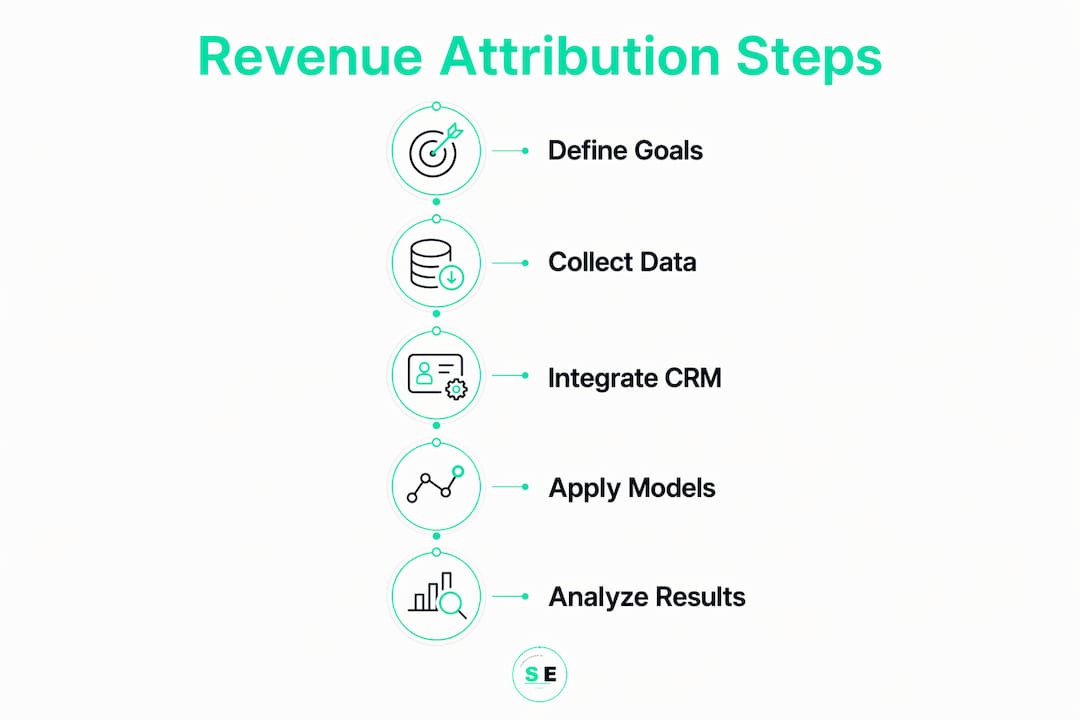
Building a reliable attribution capability requires both the right tools and the right processes. Here is a practical sequence for agencies starting from scratch or rebuilding a broken system:
-
Audit your current tracking. Identify every UTM parameter in use across all client accounts. Standardize naming conventions agency-wide before touching any attribution platform.
-
Choose platform-agnostic tools. Tools like Northbeam, Rockerbox, Triple Whale, or a GA4 and BigQuery combination pull data from all channels without the bias of platform-native reporting. This gives you a single source of truth.
-
Integrate CRM data. Connect your clients' CRM systems to your attribution stack. The goal is closed-loop reporting: tracking a prospect from first ad click through to closed revenue. Without this step, you are measuring activity, not outcomes.
-
Run multiple attribution models simultaneously. Present last-touch, linear, and data-driven models side by side in client reports. This approach acknowledges measurement uncertainty while showing the full range of marketing impact.
-
Automate reporting. Manual spreadsheet-based reporting consumes hours per client each month. Automated platforms that integrate 70 or more data sources deliver real-time dashboards that update without analyst intervention.
-
Educate clients on measurement. Set expectations early. Explain why platform-reported numbers differ from CRM data. Clients who understand blended analytics approaches are less likely to question your methodology when numbers do not match their ad platform dashboards.
The most accurate attribution integrates sales call data, CRM notes, and marketing touchpoints to build a complete account-level conversion story. That level of detail is what separates agencies delivering genuine revenue intelligence from those still reporting on impressions.
You can also explore how to build a revenue dashboard without a dedicated data team as a practical starting point for agencies with limited technical resources.
| Attribution tool type | Best use case | Key limitation |
|---|---|---|
| Platform-native (Google Ads, Meta) | Quick campaign-level reporting | Inflates conversions; no cross-channel view |
| GA4 + BigQuery | Flexible, custom modeling | Requires technical setup and data engineering |
| Northbeam / Rockerbox | Cross-channel, platform-agnostic | Subscription cost; onboarding time |
| Triple Whale | E-commerce focused attribution | Less suited for B2B or service-based clients |
| CRM-integrated (Salesforce, HubSpot) | Closed-loop revenue attribution | Requires CRM access and clean pipeline data |
Revenue attribution as a long-term agency strategy
Attribution failures almost always trace back to operational and process misalignment, not technology limitations. The agencies I have seen struggle most with attribution are not using bad tools. They are using good tools badly, with inconsistent tracking, no CRM integration, and no shared framework across their teams.
The agencies winning on attribution treat it as a mutual optimization tool rather than a contract defense mechanism. Using attribution to navigate rather than just report creates longer, more profitable client relationships because both sides are working from the same data toward the same revenue goals.
The future of agency reporting is moving toward AI-powered, account-level revenue intelligence that synthesizes signals in near real time. AI-powered attribution platforms are already shifting attribution from a reporting function to a decisioning function, where the system recommends budget moves rather than just recording what happened. Agencies that build this capability now will have a structural advantage that is very hard for competitors to replicate quickly.
Revenue attribution also addresses the B2B revenue leakage problem directly. When agencies cannot trace which campaigns drive closed deals, budget flows to underperforming channels and high-performing ones get cut. That misallocation is a form of revenue leakage that compounds month over month.
Key takeaways
Revenue attribution transforms agencies from cost centers into revenue drivers by connecting every marketing action to actual closed deals.
| Point | Details |
|---|---|
| Attribution beats vanity metrics | Clicks and leads do not prove ROI. Closed-loop revenue data does. |
| Multi-touch models outperform single-touch | Running last-touch, linear, and data-driven models in parallel gives a complete picture. |
| CRM integration is non-negotiable | Without pipeline data, agencies track activity, not revenue outcomes. |
| UTM governance comes first | Standardized tracking conventions are the foundation of reliable attribution data. |
| Automation frees strategic capacity | Automated dashboards eliminate manual reporting hours and improve client transparency. |
My take on why attribution is an agency's best growth lever
I have worked with agencies at every stage, from solo consultants to 200-person shops, and the pattern is consistent. The ones growing fastest are not necessarily running better campaigns. They are measuring better. They have built attribution systems that let them prove value, reallocate budget quickly, and have honest conversations with clients about what is working.
The uncomfortable truth is that most attribution problems are not technical. They are organizational. Teams disagree on which metrics matter. Clients resist sharing CRM access. Analysts spend their best hours building reports instead of interpreting them. No tool fixes those problems on its own.
What does fix them is treating attribution as a business practice, not a reporting task. That means standardizing frameworks across every client account, training every team member on UTM governance, and making revenue data the center of every client conversation. When you do that, attribution stops being a measurement exercise and becomes the engine that drives every strategic decision you make.
The agencies I respect most use attribution data the way a CFO uses financial statements: not to prove they were right, but to figure out what to do next.
— Bernard
How Signalengine helps agencies prove revenue impact ⚡
Agencies need unified data, not more dashboards to manage manually. Signalengine brings together CRM data, ad platform signals, and pipeline intelligence into one place, so you can show clients exactly where their revenue is coming from.

With AI-powered attribution reporting, Signalengine identifies revenue leakage across your client accounts, flags missed renewal opportunities, and delivers client-ready ROI dashboards without hours of manual work. The Signal Engine pipeline tools give agencies a single source of truth for deal tracking and cross-channel attribution. You can also explore the full setup and documentation to see how quickly your team can get running. The average agency uncovers $38K in recoverable revenue in the first month.
FAQ
What is revenue attribution for marketing agencies?
Revenue attribution is the process of linking specific marketing touchpoints to actual closed revenue, rather than stopping at leads or clicks. It gives agencies a factual basis for proving ROI and optimizing budget allocation across channels.
Why do agencies struggle with accurate attribution?
65.7% of marketers report data integration as their top attribution barrier, and most agencies compound this with inconsistent UTM tracking and limited CRM access. Platform-native reporting inflates conversion counts, making results look better than they are.
What attribution model should agencies use?
No single model is best. Running last-touch, linear, and data-driven models simultaneously gives a more complete view of marketing impact than relying on one framework alone.
How does CRM integration improve attribution accuracy?
CRM data connects marketing touchpoints to actual closed deals, closing the loop between campaign activity and revenue. Without it, agencies can only report on lead volume, not business outcomes.
How long does it take to implement revenue attribution?
Basic attribution with UTM governance and GA4 can be set up in days. Full closed-loop attribution with CRM integration and automated dashboards typically takes two to four weeks depending on data source complexity and client cooperation.
Ready to Stop the Revenue Leak?
Signal Engine gives small and local businesses 31 AI-powered tools to score leads by buying intent, predict churn before it happens, auto-generate email and SMS campaigns, and recover missed calls automatically — all in one dashboard starting at $49/month.
Start your free 7-day trial — no credit card required. Setup takes 5 minutes.