

TL;DR:
- AI-driven revenue analysis automates data processing and provides real-time, predictive insights that improve forecast accuracy and align revenue teams. It enables early churn detection, enhances cross-functional coordination, and offers affordable solutions for small and mid-sized businesses. Most importantly, it transforms decision-making from reactive reporting into proactive, data-driven strategies that maximize revenue growth.
AI-driven revenue analysis is the process of using machine learning and advanced analytics to automate revenue management tasks, delivering faster and more precise insights than traditional reporting ever could. The benefits of AI-driven revenue analysis go far beyond speed. Platforms like Salesforce Revenue Cloud, SAP AI Analytics, and Signalengine now give business owners and sales leaders the ability to predict churn, score leads by buying intent, and align every revenue-generating team around a single source of truth. This article breaks down exactly what those benefits look like in practice, and why they matter for your growth strategy right now.
1. What are the core benefits of AI-driven revenue analysis?
AI-driven revenue analysis, also called revenue intelligence, converts raw customer and sales data into prescriptive guidance your team can act on today. Traditional reporting tells you what happened last quarter. Revenue intelligence tells you what is about to happen next week.

The core benefits fall into five categories: automation of manual data work, improved forecast accuracy, real-time decision support, cross-functional alignment, and proactive churn prevention. Each of these builds on the others. When your data is clean and automated, your forecasts get sharper. When your forecasts are sharper, your teams align faster. When your teams align, you stop losing revenue to gaps nobody noticed.
2. How AI automates and accelerates revenue insights
AI data analytics shifts organizations from descriptive reporting to real-time decision enablement by automating data preparation and pattern detection. That shift is significant. Your analysts stop spending hours cleaning spreadsheets and start spending their time interpreting signals.
Here is what automation looks like in practice:
- Data ingestion: AI pulls from CRM records, billing systems, support tickets, and product usage logs simultaneously.
- Pattern detection: Machine learning flags anomalies, such as a customer who stopped logging in after three years of daily use.
- Insight delivery: Natural-language interfaces let non-technical team members query revenue data in plain English, no SQL required.
- Continuous updates: Insights refresh automatically as new data arrives, replacing static monthly reports with live signals.
The result is a faster data-to-insight cycle that scales across structured and unstructured data without proportional manual effort. Your team makes better calls, faster, with less guesswork.
Pro Tip: Set up automated alerts for behavioral signals, such as a drop in product usage or a missed payment, before you build any new dashboards. Alerts catch problems in real time. Dashboards only show you what already happened.
3. Improving revenue forecast accuracy with AI
Accurate forecasting is the single biggest competitive advantage a sales leader can have. Predictive scoring and deal risk signaling help sales teams focus on the most promising prospects and catch stalled deals before they die quietly.
AI improves forecast accuracy through three specific mechanisms:
- Lead scoring by behavior: AI ranks prospects by actual buying signals, not just demographic fit. A lead who visited your pricing page four times this week scores higher than one who downloaded a whitepaper six months ago.
- Deal risk detection: AI analyzes deal behavior patterns to flag opportunities at risk of stalling or closing below target. Your reps get a warning, not a surprise.
- Renewals forecasting: Renewals forecasting combines AI risk signals with human assessment at fixed checkpoints to improve renewal outcomes and avoid surprises. Gainsight's framework, for example, requires documented risk mitigation plans at each checkpoint so leadership always has full visibility.
The practical outcome is predictable revenue. You stop managing by gut feel and start managing by probability. That shift alone improves margin, because you allocate sales resources to deals that are actually likely to close.
4. How AI aligns sales, marketing, and finance for better revenue outcomes
Revenue optimization is broader than forecasting. It requires proactive, cross-functional management of the entire revenue lifecycle, from first touch to renewal. Most businesses lose revenue not because they lack customers, but because their teams are working from different data.
AI-driven revenue analysis fixes that by creating a shared signal layer every team can trust.
"Cross-functional alignment reduces operational silos and creates a more sustainable revenue growth engine." — Salesforce Revenue Optimization Guide
Here is how alignment plays out across teams:
- Sales gets deal risk scores and next-best-action recommendations, so reps know exactly which accounts to call today.
- Marketing sees which campaigns are generating revenue, not just clicks, and adjusts spend accordingly.
- Customer success receives early warning signals on at-risk accounts before the customer ever sends a cancellation email.
- Finance works from the same forecast data as sales, eliminating the version-control chaos that plagues most revenue reviews.
AI revenue recovery strategies show that this kind of alignment directly improves recurring revenue quality, not just volume. You grow better, not just bigger.
5. Using AI analytics to find growth opportunities and prevent churn
Churn prevention is where the advantages of AI analytics become most visible and most measurable. Centralizing customer data from CRM, support tickets, billing, and product usage into one platform makes AI churn prevention more reliable and actionable. Fivetran's approach demonstrates this directly: isolated AI models that only read CRM data miss the signals buried in support logs and billing history.
The table below shows the difference between a reactive and a proactive approach to churn:
| Approach | Signal source | When you find out | Outcome |
|---|---|---|---|
| Reactive | Customer cancels | After the fact | Revenue already lost |
| Proactive with AI | Unified data platform | 30–90 days early | Retention play possible |
| AI + next-best-action | CRM, billing, usage, support | Real time | Expansion revenue unlocked |
Churn and retention insights are most reliable when synthesizing multiple signal sources into a unified customer view. Isolated models reduce effectiveness. That is why Signalengine pulls signals from across your customer relationship, not just one data point, to score who is about to leave and who is ready to buy more.
Pro Tip: Do not wait for a customer to go quiet before you act. Set AI triggers on positive signals too, such as a customer who just hit a usage milestone. That is your best moment to offer an upgrade or a referral program.
6. Machine learning revenue insights vs. traditional analytics: what actually changes
The practical difference between machine learning revenue insights and traditional analytics is not just speed. It is the type of question you can answer.
Traditional analytics answers: "What happened?" Machine learning answers: "What will happen, and what should I do about it?" That shift from descriptive to prescriptive is what makes AI-powered revenue analysis worth the investment.
Traditional analytics requires an analyst to form a hypothesis, pull data, clean it, and build a report. That cycle takes days. AI runs continuously, surfaces anomalies without being asked, and delivers recommendations directly into the workflow where your team is already working. The impact on sales is direct: reps spend less time in spreadsheets and more time in front of customers.
7. The impact of AI on revenue streams for small and mid-size businesses
Large enterprises have used revenue intelligence tools for years. The shift happening now is that platforms like Signalengine have made the same capabilities available to small and mid-size businesses at a fraction of the cost.
The impact of AI on revenue streams for SMBs shows up in three specific areas. First, lead prioritization: instead of calling every contact in your CRM, your team focuses on the 20% most likely to convert this month. Second, retention: AI flags at-risk customers weeks before they churn, giving you time to intervene. Third, expansion: AI identifies customers who are ready for an upsell based on usage patterns, not just sales instinct.
Revenue intelligence for small businesses is no longer a luxury reserved for companies with data science teams. Signalengine's tools start at $49 per month and require no technical setup. The barrier is gone. The opportunity is not.
Key takeaways
AI-driven revenue analysis works because it replaces reactive reporting with continuous, predictive signals that align every revenue team around the same data.
| Point | Details |
|---|---|
| Automation accelerates insight | AI eliminates manual data prep and delivers continuously updated signals to your team. |
| Forecast accuracy improves | Predictive scoring and deal risk signals help sales teams prioritize and protect pipeline. |
| Cross-functional alignment reduces revenue loss | Shared AI signals connect sales, marketing, customer success, and finance around one truth. |
| Unified data prevents churn | Combining CRM, billing, and usage data gives AI the full picture needed to catch at-risk customers early. |
| SMBs can access this now | Platforms like Signalengine make revenue intelligence affordable and fast to deploy for small businesses. |
Why most businesses are still leaving money on the table
I have spent years watching businesses invest in CRM platforms, hire great sales reps, and still miss their revenue targets. The pattern is almost always the same. The data exists. The problem is that nobody is watching it continuously, and no one has agreed on what the numbers mean.
The biggest misconception I see is that AI-driven revenue analysis is a reporting upgrade. It is not. It is a decision infrastructure. The businesses that get the most out of it are the ones that treat AI signals as inputs to a structured decision process, not as answers that replace human judgment. Gainsight's renewals forecasting framework gets this right. AI scores the risk. A human reviews it at a fixed checkpoint. A documented plan gets made. That combination beats pure automation every time.
The second mistake is waiting until data is "perfect" before deploying AI. Your data will never be perfect. Start with what you have, centralize it, and let the AI surface what it finds. You will learn more from the first 30 days of live signals than from six months of data cleanup projects.
Cross-functional buy-in is not optional. If your finance team is working from a different forecast than your sales team, AI will not fix that. It will just surface the disagreement faster. Use that as a forcing function to align on shared definitions before the next planning cycle.
— Bernard
How Signalengine puts these benefits to work for your business
If you are a business owner or sales leader who wants the advantages of AI revenue insights without hiring a data team, Signalengine was built for you.
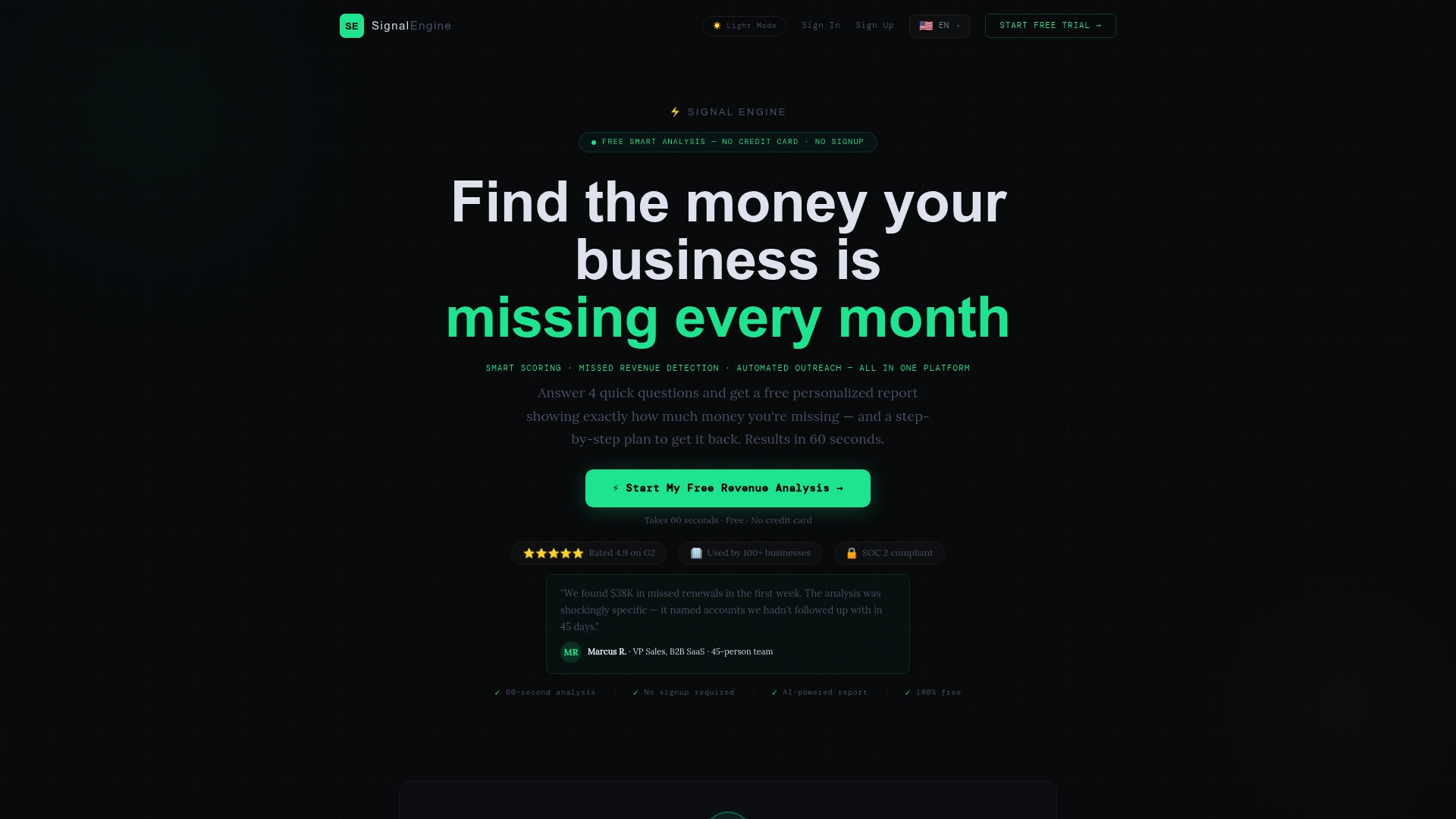
Signalengine watches your customers, scores their behavior automatically, and flags who is about to leave before they do. It finds openings in your market, tells you exactly which leads are hot right now, and auto-generates the follow-up campaigns to close them. Serving 12 verticals including HVAC, logistics, dental, and real estate, Signalengine delivers AI-powered revenue intelligence starting at $49 per month. Setup takes five minutes. No data team required.
Ready to Stop the Revenue Leak?
Signal Engine gives small and local businesses 31 AI-powered tools to score leads by buying intent, predict churn before it happens, auto-generate email and SMS campaigns, and recover missed calls automatically — all in one dashboard starting at $49/month.
Start your free 7-day trial — no credit card required. Setup takes 5 minutes.
FAQ
What is AI-driven revenue analysis?
AI-driven revenue analysis, also called revenue intelligence, uses machine learning to automate data preparation, detect patterns, and deliver predictive insights that help businesses forecast revenue and prevent churn more accurately than traditional reporting.
How does AI improve revenue forecasting accuracy?
AI analyzes deal behavior patterns and customer signals to score lead quality, flag stalled opportunities, and predict renewal risk. Renewals forecasting workflows combine AI risk scores with human review at structured checkpoints to reduce forecast surprises.
Can small businesses benefit from AI revenue analysis?
Yes. Platforms like Signalengine make AI revenue optimization available to small businesses starting at $49 per month, with no data science team or technical setup required.
How does AI help prevent customer churn?
AI prevents churn by centralizing data from CRM, billing, support, and product usage into a unified view, then flagging at-risk customers 30–90 days before they cancel. Isolated models that read only one data source are significantly less effective.
What is the difference between AI analytics and traditional reporting?
Traditional reporting answers "what happened." AI analytics answers "what will happen and what should you do next," shifting your team from reactive analysis to proactive revenue decisions based on live signals.