

TL;DR:
- AI diagnostics now accelerate analysis and enhance accuracy, enabling consultants to focus on judgment and relationships. Adoption barriers primarily involve trust, change management, and validation, not technology, requiring strategic organizational efforts. Moving to outcome-based models, firms encode expertise into AI systems, transforming traditional billing and scalability in consulting.
The role of AI diagnostics in consulting has shifted from experimental to expected. Firms that once spent weeks on data gathering and synthesis are now completing that same work in days. Yet a persistent misconception lingers: that AI diagnostics are here to replace consultants. They are not. What they actually do is compress the time between question and answer, sharpen the accuracy of analysis, and free consultants to focus on what AI cannot replicate — judgment, relationships, and accountability. This article breaks down how AI diagnostic tools work, where they create real value, and how you can put them to work today.
Table of Contents
- Key Takeaways
- How AI diagnostics reshape consulting workflows
- Barriers that slow AI adoption in consulting
- From hourly billing to outcome-driven expertise
- Practical ways to apply AI diagnostics right now
- My take on where AI diagnostics are really headed
- Let AI diagnostics surface what your pipeline is missing
- FAQ
- Ready to Stop the Revenue Leak?
Key Takeaways
| Point | Details |
|---|---|
| AI diagnostics accelerate analysis | AI reduces research and synthesis time by 30% or more, freeing consultants for higher-value judgment work. |
| Human judgment remains non-negotiable | Boards and executives still require human accountability in decisions, making trust a critical factor in AI adoption. |
| Expertise architecture drives success | Encoding domain expertise into machine-executable frameworks separates high-performing AI tools from generic ones. |
| Adoption barriers are organizational, not just technical | Change management, workflow disruption, and reimbursement gaps create friction that technology alone cannot solve. |
| Outcome-based models are the new competitive edge | Firms shifting from hourly billing to measurable outcomes are better positioned to capture AI-driven consulting value. |
How AI diagnostics reshape consulting workflows
AI diagnostic tools are not general-purpose chatbots. They are purpose-built systems that encode domain-specific expertise into structured reasoning frameworks. Think of them as expert analysts who never sleep, never forget a pattern, and can process thousands of data points in the time it takes a human to open a spreadsheet.
Here is what makes them distinct in a consulting context:
- Pattern recognition at scale. AI diagnostics identify correlations across datasets that human analysts would miss or take weeks to surface.
- Decision automation for repeatable tasks. Routine analyses like market sizing, competitor benchmarking, and financial modeling can run automatically, with outputs ready for human review.
- Speed with structure. AI reduces research time by 30% or more, which means your team spends less time crunching and more time advising.
- Diagnostic toolkits for rapid assessment. Open-source consulting agent toolkits can identify organizational gaps in under five minutes and include 16 or more strategy frameworks for executive analysis.
The practical shift this creates is significant. Senior consultants are no longer managing analysts. They are managing intelligent platforms. Your job becomes configuring, interpreting, and deploying AI agents rather than supervising junior staff doing manual research.
Pro Tip: Before evaluating any AI diagnostic tool, map out where your team currently spends the most time on repeatable, data-heavy tasks. Those bottlenecks are your highest-value starting points for AI integration.
The impact of AI in consulting is not just about speed. Accuracy matters too. In healthcare consulting, AI cardiac diagnostic tools have achieved 98% accuracy in minutes, a benchmark that validates AI diagnostic reliability across high-stakes domains. That credibility transfers to business consulting when the tools are designed with the same rigor.
Barriers that slow AI adoption in consulting
Understanding the benefits is the easy part. The harder conversation is about why so many consulting firms still struggle to integrate AI diagnostics effectively. The obstacles are real, and most of them are organizational rather than technical.
The trust deficit is bigger than it looks. Human judgment remains essential in consulting because clients need someone to stand behind a recommendation. AI can surface an insight, but a board needs a person in the room to defend it. This is not going to change soon. Boards and CEOs maintain a clear preference for human-led decisions, which means AI diagnostics work best as an input to human judgment rather than a replacement for it.
Change management is underestimated. Most firms focus on the technology and underinvest in the people side. Consultants skilled in AI deployment and change management are now more valuable than those focused on analysis alone. That is a significant signal about where the competitive edge actually sits. If you are deploying an AI diagnostic tool without a plan for how your team will adopt it, you will get resistance, workarounds, and underutilization.
The reimbursement and validation gap is real. This problem is most visible in the role of AI in healthcare consulting, where 90% of AI diagnostic models never achieve routine clinical use due to reimbursement uncertainties and validation gaps. The same logic applies in business consulting. Tools that lack clear ROI metrics, workflow proof points, or client-facing validation will stall in pilot stage indefinitely.
Here is a realistic summary of what blocks adoption:
- Distrust of AI outputs without explainability features
- Lack of internal champions to drive adoption
- Misalignment between AI tool capabilities and existing workflow structures
- No clear framework for measuring and communicating tool performance to clients
Pro Tip: When introducing AI diagnostic tools to a client engagement, present the AI output alongside your own interpretation. This positions you as the expert using the tool, not the tool replacing your expertise. It builds trust faster.
Addressing these barriers requires intentional planning. The technology is ready. The question is whether your team and your clients are.
From hourly billing to outcome-driven expertise
This is where the role of AI diagnostics in consulting gets genuinely strategic. AI is not just changing how consultants work. It is changing what consulting firms are.
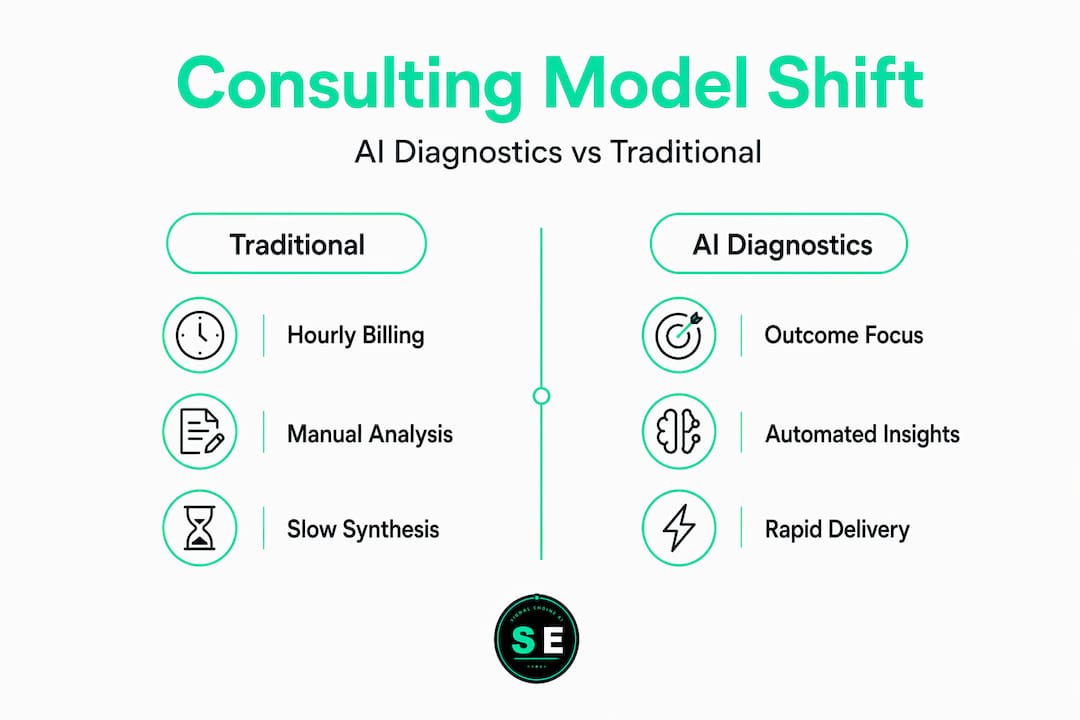
The traditional model was straightforward: sell time, charge by the hour, bill for expertise delivery. AI diagnostics are breaking that model. When an AI tool can produce a market analysis in 20 minutes that previously took three analysts three days, the time-based billing logic collapses. What replaces it is outcome-based consulting, where firms sell measurable business results rather than hours worked.
This shift requires something most firms have not built yet: Expertise Architecture. The concept means encoding your consultants' domain knowledge into machine-executable reasoning frameworks. Instead of a senior partner writing a custom analysis for every engagement, that partner's judgment gets systematized into a tool that can run that analysis automatically. The firm essentially becomes a software provider with proprietary intellectual property baked into its AI tools.
The table below contrasts the two models clearly:
| Dimension | Traditional consulting model | AI diagnostics-powered model |
|---|---|---|
| Revenue driver | Billable hours | Measurable outcomes delivered |
| Primary asset | Senior partner expertise | Encoded expertise in AI systems |
| Scalability | Limited by headcount | Scales through AI agent deployment |
| Client value proposition | Advisory relationship | Verified, repeatable results |
| Risk profile | High — output depends on individual | Distributed — AI with human oversight |
The most effective AI diagnostic tools function as specialized expert systems that automate routine tasks while preserving human oversight to prevent the hallucinations common in generic AI models. This design principle is what separates a reliable consulting AI platform from a liability.
Firms that make this transition successfully do not just use AI. They embed it into the core of what they sell.
Practical ways to apply AI diagnostics right now
You do not need to redesign your entire practice to start benefiting from AI diagnostic tools. There are specific, near-term applications that deliver clear value with manageable implementation complexity.
-
Run an AI readiness assessment first. Before committing to any tool, diagnose your current state. Open-source consulting agent toolkits can identify workflow gaps and strategy alignment issues in under five minutes, giving you a prioritized starting point rather than a blank slate.
-
Apply AI diagnostics to revenue intelligence work. This is one of the highest-ROI applications available today. AI-powered tools that detect revenue leakage patterns give consultants a fast, credible way to demonstrate client value in the first week of an engagement. Clients see the problem in numbers, not slides.
-
Use AI in financial modeling and scenario planning. AI diagnostics can run dozens of scenario variations simultaneously, something that previously required a team of analysts and days of work. For strategy consulting, this changes the depth of analysis you can deliver without changing your headcount.
-
In healthcare consulting, integrate with care pathway analysis. The role of AI in healthcare consulting is growing fast. With 57% of hospital executives prioritizing AI clinical solutions in 2026 and 2027, consultants who understand AI diagnostic applications in clinical workflows have a clear differentiation advantage.
-
Evaluate tools against four criteria before committing. Transparency of reasoning, workflow integration fit, measurable client impact, and validation evidence. Tools that cannot score well on all four are risks, not assets.
Pro Tip: When pitching AI diagnostic capabilities to a new client, lead with a specific example from their industry. Abstract AI benefits do not win engagements. Concrete evidence of recovered revenue or reduced decision cycle time does.
The firms winning right now are treating AI diagnostic tools as client-facing assets, not back-office efficiency plays. That framing changes everything about how you sell and deliver.
My take on where AI diagnostics are really headed
I have watched the consulting industry run toward every new technology wave with the same misplaced confidence. AI diagnostics are different, but not in the way most people think.
The real challenge is not building the tools. It is encoding judgment. Anyone can automate a process. Very few organizations can systematically capture the tacit reasoning behind their best consultants' decisions and translate it into a reliable, machine-executable framework. That gap is where most AI diagnostic implementations fail quietly, not with a crash, but with mediocre outputs that erode client confidence over time.
What I have seen work is a deliberate approach to what I would call expertise extraction. Firms that sit their senior practitioners down, map their actual decision logic, and then build AI diagnostic tools around that logic produce something defensible and scalable. Firms that just plug in a generic AI model and call it a diagnostic tool produce noise.
The other thing that gets underestimated is deployment capability. The consultant's competitive edge lies not in using AI but in managing the cultural and workflow adoption that follows. That is a skill the industry has not caught up to yet, and it is where the next generation of high-value consultants will separate themselves.
My honest advice: stop worrying about whether AI will replace you. Start building the capability to deploy it better than anyone else in your space.
— Bernard
Let AI diagnostics surface what your pipeline is missing
Most consultants are not losing business because of bad strategy. They are losing it because revenue signals get missed. A churn risk goes undetected. A renewal opportunity sits uncontacted. A high-intent prospect never gets a follow-up.
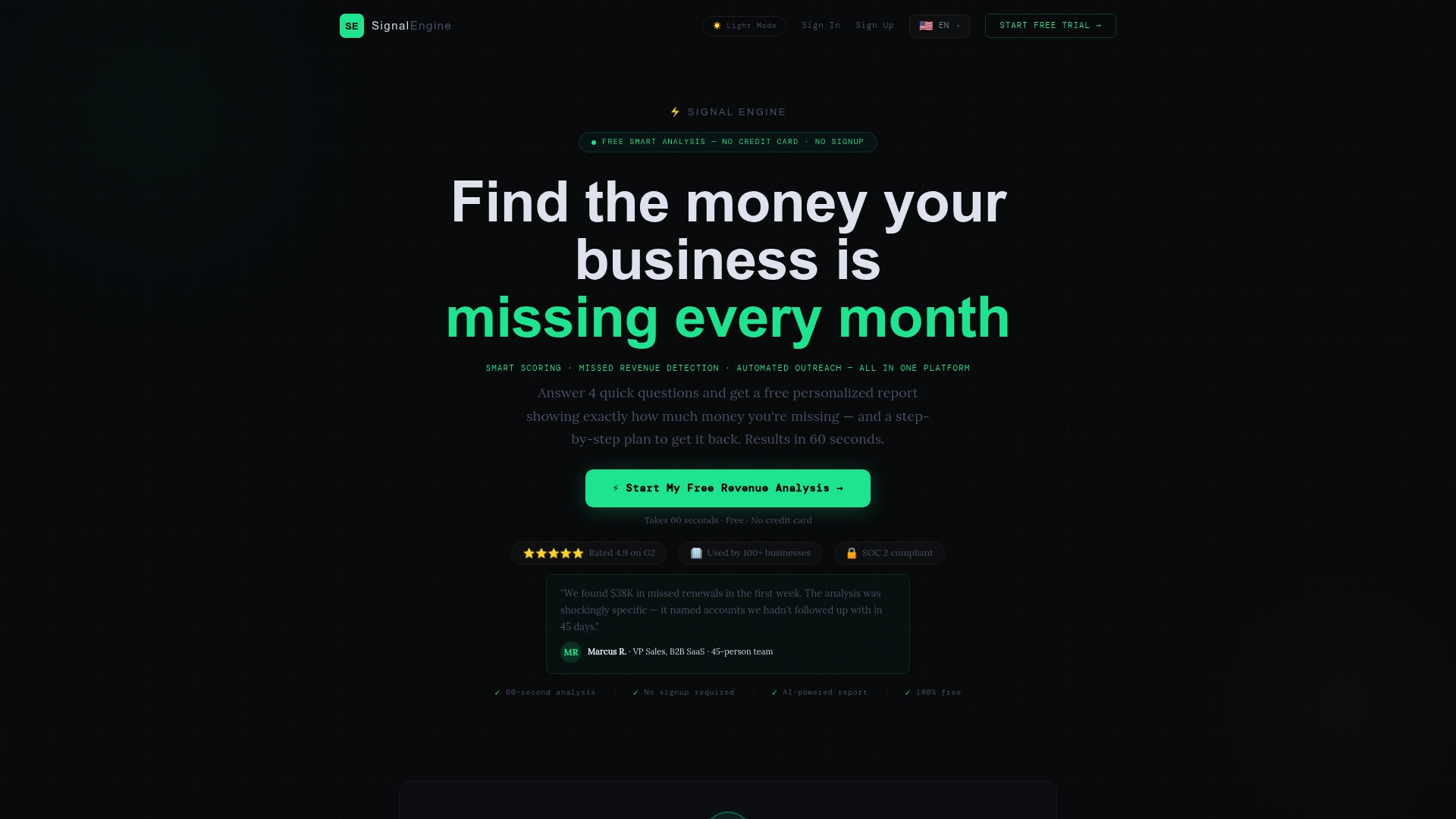
That is exactly what Signalengine is built to fix. The platform uses AI-driven analysis to run a free revenue leakage audit that identifies where your pipeline is silently draining and gives you a 30-day recovery playbook to get it back. For consultants who want to demonstrate immediate, measurable client value, this is the kind of AI diagnostic output that wins trust fast. No lengthy onboarding. No guesswork. Just clear signals and clear next steps.
Start your free AI revenue audit and see what your data has already been trying to tell you. ⚡
FAQ
What is the role of AI diagnostics in consulting?
AI diagnostics in consulting function as intelligent analysis tools that automate data gathering, pattern recognition, and scenario modeling, freeing consultants to focus on judgment-intensive work. They reduce research time by 30% or more while improving the accuracy and speed of client recommendations.
Will AI diagnostic tools replace human consultants?
No. Boards and executives consistently prefer human-led decisions, and human judgment remains critical for defending recommendations, managing client relationships, and navigating organizational complexity. AI diagnostics support consultants rather than replace them.
How do consultants evaluate AI diagnostic tools?
Evaluate AI diagnostic tools based on four criteria: transparency of reasoning, fit with existing workflows, measurable impact on client outcomes, and validated performance evidence. Tools that lack explainability or workflow integration tend to stall in pilot stage without delivering ongoing value.
What is expertise architecture in AI consulting?
Expertise architecture refers to encoding a firm's domain knowledge into machine-executable frameworks so that AI tools can replicate expert reasoning at scale. This approach, as described in research on consulting's fourth transformation, is what separates reliable AI consulting platforms from generic models prone to hallucination.
What are the biggest barriers to AI adoption in consulting?
The primary barriers are a trust deficit around AI outputs, underinvestment in change management, misalignment between tools and workflows, and reimbursement or validation gaps. Addressing organizational friction is as important as selecting the right technology.
Ready to Stop the Revenue Leak?
Signal Engine gives small and local businesses 31 AI-powered tools to score leads by buying intent, predict churn before it happens, auto-generate email and SMS campaigns, and recover missed calls automatically — all in one dashboard starting at $49/month. Start your free 7-day trial — no credit card required. Setup takes 5 minutes.