

TL;DR:
- AI-driven revenue recovery leverages machine learning, automation, and analytics to accelerate payment retries and improve cash application accuracy. Implementing AI-enhanced dunning increases recovery rates to 70–85%, and embedding AI into workflows boosts efficiency and practitioner adoption. Challenges include ensuring data quality, separating dunning from collections, and integrating compliance into AI systems from the start.
AI-driven revenue recovery is defined as the use of machine learning, automation, and predictive analytics to reclaim lost or at-risk revenue through faster payment retries, smarter customer communication, and more accurate cash application. The role of AI in revenue recovery has shifted from experimental to operational. Microsoft's AI-augmented cash collection program increased payment matching accuracy from 40% to 90%, applying 98% of payments within 48 hours. That single data point reframes what recovery looks like at scale. For business leaders evaluating artificial intelligence revenue solutions, the question is no longer whether AI works. It's which mechanics to fix first.
How does AI-driven dunning automation boost revenue recovery?
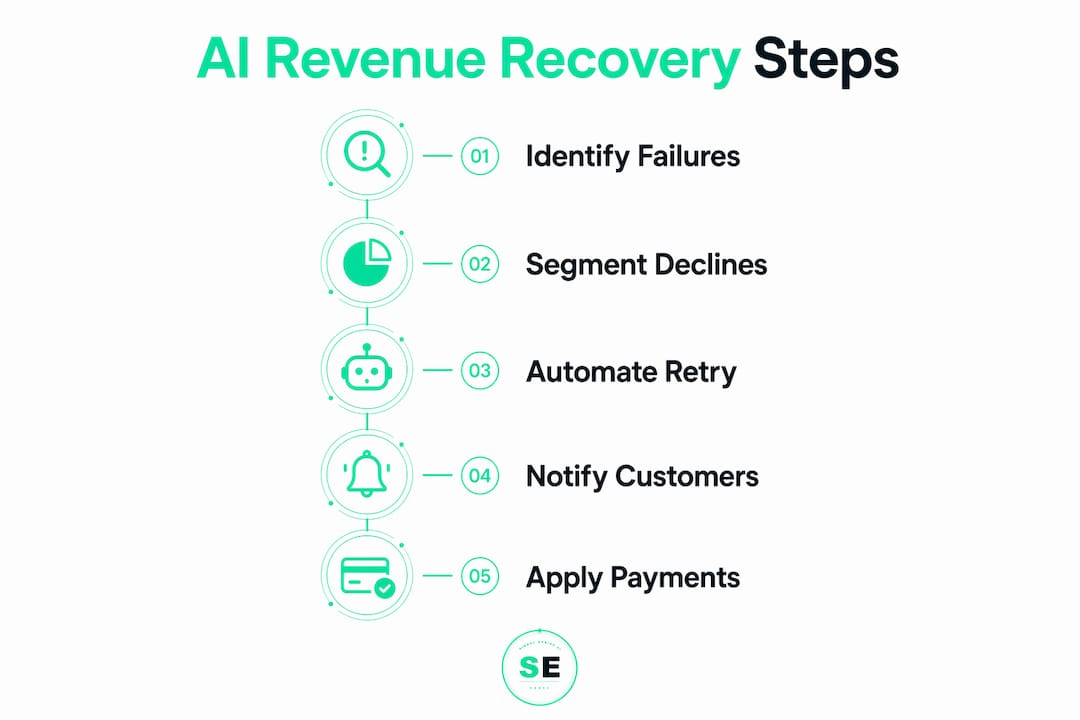
Dunning automation is the process of systematically retrying failed payments and notifying customers through timed, sequenced outreach. Traditional fixed retry schedules recover roughly 50 to 60% of initially failed payments. AI-optimized dunning recovers 70 to 85% of the same failures. That 15 to 25 percentage point gap represents real revenue your business is currently leaving on the table.
The difference comes from segmentation. AI classifies each failed payment by decline reason: expired card, insufficient funds, or bank-side technical decline. Each category gets a different retry window, message tone, and escalation path. A card expiry failure responds well to an immediate self-service update prompt. An insufficient funds decline responds better to a retry timed three to five days later, after a likely payroll cycle.
Here is how the three approaches compare:
| Approach | Recovery rate | Key limitation |
|---|---|---|
| No dunning | 20–30% | Revenue bleeds silently |
| Fixed retry schedule | 50–60% | Ignores decline reason and timing |
| AI-optimized dunning | 70–85% | Requires clean event data and webhook history |
Beyond recovery rates, effective dunning automation reduces Days Sales Outstanding by 3 to 7 days when integrated with billing and cash application systems. Fewer outstanding days means faster cash flow and less manual chasing.
Pro Tip: Start dunning sequences before a payment is technically overdue. Proactive card-update prompts sent 7 days before expiry recover a significant share of failures before they ever occur.
What operational improvements does AI bring to payment matching?
Payment matching is the process of reconciling incoming payments against open invoices. Without AI, finance teams manually match transactions, a task that is slow, error-prone, and expensive at scale. Microsoft's program is the clearest proof point: AI assistance in cash collection cut call-prep time by 40% while pushing matching accuracy from 40% to 90%.

The mechanism behind that improvement is generative AI embedded directly into the case manager's daily workflow. Instead of toggling between systems, collectors get AI-generated call summaries, suggested reply drafts, and prioritized case queues. The AI surfaces what matters and suppresses what doesn't. Adoption happens because the tool reduces friction rather than adding it.
Key operational wins from AI-augmented collections workflows include:
- Faster payment application: 98% of payments applied within 48 hours versus multi-day manual cycles
- Reduced inquiry handling time: AI drafts responses to common customer queries, cutting resolution time significantly
- Smarter prioritization: Cases ranked by payment likelihood and account risk, not just invoice age
- Call prep automation: Account history, dispute notes, and payment patterns surfaced before each call
Pro Tip: Fix fragmented data workflows before layering AI on top. AI amplifies whatever data quality exists underneath it. Clean inputs produce sharp outputs. Messy inputs produce confident wrong answers.
The broader lesson from Microsoft's experience is that embedding AI in daily workflows produces measurable productivity gains and practitioner adoption. AI that lives inside the tool your team already uses gets used. AI that requires a separate login gets ignored.
How do AI voice agents and omnichannel models accelerate collections?
AI voice agents represent the most visible frontier of AI in financial recovery. These systems make outbound calls, handle objections, collect payment commitments, and update CRM records without human involvement. One implementation by Aloware showed an AI voice agent recovering 57% of past-due accounts receivable within 4 days, saving over 10 hours of manual effort monthly without adding headcount. That result is not a pilot. It's a production outcome.
The architecture behind enterprise-scale AI collections is more sophisticated. EXL's PayMentor platform, built on AWS using Amazon SageMaker and serverless services, runs ML models that predict payment likelihood and optimize communication channel selection per customer. The system separates customer ranking models from channel preference models and retrains both frequently to stay accurate as customer behavior shifts.
A modern omnichannel AI recovery sequence looks like this:
- Score and rank accounts by payment probability using ML models trained on transaction history and behavioral signals
- Select the optimal channel per customer: voice, SMS, email, or in-app notification based on prior engagement data
- Deploy AI voice agents for high-balance or time-sensitive accounts requiring a conversational touchpoint
- Trigger SMS or email follow-ups automatically based on call outcome: no answer, promise to pay, or dispute raised
- Log all interactions to CRM in real time using cloud streaming, keeping human agents informed without manual entry
- Escalate to human collectors only when AI encounters complexity beyond its decision rules
"Compliance is not an add-on. It must be engineered into AI agents from the start, including call frequency limits, consent verification, interaction logging, and full auditability." — Twig, Voice AI Agents and Compliance in Fintech Collections
Regulations like Reg F and TCPA impose strict call-frequency controls and consent requirements. AI systems that treat compliance as an afterthought create legal exposure that erases recovery gains. The systems that work long-term build call-frequency controls and consent checks directly into the agent architecture.
What are common challenges when implementing AI in revenue recovery?
The biggest implementation mistake is treating dunning and collections as the same problem. Dunning and collections are separate systems with different goals, customer relationships, and automation roles. Dunning prevents payment failures from aging. Collections manage exceptions after failure has occurred. Mixing the two creates tone mismatches that damage customer relationships and inflate costs.
Data quality is the second major obstacle. Successful AI payment recovery requires complete webhook history and accurate event labeling. Without clean training data, ML models degrade quickly and produce retry recommendations that harm recovery rates rather than improve them. Many businesses discover their data infrastructure is not ready for AI when they try to deploy it.
Best practices for AI deployment in revenue recovery:
- Audit your data before you build. Map every payment event, decline code, and customer interaction in your system. Gaps in webhook history will corrupt model training.
- Classify declines before retrying. Retry eligibility classification and stop logic prevent harmful retry attempts on hard declines that will never resolve.
- Separate dunning from collections workflows. Different messaging tone, escalation paths, and automation rules apply to each stage.
- Build compliance into the architecture. Consent verification, call limits, and interaction logs belong in the system design, not the policy manual.
- Measure the right metrics. Recovery rate, DSO reduction, and cost per dollar recovered tell you whether AI is working. Retry volume does not.
Pro Tip: Run a data instrumentation audit before selecting any AI vendor. Ask specifically: do we have complete decline reason codes, retry history, and customer contact preferences in one place? If the answer is no, fix that first.
Experian's research on predictive analytics in collections confirms that AI improves decision-making most when it operates on clean, segmented debtor data. The technology is not the bottleneck. The data is.
Key takeaways
AI-driven revenue recovery works because it replaces fixed, manual processes with models that adapt to payment behavior, customer risk, and channel preference in real time.
| Point | Details |
|---|---|
| AI dunning outperforms fixed schedules | AI-optimized dunning recovers 70–85% of failed payments versus 50–60% with fixed retry schedules. |
| Payment matching accuracy doubles with AI | Microsoft increased matching accuracy from 40% to 90% by embedding AI directly into collector workflows. |
| Voice agents recover AR fast | An AI voice agent recovered 57% of past-due AR in 4 days without adding headcount. |
| Compliance must be built in | Reg F and TCPA requirements belong in the AI system architecture, not added after deployment. |
| Data quality determines AI outcomes | Clean webhook history and accurate decline labeling are prerequisites for effective ML model training. |
Why most businesses are solving the wrong problem first
I've watched a lot of businesses buy AI tools before they've fixed their data. They layer a machine learning model on top of incomplete webhook history, mixed decline codes, and no stop logic, and then wonder why recovery rates don't move. The technology gets blamed. The real problem was the foundation.
The Microsoft case study is instructive precisely because it didn't start with a flashy AI channel. It started with embedding AI assistance into the daily workflow of existing case managers. The result was a 40% reduction in call-prep time and a doubling of payment matching accuracy. That's not a headline feature. That's operational mechanics done right.
My honest view: the role of AI in SaaS revenue recovery and broader financial recovery is most powerful when it augments human judgment rather than replacing it entirely. Voice agents and omnichannel automation are real and they work. But the businesses getting the best results are the ones that used AI to fix their internal workflows first, then extended it outward to customer-facing channels. The sequence matters. Fix the engine before you repaint the car.
The regulatory environment is also tightening. Reg F, TCPA, and emerging state-level AI disclosure rules mean that compliance-first design is not optional. Businesses that treat it as a checkbox will face exposure. Businesses that engineer it in from day one will have a durable advantage.
— Bernard
See AI-driven revenue recovery in action
If your business is losing revenue to failed payments, missed follow-ups, or slow cash application, you don't need a bigger team. You need smarter signals.

Signalengine is built for exactly this. The AI-powered revenue intelligence platform watches your customers, scores their behavior, flags churn risk before it becomes a loss, and auto-generates the outreach to recover it. No data science team required. No enterprise contract. Signalengine serves SMBs across 12 verticals including HVAC, logistics, dental, and real estate, starting at $49/month. You can also explore a live demo to see the recovery tools in action before you commit.
Ready to Stop the Revenue Leak?
Signal Engine gives small and local businesses 31 AI-powered tools to score leads by buying intent, predict churn before it happens, auto-generate email and SMS campaigns, and recover missed calls automatically — all in one dashboard starting at $49/month.
Start your free 7-day trial — no credit card required. Setup takes 5 minutes.
FAQ
What is the role of AI in revenue recovery?
AI automates and optimizes the key mechanics of revenue recovery: payment retries, customer outreach, cash application, and case prioritization. It replaces fixed manual processes with adaptive models that respond to payment behavior and customer risk in real time.
How much can AI improve payment recovery rates?
AI-optimized dunning recovers 70 to 85% of initially failed payments, compared to 50 to 60% with traditional fixed retry schedules. That gap represents a 15 to 25 percentage point improvement in recovered revenue.
What is the difference between AI dunning and AI collections?
Dunning prevents payment failures from aging by retrying charges and prompting customers to update payment details. Collections manage accounts after failure has already occurred. They require different automation rules, messaging tone, and escalation paths.
How do AI voice agents fit into a recovery strategy?
AI voice agents handle outbound collection calls, capture payment commitments, and update CRM records automatically. One production deployment recovered 57% of past-due AR within 4 days, making them effective for high-volume or time-sensitive accounts.
What data does a business need before deploying AI for revenue recovery?
Complete payment event history, accurate decline reason codes, retry logs, and customer contact preferences are the minimum requirements. Without clean, labeled data, ML models train on noise and produce unreliable recovery recommendations.