

TL;DR:
- A structured revenue recovery playbook helps businesses identify and fix pipeline leaks systematically over 90 days. Prioritizing high-impact, low-effort issues and assigning clear ownership ensures sustained revenue regain and system improvement. AI tools like Signalengine can accelerate recovery efforts by detecting anomalies and automating follow-up workflows efficiently.
Most businesses are losing revenue right now without knowing exactly where it's going. Process gaps, CRM rot, and missed follow-ups quietly drain your pipeline while your team focuses on new acquisition. A revenue recovery playbook checklist, known in RevOps circles as a structured revenue operations audit framework, gives you a systematic way to find that money and get it back. This article walks you through the exact checklist categories, prioritization methods, and operating cadence your team needs to recover lost revenue and keep it from slipping away again.
Table of Contents
- Key takeaways
- The revenue recovery playbook checklist: foundational criteria
- 1. Define and document your revenue lifecycle stages
- 2. Audit and score every revenue leak source
- 3. Clean your CRM before anything else
- 4. Reopen closed-lost deals with a structured win-back motion
- 5. Implement billing and contract reconciliation
- 6. Build an automated enforcement layer
- 7. Prioritize and categorize recovery by speed and ROI
- 8. Assign ownership and decision deadlines
- 9. Establish a weekly evidence cadence and monthly review
- 10. Build prevention into your process, not just recovery
- 11. Use AI to detect anomalies and signal recovery opportunities
- My honest take on building a recovery playbook
- How Signalengine accelerates your recovery playbook
- FAQ
- Ready to Stop the Revenue Leak?
Key takeaways
| Point | Details |
|---|---|
| Start with a 90-day framework | Structure recovery in three phases: stabilize definitions, enforce SLAs, then automate systems. |
| Score before you fix | Use impact, urgency, and effort scoring to prioritize recovery efforts with the highest ROI first. |
| Assign a single owner per category | One decision-maker per revenue leak category prevents accountability gaps and regression. |
| Automate only clean data | Fix CRM hygiene and lifecycle definitions before layering on any automation. |
| Recovery without prevention fails | Feed recovered issues back into pre-submission checks to stop the same leaks from recurring. |
The revenue recovery playbook checklist: foundational criteria
Before you build anything, you need to know what a solid checklist actually requires. Most financial recovery guides jump straight to tactics. That's a mistake. The structure underneath the tactics determines whether you recover revenue once or build a system that keeps it.
A 90-day structured playbook gives you the most reliable foundation. Days 1 through 30 focus on stabilizing lifecycle definitions and running a baseline audit. Days 31 through 60 add validation layers and SLA enforcement. Days 61 through 90 shift to automation and integration with your operating cadence. That sequence matters because each phase builds on the previous one.
Here are the foundational criteria your revenue recovery playbook checklist must meet before you execute:
- Defined revenue lifecycle stages. Every stage in your funnel needs a clear entry criterion, exit criterion, and owner. Without this, your audit scores nothing meaningful.
- CRM hygiene protocols. Duplicate records, missing fields, and stale contacts corrupt every downstream analysis. Set a baseline data standard before auditing.
- SLA and response cadences. Each critical handoff, lead routing, renewal trigger, and re-engagement motion needs a defined response window.
- Impact, urgency, and effort scoring. Every leak you identify gets scored on these three dimensions before any fix gets scheduled.
- Technology integration map. Your CRM, billing system, and outreach tools need to talk to each other. Document the gaps.
- Monitoring and operating cadence. Weekly evidence reviews and quarterly audits keep recovery gains from drifting back.
Pro Tip: Before your first audit session, pull a 90-day snapshot of your pipeline and flag every deal that stalled without a recorded outcome. That list is your starting inventory of recoverable revenue.
1. Define and document your revenue lifecycle stages
Your pipeline is only as reliable as the definitions holding it together. CRM handoffs and stage hygiene are among the fastest wins in any recovery effort. Start by documenting what qualifies a deal to enter and exit each stage. If two reps give different answers, you have a definition problem, not a performance problem.
Map every handoff point: marketing to sales, sales to customer success, customer success to renewals. Each one is a potential leak. Assign an owner to each transition and a maximum response time.

2. Audit and score every revenue leak source
A 12-category RevOps audit that scores each item on impact, urgency, and effort gives you a priority-ranked list instead of a random to-do pile. The scoring scale runs from 1 to 125. High-impact, high-urgency, low-effort items go into your immediate sprint backlog. Strategic but complex fixes get scheduled for later phases.
Your audit categories should cover at minimum: pipeline hygiene, lead routing, renewal tracking, billing accuracy, closed-lost outreach, and collections. Do not start fixing until you have scored everything. Prioritizing high-impact items avoids wasting time on low-value work that feels productive but moves the needle very little.
3. Clean your CRM before anything else
Think of CRM hygiene as the foundation you pour before building the house. Duplicate contacts, closed deals still marked open, and missing contract values all produce false readings during your audit. Run a deduplication pass, enforce required fields on deal records, and archive any opportunity older than 180 days without an activity log.
This step is not glamorous, but automation built on dirty data causes real harm. If your CRM is messy when you turn on automated outreach, you will send the wrong message to the wrong person at the wrong time, and that is harder to recover from than a missed follow-up.
4. Reopen closed-lost deals with a structured win-back motion
Closed-lost deals are not dead. Many of them are just paused. The key is context. Reopening a closed-lost deal requires pulling the last decision context first: why did the deal stall, who was the final decision-maker, what objection was never resolved. Without that context, your outreach is generic, and generic loses.
The checklist for a reopen motion looks like this:
- Pull the full deal history and last interaction notes.
- Identify the real objection versus the stated one.
- Write a personalized one-paragraph re-engagement message with a single clear objective for the call.
- Execute within 24 hours of identifying the deal as a reopen candidate.
- Follow up across at least two channels, email and phone, within 72 hours.
Most teams underestimate the data context required here. Skipping the context-pull step leads to outreach that feels cold, even when the timing is right.
5. Implement billing and contract reconciliation
For SaaS and service businesses, billing errors are a silent leak. Automated remittance reconciliation can recover 3% to 5% of annual revenue, and specialized recovery efforts recover up to 8% within 90 to 120 days. Those are not small numbers on a $2M book of business.
Your checklist here covers: reconciling invoices against contracts monthly, flagging discrepancies above a defined threshold for review within 48 hours, and running a quarterly contract audit against your CRM to catch seats, tiers, or usage that was never billed correctly.
Pro Tip: Set up a simple spreadsheet comparing contracted ARR against invoiced ARR for every account. The gap between those two numbers is your starting recovery target.
6. Build an automated enforcement layer
Automation is how recovery scales. But as noted above, you automate after you clean, not before. Once your lifecycle definitions and CRM data are stable, layer in automated triggers for these scenarios:
- Deal stuck in the same stage for more than 14 days: auto-alert to the deal owner.
- Renewal date within 60 days without a logged activity: auto-task created for the CSM.
- Invoice unpaid at 30 days: automated reminder sequence initiated.
- Closed-lost deal aged 90 days: added to a reopen candidate queue for review.
Each trigger needs a clear owner and a defined escalation path if the initial action does not produce a response within the SLA window.
7. Prioritize and categorize recovery by speed and ROI
Not all revenue recovery is equal. Use this comparison to allocate your team's effort:
| Recovery category | Speed | Complexity | Relative ROI |
|---|---|---|---|
| CRM hygiene and stage cleanup | Fast (1 to 2 weeks) | Low | High |
| Closed-lost deal reopen motion | Medium (2 to 4 weeks) | Medium | Very high |
| Billing and contract reconciliation | Medium (3 to 6 weeks) | Medium | High |
| Collections and AR prioritization | Slow (4 to 8 weeks) | High | Medium |
| Automated enforcement workflows | Slow to build, fast ongoing | High upfront | Very high long-term |
One-time cleanups generate a spike in recovery. Continuous prevention models generate compounding gains. The continuous audit cadence with quick-win sprints running in parallel with strategic projects is what separates teams that recover revenue once from teams that build a permanent improvement in pipeline health.
The case for hidden revenue losses being concentrated in a few categories is well-established. Focus your first sprint on the top two or three categories by score, not the longest list.
8. Assign ownership and decision deadlines
A recovery checklist with no owner is a list of good intentions. Assign a single decision owner and a decision deadline to every revenue leak category you identify. This is not a committee responsibility. One person, one deadline, one escalation path.
Private equity operating models have used this approach for years because it creates a direct line between an identified leak and someone whose performance metric includes fixing it. Weekly evidence tracking prevents regression. If the metric is not moving, the conversation happens the same week, not at the quarterly review.
9. Establish a weekly evidence cadence and monthly review
Your checklist becomes a living system when it is reviewed on a fixed schedule. A weekly evidence cadence means each owner brings one data point per category: what changed, what did not, and what is blocked. The weekly review model keeps pressure on recovery progress without turning every meeting into a status theater.
Monthly reviews zoom out: are the leading indicators (open rates on re-engagement sequences, stage conversion rates, invoice reconciliation completion) moving in the right direction? If not, the fix goes into the next sprint backlog.
10. Build prevention into your process, not just recovery
Recovery without prevention increases your ongoing cost. Every issue you recover needs to feed back into the upstream process that allowed it to occur. In billing, this means updating your pre-submission scrubbing rules. In sales, it means updating your stage entry criteria or routing logic. In customer success, it means updating your renewal risk scoring triggers.
A feedback loop into pre-submission checks reduces repeat denials and underpayments over time. The goal is not to keep recovering the same dollar. The goal is to close the hole. Use the metrics for detecting lost revenue in your business to track whether the same category keeps appearing in your audits quarter over quarter.
11. Use AI to detect anomalies and signal recovery opportunities
AI does not replace the judgment calls in a playbook for revenue growth. It surfaces the patterns your team would miss manually. Specifically, AI tools used in revenue management track: deal velocity anomalies, churn risk signals based on behavioral data, invoice patterns that suggest underbilling, and lead scoring that identifies buy-readiness before a rep reaches out.
The critical rule: AI scales both good and bad behaviors. If your underlying data is clean and your process definitions are solid, AI multiplies your recovery speed. If they are not, it multiplies your errors. Stabilize first, automate second. Tools like those built into Signalengine's platform are specifically designed to run anomaly detection on existing pipeline data and surface recovery opportunities without requiring a lengthy implementation.
My honest take on building a recovery playbook
I've reviewed a lot of recovery efforts that started strong and stalled by week six. The pattern is almost always the same. The team recovered a few quick wins, declared success, and moved on before the system was embedded in any regular operating rhythm.
What I've learned is that revenue recovery is a discipline, not a project. The checklist matters, but the operating cadence behind it matters more. Without a fixed review schedule and a named owner per category, the playbook becomes a document nobody looks at.
The other trap I see constantly is chasing easy wins instead of high-impact ones. A team will spend three weeks cleaning up a small segment of their contact database while a closed-lost deal reopen motion worth six figures sits untouched because it requires uncomfortable outreach. Prioritization by impact is not just a nice framework. It is the only way to make sure your effort goes where it actually moves revenue.
My honest advice: name one person accountable for revenue recovery as a function, not as a side project. Give them a dashboard, a weekly slot in the leadership meeting, and the authority to enforce SLA compliance. That single structural change will outperform any checklist on its own.
— Bernard
How Signalengine accelerates your recovery playbook
Executing a revenue recovery playbook checklist manually is slow. Signalengine gives you the AI layer that makes it fast. ⚡
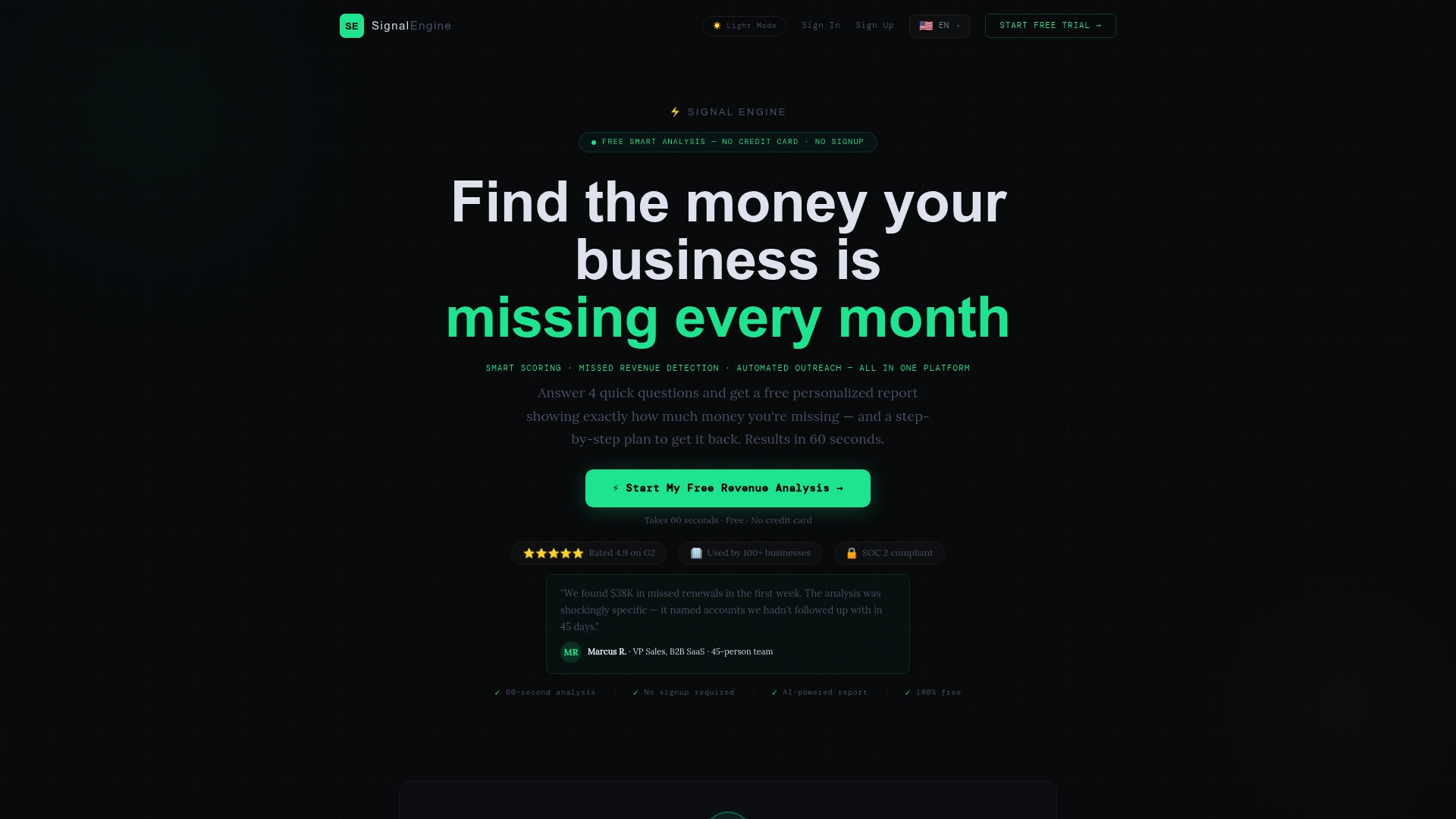
The platform's pipeline intelligence tools track deal velocity, flag stalled opportunities, and surface churn signals before accounts go cold. AI-powered lead scoring ranks your reopen candidates by buy-readiness so your reps work the highest-value targets first. Automated email and SMS sequences handle follow-up cadences without manual intervention.
For SaaS teams and agencies running the playbook described here, Signalengine integrates CRM hygiene monitoring, SLA tracking, and anomaly detection in one dashboard. You can watch a live demo to see exactly how the recovery workflow operates. Setup takes five minutes. No prolonged onboarding, no consultants required. Signalengine users report an average of $38K in recovery potential identified in the first month.
FAQ
What is a revenue recovery playbook checklist?
A revenue recovery playbook checklist is a structured audit and action framework that helps businesses identify, prioritize, and recover lost revenue across pipeline, billing, and collections categories. It combines scoring methods, ownership assignment, and operating cadence into a repeatable system.
How long does a revenue recovery playbook take to show results?
A 90-day structured playbook typically shows early wins in the first 30 days from CRM cleanup and closed-lost outreach, with sustained gains visible by day 60 as SLA enforcement and automation take hold.
How do you prioritize revenue recovery efforts?
Score each identified leak on impact, urgency, and effort using a framework like the 1 to 125 scoring model. Focus your first sprint on high-impact, high-urgency, low-effort items and schedule complex fixes in later phases.
What causes revenue recovery efforts to fail?
Most recovery efforts fail because they lack a fixed operating cadence and named ownership per category. A one-time cleanup without a prevention feedback loop allows the same leaks to reappear within one to two quarters.
How does AI help with revenue recovery?
AI tools detect deal velocity anomalies, churn risk signals, and billing inconsistencies at a scale no manual review can match. The critical prerequisite: your CRM data and lifecycle definitions must be clean before automation is applied.
Ready to Stop the Revenue Leak?
Signal Engine gives small and local businesses 31 AI-powered tools to score leads by buying intent, predict churn before it happens, auto-generate email and SMS campaigns, and recover missed calls automatically — all in one dashboard starting at $49/month.
Start your free 7-day trial — no credit card required. Setup takes 5 minutes.