

Competitive intelligence for SMBs means one thing: the ethical and repeatable collection of public information about competitors so you can decide on pricing, positioning, or product changes with facts instead of guesses. The output that matters isn't a research deck. It's a short, decision-ready memo. Start by picking one business decision you need to make this month, then build your intelligence gathering around answering it.
TL;DR:
- Focusing on 3 to 6 priority competitors and 2 to 4 signal lanes ensures actionable insights without overwhelming the process.
- Using simple sources like Google Alerts and manual review checks can be sufficient, with AI tools speeding up signal detection and summarization.
- Building a one-page decision memo with specific observations, evidence, and actions increases the likelihood of follow-through and measurable results.
- Competitive intelligence is ethical and legal when restricted to publicly available information and avoiding direct coordination with competitors.
- Conducting a light monthly review and a deeper quarterly assessment maintains awareness of market shifts without overextending resources.
Table of Contents
- Why Competitive Intelligence for SMBs Actually Moves the Needle
- How Do You Build a Repeatable SMB CI Workflow?
- Which Tools Actually Fit an SMB Budget?
- How Do You Turn Findings Into a Real Decision?
- What Are the Legal and Ethical Limits on SMB Competitive Intelligence?
- How Signal Engine Shortens the Setup for Service SMBs
- What Does Successful SMB Competitive Intelligence Look Like in Practice?
- How Do You Fold Competitive Intelligence Into Existing Business Tools?
- Publisher Perspective: Speed Over Perfection
- Ready to Stop the Revenue Leak?
- Primary Sources and Further Reading
- Sources
- FAQ
Why Competitive Intelligence for SMBs Actually Moves the Needle
Most small business owners think they already know their competition. Then they run a real comparison and find a competitor quietly cut prices six weeks ago, or launched a feature that's now showing up in their own lost-deal notes. Competitive intelligence for SMBs closes that gap. It sharpens pricing decisions, tightens your sales pitch, tells you which product features to build next, and can flag churn risk before a customer walks.
The trick is watching the right signals instead of everything. A step-by-step competitor analysis guide from Salesforce identifies the categories that consistently drive business decisions:
- Pricing and packaging — informs whether you test a price change or bundle a service differently.
- Messaging and positioning — tells you if your value proposition still stands out.
- Reviews and customer complaints — surfaces gaps you can turn into a sales talking point.
- Search visibility — shows where you're losing organic traffic to a rival.
- Hiring and funding signals — often predict expansion into your market before it happens.
- Ads and partnerships — reveal what's working well enough for a competitor to keep spending on it.
Each signal maps to a decision. A competitor dropping prices doesn't automatically mean you should too, but it does mean you run a controlled price test instead of reacting blind.
How Do You Build a Repeatable SMB CI Workflow?
You don't need a research team. You need a process that fits into a Tuesday afternoon. Here's the compact version that works for a five-person landscaping company or a twelve-person dental practice alike.
- Define one business decision. Are you setting Q3 pricing? Deciding whether to add a service line? Name it specifically.
- Scope your competitors. List direct competitors, indirect alternatives, and the "status quo" (customers doing nothing, or DIY).
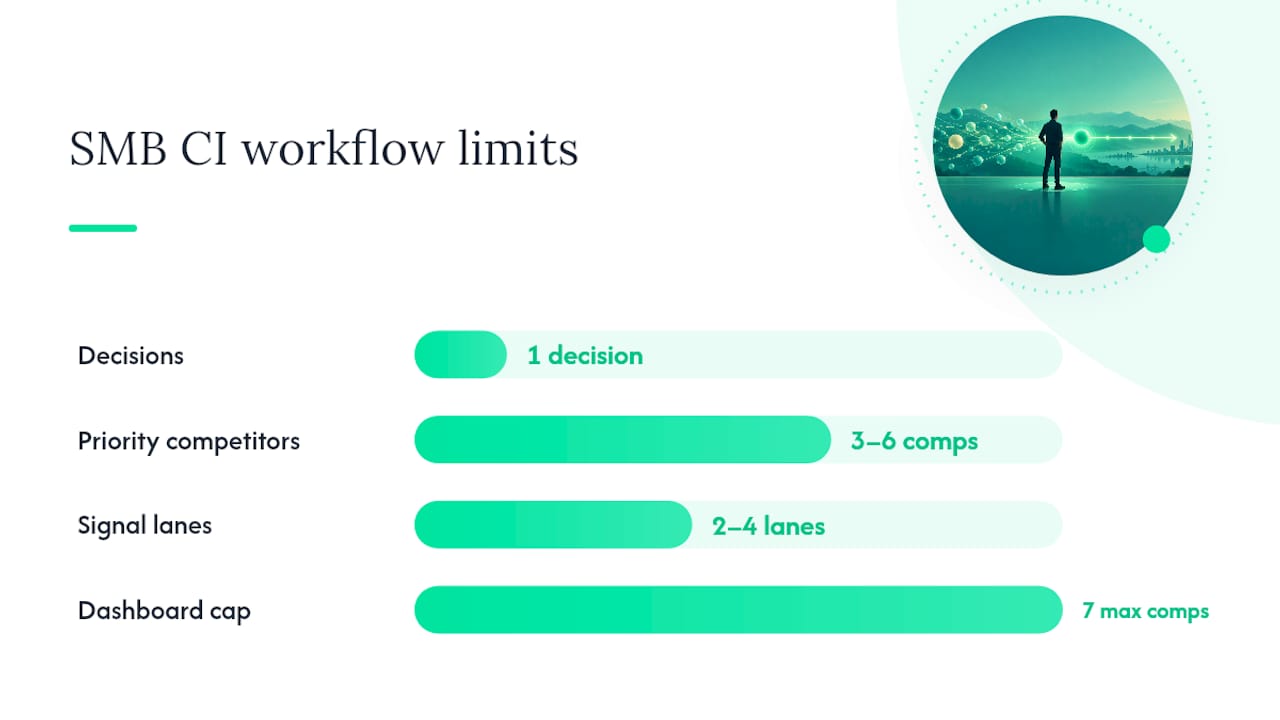
- Pick 3 to 6 priority competitors and 2 to 4 signal lanes. More than that creates noise nobody reads.
- Collect evidence with a source trail. Record the URL, the capture date, and a screenshot for every observation. Without this, findings are unverifiable opinions.
- Enter findings into a simple comparison grid. One row per competitor, one column per signal lane.
- Score each finding by impact and effort, then assign an owner and a deadline. A finding with no owner never turns into action.
- Measure the outcome against whatever metric the decision was supposed to move.
Run a light monthly review to catch pricing or messaging shifts, and a deeper quarterly review that reassesses your whole competitor set. Local businesses should fold in map visibility, Google Business Profile accuracy, and booking friction during the local competitor analysis pass, since those often move revenue faster than a repositioning project.
Pro Tip: Cap your first dashboard at one decision and seven competitors max. Teams that try to monitor everything end up with a spreadsheet nobody opens after week two.
Which Tools Actually Fit an SMB Budget?
You don't need an enterprise CI platform to run this well. You need tools matched to specific jobs, and a clear line for when free stops being worth the time it costs.
- Signal monitoring: free tools like Google Alerts catch mentions and news; paid tools consolidate multiple sources into one feed and save hours of manual searching.
- Review analytics: dedicated review-tracking tools flag sentiment shifts across Google, Yelp, and industry-specific platforms faster than manual checks.
- Ads and creative tracking: ad-library tools let you see what a competitor is actively spending on, which tells you what's converting for them.
- SEO and traffic visibility: a competitor SEO analysis guide walks through spotting keyword and content gaps worth targeting.
- Pricing teardown: manually checking public pricing pages quarterly is often enough for most service businesses; only automate this if pricing changes weekly.
AI genuinely earns its place here for triage and summarization. It can compress a week of manual browsing into a few minutes by flagging pricing shifts, messaging changes, and hiring spikes automatically. But every AI-generated summary needs a source URL attached and a human check before it enters your decision memo. Treat AI output as a lead, not a fact. Our own breakdown of lightweight competitor monitoring covers how to set this up without burning a full day a week on manual checks.
How Do You Turn Findings Into a Real Decision?
Intelligence that sits in a spreadsheet doesn't change anything. The deliverable that actually gets used is a one-page decision memo, and it should always contain the same fields:
- Observed change — what specifically shifted (a price, a headline, a new feature).
- Evidence — the source URL and capture date.
- Why it matters — the business impact in one sentence.
- Recommended response — the specific action, not a general direction.
- Owner — one named person, not a department.
- Deadline — a real date.
- Measurement — the metric and timeframe you'll check against.
A decision-memo approach favored by small-team CI practitioners keeps outputs short specifically so busy owners actually read and act on them, rather than filing a twelve-page report.
Concrete responses that come out of a good memo: a controlled price test on one service tier, a landing-page rewrite that addresses a gap a competitor's reviews keep mentioning, a structured review-response program, or an ad creative A/B test copying a format a rival is clearly running at scale. Close the loop by checking the metric you named in the memo, on the timeframe you set. If you said "measure conversion rate over 30 days," measure it on day 30, not day 45 when you finally remember.
What Are the Legal and Ethical Limits on SMB Competitive Intelligence?
Competitive intelligence stays legal and useful when it sticks to publicly available information gathered honestly. That means no impersonating a customer to access gated pricing, no bypassing login walls, and no scraping data a competitor has explicitly restricted.
The riskier gray zone is competitor coordination. Directly discussing current or future pricing with a competitor, even informally at a trade event, can raise real antitrust concerns, so keep intelligence gathering strictly one-directional and public-source only.
Operational mistakes cause more failed CI programs than legal ones do. Common pitfalls include:
- Tracking too many competitors with no clear decision attached.
- Skipping the source trail, so nobody can verify a finding six months later.
- Assigning no owner, which means findings never become actions.
Pro Tip: If a finding can't name a URL and a capture date, it's a rumor, not evidence. Don't let it into your decision memo.
How Signal Engine Shortens the Setup for Service SMBs
Most of the workflow above takes real hours the first time you build it: setting up monitoring, scoring findings, drafting next steps. Our platform automates the parts that eat the most time.
- Automated competitor gap analysis flags real differences in competitor offerings without a manual comparison grid.
- Buy-readiness scoring tells you which leads are worth a pricing conversation right now.
- Churn prediction catches at-risk accounts before a competitor's pricing move pulls them away.
- Next-action drafting turns a detected signal into a draft response waiting for one-click approval.
An onboarding AI builds an industry-specific setup for service businesses, HVAC, plumbing, dental, landscaping, and more, out of the box, which cuts the manual configuration that usually stalls a CI program before it starts. See the full revenue intelligence overview for small business for how the pieces fit together.
What Does Successful SMB Competitive Intelligence Look Like in Practice?
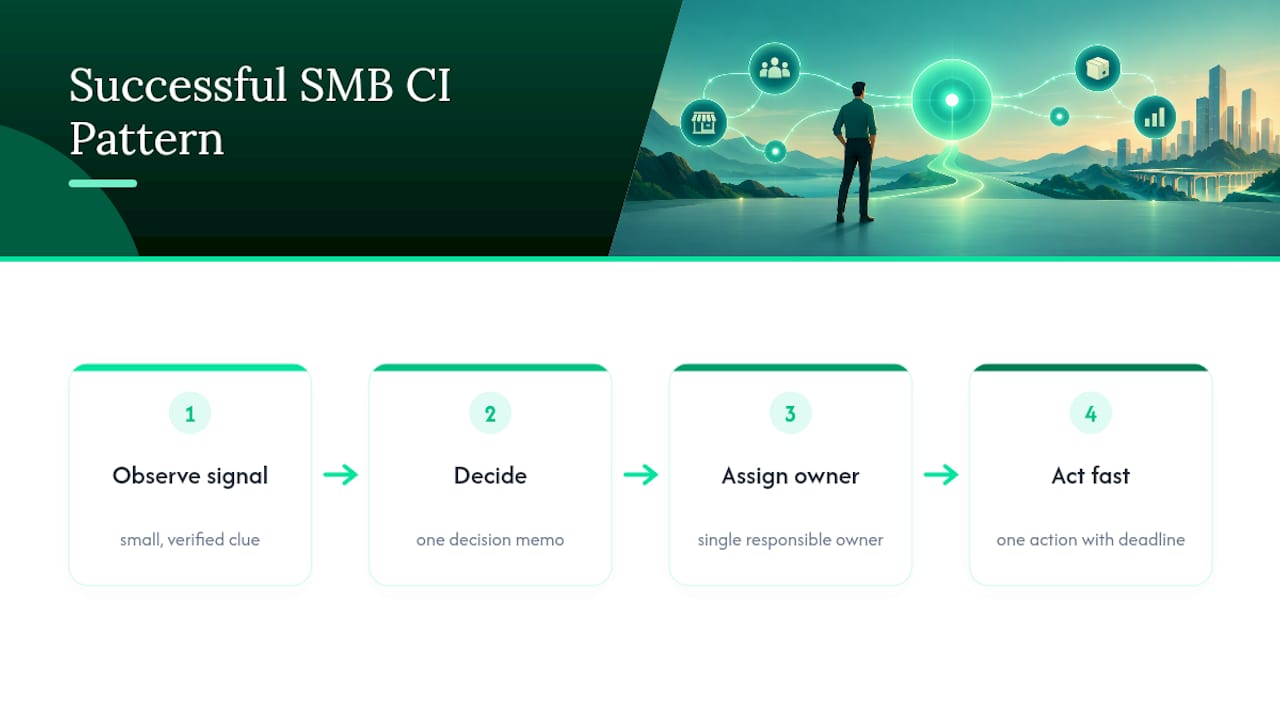
The businesses that get real value from competitive intelligence share a pattern: they act on small, verified signals quickly instead of waiting for a perfect annual review.
A regional HVAC contractor noticing a competitor's Google reviews turning negative around response times has an immediate opening. The fix is not a marketing overhaul. It's tightening their own callback speed and making that a headline in their next ad, a direct response to a documented weakness rather than a guess.
A dental practice tracking a competitor's new patient-financing page can respond within a week by adding a comparable option to their own booking flow, closing a gap before it costs them a single consultation.
A landscaping company that spots a rival's seasonal price increase through a public rate sheet has a clean opening to test a modest increase of its own, backed by evidence instead of nerves.
None of these required a research department. Each started with one observed signal, one decision memo, one owner, and one deadline. The businesses that struggle with CI usually aren't lacking data. They're lacking the discipline to turn one finding into one action before moving to the next. Scale comes later, once the habit of noticing, recording, and acting is already working at a small size.
How Do You Fold Competitive Intelligence Into Existing Business Tools?
Competitive intelligence works best when it lives next to the tools you already check daily, not in a separate system nobody opens.
If your CRM already tracks deal stages, add a field for "competitor mentioned" so your sales notes automatically build a live log of who you're actually losing deals to. If you run a shared calendar or task tool, schedule the monthly light review as a recurring task with a named owner, the same way you'd schedule payroll. Store your comparison grid and decision memos in whatever document tool your team already uses for other records. A new platform nobody logs into defeats the purpose.
For sales enablement, feed CI findings straight into the materials your team uses on calls. A gap you found in a competitor's onboarding process becomes a line in your sales deck the same week, not the following quarter. Our piece on deal intelligence for SMB sales teams covers how signal scoring can plug directly into the pipeline stages you're already managing.
The goal is friction-free repetition. If checking competitor signals requires opening a fourth new tool, most owners will do it twice and quit. If it's a five-minute addition to a process you already run weekly, it survives past month one.
Publisher Perspective: Speed Over Perfection
Most SMBs overthink competitive intelligence and underthink follow-through. Skip the temptation to rebuild your entire positioning after one competitor scare. Fix the operational stuff first, booking speed, review responses, listing accuracy, since those changes are fast, testable, and usually worth more than a rebrand.
Run a first sprint of about 90 minutes: pick one decision, pull evidence on five competitors, write one memo. Then build a 30/60/90 plan from what you find. Keep ownership light. One person, one recurring calendar block, is worth more than a committee that meets quarterly and forgets by Friday.
— Bernard
Ready to Stop the Revenue Leak?
Signal Engine gives small and local businesses 31 AI-powered tools to score leads by buying intent, predict churn before it happens, auto-generate email and SMS campaigns, and recover missed calls automatically, all in one dashboard starting at $49/month.
Running the workflow above by hand works, but it eats hours you probably don't have between jobs, patients, or job sites. Signal Engine's Growth plan runs at $149 per month and automates the gap analysis, scoring, and next-action drafting this article just walked through, so your team spends time acting on findings instead of hunting for them. If you want to see the buy-readiness scoring and churn prediction in action first, book a live demo before committing to anything.
Start your free 7-day trial, no credit card required. Setup takes 5 minutes.
Primary Sources and Further Reading
- Salesforce's competitor analysis guide covers the core signal categories worth tracking.
- BrightLocal's local competitor analysis guide details map visibility and review metrics for local businesses.
- The SBA's market research and competitive analysis guidance offers federal-level guidance on the research process.
- FastStrat's competitor analysis guide explains the decision-memo approach for small teams.
- TrajectoryAI's practical AI guide walks through using AI responsibly for monitoring and verification.
Sources
- Competitor Analysis for Small Business: Step-by-Step 2026 (Salesforce)
- Local competitor analysis (BrightLocal)
- Legacy
- AI for Competitive Intelligence: A Practical Guide for SMBs - TrajectoryAI
- Competitor analysis for small business (FastStrat)
FAQ
What Is the Difference Between SMB, Mid-Market, and Enterprise?
There's no single universal definition. The SBA uses industry-specific NAICS size standards for government eligibility, while common B2B practice often treats "small" as under 100 employees and "midsize" as 100 to 999. Document which definition your business uses before benchmarking competitors against it.
What Is Competitive Intelligence?
Competitive intelligence is the ethical, repeatable collection of public information about competitors and market conditions used to inform decisions on pricing, positioning, product priorities, and sales strategy. For SMBs, the goal is a short decision memo, not a lengthy research report, according to Salesforce's competitor analysis framework.
Is Competitive Intelligence Legal?
Yes, as long as you gather only lawfully accessible public information and don't impersonate customers or bypass access controls to get it. Avoid any direct coordination with competitors on pricing or output, since that can raise antitrust concerns even in informal settings.
What Does Signal Engine Cost for Competitive Intelligence Features?
Signal Engine offers a Free plan alongside paid tiers, with the Growth plan at $149 per month and the Scale plan at $297 per month. Full plan details and current pricing are available on the pricing page.
How Often Should an SMB Run Competitive Intelligence Reviews?
Run a light monthly review to catch pricing, messaging, or review changes, then a deeper quarterly review that reassesses your full competitor set and signal lanes. This cadence, recommended in BrightLocal's local competitor analysis guidance, keeps the workload manageable without letting major shifts go unnoticed.