

Intent data is the record of buying signals a prospect leaves behind before they ever talk to sales, and the single most useful move a small business can make is to stop treating every visitor the same. Start by capturing your own first-party signals, layer in one affordable third-party monitor, run those signals through a simple scoring model like the Fit, Engagement, Intent, and Reach framework, and attach a specific play to whatever score comes out. A platform like Signal Engine can automate that last step, but the framework works even in a spreadsheet.
TL;DR:
- Small businesses should prioritize first-party intent signals, like website visits and demo requests, as they offer the highest confidence and timeliness.
- Scoring accounts based on buying group behavior, rather than individual contacts, improves pipeline efficiency and reduces wasted outreach efforts.
- Implementing a simple four-layer intent model and routing signals into existing CRM fields enables rapid setup and more accurate prioritization.
- Using publicly available, low-cost monitoring tools for custom signals and adding a single third-party provider can be effective on a small budget.
- Automated routing and play-specific actions are essential for translating intent signals into timely, relevant outreach that minimizes revenue leakage.
Table of Contents
- What Is Intent Data and What Are Its Main Types?
- Why Does Intent Data Matter for Small Businesses?
- How Do You Collect Intent Signals on a Small Budget?
- What Scoring Model Works for a Small Sales Team?
- What Should You Do When a Signal Fires?
- What Tools Do You Actually Need?
- What Does a 30/60/90-Day Rollout Look Like?
- What Are the Privacy and Compliance Rules Around Intent Data?
- How Have Small Businesses Actually Used Intent Data?
- How Do You Connect Intent Data to Your Existing CRM?
- Author Perspective
- Why Signal Engine Fits a Small Team's Intent Stack
- Ready to Stop the Revenue Leak.?
- Sources
- FAQ
What Is Intent Data and What Are Its Main Types?
Intent data tells you who is actively shopping right now. Fit data tells you who could theoretically buy from you someday. Confusing the two is the most expensive mistake small teams make, because a company that matches your ideal customer profile perfectly but has shown zero buying behavior is not a lead. It is a name on a list.
There are three sources of intent data, plus a category most SMBs overlook.
- First-party intent comes from your own website and product: pricing page visits, demo requests, repeated logins, or a free trial that suddenly goes quiet. This is the highest-confidence signal available, because nobody browses a pricing page by accident.
- Second-party intent is shared or purchased from a partner with direct customer relationships, such as a review site sharing which companies read comparison content on its platform.
- Third-party intent aggregates behavior across the web, typically topic research surges tracked by data cooperatives, showing that a company is researching a category, not necessarily your product.
- Custom monitors are signals you build yourself: a job posting that flags hiring for a role your product supports, a funding announcement, or a new review left on Google or Yelp.
Freshness separates useful intent from noise. A pricing page visit is hot for maybe 48 to 72 hours. A funding announcement stays relevant for a few weeks. A third-party topic surge, by contrast, can lose most of its predictive power within two weeks, according to Smarte's research on intent scoring models. Score signals with an expiration date in mind, not as permanent facts about an account.
Why Does Intent Data Matter for Small Businesses?
The real payoff isn't more leads. It's fewer wasted calls. A small sales team that cold-calls a list of 200 "fit" accounts might book five meetings. The same team working 40 accounts that just visited a pricing page or requested a demo will usually book more meetings with less effort, because the outreach lands the moment someone is actually paying attention.
The most common misconception is scoring individual contacts instead of the whole buying group. A single marketing manager clicking your case study means little. Three people from the same company visiting your site in one week, including someone from finance, is a strong signal, and scoring the account rather than the contact predicts closed deals more reliably.
Two numbers matter more than raw signal count:
- Signal-to-action rate: the share of signals that actually triggered a defined play within its SLA window, which industry guidance treats as the real health metric for any intent program, not volume.
- Conversion lift on scored accounts compared to your cold outbound baseline, measured monthly so you can tell if the model is actually predictive or just busy.
If neither number improves after 60 to 90 days, the scoring weights need adjusting, not more data sources.
How Do You Collect Intent Signals on a Small Budget?
You don't need a data team to start. You need a checklist and about a week.
- Instrument your own site first. Tag your pricing page, demo request form, and any comparison or "vs." pages with event tracking. This is free with most website analytics tools and it's the highest-confidence signal you'll ever get.
- Track product usage if you sell software. Logins, feature adoption, and sudden drop-offs are first-party gold. A free trial that stops logging in on day four is a churn signal disguised as a non-event.
- Add one low-cost third-party feed. Topic surge alerts or review-site research alerts (a prospect reading comparison content) widen your net without requiring an enterprise contract. Use these for prioritization, not same-day outreach, since third-party intent runs cooler than first-party signals.
- Build one custom monitor. Job board scraping for a role tied to your product, or a saved search on a funding database, catches signals no vendor sells. A landscaping software company might monitor job postings for "operations manager" at companies over 20 employees, a proxy for growth pain.
- Route everything into one place. A shared CRM field or spreadsheet tab beats five disconnected alert inboxes. If signals live in Slack, email, and a spreadsheet simultaneously, nobody acts on any of them consistently.
The goal in week one isn't completeness. It's one working pipeline you can improve, not five half-built ones.
What Scoring Model Works for a Small Sales Team?
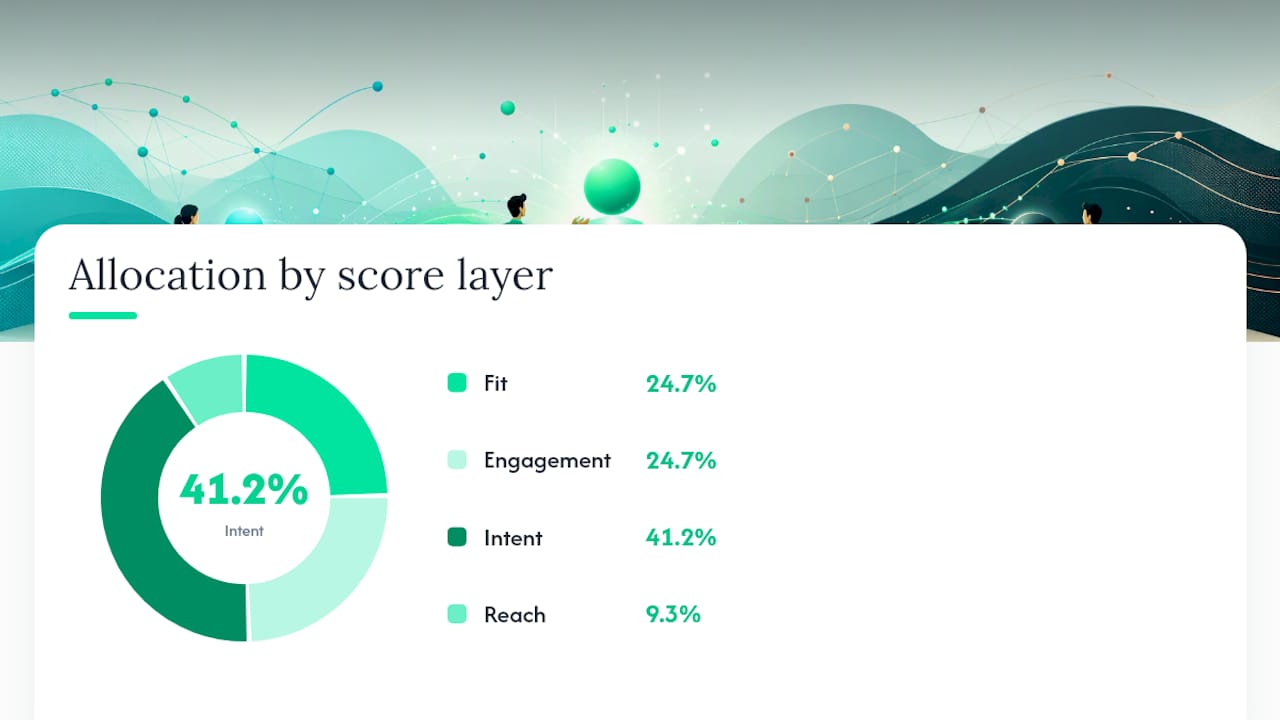
The four-layer model, Fit, Engagement, Intent, and Reach, gives you a repeatable score without a statistician. Here's a workable starting allocation.
| Layer | What it measures | Example points | Decay rule |
|---|---|---|---|
| Fit | Matches your ICP (industry, size, budget) | 0 to 24 | Rarely decays |
| Engagement | Email opens, content downloads, webinar attendance | 0 to 24 | Decays over 30 days |
| Intent | Pricing visits, demo requests, third-party surges | 0 to 40 | Decays within two weeks |
| Reach | Verified contact info for a real decision maker | 0 to 9 | Rechecked monthly |
Reach is the layer most SMBs skip, and it's the one that keeps you from routing a hot account to a rep who can't actually reach anyone there. Adding a Reach layer prevents wasted effort on accounts with no verified contact.
Set three tiers based on total score:
- 75 to 100 points: same-day outreach, owned by your top closer.
- 40 to 74 points: enrichment queue, add contacts and context before a rep touches it.
- Under 40 points: nurture sequence, automated email or SMS until the score climbs.
Pro Tip: Score the account, not the person who filled out the form. If three people from one company show intent signals in the same week, that account jumps tiers even if no single contact crosses the threshold alone.
Review your point weights against closed-won data every month. If accounts that closed had lower Intent scores than accounts that went cold, your decay window is probably too aggressive or too lenient.
What Should You Do When a Signal Fires?
A score without an attached play is just a number. Every signal type needs an owner, a deadline, and a defined next step.
- Same-day outreach for first-party spikes. Owner: your senior rep. SLA: within four business hours. A pricing-page visit from a Fit-qualified account gets a personalized email referencing the specific plan they viewed, not a template.
- ABM retargeting for engaged-but-quiet accounts. Owner: marketing. SLA: campaign live within 48 hours. Run a short LinkedIn or display sequence aimed at the buying group, not just the one contact who engaged.
- Automated email and SMS sequences for nurture-tier accounts. Owner: marketing automation, no human required. SLA: sequence starts within 24 hours of scoring. Keep it useful, not salesy, until the score improves.
- Competitive-displacement outreach when a signal suggests a rival is slipping. Owner: sales. SLA: 24 hours. A support-related complaint pattern or a contract renewal date approaching is the trigger.
- Churn or expansion routing for existing customers. Owner: customer success. SLA: same day for churn risk, one week for expansion signals like a usage spike.
Track signal-to-action rate across all five plays weekly. A play that consistently misses its SLA is a process problem, not a data problem, and fixing the handoff usually beats buying another data source.
What Tools Do You Actually Need?
You need four things, not forty. Visitor identification or enrichment, a CRM property to hold the score, workflow automation to trigger the play, and an alerting layer so the right person actually sees the signal in time.
Before you buy anything, run it through this checklist:
- Setup time under two weeks with your current staff.
- Native CRM sync so scores don't live in a separate tab nobody checks.
- Person-level identification rate, not just company-level guesses.
- Pricing that scales with your seat count, not a flat enterprise contract.
- Built-in alerting and routing so a hot signal doesn't sit in an inbox until Monday.
A purpose-built SMB revenue intelligence platform can cover all four categories in one dashboard instead of stitching together three separate tools, which matters when your team is three people, not thirty. Signal Engine's benchmarking research on revenue leakage is worth a look if you want a sense of how much pipeline typically slips through the cracks when scoring and routing aren't automated.
What Does a 30/60/90-Day Rollout Look Like?
- Days 1 to 30: Instrument first-party tracking on pricing, demo, and comparison pages. Run one manual play, same-day outreach on Fit-qualified visitors, and log the outcome by hand.
- Days 31 to 60: Add one third-party or custom monitor. Build the four-layer scoring model in your CRM or a shared spreadsheet, and assign owners to each tier.
- Days 61 to 90: Automate routing so scored accounts move without a manual handoff, then correlate scores against closed-won deals to recalibrate weights.
You don't need a dedicated analyst for this. One person spending a few hours a week, plus a tool that automates the scoring without a data science background, is enough to run all three phases. Report signal-to-action rate and conversion lift at each checkpoint, nothing more.
What Are the Privacy and Compliance Rules Around Intent Data?
Intent data sits closer to regulated territory than most small business owners assume. First-party tracking on your own site is generally safe ground if you disclose it in a privacy policy and honor opt-outs, but third-party and aggregated intent data can involve personal information collected without direct consent from the individual.
Check three things before buying or building a monitor. First, does the provider disclose how it sources its data, and can it name a legal basis for collecting it? Vague answers here are a red flag. Second, does your outreach comply with email and SMS consent rules in your state or country, since scoring someone as "hot" doesn't override consent requirements for how you contact them. Third, are you storing more personal data than the play actually requires? A job title and company name is usually enough to route a play; you rarely need a home address or personal social profiles to run a same-day outreach sequence.
Ethically, the line worth holding is simple: use intent signals to be more relevant, not more invasive. A prospect who visited your pricing page expects a helpful follow-up. That same prospect finding out you tracked their personal LinkedIn activity feels like surveillance, even where it's technically legal. Build your monitors around business behavior, company-level signals, job changes, funding news, not personal browsing habits, and you'll stay on the right side of both the law and the relationship.
How Have Small Businesses Actually Used Intent Data?
The pattern that shows up across smaller companies isn't sophistication. It's speed and focus. A three-person sales team at a regional logistics provider that starts tracking pricing-page visits and pairs it with same-day outreach typically sees meeting rates climb within weeks, simply because reps stop calling cold lists and start calling people who already showed interest.

A dental practice group expanding into a second location used job posting monitors as a proxy for growth. Watching competitor practices post for hygienists and front-desk staff gave the sales team at their supply vendor a signal for who was scaling up and likely to need new equipment contracts, a custom monitor built with no data science background at all.
A landscaping company selling B2B service contracts found that its highest-converting signal wasn't a pricing visit. It was a prospect requesting a quote twice within 30 days without booking, a first-party pattern only visible once they started tracking form fills as a scored event rather than a one-time submission. That single insight reshaped their entire nurture sequence around the second-request trigger instead of the first.
None of these required an enterprise data stack. They required someone willing to track one behavior consistently and build a play around it.
How Do You Connect Intent Data to Your Existing CRM?
Most small businesses already run a CRM, whether that's a standalone platform or a bundled tool inside their marketing software, and the mistake is treating intent data as a separate system instead of a field inside the one you already use. Every signal should ultimately land as a property on the account record: a score, a timestamp, and the play it triggered.
Start with what your CRM already supports natively. Most modern platforms allow custom fields and can accept webhook data from a website tracker or a workflow automation tool, which means your pricing-page visits and demo requests can populate a "last intent signal" field without custom development. From there, workflow rules inside the CRM, or a connected automation layer, can move an account between tiers automatically and notify the assigned rep.
The friction usually shows up when third-party or custom monitor data lives in a separate spreadsheet that never syncs back. If your funding-alert monitor or job-posting scraper feeds a Google Sheet that nobody checks against the CRM, the signal is functionally dead. A platform built to sit on top of your existing stack, rather than replace it, solves this by pushing enriched, scored accounts directly into the CRM fields your reps already look at every day, which is part of why prospect intent workflows are built around syncing rather than replacing what small teams already use.
Author Perspective
The pitfall I see most often isn't a lack of data. It's teams buying a third-party feed before they've instrumented their own website. First-party signals are free, higher confidence, and sitting right there in your analytics. Get that pipeline working and scored before spending a dollar on anything else.
— Bernard
Why Signal Engine Fits a Small Team's Intent Stack
Signal Engine is the alternative to stitching together three separate tools for scoring, enrichment, and outreach automation, and the practical payoff is that a three-person team can run the full Fit, Engagement, Intent, and Reach model without hiring a data analyst. Instead of exporting CRM data into a spreadsheet to calculate scores by hand, Signal Engine's 31 AI-powered tools score accounts by buying intent automatically, flag churn risk before it costs you a renewal, and generate the email and SMS sequences that turn a hot signal into same-day outreach without a manual handoff.
That last part matters more than it sounds. A scoring model is only as good as the play attached to it, and most SMBs lose signal-to-action rate in the gap between "the account scored high" and "someone actually called them." Automated routing closes that gap. If you want to see how the scoring and alerting dashboard works before committing, the free plan is a reasonable place to start testing the model against your own accounts, and for teams that need help wiring up the workflow end to end, a revenue operations partner can handle the setup work alongside it.
Ready to Stop the Revenue Leak.?
Signal Engine gives small and local businesses 31 AI-powered tools to score leads by buying intent, predict churn before it happens, auto-generate email and SMS campaigns, and and recover missed calls automatically — all in one dashboard starting at $49/month.
Start your free 7-day trial — no credit card required and Setup takes 5 minutes.
Sources
- How to Build an Intent Data Scoring Model for Outbound Prioritization
- Intent Data Analysis: A Scoring Framework That Works Without a Data Team
- The Complete Guide to Intent Data (2026) | Clay
- How to Use Intent Data: 5 Plays to Turn Signals Into Pipeline
- Intent Signal Scoring: Complete B2B Guide 2026
FAQ
What Is Intent Data?
Intent data is behavioral evidence that a company or person is actively researching or evaluating a purchase, such as pricing page visits, demo requests, or third-party topic research surges.
How Is Intent Data Collected?
It's collected through first-party website and product tracking, second-party data shared by partners, third-party aggregation across the web, and custom monitors like job postings or funding alerts you build yourself.
How Do You Collect B2B Intent Data on a Small Budget?
Start by instrumenting your own pricing and demo pages for free, then add one low-cost third-party feed or a custom monitor like a job-board scraper before considering a paid enterprise data source.
Who Offers the Best Intent Data for Small Businesses?
No single provider fits every business, but SMBs generally get better results from a platform built around their scale. Signal Engine, for instance, packages scoring, enrichment, and automated outreach into one dashboard designed for lean teams rather than enterprise data science staff.
Is It Legal to Use Intent Data for Marketing?
First-party tracking on your own site is generally fine when disclosed in a privacy policy, but third-party data use and outreach must still comply with consent rules for email and SMS in your state or country.