

Prospect intent data works by tracking digital behavior, buyers researching your category, comparing vendors, visiting pricing pages, then converting that behavior into an account-level score your team acts on before a competitor does. It identifies who is actively shopping right now, not just who fits your ideal customer profile on paper. That distinction is the entire point.
Here is how the mechanics break down:
- Signal sources: website visits, content downloads, review-site comparisons, search behavior, and technographic changes all generate raw signals.
- Mapping: those signals get tied to a specific company (and sometimes a specific person) through identity resolution.
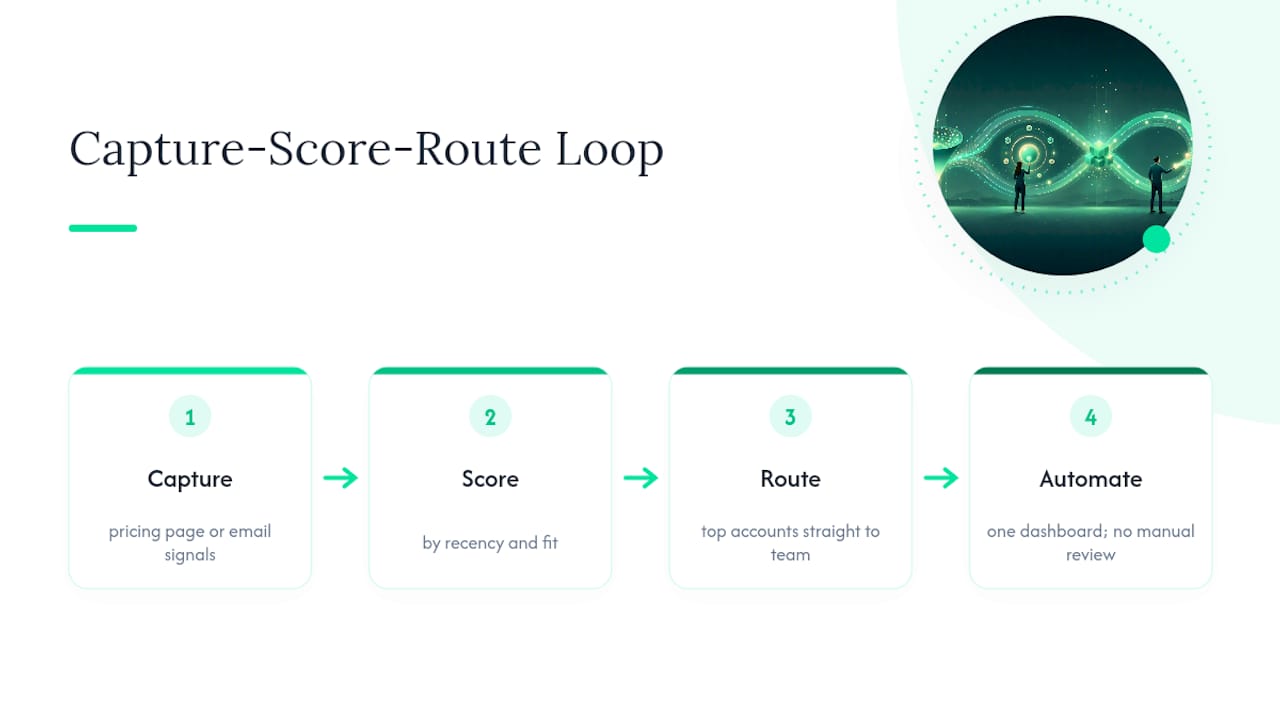
- Scoring: raw activity gets weighted by recency, intensity, and fit, then rolled into a single in-market score.
- Action: the score triggers a workflow, an SDR alert, an ad campaign, a personalized landing page, or an automated nurture sequence.
A revenue team running this well sees a shorter list of daily priorities instead of a flat spreadsheet of leads, faster booked meetings because reps reach out while the research is still happening, and a higher meeting-to-opportunity rate because the timing and message actually match where the buyer is.
Key Takeaways
Prospect intent data works by converting raw digital behavior into a weighted, account-level score that tells revenue teams exactly who to contact and when.
| Point | Details |
|---|---|
| Capture first-party signals first | Website visits and pricing-page activity are the highest-confidence, fastest-decaying signal, act within hours. |
| Weight signals by type | Score first-party activity 2 to 3 times heavier than broad third-party topic surges. |
| Automate routing with SLAs | Route hot signals to reps same-day; batch cooler third-party surges weekly. |
| Measure with the right KPIs | Track signal-to-meeting ratio and time-to-meeting, not just raw engagement volume. |
| Signal Engine automates the full loop | Aggregates intent scores and routes tasks to AEs and BDRs automatically, starting at $49/month for SMBs. |
Table of Contents
- Understanding Intent Data: The Three Types Sales Teams Rely On
- How Intent Signals Get Collected, Resolved, and Scored
- What Are the Best Sales and Marketing Playbooks for Intent Data?
- How to Leverage Intent Data Across Your Tech Stack
- Data Quality, Coverage Gaps, and Privacy Limits You Should Know
- Best Practices and Metrics for Measuring an Intent Program
- How Signal Engine Puts Intent Signals to Work for SMBs
- Where Intent Data Actually Moves the Needle
- Turn Intent Signals Into Booked Meetings, Without the Headcount
- Ready to Stop the Revenue Leak?
- Sources
- FAQ
Understanding Intent Data: The Three Types Sales Teams Rely On
Not all intent signals carry the same weight, and treating them as interchangeable is the fastest way to burn out your sales team chasing noise. There are three categories, and each one answers a different question about the buyer.
First-party intent comes directly from your own properties: website visits, pricing page views, demo requests, product usage, email engagement. This is the highest-confidence signal available because you know exactly which company and often which person generated it. According to Clay's guide to intent data, first-party signals are rarer than third-party ones but far hotter, and they decay fast. A pricing-page visit from a named account is worth acting on within hours, not days.
Second-party or partner intent sits in the middle. This is data shared through a partner ecosystem, review platform, or co-marketing arrangement, think G2 or Capterra profile views, comparison-page visits, or category research on a partner's site. It carries a named account most of the time, but the context is thinner than something happening on your own domain.
Third-party intent is aggregated from a much broader network: publisher sites, ad exchanges, content syndication, and cooperative data pools that track topic research across thousands of domains. It is the widest net but the coolest signal. A company showing a "surge" on a third-party topic might be six weeks from a purchase decision, or just doing competitive research for an unrelated project.
| Intent Type | Fidelity | Coverage | Freshness | Best Use Case |
|---|---|---|---|---|
| First-party | Highest (named account, often named contact) | Narrow (only your own traffic) | Hours to days | Immediate SDR outreach, sales alerts |
| Second/partner | High (usually named account) | Moderate | Days | Competitive positioning, review-driven follow-up |
| Third-party | Moderate (account-level, rarely person-level) | Broadest | Weeks | Top-of-funnel ad targeting, ABM list building |
Pro Tip: Weight first-party signals significantly more than third-party surges when building your outreach priority list, typically two to three times heavier. First-party tells you someone is looking at you specifically; third-party only tells you the category is warm. This weighting guidance tracks with what Clay's research recommends for teams building their first scoring model.
The mistake most SMBs make is over-indexing on third-party data because it is easier to buy in bulk. Blend it with your own site tracking and you get a hit rate your reps will actually trust.
How Intent Signals Get Collected, Resolved, and Scored
Turning a raw web event into something a rep can act on is a five-step pipeline, and skipping any step is why so many "intent data" tools end up ignored by sales teams within a month.
- Collect raw events from tracked properties: page visits, form fills, content engagement, review-site activity, technographic changes like a new job posting or funding announcement.
- Identify and resolve the anonymous traffic to a specific company, and where possible a specific contact, using IP-to-company mapping, cookies, device fingerprinting, or deterministic identifiers like a logged-in email.
- Enrich the resolved account with firmographic and technographic context: company size, industry, existing tech stack, current vendor relationships.
- Normalize the signal against a baseline. A single pricing-page visit means something different for a company that visits weekly versus one that has never shown up before.
- Score and route the normalized signal into a single account-level number, then push it into whatever workflow acts on that score.
Resolution is the step that breaks most often. IP-to-company mapping struggles with shared corporate networks, VPNs, and remote employees connecting from home ISPs that resolve to nobody useful. Cookie-based tracking degrades further every year as browsers restrict third-party cookies. Deterministic identifiers, an email captured on a form, a logged-in session, are the most reliable, but they only exist once someone has already engaged directly.
The gap between "we have intent data" and "we have usable intent data" is almost always identity resolution. A vendor that can show you exactly how a signal was matched to a specific company, and how confident that match is, is worth more than one with a bigger raw signal volume and no transparency about how it got there.
Bots inflate raw traffic counts on nearly every website, and a scoring model that does not filter them will flag accounts that never had a human visitor. Stale signals are the other quiet failure mode: a "surge" reported two weeks after it happened is functionally useless for a rep trying to catch someone mid-research. Once a signal clears these checks, it typically lands in a CRM record or triggers a marketing automation workflow, showing up as a task, an alert, or an ad audience update within minutes of the underlying event, if your infrastructure is built for it.
What Are the Best Sales and Marketing Playbooks for Intent Data?
Intent data only pays off when it drives a specific action. Here are the plays that consistently work for revenue teams, regardless of company size.
- Account prioritization: rank your target account list daily by intent score instead of working it alphabetically or by contract value alone.
- SDR signal-led outreach: trigger a personalized sequence the moment an account crosses a score threshold, referencing the specific behavior that triggered it.
- Timed ad bursts: launch a short paid campaign the week an account shows a topic surge, while the research window is still open.
- Web personalization: swap homepage or landing-page content for known accounts already showing high intent, tailored to the specific topic they researched.
- Nurture-to-meeting flows: move warm-but-not-hot accounts into an automated content sequence instead of a cold SDR queue.
- Churn-safety checks: flag existing customers researching competitor solutions before they get to a renewal conversation.
- Competitive displacement plays: identify accounts researching a rival's category right after that rival has a public service outage or price increase.
- Event-triggered outbound: pair a technographic change, a new hire, a funding round, with a tailored message about the problem that change usually creates.
A concrete example for SDR outreach:
- Trigger: an account visits your pricing page twice in 48 hours and downloads a comparison guide.
- Message: a short, specific email referencing the comparison topic, not a generic "checking in."
- Timeframe: send within four hours of the second pricing-page visit.
- KPI: track engagement-to-meeting rate on this exact sequence, isolated from your standard outbound cadence.
Teams that route first-party signals into fast, contextual outreach report reply-rate lifts of 2 to 4 times their standard cadence, according to Gangly's 2026 playbook on intent-driven selling. The metric that matters most for marketing plays is conversion lift against a control group, not raw engagement volume. For sales plays, time-to-engage tells you whether your routing is actually fast enough to matter. Building an account-based marketing checklist around these triggers keeps ABM programs from running on stale target lists.
How to Leverage Intent Data Across Your Tech Stack
Intent signals are worthless sitting in a dashboard nobody checks. They need to land inside the systems your team already works in, CRM, marketing automation platform, and ad tools, with clear rules for what happens next.
A usable CRM intent record typically needs these fields:
- Signal type (first-party pricing view, third-party topic surge, technographic trigger)
- Timestamp of the original event
- Signal weight or contribution to the overall score
- Supporting evidence (which pages, which topics, which content)
- Recommended contact (existing champion, new stakeholder, or unknown)
- Fit score (how well the account matches your ideal customer profile independent of intent)
Your signal scoring setup should combine that fit score with the intent score, because a hot account that is a terrible fit is still a waste of a rep's morning.
Activation checklist:
- Decide which signal types need real-time routing (first-party) versus daily or weekly batch processing (broad third-party surges).
- Set explicit routing rules: which score threshold sends a task to an AE, which one only updates a marketing segment.
- Define SLAs for follow-up. A same-day response requirement for hot first-party signals is standard among teams that see the strongest reply-rate lift.
- Choose notification channels that match how your team actually works, Slack alerts, CRM tasks, or both.
- Build automated outreach sequences that fire the moment a threshold is crossed, rather than waiting for a rep to check a dashboard.
Pro Tip: Feed your actual conversion outcomes back into the scoring model every quarter. If accounts scoring 80+ convert at the same rate as accounts scoring 50, your thresholds are miscalibrated, and no amount of additional data volume will fix that on its own.
Data Quality, Coverage Gaps, and Privacy Limits You Should Know
Intent data is genuinely useful, but it is not a perfect radar, and vendors that imply otherwise are setting your team up for disappointment. A few limitations show up consistently.
- False positives: a company researching your category for a school project, a competitive audit, or an unrelated internal review looks identical to a genuine buyer on paper.
- Low coverage for small companies: intent vendors resolve traffic best from large corporate networks; a five-person company on a residential ISP often generates no usable signal at all.
- Bot and crawler traffic: automated scraping and SEO tools inflate page-visit counts on public content, especially blog posts and pricing pages.
- Stale signals: a surge reported after the buying window has closed leads reps to chase deals that already happened, or didn't.
Mitigation is mostly about discipline: require recency windows on every signal you act on, cross-reference third-party surges against first-party confirmation before committing rep time, and audit your false-positive rate quarterly against actual sales outcomes.
Buyers now complete roughly 57% of their purchase journey before ever contacting a vendor, which is exactly why acting on imperfect signals still beats waiting for an inbound form fill. The upside outweighs the noise, provided your team knows which signals to trust.
Privacy and compliance deserve equal attention during vendor selection. Before signing a contract, ask:
- How is personally identifiable information collected, stored, and matched to an account?
- Does the vendor support opt-out requests, and how quickly are they honored?
- Is the collection methodology aligned with GDPR and CCPA requirements for the markets you sell into?
- Will the vendor provide sample records and a clear data lineage document before purchase?
Industry guidance from the Interactive Advertising Bureau covers acceptable measurement and privacy-aware collection practices worth reviewing before you commit budget to any provider.
Pro Tip: Require sample event records and a written explanation of identity resolution methodology before you buy. A vendor unwilling to show you how a signal became a company name is a vendor hiding weak match rates.
Best Practices and Metrics for Measuring an Intent Program
Running an intent program well comes down to discipline, not more data. Use this checklist to keep the program tight:
- Tune your score thresholds monthly against actual conversion data, not vendor defaults.
- Set explicit recency windows per signal type (hours for first-party, days for partner, weeks for broad third-party).
- Apply a fit multiplier so intent score alone never overrides ICP mismatch.
- Enforce routing SLAs, same-day for hot signals, weekly batch for cooler ones.
- Build message templates that reference the specific triggering behavior, not generic outreach copy.
- QA a sample of triggered outreach monthly to catch tone or targeting drift.
- Run a fixed test cadence, monthly or quarterly, comparing intent-triggered sequences against your standard cadence.
- Document which signal sources actually convert and cut the ones that don't within two quarters.
Track these KPIs to know whether the program is working:
- Engagement-to-meeting rate: percentage of intent-triggered outreach that converts to a booked meeting.
- Conversion lift: how much better intent-triggered sequences perform against a standard-cadence control group.
- Time-to-meeting: elapsed time between signal detection and a booked call.
- Pipeline sourced: dollar value of pipeline directly attributable to intent-triggered outreach.
- Signal-to-meeting ratio: how many flagged signals it takes to produce one qualified meeting, a core efficiency metric for tuning thresholds.
A simple test structure: split your target account list in half, route one half through standard outbound and the other through intent-triggered sequences with identical rep capacity, then compare reply rate and time-to-meeting after 30 days. This kind of test is the fastest way to prove program value to leadership without waiting a full quarter for pipeline data to mature. Analyzing prospect engagement patterns alongside this test gives you a clearer read on which content and messaging actually move accounts forward.
How Signal Engine Puts Intent Signals to Work for SMBs
Most intent data platforms are built for enterprise revenue teams with dedicated RevOps headcount to manage the scoring rules and routing logic. Signal Engine takes the same underlying mechanics, capture, score, route, act, and packages them for small and local businesses that need this working on day one, not after a six-month implementation.
A typical Signal Engine playbook looks like this: a prospect visits your pricing page twice and opens two follow-up emails within a week. The platform aggregates that first-party activity into a single score, factoring in recency and account fit, then automatically routes a task to the assigned AE or BDR with the specific behavior flagged, no manual review, no dashboard-checking required.
Pilot checklist for SMBs getting started:
- Define your ideal customer profile clearly enough that fit scoring means something.
- Enable first-party tracking on your website and key landing pages.
- Map your routing rules, who gets notified, on what threshold, through what channel.
- Run a two-week pilot on a defined segment before rolling out account-wide.
- Review signal-to-meeting ratio and time-to-engage at the end of the pilot.
Expect early wins in the form of faster rep response times and a shorter, more focused daily call list rather than a dramatic pipeline spike in week one. That comes later, once thresholds are tuned against real outcomes.
Pro Tip: Start your pilot with a single high-value signal, pricing page visits, before layering in broader third-party surges. One clean signal your team trusts beats five noisy ones they learn to ignore.
Teams in field service or logistics verticals can see how this plays out in practice through Signal Engine's revenue intelligence for field service businesses, where trigger-to-action timing matters just as much as it does in software sales.
Where Intent Data Actually Moves the Needle
Not every intent signal deserves equal trust, and the industry's tendency to sell every surge as equally actionable does revenue teams a disservice. In my assessment of how these signals perform in practice, three categories consistently outperform the rest: pricing-page visits, review-site comparison activity, and hiring or funding triggers. Everything else, generic topic surges, broad content syndication signals, tends to work better as a secondary filter than a primary trigger.

Pricing-page visits win because intent rarely gets more literal. Someone comparing your solution against a competitor on G2 or Capterra has already moved past awareness and into evaluation. Hiring and funding signals are underrated because they predict a budget event before the buyer has even started shopping, giving you a rare window to be first in the conversation rather than the fourth vendor they talk to.
If your team has limited bandwidth, I'd resist the temptation to buy the biggest third-party data package on the market first. Start narrow. Get first-party tracking and review-site signals working cleanly, prove the reply-rate lift, then expand into broader topic surges once your team has built the muscle to act on signals fast. The mistake I see most often is the reverse order: teams buy broad coverage, drown in low-confidence alerts, and abandon the whole program within a quarter.
Turn Intent Signals Into Booked Meetings, Without the Headcount
Everything covered here, capturing first-party signals, scoring by recency and fit, routing fast, works best when it runs automatically instead of depending on someone checking a dashboard every morning. That's the exact gap Signal Engine was built to close for small and local businesses that don't have a RevOps team to build this from scratch.
Signal Engine scores your leads by buying intent the moment they hit your pricing page or open a follow-up email, flags accounts at risk of churning before they cancel, and routes the highest-priority accounts straight to your team without any manual review. It's the same capture-score-route loop covered throughout this guide, running in one dashboard built for businesses that need results in days, not quarters. You can see the full feature set on the revenue intelligence platform page, or get a firsthand look through a live demo.
The fastest way to know if this fits your team is to run it against your own accounts for a week.
Ready to Stop the Revenue Leak?
Signal Engine gives small and local businesses 31 AI-powered tools to score leads by buying intent, predict churn before it happens, auto-generate email and SMS campaigns, and recover missed calls automatically — all in one dashboard starting at $49/month.
Start your free 7-day trial — no credit card required. Setup takes 5 minutes.
Sources
For readers who want to go deeper into scoring methodology, privacy standards, or vendor selection, these sources cover the ground this article draws from:
- The Complete Guide to Intent Data (2026) | Clay
- How to Use Intent Data in Sales: A 2026 Playbook for Reps — Gangly Blog
- How to Use Buyer Intent Data to Boost Sales
- Iab
Before signing with any intent data vendor, ask for sample event records and a written explanation of their identity-resolution methodology. A provider unwilling to share that lineage is telling you something about the confidence behind their match rates.
FAQ
How does intent data work?
Intent data tracks digital behavior, website visits, content downloads, search activity, resolves that behavior to a specific company, then scores the resulting signal by recency, intensity, and fit to flag accounts actively in a buying window.
What is the rule of 7 in B2B?
The rule of 7 is a marketing principle suggesting a prospect typically needs around seven touches or exposures to a brand before they're ready to buy. Intent data helps by identifying which of those seven touches actually matter, so outreach lands when engagement is already elevated rather than cold.
How does 6sense get intent data?
Enterprise intent platforms like 6sense combine first-party website tracking with third-party data cooperatives and technographic databases, then apply proprietary machine learning models to predict account-level buying stages. The core mechanics mirror the collect, resolve, score, activate pipeline covered throughout this guide.
How does Bombora intent work?
Bombora aggregates content consumption data across a large publisher cooperative, tracks which companies show elevated research activity on specific business topics, and calculates a "surge score" by comparing current activity against each company's historical baseline.
Can small businesses afford intent data tools?
Yes. Platforms built specifically for SMBs, including Signal Engine, package lead scoring and intent-based routing starting around $49 a month, far below the enterprise intent platforms that typically require annual contracts and dedicated RevOps support.
How fresh does an intent signal need to be to act on it?
First-party signals like pricing-page visits should trigger outreach within hours; third-party topic surges remain useful for days to a few weeks depending on the topic, since broader signals decay more slowly than direct-site activity.