

TL;DR:
- Revenue signals are business-aligned data points that guide ad platform AI to target your most profitable customers. Implementing high-quality, enriched signals improves conversions by up to 24% and reduces acquisition costs by 13-15%. Building a robust data infrastructure and focusing on profit-based signals greatly enhances paid media performance and profitability.
Revenue signals are defined as business-aligned, value-based conversion data points that tell ad platform AI which customers are actually worth acquiring. Feeding high-quality signals to platforms like Google Ads and Meta lifts attributed conversions up to 24% and lowers cost per acquisition by 13–15%. The industry term for this practice is signal engineering, and it represents the biggest shift in paid media since automated bidding replaced manual CPCs. Understanding how revenue signals improve ad targeting is no longer optional for marketing professionals. It is the difference between funding growth and funding waste.
How do revenue signals enhance AI-driven ad targeting accuracy?
Ad platform AI optimizes for whatever signal you give it. Feed it raw click volume, and it finds cheap clicks. Feed it gross revenue tied to customer lifetime value, and it finds profitable customers. The distinction sounds simple, but most campaigns still run on the wrong signal.

Value-based bidding shifts AI focus from the cheapest conversions to the most profitable customers by feeding lifetime value, margin tier, and loyalty depth into bidding algorithms. This changes the entire optimization loop. Instead of racing toward volume, the AI races toward financial outcomes your business actually cares about.
The mechanism works through layering. You combine Customer Match lists from your CRM, predicted lifetime value scores, and purchase context data into a single enriched signal. Enriched conversion data with customer identifiers and purchase context facilitates platform learning and helps the AI find lookalike audiences that mirror your best buyers.
- Customer Match data: Upload hashed email lists segmented by spend tier or loyalty status
- Lifetime value signals: Pass predicted LTV at the conversion event, not just order value
- Margin-adjusted values: Weight conversion values by product margin, not gross revenue
- Predictive signals: Use leading indicators to train AI on future outcomes today
Pro Tip: Run a parallel campaign using raw conversion volume alongside your value-based campaign for 30 days. The ROAS gap between the two will make the business case for signal engineering faster than any presentation.
The result is a targeting system that gets smarter with every conversion. The AI learns which audience segments, devices, and times of day produce your highest-margin customers, then concentrates budget there automatically.
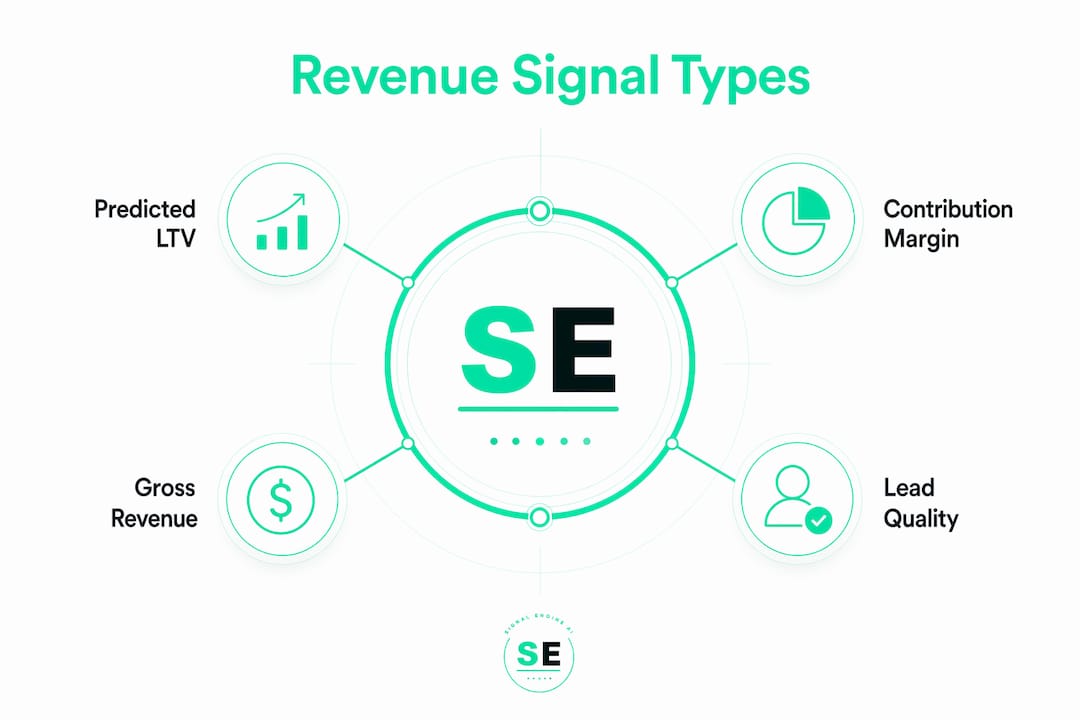
What types of revenue signals drive the best ad targeting results?
Not all revenue signals carry equal weight. The most impactful signals are the ones that reflect actual business value, not just transaction activity.
Gross revenue is the starting point, but it is also the weakest signal on its own. A $500 sale with 10% margin is worth less than a $300 sale with 60% margin. Passing gross revenue alone trains AI to chase top-line numbers that may not translate to profit.
Contribution margin signals fix this problem. Profit-based bidding that accounts for margins, returns, and refunds increases campaign profitability by 20–40% for ecommerce brands with uneven margins. That is a material improvement that gross revenue signals simply cannot produce.
Predicted lifetime value is the most forward-looking signal type. For SaaS companies, subscription businesses, and service providers, the first transaction is rarely the most valuable one. Predictive models allow marketers to report conversion values within attribution windows for delayed purchases, training AI for future outcomes today rather than waiting months for actual revenue data to accumulate.
| Signal type | What it measures | Best use case |
|---|---|---|
| Gross revenue | Total transaction value | Baseline optimization, high-volume retail |
| Contribution margin | Revenue minus direct costs | Ecommerce with mixed-margin catalogs |
| Predicted LTV | Estimated customer lifetime spend | SaaS, subscriptions, service businesses |
| Lead quality score | Probability of high-value close | B2B, real estate, high-ticket services |
| Loyalty depth | Repeat purchase frequency and recency | Retention-focused campaigns |
Pro Tip: Enterprise PPC programs run 10–30 conversion value rules per account, assigning different values by location, device, and audience membership. Start with three rules: new customer, returning customer, and high-margin product category.
Lead quality scores deserve special attention for service businesses. A dental practice or HVAC company does not benefit from optimizing for form fills. It benefits from optimizing for booked appointments with high-value service needs. Scoring leads before passing them back to the ad platform as conversion values is one of the highest-leverage moves available in 2026.
What infrastructure makes revenue signal integration actually work?
Clean data in, clean targeting out. The infrastructure behind signal integration is unglamorous, but it determines whether your signals get accepted and acted on by the platform or quietly ignored.
-
Build a Customer Match pipeline. Your CRM data needs a reliable, automated path to your ad platforms. Manual CSV uploads break down, go stale, and introduce errors. Brands that rebuilt their Google Ads data infrastructure using Customer Match and enhanced conversions report blended ROAS improvements of 18–34%. That improvement comes directly from match quality, not creative or bid changes.
-
Implement enhanced conversions. Enhanced conversions send hashed first-party identifiers (email, phone, address) alongside standard conversion tags. This dramatically improves signal matching in a privacy-compliant way and recovers conversions that cookie-based tracking misses.
-
Clean your first-party data before you feed it. Poor data hygiene and siloed first-party data systems hinder signal integration and lead to signal rejection by platforms. Standardize email formats, deduplicate records, and validate phone numbers before any data leaves your CRM.
-
Prioritize signals, do not flood the platform. Sending every behavioral event as a conversion signal creates noise. The AI cannot distinguish between a high-value purchase signal and a newsletter signup if you treat both as conversions. Assign clear hierarchy: primary conversion events tied to revenue, secondary events for optimization support only.
-
Measure incrementality, not just ROAS. Reported ROAS can look strong while actual incremental revenue stays flat. Run geo-based or holdout experiments quarterly to confirm your signals are driving real lift, not just claiming credit for organic demand.
Pro Tip: Hash your customer data using SHA-256 before uploading to any ad platform. This is the standard format Google and Meta both require, and it protects customer privacy while maintaining match accuracy.
Infrastructure investment pays back fast. The revenue attribution practices that separate high-performing agencies from average ones almost always trace back to data pipeline quality, not creative genius.
What measurable business impact do revenue signals actually deliver?
The numbers are hard to ignore. Switching from target-CPA to target-ROAS bid strategies with first-party value signals yields a median 14% increase in conversion value and over 70% year-over-year paid search revenue growth in retail case studies. That is not a marginal improvement. It is a structural shift in what paid media can produce.
The profitability gains are equally significant. Ecommerce brands that move from raw revenue optimization to profit-based bidding see 20–40% increases in campaign profitability. The mechanism is straightforward: the AI stops spending budget acquiring customers who return products or churn after one purchase, and concentrates spend on customers who stay and buy again.
Audience quality improves alongside financial metrics. When you feed the platform signals tied to loyalty depth and lifetime value, the lookalike audiences it builds reflect your best customers, not just your most recent ones. This compounds over time. Each high-value conversion teaches the algorithm more about what your ideal customer looks like.
The AI-driven revenue analysis that powers these gains also surfaces patterns human analysts miss, including which customer segments have the highest predicted LTV before they have completed a second purchase. Acting on those patterns early is where the real competitive edge lives.
How to apply revenue signals for maximum ad targeting performance
Applying revenue signals well requires a deliberate architecture, not just better data. Here is how to build it.
- Segment your Customer Match lists by value tier. Upload separate lists for your top 20% of customers by lifetime spend, your active mid-tier customers, and lapsed customers. Each list gets different bid adjustments and creative treatment.
- Assign value rules by business priority. New customer acquisition, high-margin product categories, and premium geographic markets all deserve distinct conversion values. Conversion value rules that assign profit-based values by location, audience membership, and device optimize campaigns toward business priorities, not just raw revenue.
- Use lookalike expansion off your best segments. Build lookalike audiences from your top-tier Customer Match list, not your full customer file. The signal quality difference is significant.
- Pre-validate creative on organic channels. Content that earns strong engagement on email or organic social before being used in paid campaigns carries a performance advantage. The audience response data acts as a soft signal about message-market fit.
- Run incrementality tests every quarter. Signal layering combined with lookalike and loyalty data guides AI to focus budget on highest-value customers. Confirm the lift is real with holdout experiments, not just platform-reported attribution.
Pro Tip: Treat your signal architecture as a living system. Review conversion value rules monthly and update Customer Match lists weekly. Stale data degrades signal quality faster than most marketers realize.
The strategic advantage in signal-based advertising comes from aligning spend timing with actionable business events and buyer intent. Moving from always-on campaigns to trigger-based campaigns, fired by revenue signals like a contract renewal window or a repeat purchase threshold, produces materially better results than static budget allocation.
Key Takeaways
Revenue signals improve ad targeting by giving platform AI the financial context it needs to find and bid on your most profitable customers, not just your most frequent converters.
| Point | Details |
|---|---|
| Signal quality drives AI accuracy | Feeding margin and LTV data to ad platforms lifts conversions up to 24% and cuts CPA by 13–15%. |
| Profit-based bidding beats revenue-based | Shifting from gross revenue to margin-adjusted signals increases campaign profitability by 20–40%. |
| Infrastructure determines signal usability | Clean Customer Match pipelines and enhanced conversions produce 18–34% ROAS improvements. |
| Signal layering focuses AI on best customers | Combining CRM lists, LTV scores, and loyalty data guides budget toward high-value segments. |
| Incrementality testing validates real lift | Holdout experiments confirm signals are driving new revenue, not just claiming credit for organic demand. |
Why most marketers are still leaving money on the table
The shift from volume to value optimization has been underway for years, but the majority of ad accounts I review are still optimizing for the wrong thing. They are feeding platforms raw conversion counts, passing gross revenue without margin adjustments, and wondering why ROAS looks fine while profit stays flat.
The uncomfortable truth is that most campaigns are not failing because of bad creative or poor audience selection. They are failing because the signal they are optimizing toward does not reflect what the business actually values. The AI is doing exactly what it was told. The problem is the instruction.
I have seen businesses with genuinely strong products and solid customer retention run paid media for years without ever connecting their CRM data to their ad accounts. The moment they built that pipeline and started passing predicted lifetime value as a conversion signal, their cost per acquired customer dropped materially. Not because the ads changed. Because the AI finally knew what a good customer looked like.
The other pitfall I see constantly is signal noise. Marketers add more conversion events thinking more data helps. It often does the opposite. Flooding a platform with 15 different conversion events at equal weight confuses the optimization algorithm. Fewer, cleaner, higher-quality signals consistently outperform high-volume, low-quality signal sets.
My prediction for the rest of 2026: ad platforms will increasingly reward accounts with rich, business-aligned signal inputs and penalize accounts running on thin or generic conversion data. The gap between signal-rich and signal-poor advertisers will widen. Investing in data infrastructure now is not a technical project. It is a competitive one.
— Bernard
How Signalengine helps you build a revenue signal advantage
Your ad targeting is only as good as the customer data behind it. Signalengine watches your customers, scores their behavior automatically, and flags who is ready to buy, who is about to leave, and where your next revenue opportunity is hiding.

Signalengine's AI-powered revenue intelligence tools give you the exact signals your ad platforms need: lead scores by buying intent, churn risk flags, and customer value tiers, all updated automatically. No data team required. No manual exports. Just clean, business-aligned signals ready to feed into your campaigns. Built for SMBs across 12 verticals and starting at $49/month, it is priced for businesses that need results, not complexity.
Ready to Stop the Revenue Leak?
Signal Engine gives small and local businesses 31 AI-powered tools to score leads by buying intent, predict churn before it happens, auto-generate email and SMS campaigns, and recover missed calls automatically — all in one dashboard starting at $49/month.
Start your free 7-day trial — no credit card required. Setup takes 5 minutes.
FAQ
What are revenue signals in advertising?
Revenue signals are business-aligned data points, such as customer lifetime value, profit margin, and lead quality scores, passed to ad platforms to help AI optimize for financial outcomes rather than raw conversion volume.
How do revenue signals improve ad targeting accuracy?
Revenue signals train platform AI to identify and bid on audiences that match your highest-value customers. Feeding enriched signals like predicted LTV and margin data lifts attributed conversions up to 24% and reduces cost per acquisition by 13–15%.
What is value-based bidding and how does it use revenue signals?
Value-based bidding is a bid strategy that uses revenue signals to assign different conversion values to different customer types. It shifts AI optimization from cheapest conversions to most profitable customers, producing a median 14% increase in conversion value.
How do I start using revenue signals in my ad campaigns?
Start by building a Customer Match pipeline from your CRM, implementing enhanced conversions, and assigning margin-adjusted values to your primary conversion events. Clean, hashed first-party data is the foundation for any effective signal integration.
Why does data hygiene matter for revenue signal performance?
Poor data hygiene causes signal rejection by ad platforms and wastes optimization effort. Standardizing email formats, deduplicating records, and using SHA-256 hashing before upload ensures your signals are matched accurately and acted on by the algorithm.