

TL;DR:
- Automated outreach sequences are a cost-effective way for small businesses to maintain customer engagement and convert prospects. Signalengine combines AI-driven churn scoring with these sequences to ensure human follow-up occurs only when leads are warmed. Proper setup of multiple technical layers and compliance with regulations is essential for success.
Automated outreach sequences are the single most cost-effective infrastructure layer a small or local business can deploy to keep at-risk customers engaged and convert cold prospects into booked appointments. Think of them as a persistent, rule-driven sales rep that never forgets to follow up. Signalengine pairs AI-driven churn scoring with these sequences so your human team only picks up the phone when a lead is already warm. Two anchors matter from the start: your sequences must comply with CAN-SPAM (email) and TCPA (SMS), and your technical stack needs all seven layers working together — data, enrichment, verification, mailbox infrastructure, sequencing engine, reply classification, and CRM sync — or the motion breaks within weeks.
- Sequences are one-to-few, paced, and branched — not mass blasts
- A 10%+ reply rate becomes achievable when deliverability, personalization, and cadence align
- CRM sync is non-negotiable: every send, reply, and opt-out must write back automatically
- Compliance controls (suppression lists, opt-out links, consent records) belong in the setup, not as an afterthought
Pro Tip: Start with a 4-touch sequence that spans two channels. This structure is proven to deliver the best reply and conversion rates for SMBs. Only add complexity after you collect baseline data.
Table of Contents
- What role do automated outreach sequences actually play?
- How sequences serve every stage of the customer lifecycle
- Design best practices that make sequences actually convert
- What to measure and when to expect results
- U.S. compliance checklist for automated email and SMS
- How to implement your first sequence in 5 steps
- How Signalengine applies automated sequences for service businesses
- Key Takeaways
- Automation should serve your people, not replace them
- Ready to Stop the Revenue Leak?
- Useful sources and legal references
- FAQ
What role do automated outreach sequences actually play?
An automated outreach sequence is a pre-built, rule-driven series of messages — email, SMS, voice, or LinkedIn — sent to a contact based on a specific trigger. When a contact replies, books, or opts out, the sequence pauses or forks automatically. Results write back to your CRM. That last part is what separates a sequence from a mass email: the system learns from every interaction and routes hot signals to a human rep.
High-value triggers for SMBs:
- Onboarding: welcome message fires the moment a new customer signs up or books their first appointment
- Churn-risk signal: AI score crosses a threshold (e.g., churn-risk score > 0.7) and a check-in sequence launches automatically
- Missed appointment / no-show: no confirmation within 24 hours triggers a rebooking nudge
- Abandoned booking: customer started scheduling but did not finish
- Re-engagement: no activity for 60–90 days fires a low-friction win-back flow
- Renewal window: service due in 30 days triggers an upsell or renewal reminder
| Trigger Type | Example Condition | Sequence Goal |
|---|---|---|
| Churn-risk | AI score > 0.7 | Retain at-risk customer |
| Missed appointment | No confirmation in 24 hrs | Rebook the slot |
| Re-engagement | No activity for 90 days | Win back lapsed customer |
| Renewal | Service due in 30 days | Upsell or renew contract |
| Onboarding | New signup or first booking | Activate and reduce early churn |
How sequences serve every stage of the customer lifecycle
Sequences map directly onto the four lifecycle stages your business already manages.
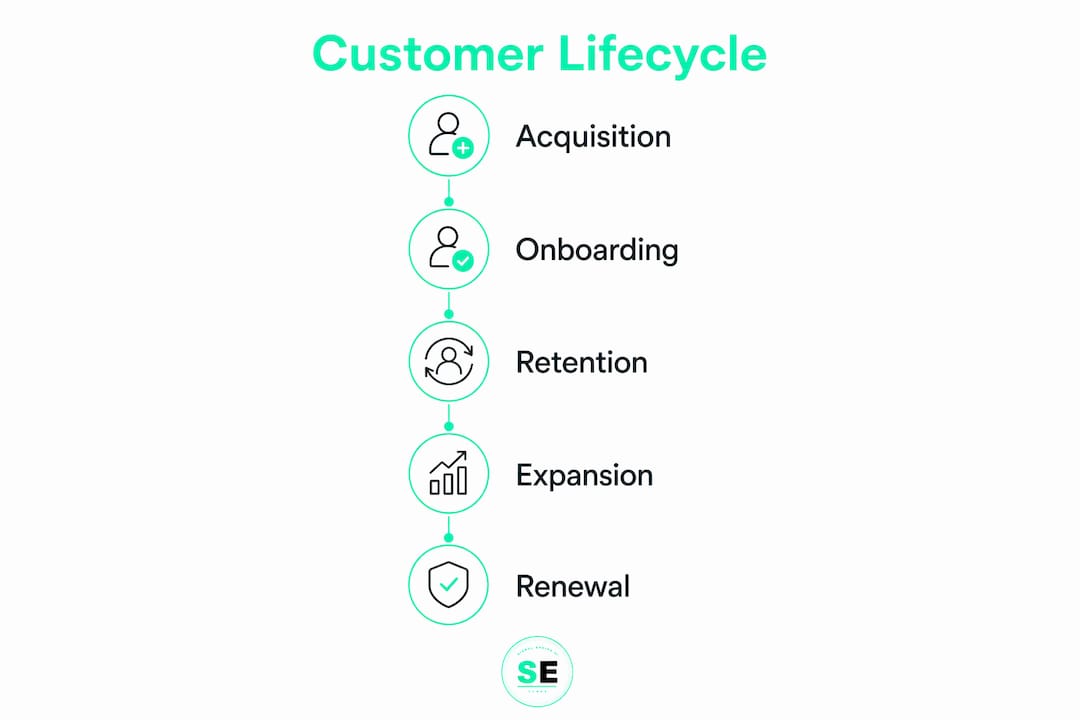
Acquisition: A short prospecting sequence — email on Day 0, LinkedIn connect on Day 2, SMS or email bump on Day 5 — moves a cold lead to a qualified conversation without a rep lifting a finger. The goal is one reply, not a closed deal.
Onboarding: Welcome messages, activation nudges, and how-to reminders reduce early churn by getting new customers to their first value moment faster. An HVAC company, for example, can auto-send a "your system check is scheduled" confirmation plus a maintenance tips email 48 hours later.
Retention: This is where AI churn prediction earns its keep. When Signalengine flags a customer as at-risk, a retention sequence fires automatically — a quick check-in, a scheduling offer, or a limited-time incentive. Churn intervention outreach tied to a scored signal converts far better than a generic newsletter.
Win-back: Light-touch outreach for lapsed customers — a two-step re-engagement email plus a breakup message — consistently delivers strong relative lift at very low marginal cost per message, making it one of the highest-ROI plays for service businesses.
Verticalized examples:
- HVAC: missed-maintenance reminder sequence with seasonal offer
- Dental: pre-appointment confirmation + 6-month recall flow
- Real estate: lead nurture after a listing view or open house visit
- Trades / landscaping: seasonal check-in flow tied to weather triggers
Design best practices that make sequences actually convert
Cadence is where most SMBs get it wrong. Practitioner data points to a 4-touch structure as an effective approach for cold and churn-intervention campaigns, including initial email, followed by SMS or LinkedIn connect, a subsequent email, and a final breakup message. Keep core emails under 90 words. Beyond five touches, reply rates flatten while complaint rates climb.
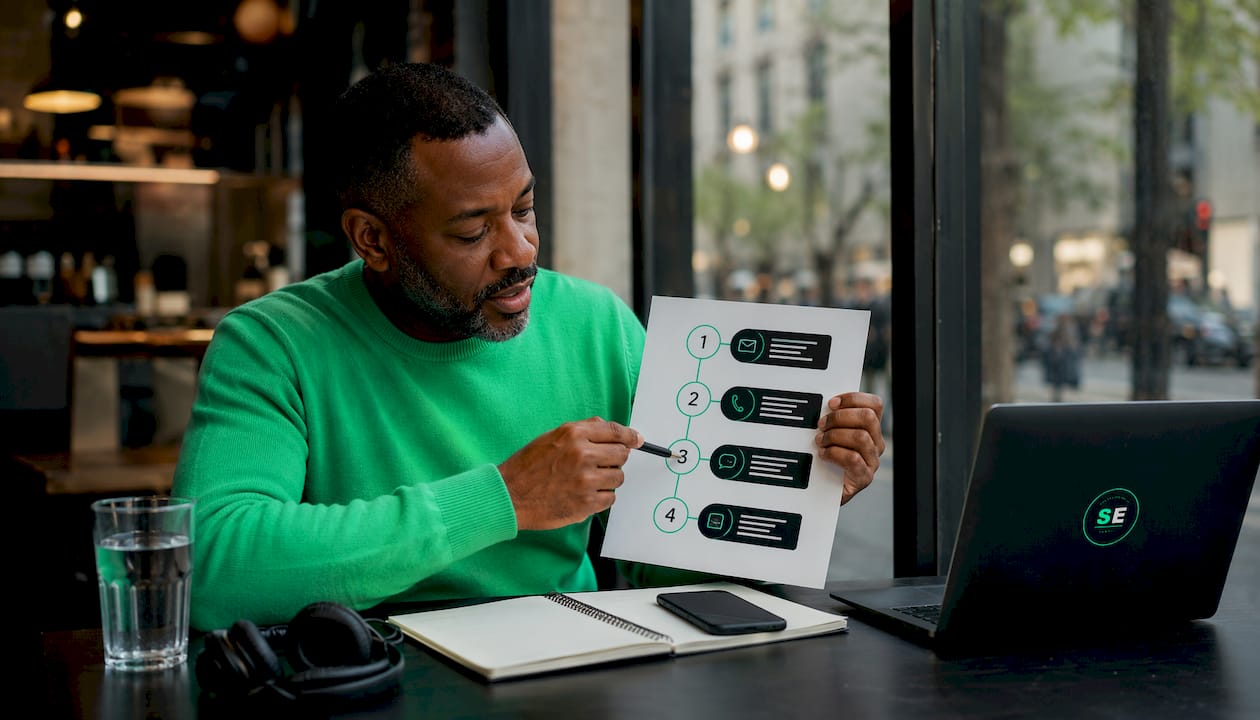
Personalization beyond {{firstName}}: Reference the actual trigger. "We noticed your spring HVAC check-up is overdue" outperforms any generic opener. Pull the appointment date, service type, or churn signal directly from your CRM into the message body.
Deliverability discipline:
- Warm every sending mailbox for ~30 days before volume sends
- Use look-alike domains for scale so your primary domain stays protected
- Waterfall-verify your list before every campaign run
Branching and exit rules: Pause or remove a contact the moment they reply, click a conversion link, or opt out. Auto-pausing on reply prevents double-sends and keeps your sender reputation clean.
Pro Tip: A/B test subject lines and opening angles on touches 1 and 2. Evaluate performance across touches 3–5, where reply rates typically peak according to practitioner data. Adding more touches without new value just generates unsubscribes.
| Sequence Type | Day 0 | Day 2 | Day 5 | Day 9 |
|---|---|---|---|---|
| Prospecting | Email (intro + value prop) | LinkedIn connect | Email bump (case study) | Breakup email |
| Churn intervention | Email (check-in offer) | SMS (quick nudge) | Email (incentive) | Breakup + opt-out |
What to measure and when to expect results
Track these KPIs from day one:
| KPI | What it tells you | When to evaluate |
|---|---|---|
| Open rate | Subject line and deliverability health | Days 1–30 |
| Reply rate (overall) | Sequence engagement | Days 30–60 |
| Positive reply rate | Message-to-offer fit | Days 30–60 |
| Conversion (booked / renewed) | Revenue impact | Days 60–90 |
| Churn rate change | Retention effectiveness | Days 60–90 |
| Unsubscribe / complaint rate | Compliance and list health | Ongoing |
Expect measurable reply-rate lift within 4–8 weeks for a new sequence. The largest gains typically appear between touches 3 and 5, as prospects build familiarity with your brand according to practitioner and field data. Cost per message for email and SMS is low, so even modest absolute response rates produce strong ROI relative to paid acquisition.
Stat to watch: Field experiments on light-touch outreach show take-up increases of 0.14–2 percentage points with high relative lift and very low marginal cost per message — a strong argument for testing simple sequences before adding complexity.
U.S. compliance checklist for automated email and SMS
Non-compliance is not a minor risk. CAN-SPAM violations carry penalties up to $51,744 per email, and TCPA class actions have cost companies millions.
CAN-SPAM (email):
- Use honest, non-deceptive subject lines
- Include a valid physical mailing address in every email
- Provide a visible, one-click unsubscribe link
- Honor opt-out requests within 10 business days
TCPA (SMS):
- Obtain documented, prior express written consent before sending marketing texts
- Include a clear opt-out keyword (e.g., "Reply STOP to unsubscribe") in every message
- Store consent records with timestamps in your CRM
Recordkeeping and controls:
- Log every opt-in, opt-out, and sequence exit event
- Maintain a suppression list and sync it before every send
- Auto-pause sequences on any reply to prevent unwanted follow-up
- Audit your third-party sending vendor for compliance features before signing
Official resources: The FTC's CAN-SPAM guidance and the FCC's TCPA page are the authoritative U.S. references. Bookmark both and review them before launching any new campaign type.
This article is general information, not legal advice. Confirm current rules with a qualified attorney or the relevant government agency for your specific situation.
How to implement your first sequence in 5 steps
1. Pick one high-value trigger and define success. Start with churn-risk score > threshold or missed appointment. Write down the one metric that proves it worked (e.g., rebooking rate).
2. Draft two short templates and one breakup. Keep every email under 90 words. Write an SMS variant for touch 2. Reference the trigger in the opening line of each message.
3. Set up mailbox warm-up, list verification, and CRM sync. Warm your mailbox for 30 days before volume sends. Verify your list. Configure your CRM so sends, replies, and opt-outs all write back automatically.
4. Run a pilot with 200–500 contacts. Measure opens, replies, and conversions for 30 days. Iterate copy and cadence before scaling. A disciplined pilot at this size gives you statistically meaningful signal without risking your sender reputation.
5. Scale gradually and add a human handoff rule. When a positive reply arrives, route it to a human rep within minutes. Add a second trigger or vertical only after your first sequence's metrics stabilize.
Quick tips:
- Always use multi-channel (email + SMS at minimum)
- Never send to a list older than 90 days without re-verification
- Route positive replies to a human — automated reminders retain clients, but humans close them
Pro Tip: Set your CRM to tag every contact who completes the sequence without replying. That tag becomes your next re-engagement segment in 60 days.
How Signalengine applies automated sequences for service businesses
Signalengine's workflow for an HVAC churn intervention looks like this: the AI flags a customer whose engagement score has dropped below threshold, the platform fires a 4-touch sequence (Day 0 email, Day 2 SMS, Day 5 email with a scheduling link, Day 9 breakup), and the reply classification engine routes any positive response directly to the technician scheduler — all without a rep manually checking a dashboard.
What makes it work technically:
- Mailbox warm-up and look-alike domain configuration built into setup
- List verification runs before every campaign batch
- CRM sync writes replies, meeting bookings, and opt-outs back to the contact record in real time
- At-risk account alerts trigger sequences automatically when a churn signal crosses the defined threshold
Your reps see warmed contacts, not cold ones. That shift alone changes the quality of every conversation they have.
Signalengine at a glance:
- 31 AI-powered tools covering lead scoring, churn prediction, and campaign automation
- Serves 12 verticals: HVAC, dental, real estate, logistics, landscaping, trades, and more
- Starts at $49/month — built for SMB budgets
- Pilot setup recommended at a few hundred contacts; many teams are live within a week.
Key Takeaways
Automated outreach sequences work because they deliver persistence and context at low cost, so human reps engage warmed leads instead of cold strangers.
| Point | Details |
|---|---|
| Sequences are infrastructure | Seven technical layers must work together; removing any one breaks the motion within weeks. |
| Start with 4 touches | Day 0 email, Day 2 SMS, Day 5 bump, Day 9 breakup is the recommended cadence for SMBs. |
| Measure touches 3–5 | The largest reply-rate gains tend to appear between touches 3 and 5. Practitioner data and field studies confirm this peak, so evaluate performance before expanding cadence. |
| Pilot at 200–500 contacts | Run a 30-day pilot at this size before scaling to protect sender reputation and get clean data. |
| Signalengine automates the trigger | Signalengine flags at-risk customers, fires the sequence, and routes positive replies to your team — starting at $49/month. |
Immediate next steps:
- Pick one trigger (churn-risk score or missed appointment) and define your success metric
- Draft two email templates and one SMS variant, then launch a 200–500 contact pilot this week
Automation should serve your people, not replace them
The businesses I see get the most out of outreach automation are the ones that treat it as preparation, not substitution. A sequence does the persistence work — the follow-ups, the nudges, the breakup message — so that when your technician, agent, or front-desk manager finally picks up the phone, the customer already knows who you are and why you're calling. That context changes everything about the conversation.
The expert insight worth internalizing: automation is a delivery mechanism, not a shortcut for weak messaging. If your offer isn't compelling, a perfectly engineered sequence will just deliver that fact faster and at scale. Fix the message first, then automate the delivery. When those two things align, the revenue impact is real and measurable — and your team spends their time closing, not chasing.
Ready to Stop the Revenue Leak?
Signalengine gives small and local businesses 31 AI-powered tools to score leads by buying intent, predict churn before it happens, auto-generate email and SMS campaigns, and recover missed calls automatically. The revenue intelligence platform maps directly to every workflow described in this guide — churn scoring, trigger-based sequences, reply routing, and CRM sync — all in one dashboard starting at $49/month.
Start your free 7-day trial — no credit card required. Setup takes 5 minutes.
Useful sources and legal references
- Automated Outreach: Complete 2026 Guide — SyncGTM: covers the seven-layer stack, cadence benchmarks, mailbox warm-up, and reply classification best practices
- Outreach Sequence Automation — SalesTarget.ai: practitioner data on touch 3–5 lift and cadence design
- Octave Outreach Sequences Guide: expert framing on automation as infrastructure for human connection
- Interventions to Bolster Benefits Take-Up — eScholarship: field experiment data on light-touch outreach lift and marginal cost
- Evaluating Effectiveness of Outreach — Frontiers in Cancer Control: evidence that low-cost digital outreach is feasible with modest absolute uptake
- FTC CAN-SPAM Compliance Guide: official U.S. email compliance requirements
- FCC TCPA / Robocall and Text Guidance: official U.S. SMS and robocall consent rules
Further reading: For deliverability specifics, mailbox warming protocols, and reply classification logic, the SyncGTM guide above is the most operationally detailed free resource available. Pair it with the email marketing tools directory to evaluate sending platforms before committing to a vendor.
FAQ
What is the role of automated outreach sequences for SMBs?
They act as persistent, low-cost infrastructure that keeps at-risk customers engaged and moves cold prospects toward a booked conversation — freeing your human team to focus on closing rather than chasing.
How many touches should a small business sequence include?
Start with 4 touches across two channels. Practitioner and field data confirm that reply rates peak between touches 3 and 5; adding more touches does not drive meaningful lift and can increase complaint rates.
How long does it take to see results from outreach automation?
Most businesses see measurable reply-rate lift within 4–8 weeks of launching a properly configured sequence, with conversion impact clearest at the 60–90 day mark.
What compliance rules apply to automated email and SMS in the U.S.?
Email sequences must follow CAN-SPAM (honest subject lines, physical address, one-click unsubscribe). SMS campaigns require prior express written consent under TCPA and a clear opt-out mechanism in every message.
How does Signalengine connect churn prediction to outreach sequences?
Signalengine scores customer behavior automatically, fires a trigger-based sequence when a churn-risk threshold is crossed, and routes positive replies to your team — all from one dashboard starting at $49/month.