

TL;DR:
- Automated prospect outreach uses AI, multi-channel sequences, and intent signals to improve response rates. Proper data, a clear ICP, and signal-based timing are essential for successful scaling. AI supports personalization and automation, but human judgment remains crucial for closing deals.
Prospect outreach automation is defined as the use of AI agents, multi-channel sequencing, and buyer intent signals to contact, nurture, and convert prospects without manual effort at every step. Agencies and sales professionals who automate prospect outreach agency steps consistently outperform those running manual campaigns, with multi-channel sequences of 5–7 touches over 21–28 days yielding reply rates 200–300% higher than single cold email approaches. That gap is not a marginal improvement. It is the difference between a pipeline that fills itself and one that demands constant manual labor. This guide covers every step: from building your ideal customer profile and selecting your tech stack, to designing sequences, deploying AI agents, and measuring what actually moves the needle.
What do you need before automating prospect outreach agency steps?
Automation amplifies whatever you feed it. Feed it bad data or a vague target, and it amplifies failure at speed.
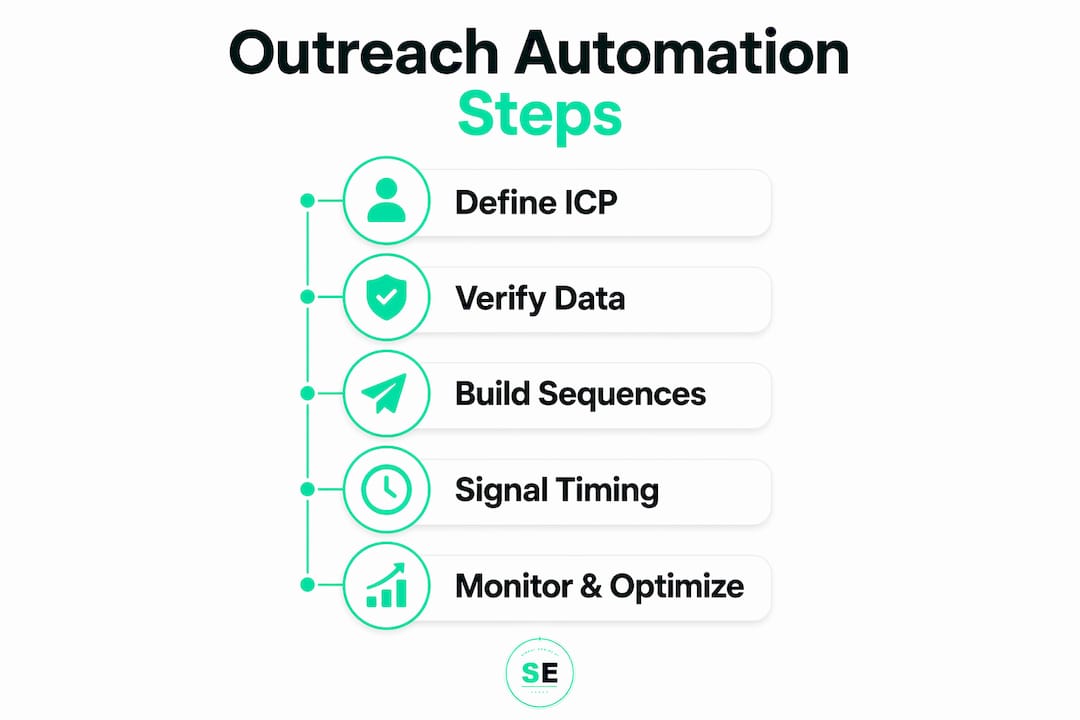
Define your ideal customer profile first
Your ideal customer profile (ICP) is the foundation of every outreach sequence you build. Define it with hard filters: industry vertical, company size, geography, decision-maker title, and annual revenue range. Agencies that segment lists by niche and geography with clear qualification rules waste far less effort on prospects who will never convert. A dental practice in Phoenix and a logistics company in Chicago require completely different messaging, even if both fit your revenue range.
Build a clean, enriched contact database
Automated systems amplify data problems rapidly. A single bad data field, like an outdated email domain, can tank your sender reputation across hundreds of contacts in one campaign run. Enrich your contact records with verified emails, LinkedIn URLs, phone numbers, and firmographic data before any sequence goes live. Tools like email verification services and data enrichment platforms catch errors before they cost you deliverability.

Pro Tip: Run every contact list through an email verification tool before importing it into your sequencing platform. A bounce rate above 3% signals that your sender domain is at risk.
The tech stack you actually need
Your outreach infrastructure has four layers:
- Email warmup: A dedicated sending domain aged for at least 4–6 weeks before cold outreach begins
- CRM integration: A central system of record that logs every touch, reply, and status change automatically
- Lead database: A source for verified contact data filtered by your ICP criteria
- Sequencing platform: The engine that fires emails, LinkedIn messages, and task reminders on schedule
Unified outbound stacks combining these four layers improve reply rates by up to 30% and meeting booking rates by roughly 5%. That improvement comes from eliminating the gaps that appear when teams switch between disconnected tools.
How do you design effective multi-touch outreach sequences?
Sequence design is where most agencies either win or waste their budget. The structure matters as much as the copy.
Optimal cadence length and channel mix
A 5–7 touch sequence spread across 3–4 weeks is the proven agency standard. Each touch uses a different channel or message type to avoid feeling repetitive. A typical agency cadence includes:
- Day 1: Personalized cold email referencing a specific trigger (recent funding, new hire, or competitor gap)
- Day 3: LinkedIn connection request with a short, relevant note
- Day 6: Follow-up email with a value drop, such as a relevant case study or data point
- Day 10: Phone call with a voicemail if no answer
- Day 14: LinkedIn message referencing the voicemail and adding another insight
- Day 18: Email with a direct ask, such as a 15-minute call request
- Day 24: Break-up email that closes the loop and leaves the door open
This structure builds relationships over 14–21 days with alternating channels and message types, which prevents the prospect from tuning you out.
Apply the 70/30 rule to every sequence
The 70/30 rule in sales cadence means 70% of your touches add value and 30% make a direct ask. This ratio produces 2.3x more qualified meetings than ask-heavy cadences. Value touches include industry insights, relevant case studies, competitor analysis snippets, or a short video walkthrough. Direct asks are your meeting requests and demo invitations. Agencies that flip this ratio and lead with asks burn through their prospect lists fast.
Pro Tip: Write your value-drop emails before your ask emails. If you cannot articulate three specific reasons why this prospect benefits from your offer, your ask will not land.
Signal-based timing beats fixed schedules
Static scheduling fires messages on a calendar. Signal-based outreach fires messages when a prospect does something that signals buying intent, such as visiting your pricing page, opening a previous email three times, or posting a job listing for a role your service supports. Trigger-based sequences achieve 8–15% meeting rates versus 2–4% for cold cadences on fixed schedules. Timing your outreach to real buyer behavior is one of the highest-leverage changes you can make to an existing sequence.
How does AI improve personalization and scale in outreach?
AI does not replace your outreach strategy. It executes it at a scale no human team can match manually.
What AI agents actually do in outreach
AI agents orchestrate multi-channel campaigns including emails, LinkedIn interactions, and personalized video demos. They manage follow-ups and handle basic objections autonomously until a lead is ready for a human conversation. A team of 5 sales development representatives using AI can manage outreach to 1,000+ prospects monthly with high personalization, reducing manual research time by 80%. That is not a productivity gain. It is a structural change in how outreach works.
Manual vs. AI-augmented outreach
| Workflow element | Manual outreach | AI-augmented outreach |
|---|---|---|
| Prospect research | 30–60 minutes per contact | Automated enrichment in seconds |
| Personalization | Written per contact | Generated from live data signals |
| Follow-up timing | Calendar-based | Trigger-based on prospect behavior |
| Channel coordination | Managed manually across tools | Orchestrated by AI across all channels |
| Objection handling | Human response required | AI handles initial replies autonomously |
| Reporting | Manual export and analysis | Real-time dashboard with auto-alerts |
Automation shifts human roles from high-volume outreach tasks to strategic work: refining offers, optimizing prompts, and closing deals. Your best sales people should spend their time on conversations, not on copy-pasting contact data.
Pro Tip: Use AI to generate the first draft of every personalized email, then have a human review the top 10% of high-value accounts before sending. This keeps quality high without slowing down volume.
Signalengine's lead scoring software monitors buyer signals automatically and scores each prospect by buying intent, so your team focuses on the contacts most likely to convert right now.
How do you launch, monitor, and improve automated outreach campaigns?
Launching automation without a monitoring plan is how agencies end up with burned domains and empty pipelines.
Start with a pilot group
Run your first automated sequence on a small segment, 50–100 contacts, before scaling. This lets you catch deliverability issues, tone problems, and sequence gaps before they affect your entire list. Gradual rollout with continuous monitoring of deliverability, open rate, reply rate, conversion rate, and unsubscribe rate is the standard approach for agencies that want long-term results.
Metrics that actually matter
Track these five numbers weekly:
- Open rate: Below 30% signals a subject line or deliverability problem
- Reply rate: Below 3% signals a messaging or targeting problem
- Positive reply rate: The share of replies that express interest, not just "remove me"
- Meeting booked rate: The ultimate conversion metric for agency outreach
- Unsubscribe rate: Above 0.5% per send is a warning sign
Common mistakes that kill campaigns
Generic messaging is the most common failure point. Sending the same email to a dental practice and a logistics firm with only the company name swapped is not personalization. It is mail merge. Prospects recognize it immediately. The second mistake is ignoring triggers. If a prospect opens your email four times but you do not follow up within 24 hours, you lose the window. The third mistake is poor CRM discipline. If your team does not log every touch and outcome, your automation has no data to learn from.
Pro Tip: Build a re-engagement sequence for cold leads who went silent after three or more touches. A simple "Is this still a priority for you?" email sent 30 days after the last touch often reopens conversations that seemed dead.
Key Takeaways
Effective prospect outreach automation requires a clean ICP, verified data, a unified tech stack, and signal-based sequencing to consistently generate qualified meetings at scale.
| Point | Details |
|---|---|
| Define your ICP first | Filter by industry, geography, and role before building any sequence or importing any data. |
| Verify data before automating | Clean contact lists prevent deliverability failures that burn your sending domain. |
| Use 5–7 touch sequences | Multi-channel cadences over 21–28 days outperform single emails by 200–300% in reply rate. |
| Apply the 70/30 rule | Weight 70% of touches toward value delivery and 30% toward direct asks for 2.3x more meetings. |
| Monitor and iterate weekly | Track open rate, reply rate, and meeting booked rate to catch problems before they scale. |
Where automation ends and strategy begins
I have watched agencies buy sequencing platforms, import 10,000 contacts, and fire off campaigns within a week. Almost every one of them burned their domain within 30 days. The tool was not the problem. The process was.
The agencies that get real results from outreach automation treat it the way a good engineer treats a production system: they test small, monitor obsessively, and only scale what is working. They also understand that AI handles the top of the funnel, but humans still close deals. The moment you hand a warm prospect to an AI for the final conversation, you lose the relationship.
What I find most underrated in the agency outreach process is the break-up email. Most teams skip it because it feels like giving up. In practice, a well-written break-up email that genuinely closes the loop generates a surprising number of late replies from prospects who were interested but distracted. It is the cheapest re-engagement tactic in the sequence.
The role of AI tools in outreach is not to replace judgment. It is to free up your judgment for the decisions that actually require it. Automation handles the repetitive work. You handle the strategy, the offer, and the close.
— Bernard
How Signalengine powers your agency outreach
Agencies that want to move fast without burning their pipeline need a platform that scores leads, monitors signals, and fires sequences automatically.
Signalengine watches your prospects, scores their buying intent in real time, and flags who is ready for outreach before you even ask. Its AI marketing automation tools handle multi-channel sequencing across email and SMS, auto-generate campaign copy, and integrate with your existing CRM without a lengthy setup. Signalengine serves 12 verticals including real estate, HVAC, logistics, and dental, and pricing starts at $49/month. That is enterprise-grade outreach automation at an SMB price. Start your free 7-day trial and see which prospects are ready to buy right now.
FAQ
What is the best sequence length for agency prospect outreach?
A 5–7 touch sequence spread over 21–28 days is the proven standard for agencies. This cadence outperforms single cold email approaches by 200–300% in reply rate.
How does AI personalize outreach at scale?
AI agents enrich contact data in real time and generate personalized messages based on trigger events like funding rounds, new hires, or leadership changes. This reduces manual research time by up to 80% per contact.
What metrics should I track in automated outreach campaigns?
Track open rate, reply rate, positive reply rate, meeting booked rate, and unsubscribe rate weekly. A reply rate below 3% signals a messaging or targeting problem that needs fixing before you scale.
How does signal-based outreach differ from fixed-schedule campaigns?
Signal-based outreach fires messages when a prospect takes a specific action, such as visiting your pricing page or opening an email multiple times. This timing achieves 8–15% meeting rates versus 2–4% for static calendar-based cadences.
How do I prevent automation from burning my sending domain?
Start with a pilot group of 50–100 contacts, use a warmed-up dedicated sending domain, and verify all contact emails before importing. Keep your bounce rate below 3% and your unsubscribe rate below 0.5% per send.
Ready to Stop the Revenue Leak?
Signal Engine gives small and local businesses 31 AI-powered tools to score leads by buying intent, predict churn before it happens, auto-generate email and SMS campaigns, and recover missed calls automatically — all in one dashboard starting at $49/month.
Start your free 7-day trial — no credit card required. Setup takes 5 minutes.