

TL;DR:
- AI tools automate client data analysis, improving productivity, prediction accuracy, and decision-making speed.
- Most successful deployments start small, focusing on specific tasks, then expand while maintaining compliance and trust.
AI tools in client analysis are defined as software systems that automate the collection, processing, and interpretation of client data to generate insights that drive retention, engagement, and revenue decisions. The role of AI tools in client analysis has shifted from a competitive advantage to a baseline expectation across industries. Businesses that still rely on manual spreadsheets and quarterly reviews are working with a fraction of the picture. AI-driven client profiling processes behavioral signals, transaction history, sentiment data, and market context simultaneously. Signalengine, Deloitte, and BCG research all confirm that this shift produces measurable gains in productivity, win rates, and prediction accuracy.
How AI tools automate and enhance client analysis workflows
AI client analysis, the industry term for AI-assisted customer intelligence, replaces manual data aggregation with automated synthesis. Where an analyst once spent hours pulling reports from disconnected systems, AI tools now consolidate client portfolio data, recent interactions, and market signals into a single structured view.
The core functions break down into four categories:
- Data synthesis. AI aggregates client records, transaction logs, and communication history into unified profiles. This removes the manual step of cross-referencing multiple platforms before every client meeting.
- Sentiment classification. AI tools classify intent and themes across unstructured feedback automatically, routing signals to the right team. A complaint buried in a support ticket gets flagged before it becomes a cancellation.
- Predictive scoring. AI assigns risk and opportunity scores to each client based on behavioral patterns. Analysts see who needs attention before the client picks up the phone.
- Report generation. Generative AI synthesizes client portfolio data, recent market activity, and meeting notes into structured pre-meeting briefs, cutting preparation time dramatically.
Pro Tip: Start with internal-only AI outputs before deploying client-facing content. Internal briefs carry lower governance risk and give your team time to validate AI accuracy before it touches a client relationship.
The deeper value is not speed. The core advantage of AI in client analysis is interpreting customer intent, not just tracking clicks or actions. A client who reduces order frequency and stops opening emails is signaling something. AI reads that pattern. A human analyst reviewing a monthly report often misses it.

What measurable benefits do businesses gain from AI-driven client profiling?
The benefits of AI in analytics are no longer theoretical. Research from 2026 puts specific numbers on the gains.
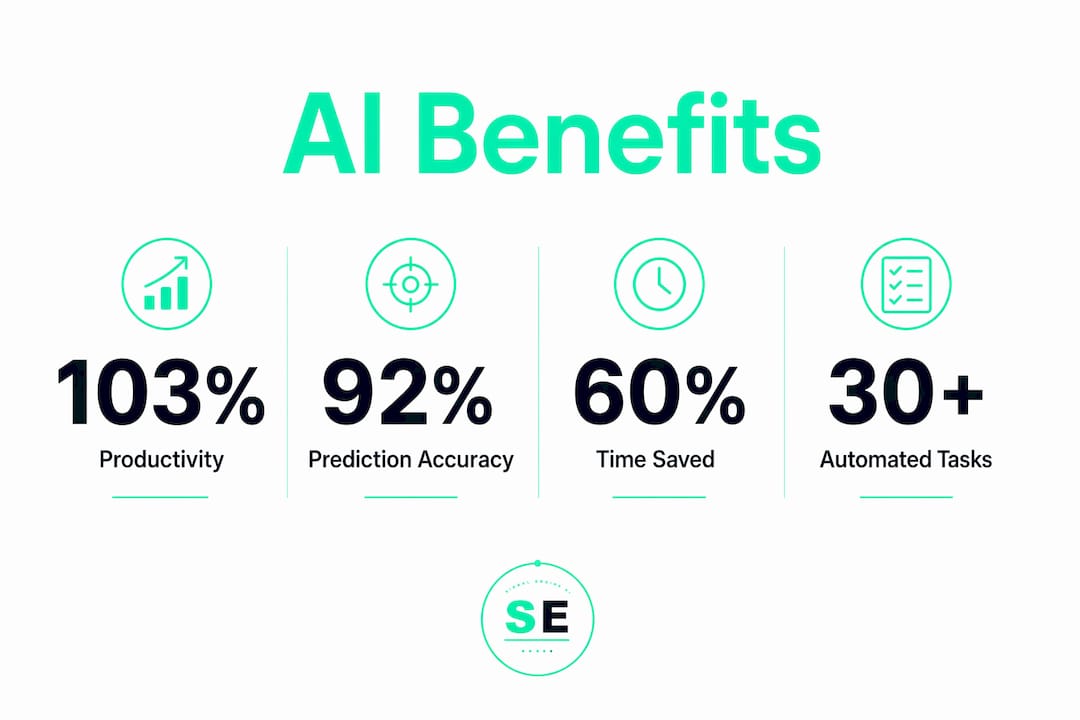
- 103% productivity uplift. Businesses that reach AI-native operational stages report doubling analyst output by automating end-to-end client workflows. That is not a marginal improvement. It means one analyst can cover the client load that previously required two.
- 15–30 minutes saved per client interaction. AI meeting prep workflows reduce advisor preparation time from 30–45 minutes to 5–10 minutes. Across a book of 200 clients, that adds up to weeks of recovered capacity each year.
- 12% improvement in new business win rates. AI market and sector scanning saves 4–6 hours weekly in manual research and improves win rates by identifying the right prospects at the right moment.
- 92% prediction accuracy. Generative AI-based synthetic panels predict consumer product choices with 92% accuracy after fine-tuning. That level of precision changes how you allocate sales and retention resources.
These numbers share a common thread. AI aids client evaluation by removing the lag between data collection and decision-making. Traditional analysis cycles run on weekly or monthly cadences. AI runs continuously, which means your team acts on current signals rather than historical summaries.
What are the practical challenges in deploying AI tools for client analysis?
Deploying AI for client insights is not a plug-and-play exercise. The risks and governance requirements vary significantly depending on how the output is used.
- Internal versus client-facing outputs carry different risk profiles. AI-generated meeting briefs used internally have low risk and high auditability. The same content sent directly to a client without review creates compliance exposure.
- Regulated industries require phased rollout. A three-phase approach covering pilot, scale, and audit captures ROI without violating SEC, FINRA, or sector-specific requirements. Skipping the audit phase is where most deployments run into trouble.
- AI hallucination is a real risk in client reports. Cross-provider verification of AI-generated analysis reduces hallucination risk by running the same query through multiple models and comparing outputs before presenting to stakeholders.
- Human judgment is not optional. Deloitte confirms that human advisors remain essential for trust and interpretation. AI surfaces the signal. A human decides what to do with it.
Pro Tip: Run every AI-generated client report through a second model before finalizing. The discrepancies between outputs reveal where the first model made assumptions. Fix those before the client sees anything.
The impact of AI on client research also extends to qualitative data. MIT Sloan research notes that AI moderators enable large-scale qualitative research faster and cheaper than traditional methods, but they may miss subtle emotional cues. That gap is exactly where a skilled analyst adds value. AI handles volume. Humans handle nuance.
The governance comparison below shows how risk levels shift across deployment contexts:
| Deployment context | Risk level | Governance requirement |
|---|---|---|
| Internal meeting briefs | Low | Basic audit trail |
| Internal client scoring | Medium | Model documentation |
| Client-facing reports | High | Legal review and compliance sign-off |
| Automated outbound messaging | Very high | Regulatory approval and human oversight |
How can business leaders apply AI tools to improve client retention and engagement?
The most effective approach is to start narrow and expand. Broad AI deployments fail because they try to change everything at once. Purpose-built tools for a single workflow, such as churn prediction or meeting prep, deliver faster ROI and build internal confidence.
Here is a practical sequence for business leaders:
- Identify your highest-cost manual task. For most teams, this is pre-meeting research or post-meeting note synthesis. Start there.
- Deploy a purpose-built AI tool for that task only. Measure time saved and output quality before expanding.
- Use AI sentiment and theme analysis to prioritize outreach. Clients showing disengagement signals get contacted first. Clients showing growth signals get expansion offers.
- Feed AI outputs into advisor workflows, not around them. The goal is to give your team better information, not to replace the conversation.
The impact of AI on client research shows up most clearly in personalization. AI-driven client profiling identifies which clients respond to email, which prefer calls, and which go quiet before churning. That behavioral data shapes every outreach decision.
- Segment clients by engagement score, not just revenue tier.
- Flag clients whose interaction frequency drops below their personal baseline.
- Use AI-generated themes from support tickets to anticipate service gaps before they escalate.
- Integrate AI sales tools into your existing CRM to score leads by buying intent automatically.
The businesses seeing the strongest results from AI in client insights are not the ones with the biggest budgets. They are the ones that picked one problem, solved it with AI, and then expanded. That discipline separates sustainable adoption from expensive experiments.
Pro Tip: Build a 90-day review into every AI deployment. At 90 days, you have enough data to see whether the model is drifting from reality. Recalibrate before the drift compounds.
Key takeaways
AI tools in client analysis deliver the highest returns when they automate routine data tasks, surface behavioral signals early, and feed human advisors with better information rather than replacing their judgment.
| Point | Details |
|---|---|
| Productivity doubles at AI-native stage | Deloitte reports a 103% productivity uplift for firms that fully automate client analysis workflows. |
| Meeting prep time drops sharply | AI reduces advisor prep from 30–45 minutes to 5–10 minutes per client interaction. |
| Phased rollout protects compliance | A pilot, scale, and audit sequence captures ROI without regulatory exposure. |
| Human judgment stays in the loop | AI surfaces signals and drafts briefs; human advisors own the client relationship and final decisions. |
| Start narrow, then expand | Purpose-built tools for one workflow outperform broad deployments and build team confidence faster. |
Where I think most teams get this wrong
The conversation about AI in client analysis tends to focus on what AI can do. The harder question is what your team will actually use. I have seen well-funded deployments fail because analysts did not trust the outputs. They kept doing the work manually and used the AI dashboard to satisfy a reporting requirement.
The fix is not better AI. The fix is better change management. When analysts understand how the model scores a client, they trust it. When the model is a black box, they ignore it. Transparency in how AI reaches a conclusion is not a nice-to-have. It is the adoption requirement.
The other mistake is treating AI as a replacement for client relationships. The firms that get the most from AI-driven revenue analysis use it to free up advisor time for conversations, not to reduce the number of conversations. AI handles the data. Humans handle the trust. That division of labor is what makes the whole system work.
Governance also gets underestimated. The teams that skip the audit phase of their rollout are the ones that end up with a compliance incident six months later. A structured review at each phase is not bureaucracy. It is the mechanism that keeps AI outputs accurate and defensible.
— Bernard
AI-powered client intelligence, built for businesses that move fast
Your clients are sending signals right now. Some are ready to buy more. Some are about to leave. The difference between catching those signals and missing them is whether your analysis runs continuously or in monthly batches.

Signalengine gives you revenue intelligence tools that score client behavior automatically, flag churn risk before it becomes a cancellation, and tell you exactly who to contact and when. The churn prediction software watches your client base around the clock so you do not have to. Signalengine serves 12 verticals including HVAC, logistics, dental, real estate, and landscaping, starting at $49/month with a free 7-day trial and a 5-minute setup.
Ready to Stop the Revenue Leak?
Signal Engine gives small and local businesses 31 AI-powered tools to score leads by buying intent, predict churn before it happens, auto-generate email and SMS campaigns, and recover missed calls automatically — all in one dashboard starting at $49/month.
Start your free 7-day trial — no credit card required. Setup takes 5 minutes.
FAQ
What is the role of AI tools in client analysis?
AI tools in client analysis automate data collection, classify client sentiment, score behavioral signals, and generate structured insights that help businesses improve retention and decision-making. The core function is interpreting client intent, not just recording actions.
How accurate is AI at predicting client behavior?
Generative AI-based synthetic panels predict consumer product choices with 92% accuracy after fine-tuning, according to BCG research. That level of accuracy makes AI a reliable input for retention and expansion decisions.
How much time do AI tools save in client workflows?
AI meeting prep tools reduce advisor preparation time from 30–45 minutes to 5–10 minutes per client interaction. Across a large client book, that recovery compounds into weeks of additional capacity each year.
What is the biggest risk when deploying AI for client analysis?
The highest risk is deploying AI-generated content directly to clients without human review or compliance sign-off. Internal outputs carry low risk, but client-facing reports require governance, legal review, and model documentation.
Do AI tools replace human advisors in client analysis?
AI tools do not replace human advisors. Deloitte confirms that human judgment remains the differentiator in client relationships. AI handles data synthesis and pattern detection; advisors handle trust, interpretation, and final decisions.