

TL;DR:
- Automated outreach uses software to send personalized, sequenced messages across multiple channels at high volumes. It outperforms manual prospecting by scaling to 10,000 touches per month and achieving higher reply rates. Proper infrastructure, list hygiene, and CRM sync are essential for successful automation.
Automated outreach is defined as software-driven, multi-channel outbound prospecting that sends sequenced, personalized messages across email, LinkedIn, SMS, and phone without manual effort per contact. It replaces one-by-one prospecting with programmatic execution, handling list building, personalization, and CRM sync automatically. Automated outreach can scale to 10,000 touches per month, while a single sales rep doing manual outreach typically peaks at 1,500. That volume gap is the core reason businesses adopt outreach automation. The industry term for this practice is "sales engagement automation," and understanding how it works separates teams that fill pipelines from teams that spin their wheels.
What is automated outreach and how does it work?
Automated outreach runs on four core components: list building, trigger-based sequencing, personalization, and CRM synchronization. Each component feeds the next. Without all four working together, the system breaks down.
List building starts with sourcing verified contacts from data providers or your own CRM. Contacts get segmented into groups of 200–500 based on industry, role, or behavior. Smaller segments let you write tighter, more relevant messages that feel personal rather than broadcast.
Sequencing is the engine. A sequence defines how many touches a prospect receives, on which channels, and in what order. A typical B2B sequence might start with a LinkedIn connection request on day one, a cold email on day three, a follow-up email on day seven, and a phone call on day ten. The sequence branches based on behavior. If a prospect opens the email twice but does not reply, the system can trigger a different message than it sends to someone who never opened at all.

Personalization is where AI earns its place. AI-driven personalization improves open rates by 30% compared to generic sequences. The system pulls in data points like the prospect's job title, company size, recent news, or LinkedIn activity to generate first lines that feel written by a human.
CRM sync closes the loop. Every reply, open, click, and bounce feeds back into your CRM so your sales team always knows where each prospect stands. Without bidirectional sync, your outreach data and your CRM data drift apart fast.
- Dedicated outbound infrastructure: Never run automated outreach through a standard marketing ESP like Mailchimp or Klaviyo. Standard ESPs can damage domain reputation in under 2 weeks when used for cold outreach. Use dedicated outbound domains and purpose-built sending infrastructure instead.
- Mailbox warmup: New sending domains need at least 30 days of warmup before you send at volume. Warmup tools simulate real email activity to build sender reputation gradually.
- Reply classification: Every reply gets categorized as interested, not interested, out of office, or referral. This classification feeds back into the sequence logic and keeps your pipeline data clean.
Pro Tip: Set up a look-alike domain for outbound sending. For example, if your main domain is yourbusiness.com, send outreach from yourbusiness.co or yourbusiness.io. This protects your primary domain's deliverability.
What are the real benefits of automated outreach vs. manual?
The volume advantage alone justifies the switch. Automated outreach scales to 10,000 monthly touches versus a manual ceiling of roughly 1,500 for one rep. That is not a marginal improvement. It is a structural change in what your team can accomplish.
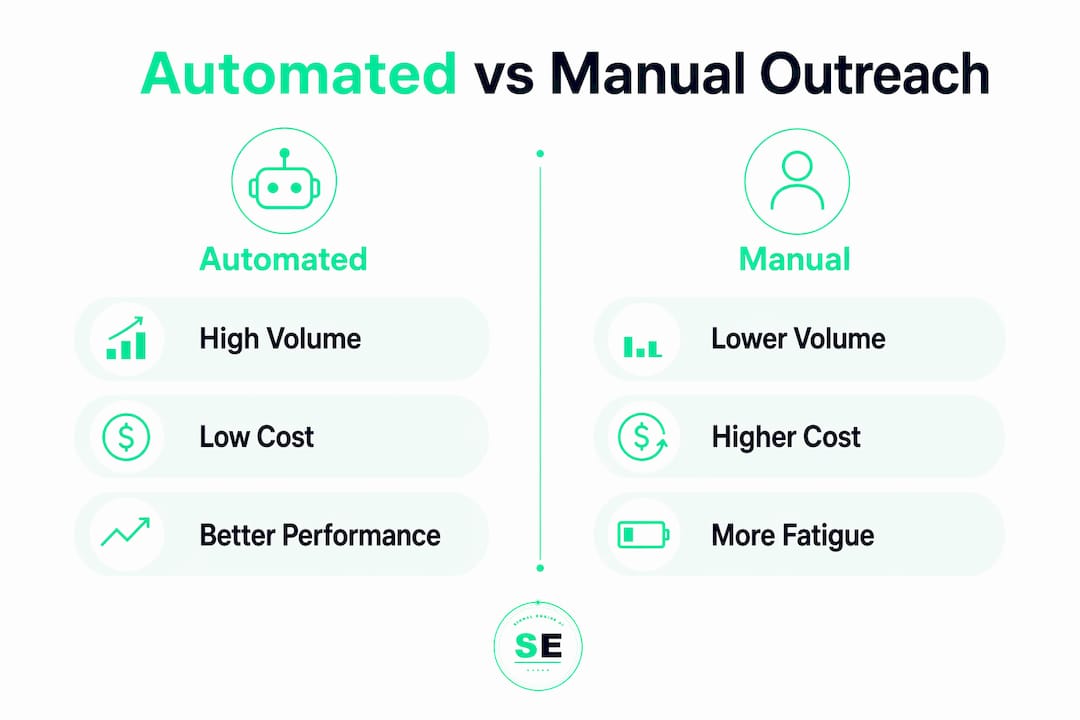
The performance numbers back it up. AI-driven sequencing achieves 28% reply rates versus 12% for manual outreach. That gap compounds over time. More replies mean more conversations, more demos, and more closed deals.
| Metric | Automated outreach | Manual outreach |
|---|---|---|
| Monthly touches per rep | Up to 10,000 | ~1,500 |
| Average reply rate | 28% | 12% |
| Cost per touch | ~$0.10 | $5.00+ |
| Demo bookings | 3x higher | Baseline |
| ROI timeline | 4:1 within 90 days | Variable |
Cost per touch is the metric most teams overlook. At $0.10 automated versus $5.00 or more for manual, the economics shift dramatically at scale. A team running 5,000 touches per month saves roughly $24,500 in labor cost compared to doing the same work manually.
Automation also reduces sales development rep (SDR) fatigue. Manual outreach is repetitive and demoralizing at high volume. Automation handles the mechanical work so your reps focus on conversations that actually require human judgment. That shift accelerates pipeline velocity because reps spend time on qualified prospects instead of data entry.
How to build a successful automated outreach campaign
Execution separates campaigns that generate pipeline from campaigns that generate noise. The setup phase matters more than the copy.
-
Segment your list before you write a single message. Build segments of 200–500 contacts with a shared characteristic: same industry, same job title, same trigger event like a funding round or new hire. Tight segments let you write one message that feels relevant to every person on the list.
-
Warm your mailboxes for 30 days. Mailboxes require a 30-day warmup period before sending at full volume. Start with 10–20 emails per day and increase gradually. Skipping this step burns your domain reputation before your first real campaign launches.
-
Write sequences with branching logic. Do not send the same follow-up to everyone. Sequences must pause or fork based on prospect engagement including opens, replies, and site visits. A prospect who opened your email three times gets a different message than one who never engaged.
-
Classify every reply. Sort replies into categories: interested, not interested, wrong person, out of office, and referral. This classification feeds your CRM and tells the sequence what to do next. Unclassified replies create chaos in your pipeline data.
-
Sync bidirectionally with your CRM. Every status change in your outreach platform should update your CRM in real time. Lack of closed-loop synchronization causes disorganized outreach and harms brand reputation when reps contact prospects who already replied.
-
Respect platform sending limits. Most outbound platforms cap daily sends per mailbox at 50–100 emails. Staying within limits protects deliverability. Spread volume across multiple warmed mailboxes if you need to scale faster.
Pro Tip: Build a "hot reply" workflow that alerts a human rep within 15 minutes of a positive reply. Speed to response on interested prospects is one of the highest-leverage actions in any outreach campaign.
Common misconceptions about outreach automation
Automated outreach is not mass emailing. This distinction matters legally and practically. Mass email goes to opted-in subscribers via marketing ESPs. Automated outreach targets cold prospects via dedicated outbound infrastructure with personalized, sequenced messages. Conflating the two leads to the wrong tools, wrong tactics, and potential deliverability disasters.
The biggest misconception is that better copy fixes everything. Copywriting alone does not drive outreach performance. List hygiene, reply classification, and CRM data feedback loops drive actual results. A brilliant email sent to a stale list with no reply handling will underperform a mediocre email sent to a verified, well-segmented list with proper follow-up logic.
A few other misconceptions worth correcting:
- "Automation replaces salespeople." It does not. Hybrid outreach strategies achieve 10%+ reply rates by letting automation handle volume while humans focus on closing. Fully automated sequences without human involvement typically produce 1–3% reply rates.
- "More touches always mean more results." Overloading a prospect with too many touches damages your brand. Sequences longer than 7–8 steps with no engagement signal usually do more harm than good.
- "Set it and forget it." Campaigns need weekly review. Deliverability changes, reply rates shift, and list quality degrades. Without strategic branching logic and human oversight, automation generates volume but not qualified pipeline.
The risk of improper automation is real. Sending from your primary domain without warmup, skipping reply classification, and ignoring bounce rates can get your domain blacklisted within weeks. Recovery from a blacklisted domain takes months and sometimes requires starting over with a new domain entirely.
Key Takeaways
Automated outreach outperforms manual prospecting on every measurable metric, but only when the underlying infrastructure, list quality, and CRM sync are built correctly from the start.
| Point | Details |
|---|---|
| Volume advantage is structural | Automation handles up to 10,000 monthly touches vs. 1,500 for manual outreach. |
| Reply rates nearly double | AI-driven sequences average 28% reply rates compared to 12% for manual methods. |
| Infrastructure beats copywriting | List hygiene, mailbox warmup, and CRM sync drive performance more than message quality alone. |
| Hybrid models outperform pure automation | Human reps handling replies and closing achieve 10%+ reply rates vs. 1–3% fully automated. |
| Domain protection is non-negotiable | Use dedicated outbound domains and 30-day warmup to protect deliverability from day one. |
Why most teams get automated outreach backwards
I have watched hundreds of teams launch outreach campaigns and fail for the same reason: they treat it as a messaging problem when it is actually an infrastructure problem. They spend two weeks perfecting subject lines and zero time warming their mailboxes. Then they wonder why their open rates are 4% and their domain ends up on a blacklist.
The teams that win with outreach automation build the plumbing first. They set up dedicated sending domains, run warmup for a full month, verify every contact before it enters a sequence, and build reply classification into the workflow from day one. The copy comes last, not first. And honestly, once the infrastructure is solid, even average copy performs well because the messages actually reach the inbox.
The other mistake I see constantly is treating automation as a replacement for sales judgment. It is not. Automation is a force multiplier for human judgment. The best campaigns I have seen pair tight AI-driven sequencing with a human rep who jumps on every positive reply within minutes. That combination, not the automation alone, is what fills a calendar with qualified meetings.
If you are just getting started with outreach automation for your agency, resist the urge to launch fast. Slow down, build the infrastructure correctly, and your first campaign will outperform anything you could have done manually.
— Bernard
How Signalengine powers your outreach from day one
Outreach automation works best when it connects to live revenue intelligence. Signalengine gives your business AI-powered revenue tools that score leads by buying intent, flag customers about to leave, and auto-generate email and SMS campaigns based on real behavior signals.
You do not need a data team or a six-figure tech stack. Signalengine is built for SMBs across 12 verticals including HVAC, logistics, dental, and real estate, starting at $49/month. Setup takes five minutes. The platform watches your customers, scores their signals, and tells you exactly who to contact and when. That is the missing layer most outreach campaigns never have. See a live demo to watch it in action.
FAQ
What is automated outreach in simple terms?
Automated outreach is software that sends personalized, sequenced messages to prospects across email, LinkedIn, SMS, and phone without manual effort per contact. It replaces one-by-one prospecting with programmatic execution at scale.
How does automated outreach differ from email marketing?
Email marketing targets opted-in subscribers via marketing ESPs. Automated outreach targets cold prospects via dedicated outbound infrastructure with personalized sequences, not broadcast newsletters.
What reply rate should I expect from automated outreach?
AI-driven automated outreach sequences average 28% reply rates. Manual outreach averages 12%. Hybrid models with human follow-up on positive replies can exceed 10% qualified reply rates consistently.
How long does it take to set up an automated outreach campaign?
The setup phase takes 30–45 days when done correctly. Mailbox warmup alone requires 30 days. List building, segmentation, and CRM integration add another one to two weeks before your first sequence launches.
Is automated outreach legal?
Automated outreach to business contacts is legal in most jurisdictions when it follows CAN-SPAM, GDPR, and CASL requirements. Use accurate sender information, include opt-out options, and honor unsubscribe requests immediately to stay compliant.
Ready to Stop the Revenue Leak?
Signal Engine gives small and local businesses 31 AI-powered tools to score leads by buying intent, predict churn before it happens, auto-generate email and SMS campaigns, and recover missed calls automatically — all in one dashboard starting at $49/month.
Start your free 7-day trial — no credit card required. Setup takes 5 minutes.