

TL;DR:
- Effective revenue audits focus on system reliability by examining contracts, recognition policies, and internal controls. Conducting thorough, risk-based testing and documenting traceability ensures accurate recognition timing and amounts. Reporting impact-driven findings and recommending ongoing metrics foster sustainable revenue governance.
Most revenue leaks don't announce themselves. They accumulate quietly in overlooked contract terms, misapplied recognition policies, and gaps between what a client's CRM shows and what actually gets invoiced. When you conduct a revenue audit for a client business, you're not just checking numbers. You're mapping the entire system that turns customer commitments into recognized income. This guide covers everything from scoping the engagement to reporting findings. Whether you're a financial professional or a business leader, what follows is a practical framework you can apply immediately.
Table of Contents
- Key Takeaways
- What to do before you conduct a revenue audit
- How to execute the revenue audit process step by step
- Common challenges during revenue audits and how to handle them
- How to verify findings and report results to clients
- My honest take on what makes revenue audits actually work
- How Signalengine helps you audit smarter
- Ready to Stop the Revenue Leak?
- FAQ
Key Takeaways
| Point | Details |
|---|---|
| Scope before you sample | Gather contracts, CRM data, and recognition policies before testing a single transaction. |
| Apply the five-step model | Use the ASC 606 framework to test whether revenue was recognized at the right time and amount. |
| Cut-off testing is non-negotiable | Period-end cut-off errors are among the most common misstatements; test the last and first five business days of every period. |
| Document the full traceability chain | Invoices alone won't satisfy auditors. Trace contracts through performance obligations to delivery evidence. |
| Report by impact, not volume | Prioritize findings that affect recognition timing or amounts, and build 30-day and 90-day recovery plans around them. |
What to do before you conduct a revenue audit
Before you touch a single transaction, you need to understand how your client's revenue system actually works. That means understanding their contracts, their accounting policies, and the technology connecting deals to dollars.
Start by requesting a foundational document set. This includes:
- Signed customer contracts and any amendments
- The client's current revenue recognition policy (written, not assumed)
- Prior-period audit reports or management letters
- CRM exports showing pipeline stages, deal close dates, and contract values
- Any performance obligation analysis already completed internally
The revenue recognition policy deserves special attention. Under ASC 606, the five-step model governs when and how revenue gets recorded. If your client doesn't have a written policy, that's a finding before you've even started testing. You need to understand how they identify contracts, identify performance obligations, determine transaction prices, allocate those prices across obligations, and recognize revenue as each obligation is satisfied.
Assess the current revenue system holistically. Look at how the CRM feeds into billing and how billing connects to the general ledger. Weak pipeline controls or manual workarounds are early warning signs. Multi-element arrangements and frequent contract modifications are two areas that almost always require extra scrutiny.
Pro Tip: Ask clients to flag contracts with variable consideration, renewal options, or mid-term modifications before the audit begins. These are your highest-risk documents and will consume the most testing time.
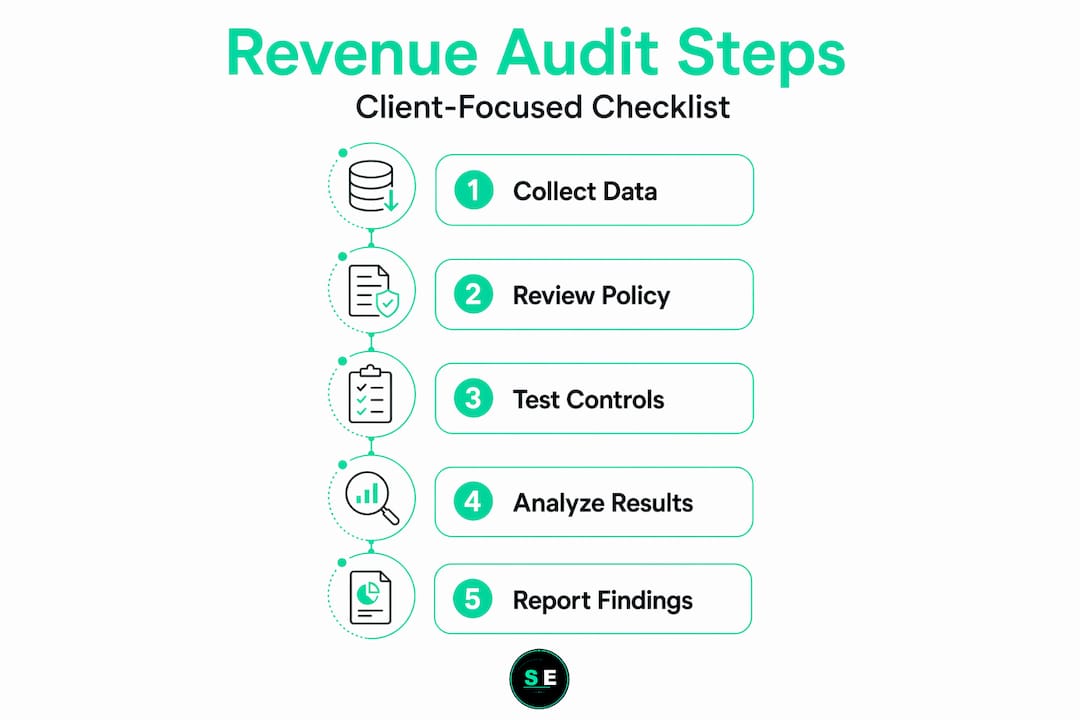
How to execute the revenue audit process step by step
This is where the client business revenue check becomes a structured, defensible engagement. Follow a logical sequence from contract review through evidence documentation.
-
Review contracts for performance obligations. Start at the source. For each sampled contract, identify every distinct good or service the client has promised to deliver. This step determines whether revenue should be recognized at a point in time or over time.
-
Trace transactions through internal systems. Follow each contract from CRM entry through invoicing to the general ledger entry. Document every system it touches. Gaps in this chain indicate control weaknesses worth noting.
-
Perform substantive testing against key assertions. The assertions that matter most in a business revenue analysis are occurrence, completeness, cut-off, and accuracy. Framing tests around these assertions prevents shallow sampling and targets real misstatement risk.
-
Run cut-off procedures. Test the last five and first five business days around each period end. Cut-off testing catches revenue recognized too early or too late, which is one of the most common and most consequential errors you'll find.
-
Link accounts receivable testing to revenue testing. These two areas reinforce each other. Linking AR and revenue procedures lets you confirm revenue occurrence through customer confirmations and subsequent cash collections, saving time while increasing coverage.
-
Interview key stakeholders. Talk to the people who negotiate contracts, manage billing, and close the books. Their explanations often reveal process deviations that no document shows.
-
Document findings with evidence mapping. Every conclusion needs a clear path from assertion to evidence. Auditors require traceability from contracts through delivery evidence to revenue schedules. Invoices alone are not sufficient.
Here's a quick reference for the core assertions and the corresponding tests:
| Assertion | Primary test | Secondary test |
|---|---|---|
| Occurrence | Customer confirmations | Review signed delivery documents |
| Completeness | Agree revenue schedule to GL | Test unrecorded liabilities |
| Cut-off | Review period-end transactions | Check shipping and acceptance dates |
| Accuracy | Recalculate allocation using SSP | Compare invoiced amounts to contract |
| Presentation | Review disclosures against policy | Compare to prior period disclosures |
Pro Tip: Use a stratified sample rather than a purely random one. Pull the largest contracts by value plus a random selection of smaller ones. High-value deals carry disproportionate risk and deserve focused testing.
Common challenges during revenue audits and how to handle them
Even a well-scoped audit hits friction. Knowing where that friction typically appears lets you plan around it rather than react to it.
Missing or inconsistent documentation is the most common obstacle. Clients often don't have signed contracts on file for every active customer, especially if deals were closed verbally or via email threads. Preempt this by issuing a Prepared by Client (PBC) list early. Front-loading a complete PBC pack reduces fieldwork delays significantly and signals to the client that this is a serious, structured process.
- Last-minute contract changes. Mid-audit amendments complicate everything. If a client modifies a contract during your fieldwork, you need to assess whether it's a modification, a termination and replacement, or simply a price adjustment. Each scenario has different recognition implications.
- Cut-off errors under pressure. Finance teams under quarter-end pressure will sometimes pull forward revenue to hit targets. Your cut-off procedures exist specifically to catch this. Don't compress that testing window regardless of time constraints.
- Undocumented judgment calls. When clients make judgment calls on variable consideration or principal versus agent determination, those judgments need to be written down. Recognition policies must be living documents that capture how the business applies ASC 606 to real, recurring situations.
When client cooperation starts slipping, be explicit about what you need and why. Show stakeholders how better data readiness protects them. The hidden costs of B2B revenue leakage are real, and most clients respond when you frame documentation gaps as financial risk, not administrative burden.
A clean audit trail isn't about satisfying auditors. It's about giving leadership a clear, defensible picture of where their revenue actually comes from and whether the system generating it is reliable.
How to verify findings and report results to clients
The final phase of how to perform a revenue audit is where the work becomes genuinely useful to your client. Raw findings mean nothing without context and prioritization.

Start by sorting issues by impact. Not every deviation from policy is material. Categorize findings as:
| Priority | Criteria | Recommended response timeline |
|---|---|---|
| Critical | Affects reported revenue amounts or timing materially | Address within 30 days |
| Significant | Indicates control weakness with moderate misstatement risk | Address within 90 days |
| Informational | Process inefficiency with no material financial impact | Include in next policy review cycle |
Build a 30-day action plan around critical findings and a 90-day plan for significant ones. Practical revenue audits that include clear short and medium-term action plans give leadership something to act on immediately rather than a list of problems to feel bad about.
When presenting to leadership, lead with business impact. "Your cut-off process is exposing you to material misstatement risk in Q4" lands harder than citing an accounting standard. Use concrete numbers wherever possible. Quantify the revenue at risk. Show how the control gap translates into dollars.
Governance is the final piece. A revenue audit that ends at the report stage misses an opportunity. Use your findings to push for ongoing revenue monitoring. Metrics like deal-to-invoice cycle time, AR aging by cohort, and contract modification frequency are indicators you can track continuously. Connecting key revenue metrics to ongoing reporting turns a one-time audit into a sustainable revenue governance practice.
Pro Tip: Give your client two documents: a full findings report for the finance team, and a one-page executive summary with dollar impact and priority actions for leadership. Two audiences, two formats. You'll get faster buy-in on remediation.
My honest take on what makes revenue audits actually work
I've reviewed a lot of revenue audits over the years, and the ones that miss the mark share a common flaw. They focus too narrowly on whether numbers are correct rather than whether the system producing those numbers is reliable.
The most impactful engagements I've seen treat the revenue audit process as a diagnostic of system behavior. When you look at revenue patterns across the entire cycle from buyer engagement through deal close to invoicing and recognition, you start seeing things that transaction-level testing never surfaces. Founder-dependent deal control is a perfect example. In many small and mid-size businesses, one or two people hold all the contract knowledge in their heads. That's a revenue risk. It's also an audit risk. And it rarely shows up in any document you'll receive in a PBC pack.
I've also learned that thoroughness and pragmatism are not opposites. An auditor who tests everything at the same level of rigor wastes time and erodes client trust. Risk-rank your procedures. Go deep where exposure is real.
The other thing I'd push back on is the instinct to treat documentation deficiencies as the client's problem. Part of your job is to build an audit strategy that accounts for clients who are not audit-ready. Technology changes this equation dramatically. Clients using AI-powered revenue tracking tools come in with cleaner data, clearer pipeline visibility, and less reliance on manual reconciliation. That's a meaningful efficiency gain for both sides.
— Bernard
How Signalengine helps you audit smarter

When you're preparing for or conducting a revenue audit, the biggest time sink is usually chasing down data that should have been organized weeks ago. Signalengine eliminates that problem. Its AI-powered platform gives businesses continuous visibility into their revenue pipeline, flags churn risk in real time, and tracks deal movement from first signal to close.
For auditors and business leaders, that means walking into an engagement with clean, structured revenue data rather than spreadsheet chaos. You can watch how Signal Engine works in a live demo, or explore the deal tracking and pipeline tools built specifically for SMBs and growing teams. SaaS businesses can also check out tools built for small SaaS teams that surface revenue gaps before they compound. The average user identifies $38K in recoverable revenue in the first month alone. That's audit prep and revenue recovery working at the same time. ⚡
Ready to Stop the Revenue Leak?
Signal Engine gives small and local businesses 31 AI-powered tools to score leads by buying intent, predict churn before it happens, auto-generate email and SMS campaigns, and recover missed calls automatically — all in one dashboard starting at $49/month.
Start your free 7-day trial — no credit card required. Setup takes 5 minutes.
FAQ
What does it mean to conduct a revenue audit for a client?
A revenue audit is a structured review of a client's entire revenue system, covering contracts, recognition policies, internal controls, and transaction-level testing to verify that revenue is recorded accurately and in the right period.
What is the five-step revenue recognition model?
It's the framework under ASC 606 that requires businesses to identify the contract, identify performance obligations, determine the transaction price, allocate that price, and recognize revenue as each obligation is satisfied.
How long does a revenue audit typically take?
Scope determines timeline, but most client revenue audits run two to six weeks. Front-loading PBC documentation is the single most effective way to compress fieldwork time.
What are the highest-risk areas in a revenue audit?
Cut-off errors, multi-element arrangements, and contract modifications carry the most misstatement risk. Occurrence and cut-off assertions are where fraud and unintentional errors most often appear.
How do you report revenue audit findings to leadership?
Categorize findings by financial impact, build 30-day and 90-day action plans for critical and significant issues, and present an executive summary with dollar exposure alongside the full technical report for the finance team.