

TL;DR:
- Monthly recurring revenue loss results from customer cancellations and downgrades that decrease predictable income.
- Controlling MRR loss relies on early detection, operational discipline, and cross-team collaboration to prevent revenue erosion.
Monthly recurring revenue loss, known in the subscription industry as MRR loss or MRR churn, is the measurable drop in predictable subscription income a business experiences each month due to customer cancellations and downgrades. It is distinct from simply losing customers. A business can lose five small accounts and retain one large one, and the net revenue impact may be positive. That distinction matters enormously for financial planning. The subscription economy reached an estimated $722 billion in 2025, making MRR loss one of the most consequential metrics any recurring revenue business can track. Understanding it is the first step toward controlling it.
What is monthly recurring revenue loss and how is it measured?
MRR loss is calculated using two related formulas. Gross MRR churn equals the sum of revenue lost to cancellations and downgrades, divided by total starting MRR for the period, expressed as a percentage. Net MRR churn adjusts that figure by subtracting expansion revenue from existing customers, such as upsells or seat additions. A business with $100,000 in starting MRR that loses $4,000 to cancellations and gains $2,000 in upgrades has a gross MRR churn of 4% but a net MRR churn of 2%.
The difference between these two figures tells you something specific. Gross churn shows the raw damage. Net churn shows whether your existing customer base is growing or shrinking in revenue terms. A negative net MRR churn rate means expansion revenue exceeds losses. That is the goal every subscription business should target.
| Metric | What it measures | Key distinction |
|---|---|---|
| Customer churn | Number of customers lost | Ignores account size or revenue weight |
| Gross MRR churn | Revenue lost to cancellations and downgrades | No credit for expansion |
| Net MRR churn | Revenue lost minus expansion revenue | Best indicator of revenue health |
| Revenue leakage | Losses from billing errors or missed renewals | Operational, not lifecycle-driven |
Pro Tip: Track normalized MRR by adjusting for one-time fees and discounts before calculating churn. Inconsistent MRR definitions inflate or deflate churn figures and make month-over-month comparisons unreliable.
What causes monthly recurring revenue loss?
Revenue loss in subscription businesses falls into two distinct categories: lifecycle failure and operational failure. Lifecycle failure is churn. Operational failure is leakage. Confusing the two leads to misdiagnosed problems and wasted retention spend.
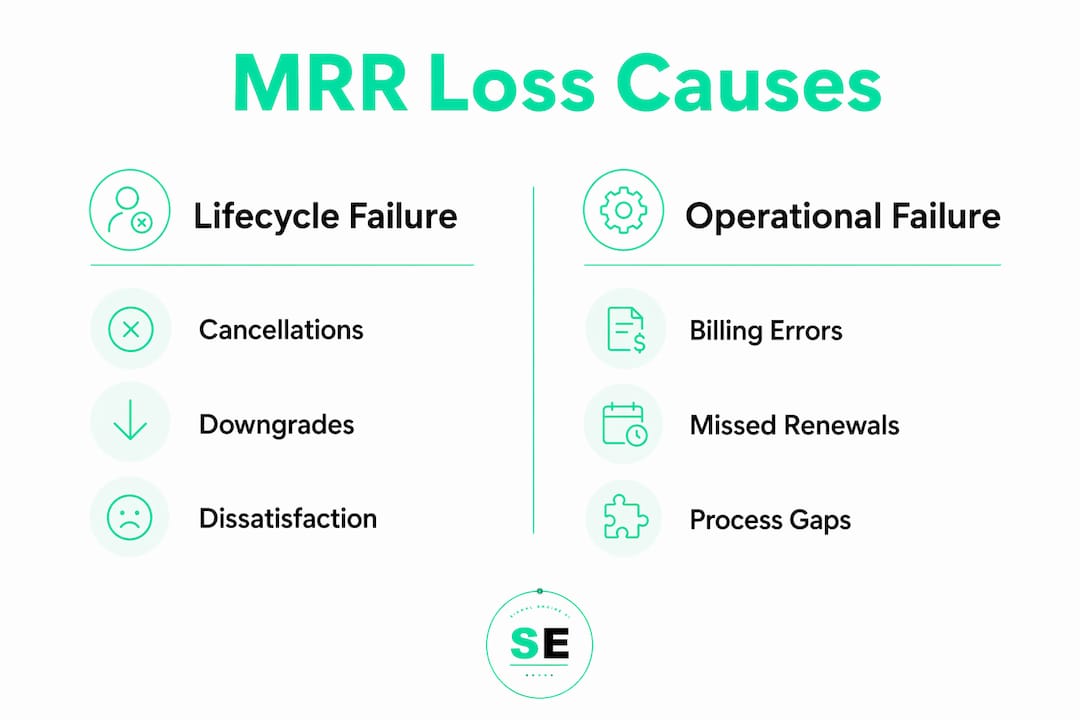
Churn-driven MRR loss comes from customers who cancel or downgrade their subscriptions. The causes include product dissatisfaction, competitive switching, budget cuts, or simply a failure to demonstrate ongoing value. High-value accounts that go quiet before renewal are a particularly costly source of loss, because the revenue impact is concentrated and the warning signs often appear weeks before the cancellation date.
Revenue leakage results from operational failures like billing errors or contract mismanagement and can cost businesses 2%–5% of annual revenue independent from churn. That is money leaving the business without a single customer deciding to leave. Common sources include unbilled services, failed payment retries, and expired contracts that auto-lapse without renewal outreach.
The key drivers of MRR loss include:
- Cancellations from customers who found a better alternative or lost confidence in the product
- Downgrades from customers reducing spend due to budget pressure or underutilization
- Failed payments that are not retried automatically, creating involuntary churn
- Missed renewals where no outreach occurs before contract expiration
- Billing errors that go undetected until an audit or customer complaint surfaces them
- Poor onboarding that leaves customers underusing the product and vulnerable to cancellation
Small process gaps and unbilled services silently compound revenue leakage over time, reducing net retention without triggering typical churn alerts. This is the category most businesses miss entirely until a financial review forces the issue.
How does recurring revenue loss impact business growth?
The compounding math of MRR churn is the part most business owners underestimate. A 5% monthly churn rate leads to losing nearly 46% of starting MRR within one year. That means a business generating $200,000 in monthly recurring revenue today would need to acquire nearly $92,000 in new MRR just to stay flat. Growth becomes nearly impossible when acquisition is running to replace lost revenue rather than add to it.
Healthy B2B subscription businesses maintain a monthly gross revenue churn under 3% and annual net retention over 120%. That 120% figure means existing customers are generating more revenue this year than last, even after accounting for all losses. Businesses below that threshold are effectively running in place.
"Recurring revenue loss is not just a finance metric. It is a key indicator of company health, guiding product-market fit and customer success teams on where to focus retention efforts. High churn signals a business is prioritizing acquisition over adoption."
The relationship between MRR loss and customer acquisition cost (CAC) is direct and punishing. When churn is high, the payback period on new customer acquisition extends. A customer who cancels after three months on a 12-month payback plan costs the business money on net. Reducing monthly churn by even a few percentage points is more capital-efficient than acquiring new customers, because churn's exponential impact compounds across 12 months.
Pro Tip: Calculate your revenue retention rate quarterly, not just annually. Quarterly tracking catches deteriorating cohorts before they become a full-year problem, giving your team time to intervene.

Net revenue retention (NRR) is the metric that ties all of this together. NRR above 100% means your existing customers are growing in value. NRR below 100% means you are shrinking from the inside, regardless of how many new logos you add.
What strategies reduce monthly recurring revenue loss?
Reducing MRR loss requires action at three levels: early detection, proactive retention, and operational tightening. Most businesses only address one of the three.
Recurring revenue loss often indicates that a business is prioritizing acquisition over adoption, and waiting until renewal to save an account is frequently too late. The intervention window opens months before a customer cancels, not days before. That means your retention program needs to start at onboarding, not at the cancellation notice.
Here are the practical steps that reduce MRR loss:
- Map your churn by cohort. Identify which customer segments cancel most often and at what point in the lifecycle. Cohort analysis reveals patterns that aggregate churn rates hide.
- Build an early warning system. Track product usage, support ticket frequency, and login activity. Declining engagement is a leading indicator of cancellation, often visible 60–90 days before the event.
- Automate payment retries. Involuntary churn from failed payments is entirely preventable. Automated retry logic with escalating outreach recovers a meaningful share of at-risk revenue with no manual effort.
- Assign ownership to at-risk accounts. High-value accounts showing disengagement signals need a named owner and a specific intervention plan, not a generic email sequence.
- Audit billing and contract management quarterly. Revenue leakage from operational gaps erodes profitability slowly and is often missed until end-of-period reviews reveal discrepancies. A quarterly audit catches it before it compounds.
- Use AI-powered churn prediction. Platforms that score customer behavior automatically flag who is likely to leave before they act. That gives your team time to intervene with the right message at the right moment.
Existing customers hold the highest-margin growth potential in any subscription business. The goal is not just to stop them from leaving. The goal is to grow their revenue contribution until expansion exceeds all losses, creating what the industry calls negative net churn.
Pro Tip: Align your sales, finance, and customer success teams around a single MRR dashboard. Siloed data creates blind spots. When all three teams see the same churn signals, intervention happens faster.
Cross-functional alignment is not a soft recommendation. It is a structural requirement for managing MRR loss at scale. Finance sees the revenue impact. Sales sees the competitive pressure. Customer success sees the product usage signals. None of those perspectives alone is sufficient to catch churn early and act on it.
Key Takeaways
Monthly recurring revenue loss is a compounding threat that demands early detection, operational discipline, and cross-functional ownership to control effectively.
| Point | Details |
|---|---|
| MRR loss defined | Revenue lost monthly from cancellations and downgrades, separate from customer count loss. |
| Two churn formulas | Gross MRR churn ignores expansion; net MRR churn subtracts it to show true revenue health. |
| Leakage vs. churn | Operational leakage costs 2%–5% of annual revenue and requires a separate fix from lifecycle churn. |
| Compounding risk | A 5% monthly churn rate erases nearly 46% of starting MRR within 12 months. |
| Prevention window | Effective intervention starts at onboarding, not at renewal, using behavioral signals to detect risk early. |
The metric most businesses read too late
I have watched business owners treat MRR loss as a lagging indicator, something to review after the quarter closes and the damage is already done. That is the wrong frame entirely. By the time churn shows up in your monthly report, the decision to leave was made weeks or months earlier. The customer stopped logging in. Support tickets went unanswered. The renewal conversation never happened. The report just confirmed what the signals already said.
The businesses that manage MRR loss well do not have better products or lower prices. They have better visibility. They know which accounts are drifting before those accounts know they are leaving. They treat a drop in product usage the same way a doctor treats a rising fever: as a signal that something needs attention now, not after the patient collapses.
What I find most underappreciated is the leakage side of the equation. Churn gets all the attention because it is visible and emotionally charged. A customer cancels, and everyone notices. But billing errors, missed renewals, and unbilled services drain revenue just as surely, and they do it quietly. A business can have excellent retention and still lose 3%–4% of annual revenue to operational gaps that no one is tracking.
The strategic shift is simple to describe and hard to execute: stop treating your existing customers as a retention problem and start treating them as your primary growth engine. Expansion revenue from existing accounts is higher-margin, faster to close, and more predictable than new logo acquisition. The businesses that figure that out early build compounding revenue momentum. The ones that figure it out late spend years running to stand still.
— Bernard
How Signalengine helps you catch revenue loss before it compounds
Revenue loss rarely announces itself. It builds quietly through disengaged customers, missed billing cycles, and accounts that drift toward cancellation without a single conversation. Signalengine is built to catch those signals before they become losses.

Signalengine's AI-powered revenue intelligence scores customer behavior automatically, flags accounts showing churn risk, and triggers outreach before renewal windows close. You get churn prediction built for small businesses, lead scoring by buying intent, and automated email and SMS campaigns, all in one dashboard starting at $49/month. No data team required. No manual digging. Just clear signals and the next right action.
Ready to Stop the Revenue Leak?
Signal Engine gives small and local businesses 31 AI-powered tools to score leads by buying intent, predict churn before it happens, auto-generate email and SMS campaigns, and recover missed calls automatically — all in one dashboard starting at $49/month.
Start your free 7-day trial — no credit card required. Setup takes 5 minutes.
FAQ
What is monthly recurring revenue loss?
Monthly recurring revenue loss is the drop in predictable subscription income caused by customer cancellations and downgrades within a single month. It is measured as a percentage of starting MRR using the gross or net MRR churn formula.
How is gross MRR churn different from net MRR churn?
Gross MRR churn counts all revenue lost to cancellations and downgrades. Net MRR churn subtracts expansion revenue from existing customers, making it the more accurate measure of overall revenue health.
What is a healthy MRR churn rate for B2B businesses?
Healthy B2B subscription businesses maintain monthly gross revenue churn under 3% and annual net revenue retention above 120%. Businesses above 3% monthly gross churn face compounding revenue erosion that new customer acquisition rarely offsets.
How is revenue leakage different from MRR churn?
Revenue leakage results from operational failures like billing errors and missed renewals, not customer decisions to cancel. It can cost businesses 2%–5% of annual revenue and requires process fixes rather than retention programs.
When is the best time to intervene to prevent MRR loss?
The best intervention window opens 60–90 days before renewal, when behavioral signals like declining usage first appear. Waiting until the renewal date itself is typically too late to save the account.