

TL;DR:
- Revenue recovery is a vital process for businesses to identify and reclaim lost income from failed payments and billing errors. Implementing layered recovery strategies and continuous audits significantly increases recovery rates and prevents recurring leaks. Combining automation with strategic human outreach optimizes revenue retention, especially for high-value accounts.
Revenue recovery is the systematic process businesses use to track, prevent, and reclaim lost income caused by failed payments, pricing drift, billing errors, and contract misalignments. Understanding how lost revenue recovery works is not optional for growth-minded leaders. It is the difference between a business that quietly bleeds margin and one that actively defends every dollar it earns. Tools like layered recovery stacks, reconciliation audits, and AI-powered churn prediction platforms have made this process faster and more precise than ever before.

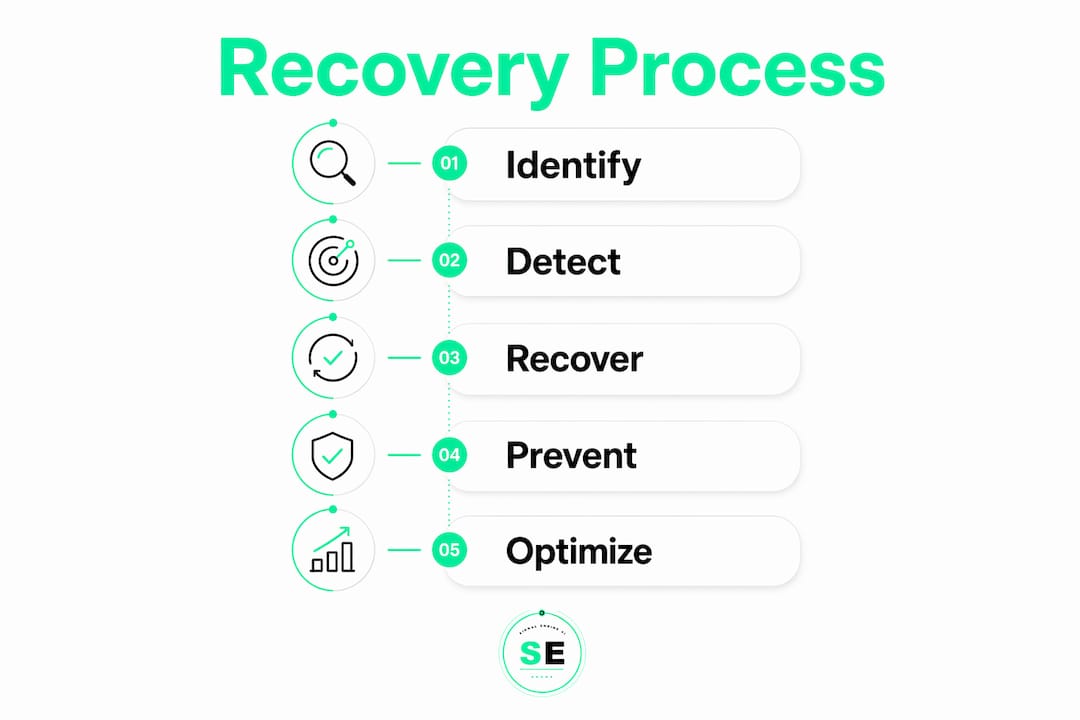
How lost revenue recovery works: the core process
Revenue recovery, known in finance and SaaS circles as revenue leakage management, operates on a simple principle. Money you are owed but not collecting is money you have already lost. The recovery process identifies where those gaps exist, quantifies the dollar impact, and applies targeted fixes.
The process breaks into three stages:
- Detection: Find where revenue is leaking using billing audits, CRM reconciliation, and payment failure reports.
- Recovery: Apply the right tool or tactic to each leak type, whether that is a retry sequence, a pricing correction, or a direct customer call.
- Prevention: Feed findings back into your upstream systems so the same leak does not reopen next quarter.
Most businesses skip the third stage entirely. That is why the same billing errors appear quarter after quarter. Revenue recovery done right is a loop, not a one-time fix.
What causes lost revenue and how can it be identified?
Lost revenue has four primary sources, and each one requires a different detection method.
| Revenue leak source | Detection method |
|---|---|
| Failed payments | Payment gateway decline reports, dunning logs |
| Pricing misconfiguration | CRM vs. billing system MRR comparison |
| Contract enforcement gaps | Contract audit against invoiced amounts |
| Excess refunds (over 2%) | Refund rate monitoring in billing platform |
Failed payments are the most common and most recoverable source. Involuntary churn from payment failures accounts for 20–40% of subscription losses. That is not customers choosing to leave. That is customers whose cards expired or whose banks flagged a transaction, and your system never caught it.
Pricing drift is subtler. It happens when discounts are applied manually, plans are changed mid-cycle, or calculation errors slip through during product updates. The fix is a quarterly three-number match audit: compare your CRM contracted MRR, your billing system billed MRR, and your bank collected MRR. If those three numbers do not match within 0.5%, you have a leakage signal worth investigating.
Contract enforcement gaps show up in professional services and B2B SaaS. A client signs for a premium tier but gets billed at standard rates because no one updated the billing system after the deal closed. These gaps are often invisible until someone runs a line-by-line contract audit.
Excess refunds are a product signal disguised as a billing problem. Refund rates above 2% indicate a product-billing mismatch that no amount of faster refund processing will fix. You need to correct the upstream issue, not just speed up the payout.
How do businesses recover lost revenue from payment failures effectively?
Payment failure recovery is where most businesses have the fastest and largest wins. The industry standard is a layered recovery stack, and it works in sequence, not in parallel.
Here is how the layers stack up:
- Card updater services (like Visa Account Updater or Mastercard Automatic Billing Updater) refresh expired card data before the charge even attempts. This layer is the cheapest fix per recovered dollar.
- Smart retry logic handles most recoverable soft declines. A soft decline means the card was temporarily unavailable, not permanently blocked.
- Multi-channel dunning catches the remaining customers through email, SMS, and in-app notifications.
Layered recovery stacks that combine card updaters, intelligent retry logic, and empathetic multi-channel communications recover significantly more revenue than any single method alone. A 4-touch retry sequence combined with a card updater recovers 60–70% of failed payments. Businesses recovering less than 40% almost always have a broken dunning process.
| Recovery method | Typical recovery rate | Best use case |
|---|---|---|
| Card updater only | 20–30% | Expired card declines |
| Smart retries only | 30–45% | Soft declines, insufficient funds |
| Multi-channel dunning only | 25–40% | Customers who need a nudge |
| Full layered stack | 60–70% | All involuntary churn scenarios |
Multi-channel recovery also reduces involuntary churn by up to 34% compared to email-only approaches. That number reflects the compounding effect of reaching customers through the channel they actually respond to.
Pro Tip: Do not stop recovery efforts at the 7–14 day mark. Extending recovery windows beyond two weeks and shifting to personalized outreach for high-value subscribers significantly increases total recovery. High-MRR customers are still reachable after standard dunning windows close.
What nuanced strategies improve revenue recovery beyond automation?
Automation handles volume. Human judgment handles value. The most effective lost revenue management programs use both, and they know exactly when to switch between them.
Automated dunning alone misses recoverable revenue from high-MRR accounts. A $5,000 per month account that fails payment deserves a personal call from an account manager, not a generic email sequence. Personalized outreach preserves the relationship and opens the door to flexible payment arrangements that automation cannot offer.
Strategic retry timing is another lever most businesses ignore. Retrying a failed payment at 2 a.m. on a Sunday produces worse results than retrying on a Tuesday morning after payroll cycles have cleared. Aligning retry attempts with issuer reset windows and customer payroll schedules meaningfully improves success rates.
Fraud risk is real in this process. Retrying failed payments indiscriminately triggers fraud blocks that make future recovery harder. Hard decline codes like "stolen card" or "lost card" should immediately route to manual contact, not another automated retry. Respecting those codes protects your merchant reputation and your customer relationship simultaneously.
Pro Tip: Add in-app notifications to your dunning sequence. Email open rates drop sharply after the first message. An in-app banner or push notification catches customers who are actively using your product but have not checked their inbox. This is especially effective for SaaS and subscription app businesses.
The continuous feedback loop is what separates a mature recovery program from a reactive one. Every billing anomaly your team catches should trigger a process review. If a pricing misconfiguration caused $12,000 in leakage last quarter, the fix is not just recovering that $12,000. The fix is updating the registration script or coding workflow that allowed the error to occur in the first place.
How to implement a continuous lost revenue recovery process
Building a sustainable recovery workflow requires structure, not just tools. Here is a practical sequence for revenue managers ready to build this out.
- Run a quarterly reconciliation audit. Compare your CRM contracted MRR, billing system billed MRR, and bank collected MRR. Any gap above 0.5% is a recovery opportunity. Use your recurring revenue analyzer to automate this comparison.
- Prioritize by dollar impact and customer value. Not every leak deserves the same response. A $50 failed payment from a month-to-month customer gets an automated sequence. A $5,000 annual contract gap gets a human on the phone.
- Deploy recovery software integrated with your billing and CRM systems. Software that sits outside your billing stack cannot act on real-time signals. Integration is what makes automation fast enough to matter.
- Track four KPIs every month: recovery rate (percentage of failed payments recovered), churn reduction, total revenue saved, and customer retention rate post-recovery.
- Feed findings upstream. Every recovered leak should trigger a process review. Billing reconciliation is a continuous cycle, not a one-time accounting task. Excess refunds above 2% signal a product-billing mismatch that requires a product-level correction, not just a billing fix.
| KPI | What it measures | Target benchmark |
|---|---|---|
| Recovery rate | % of failed payments recaptured | 60–70% with full stack |
| Churn reduction | Involuntary churn decrease | Up to 34% with multi-channel |
| Revenue saved | Dollar value recovered per quarter | Track vs. prior quarter |
| Retention post-recovery | Customers retained after dunning | Above 80% for healthy programs |
The role of AI in revenue recovery is growing fast. AI tools now score accounts by recovery likelihood, flag anomalies in real time, and recommend whether to route an account to automation or a human rep. That kind of triage used to require a dedicated analyst. Now it runs in the background while your team focuses on relationships.
Key takeaways
Revenue recovery works best as a continuous, layered process that combines automated detection with strategic human outreach and upstream process correction.
| Point | Details |
|---|---|
| Layered recovery stacks win | Combining card updaters, smart retries, and multi-channel dunning recovers 60–70% of failed payments. |
| Three-number match audits detect leaks | Comparing CRM, billing, and bank MRR figures reveals pricing drift and recoverable gaps above 10%. |
| Human outreach protects high-value accounts | Automated dunning alone misses high-MRR accounts that need personalized contact and flexible payment options. |
| Extend recovery windows past 14 days | High-value subscribers remain reachable beyond standard dunning timelines, increasing total recovery. |
| Feed findings back upstream | Every billing anomaly should trigger a process fix to prevent the same leak from recurring next quarter. |
Why automation alone is not enough: a revenue manager's honest take
I have reviewed revenue recovery programs across dozens of businesses, and the pattern is almost always the same. The automation is set up correctly. The retry logic fires on schedule. The dunning emails go out. And yet, the business is still losing 25–30% of recoverable revenue every quarter.
The gap is almost never the technology. It is the assumption that technology is sufficient. A $500 per month customer who misses a payment gets the same email sequence as a $15,000 per year account. That is not a strategy. That is a template.
The businesses that recover the most revenue treat their prioritize accounts workflow as seriously as their sales pipeline. They know which accounts are worth a personal call, which ones respond to SMS, and which ones need a payment plan conversation. They also know that catching churn early, before a payment even fails, is worth more than any dunning sequence.
My honest advice: build the automation first, because it handles the volume. Then build the human layer on top, because it handles the value. And never, ever treat a recovered payment as the end of the process. Ask why it failed. Fix the upstream cause. That is how you stop recovering the same dollar twice.
— Bernard
Recover more revenue with Signalengine's AI tools
If the strategies in this article sound like exactly what your business needs but you do not have the team to execute them manually, Signalengine was built for that gap.
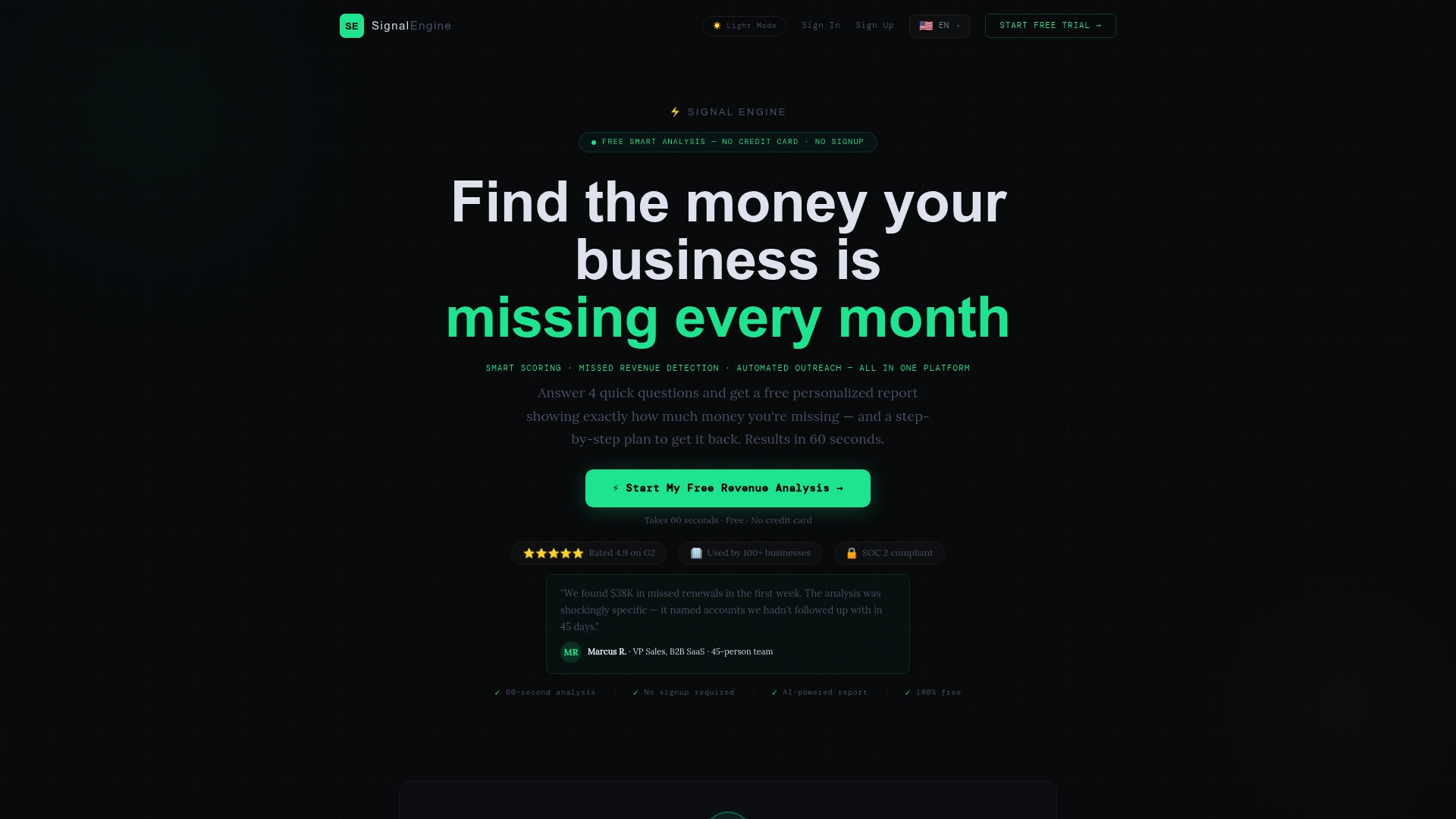
Signalengine's AI-powered revenue intelligence platform watches your customers, scores their payment risk automatically, flags who is about to churn, and triggers recovery sequences without you lifting a finger. It covers 12 verticals including HVAC, logistics, dental, and real estate. Pricing starts at $49 per month, built for SMBs that need enterprise-grade recovery without enterprise-grade overhead. You get 31 tools in one dashboard, including churn prediction, automated dunning, and real-time billing anomaly detection.
Ready to Stop the Revenue Leak?
Signal Engine gives small and local businesses 31 AI-powered tools to score leads by buying intent, predict churn before it happens, auto-generate email and SMS campaigns, and recover missed calls automatically — all in one dashboard starting at $49/month.
Start your free 7-day trial — no credit card required. Setup takes 5 minutes.
FAQ
What is lost revenue recovery?
Lost revenue recovery is the process of identifying and recapturing income that a business failed to collect due to failed payments, billing errors, pricing drift, or contract gaps. It combines automated tools like dunning sequences with manual outreach for high-value accounts.
How much revenue can a business recover from failed payments?
A business using a full layered recovery stack, including card updaters, smart retries, and multi-channel dunning, recovers 60–70% of failed payments. Businesses recovering less than 40% typically have incomplete or single-channel dunning processes.
Why is revenue recovery important for subscription businesses?
Involuntary churn from payment failures accounts for 20–40% of subscription losses. Most of that churn is preventable with the right recovery process, making revenue recovery one of the highest-return activities a subscription business can invest in.
How often should businesses run revenue reconciliation audits?
Quarterly audits are the standard best practice. The three-number match process, comparing CRM contracted MRR, billing system billed MRR, and bank collected MRR, detects pricing drift and recoverable revenue gaps that accumulate between billing cycles.
When should a business use human outreach instead of automated dunning?
Human outreach is most effective for high-MRR accounts where a personal relationship and flexible payment options matter. Automated dunning alone misses these accounts because templates cannot negotiate, empathize, or adapt to a customer's specific situation.