

TL;DR:
- A revenue recovery workflow involves systematically identifying, scoring, and acting on overdue accounts to recover unpaid revenue. Implementing risk scoring, segmentation, escalation, and automation enhances collection effectiveness and preserves customer relationships. Proper governance and real-time data are essential for a consistent and successful AR management process.
A revenue recovery workflow is the structured process of identifying, scoring, and acting on overdue accounts to collect unpaid revenue before it becomes unrecoverable. The industry term for this discipline is accounts receivable (AR) management, and the ability to prioritize accounts revenue recovery workflow separates businesses that consistently collect from those that write off avoidable losses. Platforms like Oracle Advanced Collections, Zuora, and InvoiceGrid have built entire product lines around this problem because the stakes are real. Invoices aged 90+ days carry collection rates below 40%. Every week you delay scoring and segmenting your overdue accounts, that number drops further.
What are the core components of a prioritized revenue recovery workflow?
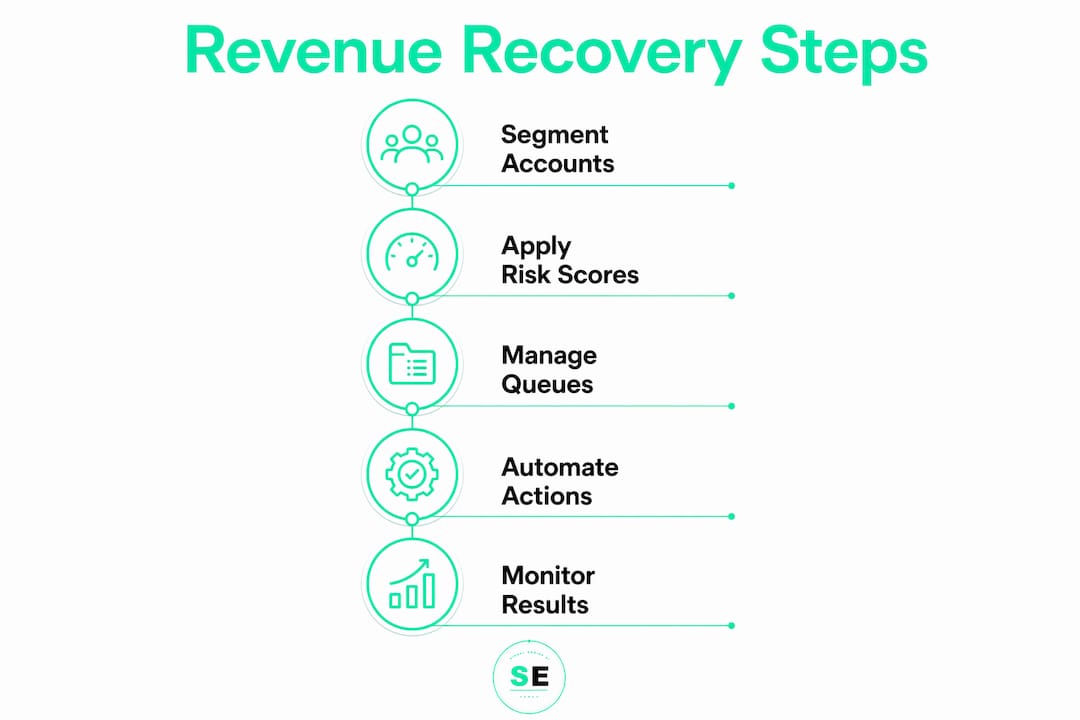
A prioritized recovery workflow is built on four layers: segmentation, risk scoring, escalation rules, and self-service options. Each layer depends on the one before it. Skip segmentation and your scoring model has no foundation. Skip scoring and your collectors are guessing.
AR aging buckets are the base segmentation tool. Every overdue account falls into one of four categories:
- 0–30 days past due: Low risk. Automated reminders are sufficient.
- 31–60 days past due: Moderate risk. Personalized outreach begins.
- 61–90 days past due: High risk. Human escalation is triggered.
- 90+ days past due: Very high risk. Legal or collections review is required.
Recalculating priority scores weekly keeps your chase list current and prevents stale data from misdirecting collector effort. Accounts move between buckets fast, and a score that was accurate seven days ago may now be dangerously low.
Risk scoring adds depth beyond age alone. A strong model combines invoice amount, days past due, payment history, customer financial health, and responsiveness into a single composite score. 30–40% of unpaid invoices result from billing disputes rather than inability to pay. That means a pure dunning approach misses nearly a third of your recovery opportunities. Your workflow must include dispute-resolution paths alongside standard outreach.

The final layer is self-service. Payment portals that let customers resolve balances on their own schedule reduce friction and compress days sales outstanding (DSO) without requiring collector time. Zuora's AR playbook identifies this orchestrated combination of technical retries, workflow automation, and self-service as the foundation of modern collections success.
How do businesses implement risk scoring and queue management?
Risk scoring turns subjective collector judgment into a repeatable, auditable number. The most practical framework assigns 1–5 points per factor across five dimensions: invoice amount, days past due, payment history, customer financial health, and responsiveness to prior outreach.
Here is how to build a working scoring system:
- Assign points per factor. A $10,000+ invoice scores 5 on amount. An invoice 90+ days overdue scores 5 on age. A customer who has never missed a payment scores 1 on payment history risk.
- Calculate a composite score out of 20. Add all five factor scores together.
- Set a daily-call threshold. Accounts scoring 12 or higher out of 20 receive daily collector contact. Accounts below 8 stay in automated sequences.
- Build tiered work queues. Segment queues by risk tier, aging bucket, and account size. A large-account, high-score queue gets your best collectors. A low-score, small-account queue runs on automation.
- Automate next-action triggers. When a score crosses a threshold, the system assigns the next action automatically. Collectors review their queues daily and work from the top down.
This approach removes the single biggest inefficiency in most AR operations: collectors deciding for themselves which accounts to call. That decision should be made by the scoring model, not by habit or gut feel.
Pro Tip: Review your scoring model's output distribution monthly. If 60% of your accounts cluster in the same risk tier, your point weights need recalibration. A well-tuned model spreads accounts across tiers and gives collectors a clear, differentiated priority list.
Salesforce-based AR implementations recommend pairing tiered queues with automated weekly AR summary reports sent to leadership. That visibility keeps executives informed without requiring manual reporting from collectors.
What are best practices for escalation timing and communication cadences?
Escalation timing is the schedule that governs when and how you contact customers based on invoice age and risk score. Getting this wrong in either direction costs you money. Contact too early and you damage relationships. Contact too late and you lose the debt.
The proven escalation sequence looks like this:
- 3–5 days before due date: Send a pre-due reminder. This is the single most underused tactic in AR management. Automated sequences that start before the due date compress DSO by 3–7 days on average.
- 1–7 days past due: Friendly reminder. Tone is helpful, not accusatory. Assume the customer forgot.
- 14 days past due: Firmer follow-up. Reference the original invoice, state the balance clearly, and offer a payment link.
- 30 days past due: Formal notice. Apply late fees if your contract allows. Late fees serve a dual purpose: they recover carrying costs and they signal seriousness.
- 60–90 days past due: Collections review or legal consideration. At this stage, the relationship cost of inaction exceeds the relationship cost of escalation.
The accounts most worth protecting are often the ones you are most reluctant to escalate. High-value customers who go 60+ days overdue without explanation are a retention risk, not just a collections problem. Treat them accordingly: escalate the invoice, but assign your most experienced collector to the account.
Customizing communication tone by customer segment matters more than most AR teams acknowledge. A long-term customer with one late invoice gets a different message than a new customer with three. Your workflow should encode these distinctions as rules, not leave them to individual collector discretion.
How can automation and technology improve recovery workflows?
Automation is what makes a prioritization framework scale. Without it, even a well-designed scoring model collapses under the volume of a real AR portfolio.
The table below maps key automation capabilities to the platforms that deliver them:
| Capability | Platform Examples | Primary Benefit |
|---|---|---|
| Automated escalation rules | Oracle Advanced Collections, Zuora | Removes manual decision-making from status transitions |
| Tiered collector queues | Salesforce AR automation | Assigns accounts by risk tier and account size automatically |
| Pre-due date dunning sequences | InvoiceGrid, LedgerUp | Compresses DSO by 3–7 days per cycle |
| Self-service payment portals | Zuora, InvoiceGrid | Recovers revenue without collector time |
| Dispute pause-and-route workflows | Oracle Advanced Collections | Prevents disputed invoices from entering standard chase queues |
Dispute handling deserves special attention. Misrouting disputed invoices into normal chase queues wastes collector effort and damages customer relationships. A properly configured automation layer detects dispute flags and routes those accounts to a resolution workflow, not a dunning sequence.
AI-powered scoring adds a dynamic layer on top of static rules. Instead of recalculating scores manually each week, AI models monitor payment behavior in real time and adjust priority rankings as new signals arrive. Signalengine applies this approach across 12 verticals, scoring customer behavior automatically and flagging accounts that need immediate attention before they age into the high-risk bucket. You can explore at-risk account alerts to see how automated monitoring works in practice.
Pro Tip: Before selecting an automation platform, map your dispute rate. If more than 25% of your overdue invoices involve billing disputes, prioritize platforms with built-in dispute-resolution routing over those that focus exclusively on dunning sequences.
Choosing the right back-office workflow to automate first is itself a strategic decision. AR prioritization typically delivers faster ROI than most other back-office automation candidates because the revenue impact is direct and measurable.
What governance and compliance measures support effective prioritization?
Governance is what keeps a prioritization workflow consistent over time. Without it, individual collectors revert to personal habits, status fields go stale, and your scoring model loses accuracy because the data feeding it is unreliable.
The comparison below shows the difference between governed and ungoverned workflows:
| Dimension | Governed Workflow | Ungoverned Workflow |
|---|---|---|
| Status transitions | Defined rules: Open → Delinquent → Resolution, with manager approval | Collectors update status manually, inconsistently |
| Account assignment | Automated by risk tier and account size | Assigned by manager discretion or rotation |
| Dispute handling | Automated pause-and-route to resolution queue | Disputed accounts remain in standard chase queue |
| Prioritization rules | Deterministic matrix using amount and days-in-arrears thresholds | Collector judgment, variable by individual |
| Audit trail | Full tracking of actions, escalations, and approvals | Partial or no documentation |
Oracle's collections lifecycle model defines delinquency status changes as system-triggered events with manager approvals and automated assignments at each transition. That structure is not bureaucracy. It is the mechanism that makes your prioritization model auditable and defensible.
Deterministic prioritization matrices are particularly valuable for regulated industries or large enterprises. A rule that flags residential accounts as highest priority when arrears exceed $5 and are more than 50 days old removes subjectivity entirely. Every collector sees the same priority list. Every escalation follows the same path. Policies without automated enforcement rarely change collection outcomes in practice.
Key takeaways
A structured, data-driven approach to accounts receivable management is the single most reliable way to recover overdue revenue without damaging customer relationships.
| Point | Details |
|---|---|
| Start with AR aging buckets | Segment all overdue accounts into 0–30, 31–60, 61–90, and 90+ day buckets before applying any scoring. |
| Use composite risk scores | Score accounts on five factors and focus daily collector calls on accounts scoring 12 or higher out of 20. |
| Start outreach before the due date | Pre-due date reminders sent 3–5 days early compress DSO by 3–7 days per billing cycle. |
| Automate dispute routing | Keep disputed invoices out of standard chase queues to protect customer relationships and collector efficiency. |
| Enforce governance with rules, not discretion | Deterministic matrices and manager-approved status transitions produce consistent, auditable recovery outcomes. |
What i've learned about prioritization that most guides skip
Most AR prioritization guides tell you to build a scoring model and automate your dunning. That advice is correct but incomplete. The part that actually determines whether your workflow succeeds or fails is what happens at the edges: disputed invoices, broken payment plans, and accounts that score high but are flagged for relationship sensitivity.
I have seen well-designed scoring models produce worse outcomes than manual processes because the governance layer was missing. Collectors received accurate priority lists and then overrode them based on familiarity with certain accounts. Without manager approval requirements at key status transitions, the model's output was advisory at best.
The second thing most guides understate is the value of technical retries before human outreach. A significant share of failed payments are card declines or expired payment methods, not customer decisions. Running automated retries at staggered intervals before a human ever contacts the customer recovers a meaningful portion of that revenue at zero relationship cost.
The third lesson is harder to operationalize: your scoring model is only as good as the data feeding it. If your CRM has stale contact records, your responsiveness scores are wrong. If your billing system has unresolved disputes sitting in "open" status, your risk scores are inflated. Investing in revenue recovery reporting infrastructure before you build the scoring model pays off faster than most finance leaders expect.
Build the governance layer first. Then build the scoring model. Then automate. In that order.
— Bernard
How Signalengine turns your recovery workflow into a revenue engine
Your scoring model is only as fast as the data behind it. Signalengine watches your customer accounts continuously, scores behavior automatically, and flags who needs attention before invoices age into the danger zone.

With Signalengine's AI-powered revenue intelligence tools, you get automated risk alerts, pre-built recovery campaign sequences, and a prioritized worklist that updates in real time. No spreadsheets. No manual scoring. No missed follow-ups. Built for SMBs across HVAC, logistics, dental, real estate, and 8 other verticals. Priced starting at $49/month.
See how it works for your business at the Signal Engine live demo.
FAQ
What is a revenue recovery workflow in AR management?
A revenue recovery workflow is the structured process of segmenting, scoring, and acting on overdue accounts to collect unpaid balances before they become unrecoverable. It combines AR aging buckets, risk scoring, escalation rules, and automation into a repeatable system.
How do i prioritize which overdue accounts to contact first?
Score each account on five factors: invoice amount, days past due, payment history, customer financial health, and responsiveness. Accounts scoring 12 or higher out of 20 receive daily collector contact; lower-scoring accounts stay in automated sequences.
When should dunning sequences start for best recovery results?
Dunning sequences starting 3–5 days before the invoice due date consistently compress DSO by 3–7 days. Starting before the due date is the single highest-impact timing adjustment most businesses can make.
Why do disputed invoices need separate workflow routing?
Routing disputed invoices into standard chase queues wastes collector time and damages customer relationships. Disputes require a resolution workflow, not a dunning sequence, because the customer's objection is to the invoice itself, not the payment.
What governance controls improve collection consistency?
Defined status transitions with manager approvals, automated account assignment by risk tier, and deterministic prioritization matrices all reduce collector discretion and produce auditable, consistent outcomes across your entire AR portfolio.
Ready to stop the revenue leak?
Signal Engine gives small and local businesses 31 AI-powered tools to score leads by buying intent, predict churn before it happens, auto-generate email and SMS campaigns, and recover missed calls automatically — all in one dashboard starting at $49/month.
Start your free 7-day trial — no credit card required. Setup takes 5 minutes.