

TL;DR:
- Revenue recovery involves proactively reclaiming income lost due to failed payments, billing errors, and involuntary churn. It is a growth strategy that ensures cash flow stability, reduces bad debt, and relies on automated, segmentation-based processes enhanced by AI technology. Implementing structured ownership, continuous measurement, and tailored communication strategies can significantly improve recovery rates within weeks.
Revenue recovery is the proactive process businesses use to reclaim income lost to failed payments, billing errors, involuntary churn, and missed renewal opportunities before those losses compound into a financial crisis. Most business leaders focus on acquiring new customers while their existing revenue pipeline silently drains. That is a costly blind spot. Effective revenue collection ensures financial health by providing realistic income forecasts and supporting reinvestment. Understanding why revenue recovery matters is not just a finance exercise. It is a growth strategy that protects every dollar your business has already earned.
Why revenue recovery matters for cash flow and financial sustainability
Revenue recovery directly determines whether your business can cover payroll, fund product development, and grow without taking on unnecessary debt. When income slips through the cracks, the damage compounds fast. A single month of unaddressed payment failures can create a cash shortfall that forces you to delay hiring, cut marketing, or draw down reserves.
The financial case is concrete. Technology-forward recovery programs consistently achieve 15 to 30% improvement in net recovery rates while maintaining customer satisfaction. That means a business losing $50,000 per year to bad debt could realistically recover $7,500 to $15,000 annually just by upgrading its recovery process. For a small business, that figure can represent an entire quarter of profit.
The benefits of revenue recovery extend beyond the immediate cash injection. Reduced bad debt expense lowers your cost of doing business. Automated recovery workflows cut the labor hours your team spends chasing overdue accounts. And when compliance automation applies regulations like Regulation F and TCPA consistently before any communication goes out, you eliminate the legal exposure that comes with manual collection efforts.
Pro Tip: Track your monthly revenue leakage as a percentage of total billed revenue. If that number exceeds 3%, you have a process problem that technology can fix faster than headcount can.
Key financial outcomes tied to strong recovery programs include:
- Improved cash flow predictability for operational planning
- Lower bad debt write-offs reducing pressure on gross margins
- Reduced collection labor costs through automation
- Minimized regulatory fines through built-in compliance controls
- Stronger reinvestment capacity for growth initiatives
What are the common causes of revenue loss and missed recovery opportunities?
Revenue leakage rarely announces itself. Most businesses discover the problem months after the money is gone. Understanding where losses originate is the first step toward closing them.
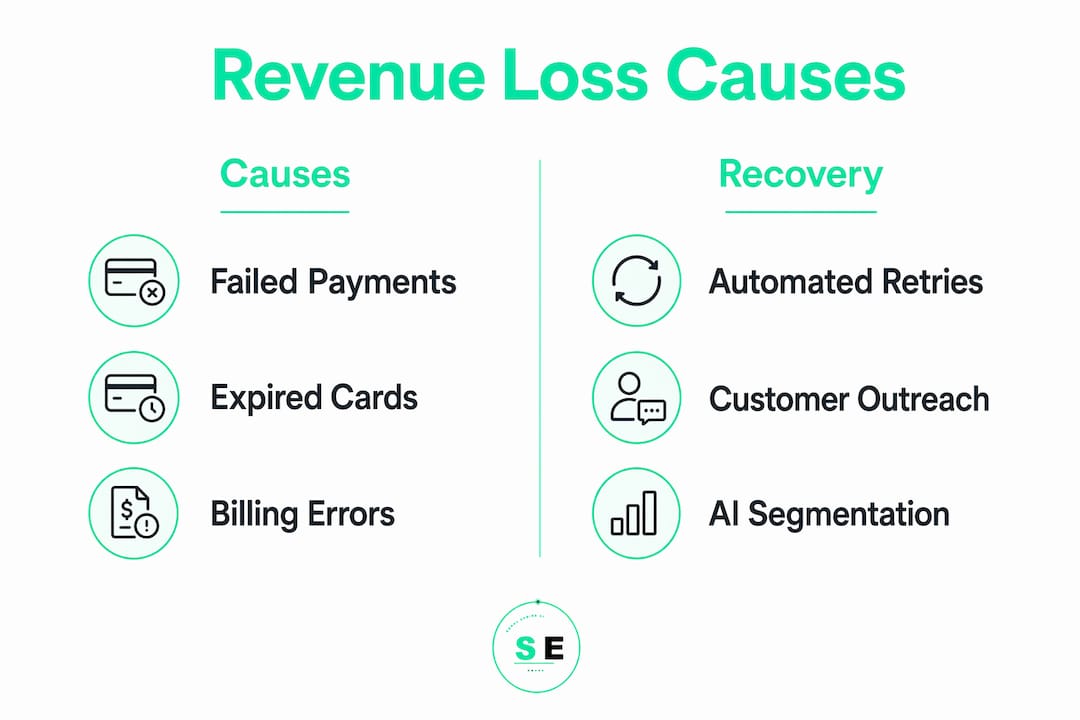
The single largest source of preventable revenue loss in subscription businesses is involuntary churn. Involuntary churn can represent 20 to 40% of total churn in subscription businesses. That means nearly half of the customers you think chose to leave actually left because a payment failed, not because they wanted to cancel. Failed subscription payments are projected to cost businesses $129 billion in lost revenue in 2025 alone. The scale of this problem is not a niche concern. It is a systemic failure across the subscription economy.
Here are the most common causes of revenue loss that businesses consistently underestimate:
- Expired or declined cards. Customers update their payment methods infrequently. Cards expire, banks reissue numbers after fraud events, and businesses that rely on a single retry attempt lose those customers permanently.
- Insufficient funds at retry time. Retrying a failed payment at the wrong moment in a customer's billing cycle guarantees failure. Timing matters more than frequency.
- Billing errors and invoice disputes. Incorrect charges, duplicate invoices, and pricing discrepancies create friction that delays payment and damages trust.
- Inefficient dunning processes. Generic, one-size-fits-all dunning emails sent at fixed intervals ignore customer behavior and produce low response rates.
- Manual, phone-heavy collection approaches. Phone-based collection is expensive, slow, and increasingly ineffective with customers who prefer digital self-service.
The contrast between voluntary and involuntary churn matters strategically. Voluntary churn signals a product or value problem. Involuntary churn signals a process problem. You can fix a process problem with technology in days. Fixing a product problem takes quarters.
| Churn type | Cause | Recovery approach |
|---|---|---|
| Involuntary churn | Failed payments, expired cards | Automated retry logic, smart dunning |
| Voluntary churn | Dissatisfaction, competitor switch | Customer success outreach, win-back campaigns |
| Billing error churn | Invoice disputes, overcharges | Audit workflows, real-time billing alerts |
How does modern technology enhance revenue recovery effectiveness?
The gap between businesses that recover 30% of failed payments and those that recover 70% is almost entirely explained by technology. Manual processes cannot compete with AI-driven automation at scale.

AI models segment delinquent accounts by likelihood to pay and optimize communication timing to increase recovery rates. This is not a marginal improvement. When you stop treating every overdue account the same way and start routing high-value, high-intent accounts to priority workflows, your recovery rate climbs and your cost per recovered dollar drops simultaneously.
The data on optimized retry logic is striking. Optimized retry strategies informed by network-level payment data can increase failed payment recovery rates by 10 to 20 percentage points over baseline retry logic. In practice, that translates from a 53% recovery rate to a 71% recovery rate without replacing your billing infrastructure. The improvement comes entirely from smarter sequencing.
"Expert recovery teams do not rely solely on platform defaults like Stripe's 8 retries over 2 weeks. They apply customer segmentation and data-driven retry sequencing to maximize recovery without customer friction." — Payment failure recovery playbook
Digital-first communication channels amplify these gains. Compliant email sequences, SMS outreach, and self-serve payment portals meet customers where they are. Customers who receive a personalized, well-timed text message with a direct payment link resolve their balance faster than customers who receive a generic dunning email three days after the failure.
Pro Tip: Do not treat smart retries as a universal solution. Use them as a timing layer inside a broader segmentation model. A high-value customer with a history of on-time payments deserves a different retry sequence than a new customer on a trial plan.
The revenue recovery reports that matter most to finance teams combine real-time retry status, contact rate data, and recovery rate by segment. Without that visibility, you are optimizing blind.
What practical steps can business leaders take to improve revenue recovery?
Improving revenue recovery does not require a six-month technology overhaul. Most businesses can close 50% of their leakage gap within 30 days by following a structured approach. The revenue recovery playbook for business leaders starts with accountability and ends with continuous measurement.
Follow these five steps to build a recovery program that holds:
- Assign clear ownership. Revenue recovery fails when it falls between finance, customer success, and operations. Designate one owner accountable for recovery metrics across all three functions.
- Map your leakage points. Audit your retry rates, churn split between voluntary and involuntary, and the dollar value sitting in each at-risk segment. You cannot recover what you have not measured.
- Replace blanket policies with segment-based strategies. Segment-specific retry policies produce better recovery results and lower customer friction than universal rules applied to every account.
- Deploy technology with compliance built in. Choose recovery software that automates regulatory compliance rather than treating it as a manual checklist. This protects you from TCPA and Regulation F violations at scale.
- Monitor key metrics weekly, not quarterly. Recovery rate by segment, average days to resolution, and cost per recovered dollar are the three numbers that tell you whether your program is working.
| Metric | What it measures | Target benchmark |
|---|---|---|
| Net recovery rate | % of failed payments successfully recovered | 65% or higher |
| Days to resolution | Average time from failure to payment | Under 14 days |
| Cost per recovered dollar | Total recovery cost divided by amount recovered | Below $0.15 |
| Involuntary churn rate | % of total churn from payment failures | Below 20% |
The businesses that execute this process consistently are the ones that treat revenue recovery as a standing operational function, not a reactive fire drill.
Key takeaways
Revenue recovery is a measurable, technology-driven discipline that directly protects cash flow, reduces bad debt, and enables sustainable growth when businesses replace manual processes with AI-powered automation and segment-specific strategies.
| Point | Details |
|---|---|
| Involuntary churn is underestimated | Up to 40% of subscription churn comes from payment failures, not customer decisions. |
| Technology closes the recovery gap | Optimized retry logic alone can lift recovery rates by 10 to 20 percentage points. |
| Segmentation beats blanket policies | Treating all delinquent accounts the same produces lower recovery and higher friction. |
| Compliance must be automated | Manual compliance checks create regulatory exposure at scale that software eliminates. |
| Ownership drives results | Assigning one accountable owner for recovery metrics is the single fastest organizational fix. |
Revenue recovery in 2026 is a strategic asset, not a back-office task
I have spent years watching business leaders treat revenue recovery as a cleanup function, something the finance team handles after the real work is done. That framing is expensive. The businesses I have seen grow most consistently are the ones that treat recovery as a front-line revenue function with the same rigor they apply to sales.
The most common mistake I see is confusing aggressive collection with effective recovery. They are not the same thing. Aggressive collection damages customer relationships and generates complaints. Effective recovery uses personalized, well-timed digital communication that gives customers a frictionless path to resolve their balance. The customer who pays through a self-serve portal at 11 PM on a Tuesday is not a collection success story. They are a retention success story.
The second mistake is trusting platform defaults. Stripe's default retry logic is a starting point, not a strategy. Every payment platform ships with generic settings designed to work for the average business. Your business is not average. Your customers have distinct payment behaviors, billing cycles, and communication preferences. The businesses winning at recovery in 2026 are the ones that have moved beyond defaults and built data-driven sequences tailored to their specific customer segments.
My advice to any business leader reading this: start by measuring what you are currently losing. Most leaders are genuinely shocked when they see the number. Once you see it, the case for investing in recovery technology becomes obvious. The ROI is not theoretical. It is sitting in your failed payment queue right now.
— Bernard
How Signal Engine helps you recover revenue automatically
If your pipeline is losing revenue to failed payments, missed renewals, or unaddressed churn risks, Signal Engine gives you the tools to find it and get it back fast.

Signal Engine's AI-powered recovery software identifies revenue leakage across your business, scores accounts by buy-readiness, and deploys automated outreach sequences without requiring a lengthy setup. The average business using Signal Engine identifies $38K in recovery potential within the first month. You can also use Signal Engine's revenue leakage detection tools to close hidden gaps before they become write-offs. Setup takes minutes, no credit card required, and you get a 30-day recovery playbook built for your specific situation. ⚡
Ready to Stop the Revenue Leak?
Signal Engine gives small and local businesses 31 AI-powered tools to score leads by buying intent, predict churn before it happens, auto-generate email and SMS campaigns, and recover missed calls automatically — all in one dashboard starting at $49/month.
Start your free 7-day trial — no credit card required. Setup takes 5 minutes.
FAQ
What is revenue recovery in business?
Revenue recovery is the process of reclaiming income lost to failed payments, billing errors, involuntary churn, and missed renewal opportunities. It combines automated retry logic, dunning workflows, and AI-driven segmentation to recover at-risk revenue before it becomes a write-off.
How much revenue do businesses lose to failed payments?
Failed subscription payments are projected to cost businesses $129 billion in 2025. Involuntary churn from payment failures can represent 20 to 40% of total churn in subscription businesses, making it one of the largest preventable sources of revenue loss.
What is the difference between voluntary and involuntary churn?
Voluntary churn occurs when a customer actively cancels. Involuntary churn occurs when a customer loses access because a payment failed. Involuntary churn is recoverable with the right retry and dunning strategy. Voluntary churn requires a product or customer success response.
How does AI improve revenue recovery rates?
AI segments delinquent accounts by payment likelihood and optimizes the timing and channel of outreach. Optimized retry strategies informed by network-level data can increase recovery rates by 10 to 20 percentage points over standard platform defaults.
What metrics should I track for revenue recovery?
Track net recovery rate, average days to resolution, cost per recovered dollar, and involuntary churn rate. A net recovery rate above 65% and an average resolution time under 14 days indicate a well-functioning recovery program.