

TL;DR:
- Most revenue leakage stems from billing mismatches and process errors rather than sales deficiencies.
- Using quote-to-cash audits and AI-driven reconciliation, businesses can identify and recover lost income efficiently.
Missed revenue opportunities are defined as income a business has already earned or could reasonably capture but fails to collect due to process failures, billing errors, or unaddressed customer churn. For consultants and business leaders, the formal term is revenue leakage, and it is far more common than most clients realize. Revenue leakage sources include approved renewals with no invoice issued, add-ons that never start billing, and pricing gaps that compound silently over months. The goal of any revenue opportunity analysis is not to find new demand. It is to recover income the business already generated but never collected.
How to identify missed revenue opportunities clients are losing right now
The first step is accepting that most revenue leakage is a reconciliation problem, not a sales problem. Missed revenues arise from mismatches between contract terms, billing system configuration, and actual billed amounts, often caused by spreadsheet errors and manual prorations. That distinction matters because it changes where you look. You are not analyzing marketing funnels. You are auditing the gap between what was agreed and what was actually charged.

Three named frameworks anchor this work: the quote-to-cash (Q2C) audit from OpsEthic, the SaaS revenue leakage model from Banyan, and the automated reconciliation approach from Zuora. Each targets a different layer of the same problem. Together, they give consultants a complete picture of where client revenue potential is being lost and how to quantify it before presenting a recovery plan.
Which operational processes cause the most revenue leakage?
Revenue leakage concentrates at predictable failure points inside the quote-to-cash cycle. Understanding these failure points is the fastest way to uncover revenue gaps without months of investigation.
The four primary leakage categories are:
- Pricing drift. Discounts approved during negotiation never get updated in the billing system. The client charges less than the contract specifies, indefinitely.
- Billing errors. Manual invoice generation introduces miscalculations, wrong line items, or missing charges. Quote exceptions and handoff errors along the Q2C path are a leading cause.
- Usage underbilling. SaaS and subscription clients frequently fail to bill for add-ons, overages, or usage tiers that customers have already consumed.
- Renewal failures. Approved renewals with no invoice issued are one of the most common and costly leakage types in subscription businesses. Renewal leakage also includes add-ons that start billing one cycle late or never.
Fragmented ownership makes all of these worse. When sales, finance, and customer success each manage separate pieces of the billing workflow without shared handoff rules, errors accumulate. Small exceptions explain individually but yield costly collective leakage across a client's entire book of business.
Pro Tip: Ask your client to pull 90 days of invoice data and count how many line items required manual correction. That rework count is your fastest proxy for leakage volume before you run a full audit.
What tools and metrics detect and quantify revenue gaps?
Detecting lost revenue streams requires both the right metrics and the right tooling. Metrics tell you where to look. Tools tell you how much you are missing.
Key KPIs for revenue opportunity analysis
| KPI | What it measures | Why it matters |
|---|---|---|
| Churn rate | Percentage of customers lost per period | High churn signals unaddressed renewal leakage |
| Invoice error rate | Percentage of invoices requiring correction | Direct indicator of billing process failure |
| Days Sales Outstanding (DSO) | Average days to collect payment | Elevated DSO reveals collections delays compounding leakage |
| Renewal rate | Percentage of contracts successfully renewed | Low renewal rate exposes missed recurring revenue |
| Revenue vs. forecast variance | Actual vs. projected revenue gap | Quantifies total leakage before segmentation |
Revenue shortfall analysis combines actual versus forecast revenue comparison and segments the gap by drivers such as churn, pipeline issues, bottlenecks, and pricing errors. That segmentation is what converts a vague "we're leaving money on the table" observation into a prioritized recovery plan.
For tooling, the choice between manual audits and automated platforms is not close. AI-driven continuous reconciliation detects billing gaps before the invoice cycle closes, when recovery is still fully possible. Traditional quarterly audits catch the same gaps weeks or months later, when partial recovery through negotiation is the best realistic outcome. Zuora's automated reconciliation engine matches over 95% of routine transactions instantly, reducing manual audit risk and accelerating exception handling. Manual spreadsheets, by contrast, carry high audit risk due to the absence of version control and traceability.
- Start with your client's revenue vs. forecast variance report.
- Segment the gap by cause: churn, billing errors, pricing drift, renewal failures.
- Run a cycle-time audit on Q2C stages to locate bottlenecks.
- Count rework events per invoice cycle to quantify manual error frequency.
- Layer in an automated reconciliation tool to catch ongoing gaps in real time.
Pro Tip: If your client is on Zuora or a similar subscription billing platform, request an exception report filtered by manual overrides. Every manual override is a potential leakage event.
How to execute a step-by-step revenue opportunity analysis
A structured analysis separates consultants who find $10,000 in recoverable revenue from those who find $200,000. The difference is sequencing. You confirm the shortfall first, then locate the cause, then build the recovery plan.
Step 1: Confirm and quantify the revenue shortfall
Pull actual revenue against forecast for the trailing 12 months. Segment the variance by customer segment, product line, and billing cycle. This gives you a dollar figure attached to a specific area of the business, not a vague estimate. Cross-functional investigation of sales, customer success, and finance data is required at this stage. No single team has the full picture.
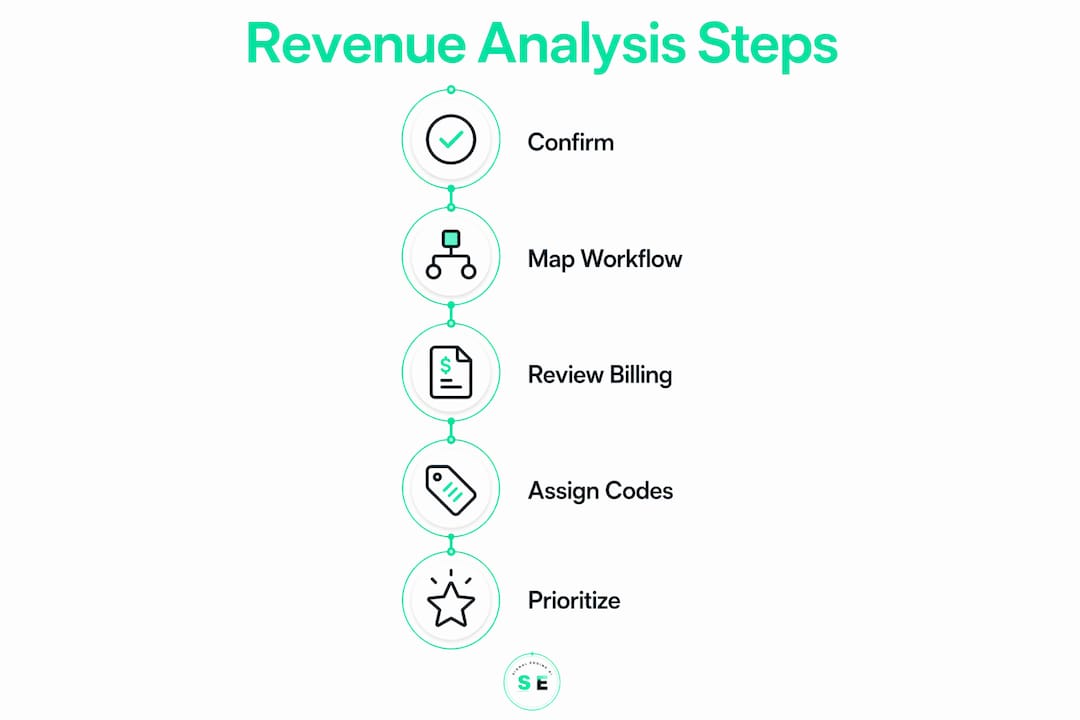
Step 2: Map the quote-to-cash workflow
Walk every stage from signed contract to cash received. Document who owns each handoff, what system holds the data, and where manual steps exist. Auditing 90 days of cycle-time data and counting rework events at each stage reveals the exact bottlenecks generating leakage. Most clients have never done this exercise. The results are almost always surprising.
Step 3: Review billing configurations and renewal execution
Compare contract terms directly against billing system configuration. Look for:
- Discounts applied in CRM but not reflected in the billing platform
- Usage tiers that trigger manually rather than automatically
- Renewal dates with no corresponding invoice in the queue
- Add-ons activated by customer success but never added to the billing record
This is where the largest recoverable amounts typically hide. Aligning contract to billing data directly and automating reconciliation produces the largest recoveries.
Step 4: Assign root cause codes and prioritize
Not all leakage is equal. Categorize each identified gap by cause (pricing drift, billing error, renewal failure, usage underbilling) and by recovery difficulty (immediate, requires negotiation, unrecoverable). Build a prioritized recovery action plan that addresses the highest-value, lowest-friction items first. This structure is what makes your findings credible to a CFO, not just a consultant's opinion.
Comparison: manual audit vs. AI-assisted reconciliation
| Factor | Manual audit | AI-assisted reconciliation |
|---|---|---|
| Detection timing | Quarterly, after invoice close | Continuous, before invoice close |
| Recovery potential | Partial, requires negotiation | Full recovery when caught early |
| Error coverage | Sample-based | Comprehensive transaction matching |
| Scalability | Limited by analyst bandwidth | Scales across entire billing history |
What strategies recover missed revenue and prevent future leakage?
Recovery without prevention is just a one-time fix. The goal is to build a system that catches leakage before it compounds.
- Assign named process owners. Every Q2C handoff needs a single accountable owner with defined SLAs. Named process owners and handoff rules with weekly exception reviews prevent leakage more reliably than deploying new software alone.
- Automate contract-to-billing data sync. Manual reconciliation between CRM, CPQ, and billing systems is the single largest source of billing errors. Automated sync eliminates the gap at the source.
- Deploy AI-powered leakage detection. Platforms that run continuous revenue reconciliation catch gaps before invoices close, when full recovery is still on the table. This is a structural advantage over any audit-based approach.
- Launch renewal rescue campaigns. For subscription clients, a 60-day pre-renewal outreach sequence targeting at-risk accounts protects recurring revenue that would otherwise churn silently. You can find a practical framework for this in the revenue recovery playbook for business leaders.
- Fix the process before adding automation. This point cannot be overstated. Automating a broken workflow accelerates errors. Mapping broken processes and assigning ownership before investing in automation is the correct sequence, not the reverse.
Pro Tip: When presenting recovery strategies to a client, lead with the process fixes, not the software. Clients who see you fix the root cause first trust your technology recommendations far more.
Key takeaways
Identifying missed revenue opportunities for clients is primarily a reconciliation and process discipline problem, not a demand generation challenge.
| Point | Details |
|---|---|
| Leakage is a reconciliation issue | Most missed revenue comes from billing mismatches, not insufficient sales volume. |
| Q2C audit is the core method | Mapping quote-to-cash stages and counting rework events locates the highest-value gaps. |
| AI detection outperforms audits | Continuous reconciliation catches gaps before invoice close, enabling full recovery. |
| Process ownership prevents recurrence | Named owners and handoff SLAs stop leakage from returning after recovery. |
| Sequence matters | Fix broken processes before deploying automation to avoid compounding existing errors. |
Why most revenue recovery efforts miss the real problem
I have worked with enough consulting engagements to say this plainly: the majority of revenue leakage I have seen is not a sales problem. It is a data alignment problem. The contract says one thing. The billing system says another. Nobody noticed because the gap was $200 per account per month, and no single person owned the reconciliation.
The uncomfortable truth is that client accounting services open doors to uncovering unrecognized revenue potential that most advisory relationships never reach. Consultants who position themselves close to a client's financial operations, not just their strategy, find the real money. The ones who stay at the strategy level write reports about growth opportunities while the billing system quietly drains the pipeline.
I also push back hard on the instinct to automate first. Every time I have seen a client rush to deploy a reconciliation platform before fixing their Q2C handoffs, the platform just automates the wrong charges faster. The sequence is non-negotiable: map the process, assign ownership, fix the breaks, then automate. That order is not a preference. It is the difference between a successful recovery and an expensive tool that nobody trusts.
The consultants who consistently find hidden client value are the ones who ask for the billing exception report on day one, not the revenue forecast. The forecast tells you there is a gap. The exception report tells you where the money went.
— Bernard
How Signalengine helps you find and recover client revenue fast
Identifying where your client's pipeline is silently draining is the hard part. Acting on it fast is where Signalengine delivers. The Signal Engine pipeline intelligence platform gives consultants and business leaders AI-powered deal tracking, churn prediction, and automated outreach in one dashboard, with no lengthy onboarding required.
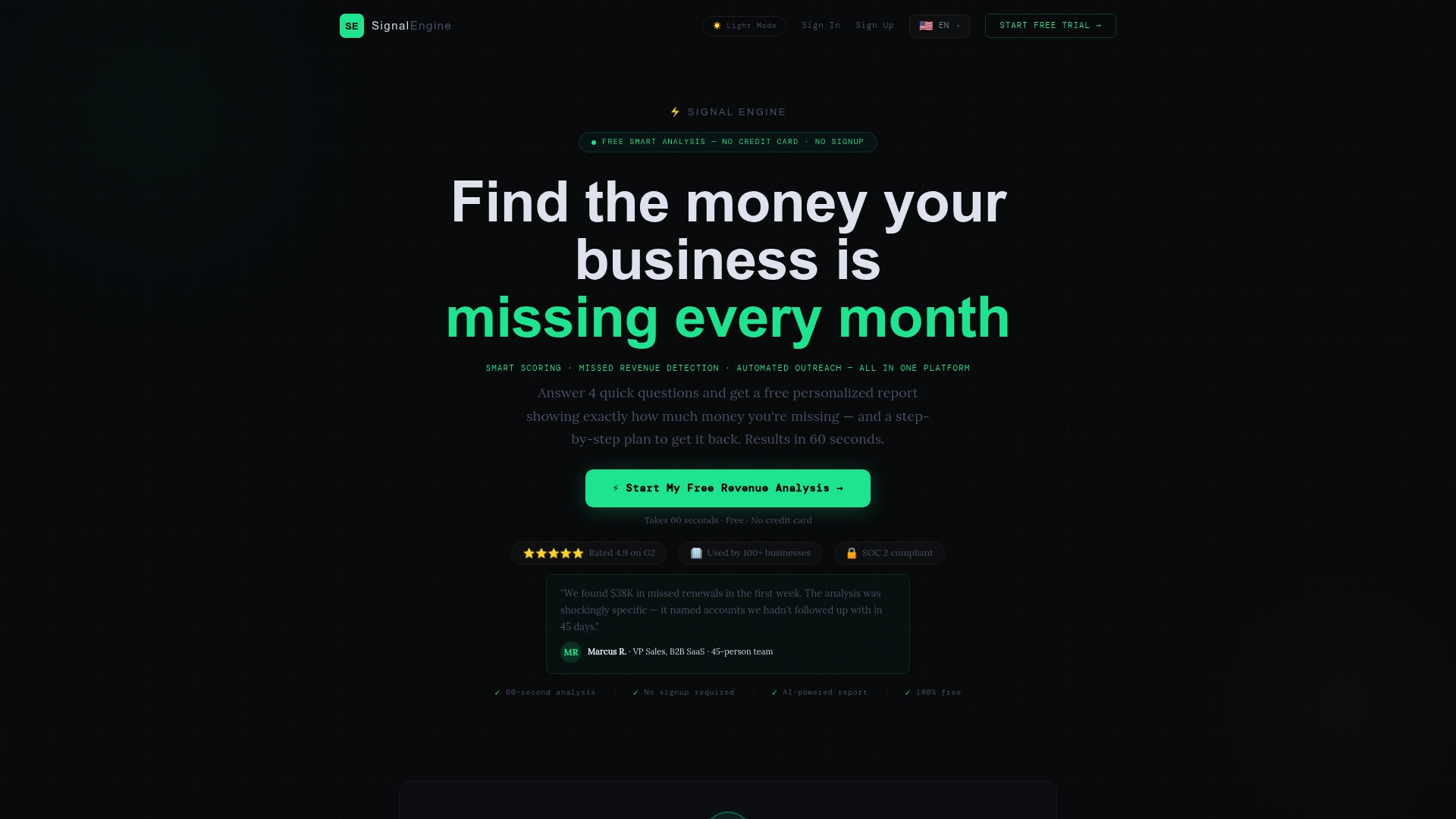
Signalengine's AI scans your client's revenue signals in real time, flags at-risk accounts before they churn, and scores leads by buy-readiness so your team focuses on the accounts most likely to convert or renew. The average user sees $38K in recovery potential identified in the first month. For SaaS teams specifically, the subscription revenue intelligence tools target exactly the renewal leakage and billing gaps this article covers. Setup takes minutes, not weeks.
FAQ
What is revenue leakage in a client business?
Revenue leakage is income a business has earned or contracted for but fails to collect due to billing errors, missed renewals, pricing mismatches, or process failures. It is a reconciliation problem, not a demand problem.
How do I start a revenue opportunity analysis for a client?
Start by comparing actual revenue against forecast for the trailing 12 months, then segment the variance by cause: churn, billing errors, pricing drift, and renewal failures. A Q2C cycle-time audit with rework counts locates the specific bottlenecks.
What KPIs best detect lost revenue streams?
Invoice error rate, renewal rate, Days Sales Outstanding, and revenue versus forecast variance are the four most direct indicators. High invoice error rates and low renewal rates together signal systemic billing and retention leakage.
Why does AI reconciliation outperform quarterly audits?
AI-driven continuous reconciliation detects billing gaps before the invoice cycle closes, when full recovery is still possible. Quarterly audits catch the same gaps after the fact, limiting recovery to partial amounts through negotiation.
How do consultants prevent revenue leakage from recurring?
Assign named process owners to every Q2C handoff, implement automated contract-to-billing data sync, and deploy continuous reconciliation monitoring. Fix broken workflows before adding automation to avoid accelerating existing errors.
Ready to Stop the Revenue Leak?
Signal Engine gives small and local businesses 31 AI-powered tools to score leads by buying intent, predict churn before it happens, auto-generate email and SMS campaigns, and recover missed calls automatically — all in one dashboard starting at $49/month.
Start your free 7-day trial — no credit card required. Setup takes 5 minutes.