

TL;DR:
- Annual recurring revenue measures a business's predictable income from active subscriptions over a year, excluding one-time fees. It helps evaluate financial health, forecast growth, and attract investors by reflecting revenue stability and customer retention. Signalengine offers AI tools to monitor and improve ARR, reducing churn and boosting recurring income.
Annual recurring revenue (ARR) is defined as the total predictable, recurring income a business earns from active subscriptions or contracts over a 12-month period. It is the foundational metric finance professionals and business owners use to evaluate financial health, plan budgets, and attract investors. ARR excludes one-time fees and non-recurring charges, focusing only on revenue you can count on repeating. The global subscription economy reached a $722 billion valuation in 2025, making ARR literacy a non-negotiable skill for anyone running a recurring revenue model. If you want to forecast accurately and grow with confidence, ARR is where you start.
What is annual recurring revenue and how is it calculated?
ARR equals the annualized value of all active recurring contracts. The basic formula is straightforward: multiply the annual subscription price by the number of active customers. A business with 200 customers each paying $500 per year carries an ARR of $100,000.

The calculation gets more nuanced when you factor in plan changes and multi-year contracts. For monthly subscribers, convert their monthly fee to an annual figure before adding it to ARR. A customer paying $50 per month contributes $600 to ARR, not $50.
ARR excludes one-time fees and onboarding charges. This is the most common calculation mistake. Setup fees, professional services billed once, and non-recurring add-ons inflate the number and distort your actual revenue baseline. Strip those out every time.
Churn and new sales move ARR in real time. When a customer cancels, ARR drops by that contract's annualized value. When you close a new annual deal or upsell an existing customer to a higher plan, ARR rises. Tracking these movements monthly gives you a clear picture of net ARR growth.
Step-by-step ARR calculation:
- List all active recurring contracts or subscriptions.
- Convert any monthly contracts to annual values (monthly fee × 12).
- Add the annualized value of all upgrades and expansions.
- Subtract the annualized value of all downgrades and cancellations.
- The result is your current ARR.
Pro Tip: Never include revenue from pilots, trials, or contracts with cancellation clauses that have not yet converted to paid status. Counting uncertain revenue as ARR creates a false sense of stability and leads to poor hiring and spending decisions.
What is the difference between ARR and monthly recurring revenue (MRR)?
ARR and MRR measure the same revenue stream at different time horizons. MRR captures what your subscription business earns in a single month. ARR captures the annualized picture. Under stable conditions, ARR equals MRR multiplied by 12. A business generating $83,333 in MRR carries approximately $1 million in ARR.
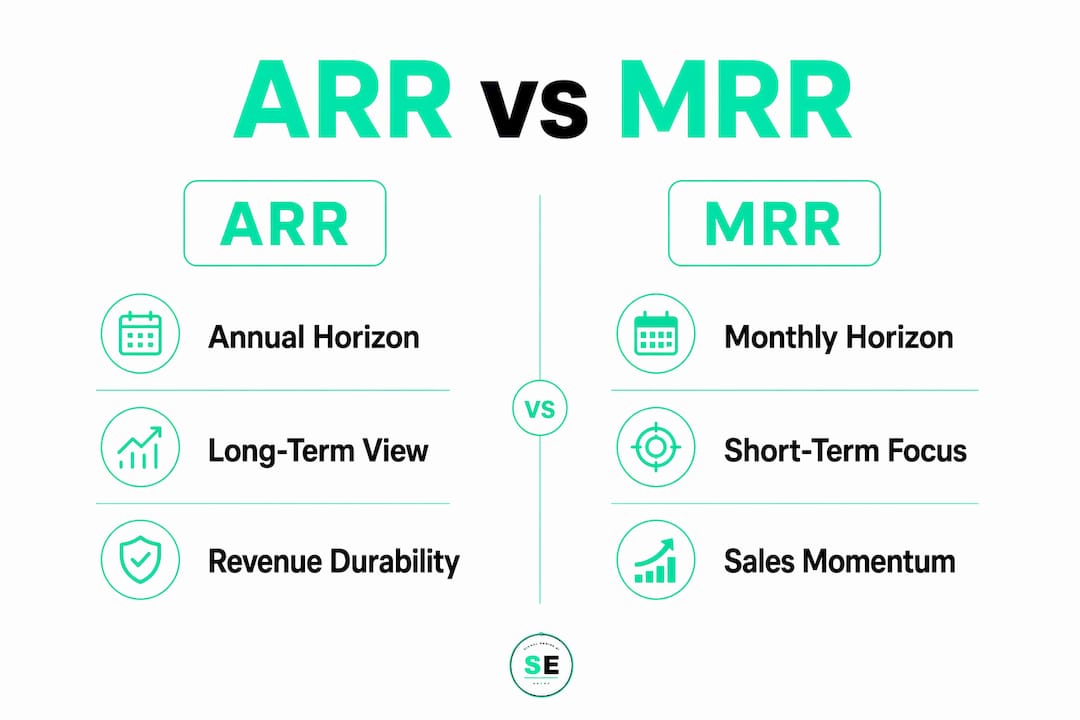
The two metrics answer different questions. MRR tracks short-term momentum. It tells you whether last month's sales push worked or whether a pricing change caused cancellations. ARR reflects the stable long-term revenue base you use for annual planning, hiring decisions, and investor reporting. ARR smooths out the monthly noise that MRR captures.
| Feature | MRR | ARR |
|---|---|---|
| Time horizon | Monthly | Annual |
| Best used for | Tracking short-term momentum | Long-term planning and forecasting |
| Sensitivity | High. Reacts to monthly changes | Lower. Filters out monthly volatility |
| Investor reporting | Less common | Standard for SaaS and subscription businesses |
| Calculation | Sum of all monthly recurring fees | MRR × 12, or sum of annual contract values |
Neither metric is superior. Fast-growing businesses watch MRR weekly to catch problems early. Finance teams and investors rely on ARR for valuation and budget planning. Using both together gives you the full picture of your recurring revenue health.
Why is ARR important for evaluating business performance?
ARR signals the durability of your revenue, not just its size. A business with $2 million in one-time project revenue and a business with $2 million in ARR are not equally valuable. The ARR business has predictable cash flow, lower revenue risk, and a far stronger foundation for growth. Investors prioritize stable ARR over large one-time sales because ARR signals sustained product value and business viability.
ARR also anchors your budgeting process. When you know your recurring revenue baseline, you can commit to headcount, marketing spend, and infrastructure costs with real confidence. Businesses without a clear ARR figure often overspend during good months and scramble during slow ones.
The importance of ARR extends to churn management. Recurring revenue requires continuous value delivery to stay intact. Every customer who cancels removes their contract's full annualized value from your ARR. At scale, this compounds fast.
Key reasons ARR matters for your business:
- Forecasting accuracy. ARR gives you a reliable starting point for 12-month revenue projections.
- Investor confidence. Buyers and investors use ARR multiples to value subscription businesses.
- Budget discipline. Knowing your recurring revenue floor prevents overspending against uncertain income.
- Churn visibility. Tracking ARR changes month over month exposes customer loss before it becomes a crisis.
- Growth benchmarking. Year-over-year ARR growth rate is the clearest signal of business momentum.
Pro Tip: When presenting ARR to investors or lenders, always show net ARR growth alongside gross ARR. Net ARR growth accounts for churn and downgrades, giving a far more honest picture of business health than a top-line ARR figure alone.
How can businesses use ARR to improve revenue forecasting and reduce churn?
ARR is a snapshot metric. It represents the current annualized value of active recurring contracts, not a guarantee of future revenue. That distinction matters enormously for forecasting. Your forecast starts with ARR as the baseline, then adjusts for expected churn, upsells, and new customer acquisition.
The most effective forecasting approach layers ARR with churn rate data. If your ARR is $500,000 and your annual churn rate is 10%, you are losing $50,000 in recurring revenue per year before you close a single new deal. That math forces a clear question: are your new sales outpacing your losses?
At a $100 million ARR scale, a one-point change in churn impacts millions of dollars annually. Even at smaller scales, the compounding effect of churn on ARR is significant and often underestimated by business owners focused on new sales.
Practical ways to use ARR for forecasting and churn reduction:
- Set ARR growth targets by cohort. Track ARR from customers acquired in the same period to see which cohorts retain best.
- Monitor contract renewal dates. Build a renewal calendar so you can intervene before at-risk contracts lapse.
- Measure expansion ARR separately. Revenue from upsells and plan upgrades tells you whether existing customers are finding more value over time.
- Flag ARR concentration risk. If one customer represents more than 20% of your ARR, that is a financial risk worth addressing.
- Connect customer success to ARR. Assign ARR values to customer success activities so your team understands the revenue impact of retention work.
Real-time revenue intelligence tools make this tracking far more manageable. Signalengine, for example, scores customer behavior automatically and flags accounts showing churn signals before they cancel. You can use the Signalengine recurring revenue analyzer to identify where lifetime value is leaking from your customer base. Connecting ARR data to churn prediction gives you a forward-looking view, not just a historical one. For a deeper look at the mechanics of reducing customer churn, the principles apply directly to protecting your ARR baseline.
ARR as a business compass, not a crystal ball
ARR is more than a calculation. It is a signal of how much your customers trust you with their money on a recurring basis. That framing changes how I think about it.
Most business owners treat ARR as a scoreboard. They look at the number, feel good or bad about it, and move on. The owners who build durable businesses treat ARR as a diagnostic. They ask: why did ARR grow this quarter? Was it new logos, upsells, or price increases? Each answer points to a different operational priority.
The biggest misunderstanding I see is treating ARR as a revenue guarantee. ARR assumes current contracts and pricing persist for the next 12 months. It does not account for the customer who is quietly shopping alternatives or the contract up for renewal in 60 days. ARR tells you where you stand today. Your customer success and churn prevention work determines whether you stay there.
The businesses that grow ARR consistently are not the ones with the best sales teams. They are the ones that deliver value continuously after the sale. Recurring revenue is a promise. Every billing cycle is a vote of confidence from your customer. When you stop earning that vote, ARR falls. When you earn it repeatedly, ARR compounds.
— Bernard
Signalengine tracks your ARR health so you don't have to guess
Your ARR number is only as useful as the intelligence behind it. Signalengine's revenue intelligence platform gives small and local businesses AI-powered tools to monitor recurring revenue, score customer behavior, and catch churn signals before they cost you contracts.

Built for SMBs across 12 verticals, Signalengine watches your customer base automatically, flags who is at risk, and tells you exactly what to do next. Features include lead scoring by buying intent, churn prediction, automated email and SMS campaigns, and missed call recovery. All in one dashboard, starting at $49/month with a 7-day free trial and no credit card required.
Key takeaways
Annual recurring revenue is the most reliable indicator of subscription business health, combining predictable income with clear signals about customer retention and growth trajectory.
| Point | Details |
|---|---|
| ARR definition | ARR is the annualized value of all active recurring contracts, excluding one-time fees. |
| Calculation accuracy | Always exclude setup fees, trials, and non-recurring charges to get a clean ARR figure. |
| ARR vs. MRR | MRR tracks monthly momentum; ARR provides the annual baseline for planning and investor reporting. |
| Churn impact | A small churn rate change moves significant revenue at scale, making retention a financial priority. |
| Forecasting use | Start every revenue forecast with ARR as the baseline, then adjust for expected churn and new sales. |
FAQ
What is annual recurring revenue in simple terms?
Annual recurring revenue is the total predictable income a business earns from subscriptions or contracts over one year, excluding one-time fees. It shows how much revenue you can reliably count on repeating.
What counts as recurring revenue for ARR purposes?
Recurring revenue includes subscription fees, contract renewals, and any charges billed on a regular schedule. One-time setup fees, onboarding charges, and non-recurring add-ons are excluded from ARR.
How does churn affect ARR?
Every customer cancellation removes that contract's full annualized value from ARR. At scale, even a one-point increase in churn rate can cost a business millions of dollars in annual recurring revenue.
Is ARR the same as annual revenue?
No. Annual revenue includes all income a business earns in a year, including one-time sales and project fees. ARR includes only predictable, recurring subscription or contract revenue.
How often should a business calculate ARR?
Most subscription businesses recalculate ARR monthly to capture the impact of new sales, cancellations, upgrades, and downgrades. Quarterly reviews are standard for investor reporting and budget planning.
Ready to Stop the Revenue Leak?
Signal Engine gives small and local businesses 31 AI-powered tools to score leads by buying intent, predict churn before it happens, auto-generate email and SMS campaigns, and recover missed calls automatically — all in one dashboard starting at $49/month.
Start your free 7-day trial — no credit card required. Setup takes 5 minutes.