

TL;DR:
- Net revenue retention (NRR) measures the percentage of recurring revenue retained and expanded from existing customers over a specific period. It indicates whether current customers generate more or less revenue, with values above 100% signaling growth. Tracking NRR alongside other metrics is vital for assessing sustainable business health and revenue momentum.
Net revenue retention (NRR) is the percentage of recurring revenue retained and grown from an existing customer base over a specific period, factoring in expansions, contractions, and churn. Also called Net Dollar Retention (NDR), this metric tells you whether your current customers are worth more or less to your business than they were at the start of a period. Snowflake's 127% NRR is the benchmark every SaaS leader references because it proves a company can grow revenue without adding a single new customer. Tools like Zuora, Stripe, and PartnerStack track NRR as a core health signal. If you lead a business or manage its finances, this number belongs on your dashboard.
What is net revenue retention and why does it matter?
Net revenue retention is defined as the share of recurring revenue from existing customers that a business keeps and expands over a set time period. The 100% mark is the critical threshold. Above it, your existing base is growing on its own. Below it, you are losing ground even if new sales look strong.
NRR is a leading indicator of sustainable growth and customer experience success. That means it predicts future revenue trajectory, not just current performance. A business with 90% NRR is quietly shrinking its base every month, regardless of how many new logos the sales team closes.
The metric captures four forces at once: starting revenue, expansion revenue from upsells and cross-sells, contraction from downgrades, and full churn from cancellations. No other single number does all of that. Customer retention rate tells you how many accounts stayed. Churn rate tells you how many left. NRR tells you how much money stayed, grew, or disappeared.

Tracking NRR alongside churn and lifetime value gives finance teams a complete picture of business health. Each metric answers a different question, and NRR answers the most important one: are your existing customers generating more or less revenue than before?
How to calculate net revenue retention
The NRR formula is straightforward. Apply it consistently and it becomes one of the most reliable numbers in your financial reporting.
The formula:
NRR = [(Starting Revenue + Expansion Revenue − Contraction Revenue − Churned Revenue) / Starting Revenue] × 100
Here is how each variable works:
- Starting Revenue is the monthly recurring revenue (MRR) or annual recurring revenue (ARR) from existing customers at the beginning of the period. New customers acquired during the period are excluded entirely.
- Expansion Revenue includes any upsells, cross-sells, seat additions, or usage increases from those same existing customers.
- Contraction Revenue covers downgrades, plan reductions, or any decrease in spend from customers who stayed.
- Churned Revenue is the full MRR or ARR lost from customers who canceled during the period.
Numeric example using the NRR formula:
- Starting MRR: $100,000
- Expansion: $20,000
- Contraction: $5,000
- Churn: $5,000
- NRR = [($100,000 + $20,000 − $5,000 − $5,000) / $100,000] × 100 = 110%
That 110% means your existing customers are generating 10% more revenue than they did at the start of the period. No new customers required.
For usage-based pricing models like those common in AWS or Snowflake billing structures, expansions come from aggregated net usage increases rather than discrete plan upgrades. You need to aggregate usage changes across consistent intervals before plugging them into the formula.
Pro Tip: The single most common NRR calculation error is mixing monthly and annual data in the same formula. If your starting revenue is MRR, every other variable must also be MRR for the same month. Timeframe consistency is not optional. One mixed variable skews your entire result.
Net revenue retention vs. gross revenue retention: key differences
These two metrics are related but measure fundamentally different things. Confusing them leads to bad decisions.
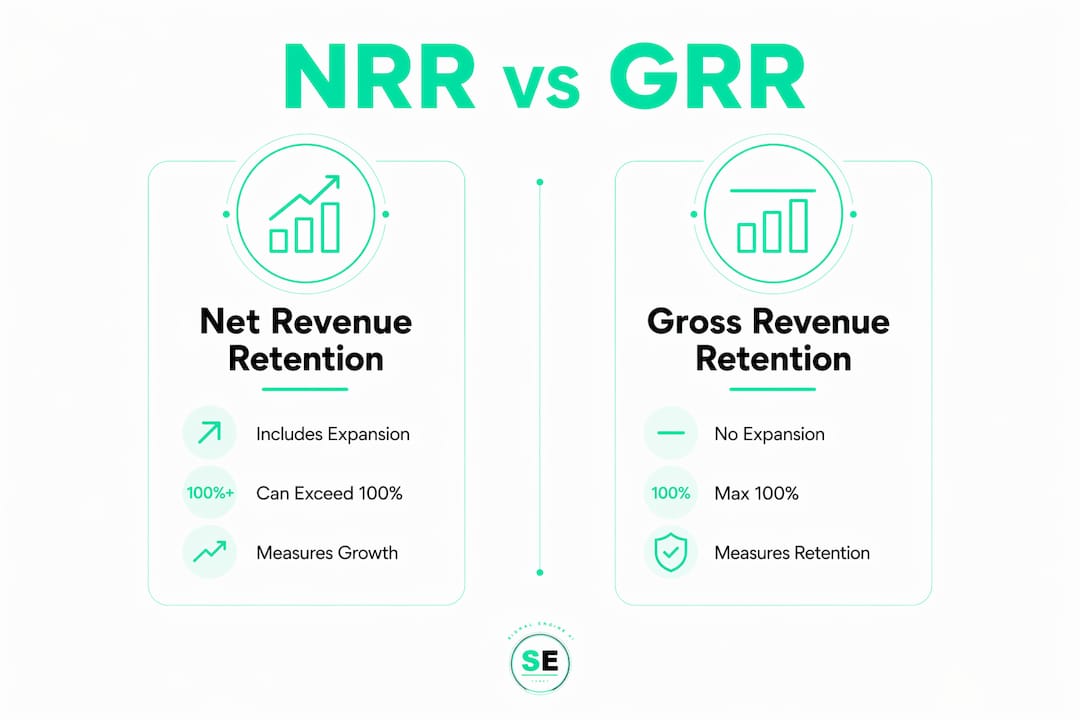
Gross Revenue Retention (GRR) measures the percentage of starting revenue retained from existing customers, counting only losses from churn and contraction. It ignores expansion entirely. Because of that, GRR cannot exceed 100%. It is a pure retention floor.
NRR includes expansion revenue on top of retention. That is why NRR can exceed 100% and why it is the more complete metric for evaluating growth potential.
| Metric | Includes Expansion | Max Value | Primary Use |
|---|---|---|---|
| Net Revenue Retention (NRR) | Yes | Unlimited | Growth trajectory from existing base |
| Gross Revenue Retention (GRR) | No | 100% | Pure retention health |
| Customer Retention Rate | No | 100% | Account-level retention |
| Churn Rate | No | 100% | Revenue or account loss rate |
Here is the scenario that trips up most finance teams: a company reports 100% NRR but only 85% GRR. That looks healthy on the surface. What it actually means is that the business is losing significant revenue to churn and contraction, but expansion from a subset of customers is masking the damage. GRR exposes that problem. NRR alone does not.
The practical rule: use GRR to diagnose retention problems and NRR to measure overall revenue momentum from your existing base. Both numbers belong in your monthly reporting.
NRR is also sometimes called Net Dollar Retention (NDR). The terms are largely interchangeable, but definitions can vary by company. When reporting to a board or investors, always specify your cohort, time period, and whether you are including or excluding specific revenue types. Ambiguity in NRR reporting destroys trust with stakeholders.
Why NRR is critical for sustainable growth
NRR is the best predictor of a company's ability to sustain growth by maximizing existing customer value beyond new sales. That is not a soft claim. It is the conclusion Stripe's analysts reach when evaluating SaaS business models, and it holds across industries.
"NRR reveals the real revenue trajectory within existing customers compared to MRR and ARR snapshots." — CRV analysts
New customer acquisition is expensive. Customer acquisition cost (CAC) in most B2B SaaS markets runs three to five times higher than the cost of retaining and expanding an existing account. A business with strong NRR compounds its revenue base without proportional increases in sales spend. That is the financial model every investor wants to see.
Strong NRR also reflects something deeper than a good sales motion. Coordinated onboarding, product adoption, and customer success drive revenue expansion. When NRR is high, it signals that your product delivers real value, your team supports customers effectively, and your pricing model captures that value over time.
Here is what low NRR signals, even when acquisition looks strong:
- Churn is accelerating faster than new revenue can replace it
- Product adoption is weak, meaning customers are not reaching full value
- Onboarding is failing, leaving customers under-engaged from day one
- Pricing structure misaligns with how customers actually use the product
- Customer success is reactive, not proactive
A business that ignores NRR while chasing new logos is running on a treadmill. The revenue leakage from churn and contraction quietly offsets every new deal closed. The math catches up eventually.
Practical strategies to improve net revenue retention
Improving NRR requires action on both sides of the equation: reduce the losses from churn and contraction, and grow the gains from expansion. Here is how to do both.
Reduce churn and contraction:
- Identify at-risk accounts early using behavioral signals, not just support tickets. Customers who stop logging in or reduce usage are signaling intent before they cancel.
- Build a proactive customer churn reduction program with defined intervention triggers.
- Use CRM data to track engagement patterns. CRM tools support retention by surfacing relationship gaps before they become cancellations.
- Conduct quarterly business reviews with high-value accounts to reinforce value and surface expansion opportunities.
Grow expansion revenue:
- Map your product catalog to natural upsell paths for each customer segment. A customer using one module is a candidate for the next.
- Train customer success teams to identify expansion revenue opportunities during routine check-ins, not just at renewal.
- Build usage-based triggers that prompt upgrade conversations automatically when customers hit usage thresholds.
- Cross-sell adjacent products or services to accounts with strong adoption of the core offering.
Measure and report consistently:
- Lock in a single NRR calculation methodology and apply it every period without variation.
- Report NRR alongside GRR so leadership sees both the full picture and the retention floor.
- Segment NRR by customer cohort, product line, or industry vertical to identify where retention is strongest and weakest.
Pro Tip: Align your onboarding, product, and customer success teams around a shared NRR target. When each team optimizes for its own metric in isolation, expansion opportunities get missed and churn warnings get ignored. A shared number creates shared accountability.
Key takeaways
Net revenue retention is the single metric that shows whether your existing customer base is growing, holding steady, or quietly shrinking.
| Point | Details |
|---|---|
| NRR definition | NRR measures recurring revenue retained and expanded from existing customers, expressed as a percentage. |
| The 100% threshold | Above 100% means existing customers generate more revenue than before; below 100% signals net loss. |
| NRR vs. GRR | GRR caps at 100% and excludes expansion; use both metrics together for a complete retention picture. |
| Calculation discipline | All formula variables must use the same time period to avoid distorted results and bad decisions. |
| Growth strategy | Reducing churn and growing expansion revenue together are the two levers that move NRR upward. |
NRR is a compass, not just a scorecard
I have watched finance teams treat NRR as a reporting obligation rather than a decision tool, and it costs them. The number gets calculated, dropped into a board deck, and forgotten until next quarter. That is the wrong way to use it.
What NRR actually does is shift your company's attention from acquisition to the customers you already have. That shift is uncomfortable for sales-led organizations. It forces a conversation about whether the product is delivering value, whether onboarding is working, and whether customer success is proactive or just reactive. Those are hard conversations. NRR makes them unavoidable.
One thing I have seen trip up even experienced finance professionals: the NRR versus NDR terminology gap. Two companies can report wildly different numbers for the same underlying performance simply because one includes a revenue category the other excludes. When you present NRR to a board or an investor, define your methodology in the same slide. Specify the cohort, the time period, and what counts as expansion versus contraction. Ambiguity in that number erodes credibility fast.
The businesses I have seen improve NRR fastest share one trait: they treat it as a cross-functional metric, not a finance metric. Product, customer success, sales, and onboarding all own a piece of it. When each team sees their work reflected in the NRR number, behavior changes. Churn warnings get acted on. Expansion conversations happen earlier. The metric becomes a compass that points every team in the same direction.
— Bernard
How Signalengine helps you protect and grow NRR
If your NRR is slipping, the problem is usually invisible until it is expensive. Signalengine's AI-powered revenue intelligence platform watches your customer behavior automatically, scores churn risk before accounts go cold, and flags expansion opportunities you would otherwise miss.

Built for SMBs across 12 verticals including HVAC, logistics, dental, and real estate, Signalengine gives you 31 tools to detect revenue signals, auto-generate retention campaigns, and recover missed revenue. You get AI churn prediction that fires before customers cancel, not after. Pricing starts at $49/month. No enterprise contract. No data team required. Just clear signals and plays that run automatically.
Ready to stop the revenue leak?
Signal Engine gives small and local businesses 31 AI-powered tools to score leads by buying intent, predict churn before it happens, auto-generate email and SMS campaigns, and recover missed calls automatically — all in one dashboard starting at $49/month.
Start your free 7-day trial — no credit card required. Setup takes 5 minutes.
FAQ
What is the net revenue retention definition in simple terms?
Net revenue retention is the percentage of recurring revenue a business keeps and grows from its existing customers over a set period, after accounting for expansions, downgrades, and cancellations.
What is a good NRR benchmark for SaaS businesses?
A 100% NRR is the baseline for health, while top-performing SaaS companies like Snowflake have reported NRR above 120%, meaning existing customers alone drive significant revenue growth.
How does NRR differ from gross revenue retention?
Gross revenue retention only measures revenue kept from existing customers without counting expansion, so it caps at 100%. NRR includes expansion revenue, which is why it can exceed 100%.
What factors affect net revenue retention most?
The primary factors are churn rate, contraction from downgrades, and expansion revenue from upsells and cross-sells. Strong onboarding and proactive customer success are the biggest drivers of improvement.
Is NRR the same as net dollar retention?
NRR and NDR are largely interchangeable terms, but methodology can vary between companies. Always define your cohort, time period, and revenue inclusions when reporting either metric to stakeholders.