

TL;DR:
- Businesses recover the most revenue within the first 30 days of a failed payment by implementing multi-channel outreach and smart retry logic. Operational issues like billing errors and pricing drift also significantly contribute to revenue leakage if addressed proactively. Automated, continuous recovery programs using AI optimize success rates, reduce costs, and help build stronger customer relationships.
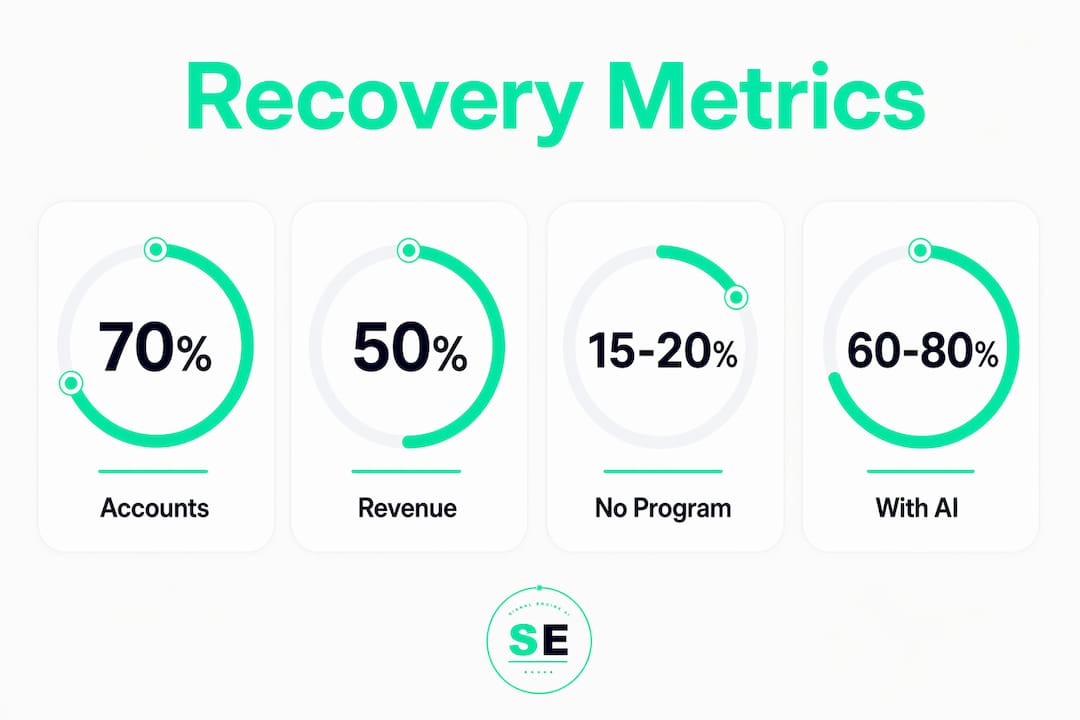
First-month revenue recovery is defined as the percentage of lost revenue, caused by failed payments or billing lapses, that a business successfully recaptures within 30 days of the initial failure. This is the industry’s most critical recovery window. Automation can lift recovery rates from a natural baseline of 15–20% up to 60–80%, making the first 30 days the highest-leverage period in any recovery program. For business leaders and financial analysts, understanding what is first-month revenue recovery is not optional. It is a direct line to retained monthly recurring revenue (MRR) and lower churn. Sources including ChurnBot, ChurnBase, and Stripe consistently show that businesses without structured recovery programs leave a significant portion of recoverable revenue on the table every single month.
What is first-month revenue recovery and why does it matter?
First-month revenue recovery is the structured process of identifying, pursuing, and recapturing revenue lost to payment failures within the first 30 days. The industry term most closely associated with this process is dunning, though full revenue recovery extends beyond dunning to include billing error correction, pricing drift remediation, and proactive customer outreach.
The financial stakes are concrete. Involuntary churn accounts for 20–40% of total SaaS churn. That means a significant share of customers who leave never intended to. They were lost to a declined card or an expired payment method, not dissatisfaction. For a business running $100,000 in MRR with a 5% payment failure rate, improving recovery from 30% to 60% adds $18,000 in annual revenue. That is pure retained profit, not new sales.
The importance of revenue recovery compounds over time. Every dollar not recovered in month one is harder to collect in month two. Customer relationships cool, payment methods expire further, and the cost of outreach rises. Acting fast is not just best practice. It is the only practice that consistently works.
What are common causes of revenue loss in the first month?
Revenue loss in the first month falls into two broad categories: payment failures and operational gaps. Both are recoverable, but only if you know which one you are dealing with.
Payment failures are the most visible cause:
-
Declined cards due to insufficient funds, fraud flags, or card network rules
-
Expired payment methods that customers forgot to update
-
Hard declines where the card issuer permanently rejects the charge
-
Soft declines where the charge fails temporarily but may succeed on retry
Operational gaps are less obvious but equally damaging:
-
Billing errors caused by incorrect pricing tiers or misconfigured subscription logic
-
Pricing drift, where contract terms and actual charges diverge over time
-
Process gaps in reconciliation that allow discrepancies to go unnoticed for weeks
The distinction between involuntary and voluntary churn matters here. Involuntary churn is caused by payment failures, not customer intent. Voluntary churn is a customer’s deliberate decision to leave. Recovery strategies target involuntary churn almost exclusively. Conflating the two leads to wasted outreach and misread metrics.
Pricing drift and billing discrepancies can account for up to 38% of total revenue leakage in some accounts. Most finance teams focus entirely on payment retries and miss this operational layer entirely.
Pro Tip: Run a monthly billing audit that compares contracted rates against actual charges. Pricing drift is silent and compounds fast. Catching it early costs almost nothing. Catching it late costs real money.
How do businesses measure and benchmark first-month revenue recovery?
Recovery rate is the core metric. It is calculated two ways, and both matter.
Recovery rate by count: Number of failed accounts successfully recovered divided by total failed accounts in the period.
Recovery rate by revenue value: Dollar value of recovered revenue divided by total dollar value of failed payments in the period.
The two numbers often diverge. A business might recover 70% of accounts by count but only 50% by revenue value if high-value accounts are failing at a higher rate. Financial analysts should track both.
| Recovery Scenario | Typical Recovery Rate | Key Driver |
|---|---|---|
| No structured program | 15–20% | Natural retries only |
| Email-only dunning | 30–45% | Automated reminders |
| Multi-channel dunning | 55–70% | Email, SMS, in-app |
| AI-optimized automation | 60–80% | Smart retry logic + segmentation |
Recovery rates drop sharply after 7 days from the initial failure. The practical implication is that your first outreach must go out within 24 hours, not 72. Every day of delay reduces the probability of recovery. After 28 days, extending the recovery window can actually complicate collections and reduce overall effectiveness.
Effective dunning programs typically run 3–4 reminder emails over 14 days, with recovery rates dropping sharply after the third email. That data point tells you where to invest: front-load your sequence, not the tail end.
Pro Tip: Segment your recovery rate reporting by MRR tier. A 60% overall recovery rate can mask a 30% recovery rate among your top 10% of accounts. That gap is where the real money is.
What are the most effective first-month revenue recovery strategies?
The most effective revenue recovery strategies combine multi-channel outreach, smart retry logic, and account segmentation. No single tactic wins alone.

1. Launch multi-channel dunning sequences immediately. Multi-channel strategies using email, SMS, and in-app notifications outperform email-only programs by 15–25 percentage points. They also reduce operating costs per recovered account. Set up automated sequences that trigger within hours of a failed payment, not days.
2. Segment accounts before sending a single message. Segmenting dunning sequences by MRR and account type is the single most critical configuration decision in any recovery program. A $500/month enterprise account needs a personal call from a customer success manager. A $29/month self-serve account needs a clean email with a one-click payment update link. Sending the same message to both is a mistake that costs you the enterprise relationship.
3. Apply smart retry logic based on decline codes. Not all payment failures are equal. Machine learning optimizes retry attempts based on specific decline codes and typical pay cycles. A soft decline on the 28th of the month may succeed on the 1st when payroll clears. A hard decline should never be retried. Retrying hard declines triggers card network penalties and damages your merchant account standing.
4. Build self-service payment update portals.Consumers under 45 prefer self-service portals accessible 24/7 over phone-based recovery. Manual phone call programs miss this preference entirely and deliver lower contact rates at higher cost. A simple, mobile-friendly payment update page linked directly from your dunning emails removes the friction that kills recovery.
5. Automate compliance and workflow prioritization with AI. Technology-first recovery programs embed compliance checks and personalized workflows via AI to prioritize accounts and optimize outreach timing. Results include 15–30% improvements in net recovery rates and measurable reductions in operating costs. Manual programs cannot replicate this at scale.
You can explore a detailed recovery playbook for leaders to build out each of these steps with specific checklists.
What challenges do companies face in first-month recovery?
Most recovery programs fail not because the technology is wrong, but because the strategy is incomplete. These are the most common pitfalls:
-
Treating dunning as the entire recovery effort. Dunning addresses payment retries. Full revenue recovery also includes billing error correction, pricing drift remediation, and proactive win-back outreach. Revenue recovery is a continuous system that identifies and resolves discrepancies at volume, not a one-time audit triggered by a failed charge.
-
Using generic messaging for all customers. A “payment failed” email sent to a high-value enterprise account signals that you do not know who they are. High-value enterprise customers require personal outreach to maintain trust during recovery. Generic messaging for this segment accelerates churn rather than preventing it.
-
Retrying payments without reading decline codes. Indiscriminate retries on hard declines generate card network flags and can get your merchant account flagged or suspended. Every retry decision should be informed by the specific decline reason.
-
Ignoring operational revenue leakage. Billing discrepancies and pricing drift are not payment failures, so they do not show up in dunning dashboards. They require a separate reconciliation process. Businesses that skip this layer consistently undercount their actual revenue leakage.
-
Running one-off audits instead of continuous monitoring. A quarterly billing review catches problems that are already three months old. Automated, continuous reconciliation catches them in days.
How can business leaders apply recovery principles to drive growth?
Recovery is not a finance team problem. It is a growth lever that requires alignment across finance, customer success, and product.
Connect recovery metrics to your growth dashboard. Recovery rate, recovered MRR, and time-to-recovery should sit alongside customer acquisition cost and lifetime value in your monthly reporting. Leaders who track these numbers make faster, better decisions about where to invest in retention.
Align recovery with customer relationship management. A failed payment is a customer relationship event, not just a billing event. Your customer success team should be notified when a high-value account enters a recovery sequence. Early intervention by a human contact can resolve the issue before it becomes a churn signal.
Invest in AI-driven revenue recovery tools. Manual recovery programs do not scale. AI-powered platforms score accounts by recovery probability, optimize retry timing, and personalize outreach automatically. The cost per recovered dollar drops significantly compared to manual programs.
-
Automate payment update reminders via email and SMS
-
Score accounts by MRR tier and recovery probability
-
Flag hard declines immediately for human review
-
Run continuous billing reconciliation, not quarterly audits
-
Report recovery rate by revenue value, not just by account count
Pro Tip: Assign a recovery owner in your organization. It does not need to be a full-time role, but someone must own the metrics, the tooling, and the process. Recovery programs without an owner drift into inactivity within 90 days.
Key takeaways
First-month revenue recovery succeeds when businesses combine multi-channel outreach, smart retry logic, and continuous billing reconciliation within the first 30 days of a payment failure.
| Point | Details |
|---|---|
| Act within 7 days | Recovery rates drop sharply after day 7, so launch outreach within 24 hours of failure. |
| Segment by MRR tier | High-value accounts need personal outreach; self-serve accounts need frictionless self-service links. |
| Use smart retry logic | Match retry attempts to decline codes and pay cycles to avoid penalties and improve success rates. |
| Recovery goes beyond dunning | Billing errors and pricing drift cause up to 38% of leakage and require separate reconciliation. |
| Automate continuously | AI-optimized programs recover 60–80% of failed revenue versus 15–20% with no structured program. |
The first month is the only month that counts
I have spent years watching businesses build sophisticated acquisition funnels and then lose revenue quietly through the back door every single billing cycle. The pattern is almost always the same: the team focuses on new logos, the recovery process is an afterthought, and nobody notices the leakage until it shows up as a churn number that does not make sense.
Here is what I have found to be true in practice. The businesses that recover the most revenue in month one are not the ones with the most aggressive dunning sequences. They are the ones that treat a failed payment as a customer signal, not a billing error. When a payment fails, something changed on the customer’s end. Maybe it is a cash flow issue. Maybe it is a card change they forgot to update. Either way, that moment is an opening for a conversation, not just an automated retry.
The technology has genuinely changed what is possible here. AI-driven retry logic and multi-channel automation have made it realistic for a small team to run a recovery program that would have required a dedicated collections department five years ago. The mistake I see most often is businesses adopting the technology but skipping the segmentation step. They automate a generic sequence and wonder why enterprise accounts are churning despite the automation.
My honest recommendation: start with your top 20% of accounts by MRR. Build a manual, personalized recovery sequence for that segment first. Measure the results. Then automate everything below that tier. The data you collect from the manual segment will make your automated sequences significantly more effective.
— Bernard
How Signalengine helps you recover revenue automatically
If you are running a service business, a SaaS product, or any subscription-based operation, first-month revenue recovery is where Signalengine pays for itself fast.

Signalengine's AI-powered revenue intelligence tools automatically score customer accounts by churn risk, flag payment issues before they compound, and trigger personalized recovery sequences across email and SMS without manual intervention. The platform is built for SMBs across 12 verticals including HVAC, logistics, dental, and real estate. Pricing starts at $49/month. You get 47 tools in one dashboard, including automated recovery workflows that run the moment a payment fails. No data team required.
Ready to stop the revenue leak?
Signal Engine gives small and local businesses 47 AI-powered tools to score leads by buying intent, predict churn before it happens, auto-generate email and SMS campaigns, and recover missed calls automatically — all in one dashboard starting at $49/month.
Start your free 7-day trial — no credit card required. Setup takes 5 minutes.
FAQ
What is first-month revenue recovery in simple terms?
First-month revenue recovery is the process of recapturing revenue lost to failed payments or billing errors within 30 days of the initial failure. It is the highest-leverage recovery window because success rates drop sharply after day 7.
What is a good first-month recovery rate?
A recovery rate of 60–80% is achievable with AI-optimized, multi-channel automation. Businesses with no structured program typically recover only 15–20% of failed revenue naturally.
How is dunning different from full revenue recovery?
Dunning covers payment retries and reminders. Full revenue recovery also includes billing error correction, pricing drift remediation, and proactive customer outreach. Treating dunning as the complete solution leaves operational leakage unaddressed.
How quickly should businesses act on a failed payment?
Outreach should begin within 24 hours of a failed payment. Recovery rates decline significantly after 7 days, and extending recovery efforts beyond 28 days can complicate collections and reduce overall effectiveness.
Which recovery channel performs best?
Multi-channel programs combining email, SMS, and in-app notifications outperform email-only approaches by 15–25 percentage points, while also reducing the cost per recovered account.