

Fix patient no-shows by doing four things in order: measure your true baseline rate, layer reminders across channels, put a human on the phone for your highest-risk bookings, and call every no-show within 24 hours to rebook. A rapid review of predictive interventions found text and phone reminders both cut no-shows, and practices that add a same-day recovery call recover a meaningful share of that lost revenue automatically.
TL;DR:
- Target the top 10 to 20 percent of high-risk patients with live outreach rather than relying solely on broad reminders for more effective no-show reduction.
- Focus on implementing layered reminders across multiple channels, especially for high-risk groups, while pairing them with timely, empathetic recovery calls within 24 hours of a missed appointment.
- Measure your baseline no-show rate using detailed data segmentation and track changes in specific cohorts to evaluate intervention effectiveness.
- Pilot targeted outreach programs first, then expand based on recovered visits and revenue, ensuring staff costs are justified by improvements.
- Use predictive risk scores to guide outreach efforts, setting thresholds to maximize the impact of personal contact while monitoring demographic equity.
Table of Contents
- What Counts as a No-Show, and What Does It Cost You?
- Why Patients Miss Appointments: The Four Drivers You Can Act On
- How Do You Measure Your Practice's No-Show Rate?
- Evidence-Based Interventions That Reduce No-Shows
- Operational Tactics: Scheduling, Waitlists, Telehealth, and Recovery
- How Should You Use Predictive Scores to Target Outreach?
- Handling Chronic No-Shows: Policy and Documentation
- Measuring Results: KPIs, Pilots, and ROI
- A 30-Day Playbook for Cutting No-Shows
- Ready to Stop the Revenue Leak?
- Sources
- FAQ
What Counts as a No-Show, and What Does It Cost You?
A no-show is a scheduled visit the patient never attends and never cancels. A cancellation, by contrast, is a visit the patient calls off ahead of time, whether that's 10 minutes or 10 days before the slot. Lumping the two together hides where your real problem sits, since late cancellations often share root causes with no-shows but get counted separately in most scheduling software.
Behavioral health and pediatric dental tend toward the high end; established primary care relationships tend toward the low end.
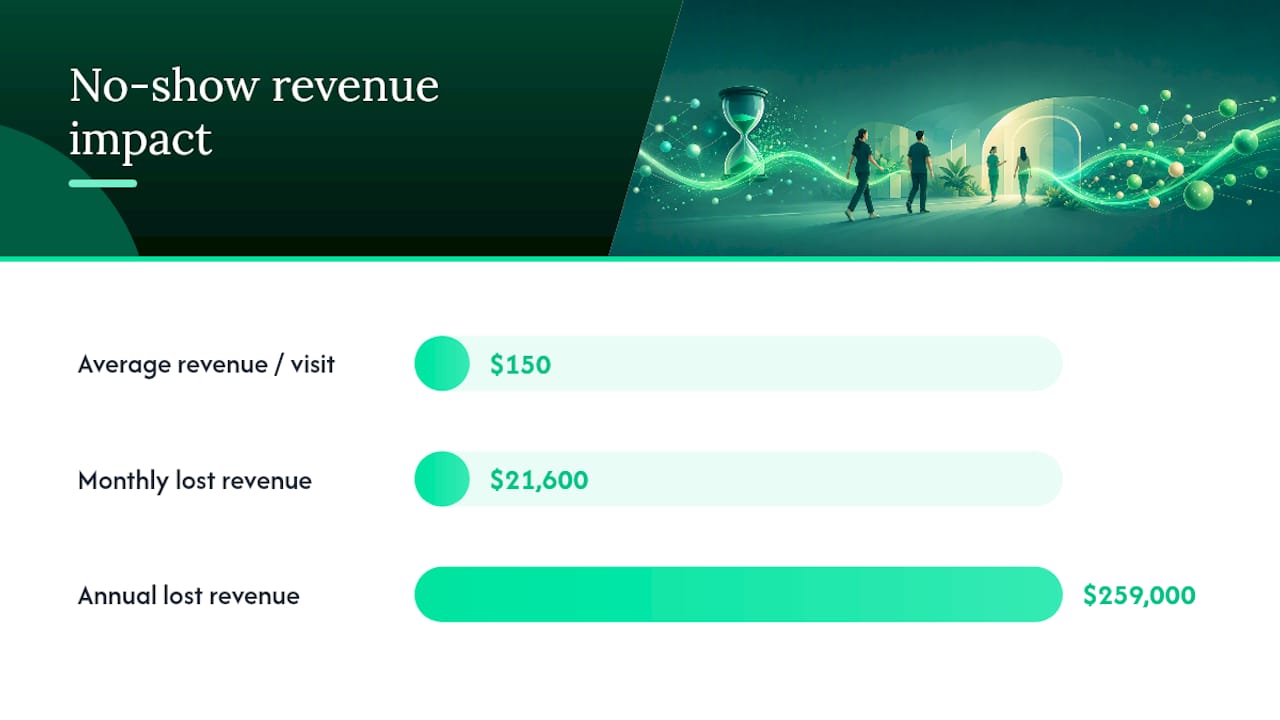
The math to quantify your own exposure is simple: multiply your monthly no-show count by average revenue per visit. At $150 average revenue per visit, that's $21,600 a month, or roughly $259,000 a year, sitting empty on the schedule.
Benchmark check: Treat any vendor claim of "we cut no-shows by 90%" with skepticism. A 2026 meta-analysis of controlled reminder studies found reminders overall improve attendance by a risk ratio of about 1.11. That's real, but modest. The bigger gains come from combining reminders with targeted live outreach, not reminders alone.
Why Patients Miss Appointments: The Four Drivers You Can Act On
Most no-shows trace back to one of four solvable problems, not simple forgetfulness. A qualitative study on patient-reported reasons for missed visits found access barriers and unclear instructions show up as often as forgetting does.
- Communication gaps: The patient never got, understood, or remembered the reminder — fixed by layered reminders across text, phone, and portal messages.
- Scheduling friction: Rebooking requires a phone call during business hours, or the visit was booked weeks out and life got in the way — fixed by online rescheduling and shorter lead times.
- Social and logistical barriers: Transportation, childcare, work schedules, or cost stand between the patient and the visit — fixed by telehealth options and flexible hours.
- Low engagement: The patient doesn't see the visit as urgent or doesn't trust the practice enough to prioritize it — fixed by empathetic outreach and patient navigators.
Analysis of the $150 billion in missed appointments lost to no-shows nationally backs this framework: blanket reminders address only one driver out of four, which is why reminder-only programs plateau.
How Do You Measure Your Practice's No-Show Rate?
The formula is: no-show rate equals no-shows divided by total scheduled appointments, minus advance cancellations, multiplied by 100.
Segmenting that number is where the useful insight lives. Appointment type, lead time, payer, patient age, and prior no-show history all predict risk differently. A BMC Health Services Research model identified long lead times, younger age, prior missed visits, and distance to clinic as consistent predictors worth tracking in your own data.
To pull your baseline from EHR scheduling data:
- Export 90 days of appointment records, including status codes for completed, canceled, and no-show.
- Calculate the overall rate using the formula above.
- Break the rate out by provider, appointment type, and lead time band (same-week versus 2+ weeks out).
- Flag patients with two or more no-shows in the past 12 months as a high-risk cohort.
- Set this 90-day snapshot as your baseline before changing anything.
Evidence-Based Interventions That Reduce No-Shows
Reminders help, but the size of the effect depends heavily on the channel and who receives it. Pooled data from a rapid review of predictive model-based interventions found text-message reminders driven by risk models reduced no-shows with high-certainty evidence (median relative risk 0.91), while phone-call reminders and patient navigator calls showed a stronger effect in several trials, with a median relative risk around 0.61.
The gap between those two numbers is the whole argument for targeting. A blanket text blast helps everyone a little. A phone call to the patients most likely to miss helps a lot, but only if you can afford the staff time to make those calls, which is why identifying who to call matters as much as the calling itself.
- Reminders (broad): Modest lift, risk ratio near 1.11 across pooled controlled studies; cheap to run at scale.
- Live phone outreach to high-risk patients: Larger effect in RCTs; a randomized quality-improvement initiative found model-driven telephone outreach reduced no-shows and narrowed the show-rate gap for Black patients in a safety-net clinic.
- Patient navigators: Effective in the same evidence base as live phone outreach, particularly for patients facing social barriers.
- Overbooking: Uncertain evidence. One insight from the same rapid review notes overbooking can work in constrained settings but risks staff overtime, longer waits, and worse access for already-underserved patients if applied broadly.
What the numbers actually say: Text reminders move the needle a little for everyone. A real conversation moves it a lot for the people who need it. Spreading your outreach budget evenly across both groups wastes the second effect.
Cost-effectiveness data on these programs is thinner than the attendance data. Before scaling a navigator program or a predictive-call system practice-wide, run it as a pilot on your highest-risk cohort first and measure recovered visits against staff hours spent.
Operational Tactics: Scheduling, Waitlists, Telehealth, and Recovery
Prevention and recovery are two separate jobs, and most practices only build for prevention.
Make rescheduling nearly frictionless. A one-touch link in every reminder, an online portal open outside business hours, and same-day slots reserved for rebooking all lower the barrier that keeps a patient from calling to move their visit instead of just skipping it. Booking systems that pair easy cancellation with SMS reminders show measurably lower no-show rates than reminder-only setups, and a well-built patient-facing booking interface removes a lot of that friction before it starts.
Layer your reminders on a schedule: 72 hours out by text or email, 24 hours out by text, and a morning-of nudge for same-day visits. Reserve a phone call for your flagged high-risk patients at the 24-hour mark.
- Keep a live waitlist and text open slots to it the moment a cancellation posts.
- Set an outreach cadence: notify the top three waitlist matches within 15 minutes, then expand outward if no one responds.
- Offer a telehealth option for patients who cite transportation or childcare as a barrier.
- Extend a small window of evening or weekend hours if your no-show data shows a spike tied to work conflicts.
- Call every no-show within 24 hours with a genuinely empathetic script, not a scolding one, and offer to rebook on the spot.
Pro Tip: Script the 24-hour recovery call to open with "we missed you" instead of "you missed your appointment." The first framing gets patients back on the schedule; the second gets them to switch providers.
Practices that build this recovery step recover a real share of lost visits and blunt the downstream disengagement that turns one missed visit into a lost patient relationship altogether.
How Should You Use Predictive Scores to Target Outreach?
A risk score only earns its keep if it changes what your staff actually does. Scoring every patient and then sending everyone the same text defeats the purpose. The score exists to tell you which small slice of your schedule deserves a phone call instead of an automated message.
Set a threshold, not a guess. A randomized quality-improvement initiative found this number falls as the risk threshold rises, which gives practice managers a concrete way to pick a cutoff that fits their staffing.
The whole design principle is this: give every patient visibility into rescheduling, give the highest-risk patients a real conversation, and resist the urge to automate harder for the middle group where the returns flatten out fast.
Equity has to sit inside this workflow, not outside it. The same randomized initiative that improved overall no-show rates also narrowed the show-rate gap for Black patients, but that outcome depended on the outreach being supportive rather than punitive. Monitor your flagged list by demographic group regularly. If one group is consistently overrepresented, that's a signal to review the model inputs, not a reason to add fees.
- Flag the top 10% to 20% of predicted risk for live calls, not automated texts.
- Track number needed to call monthly and adjust the threshold as staffing allows.
- Audit flagged lists quarterly for demographic skew.
- Pair every flag with a documented, scripted outreach action, never a silent penalty.
A tool like Signal Engine's approach to identifying at-risk patterns illustrates the operational shape this takes: score first, then route the highest-risk group into a specific, documented human action rather than more automation.
Handling Chronic No-Shows: Policy and Documentation
Chronic no-shows need a documented, consistent process, not an improvised one, and definitely not a punitive first move.
Document every no-show in the medical record with the date, the missed visit type, and a note on outreach attempted, including the channel and whether the patient responded. This record matters both for continuity of care and for defending any scheduling decision later.
- Build a three-step escalation: outreach and rescheduling support first, a direct conversation about barriers second, and limited scheduling privileges only as a last resort.
- Build an exceptions process for documented hardship, transportation issues, or health crises before applying any restriction.
- Check payer contracts and Medicaid rules before charging a no-show fee. Many payer agreements restrict or prohibit these fees outright, and rules vary by state and plan.
Treat this section as an operational starting point rather than legal counsel, and run any fee or restriction policy past your compliance contact before it goes live.
Measuring Results: KPIs, Pilots, and ROI
Track four numbers before and after any change: no-show rate by risk cohort, visits recovered through same-day rebooking, revenue recovered per month, and number needed to call.
Run a pilot before you scale anything. Split your high-risk cohort into a group that gets live outreach and a group that gets standard reminders only, run it for 60 to 90 days, and compare no-show rates between the two.
- Set your 90-day baseline rate and cohort segmentation first.
- Run the pilot on one provider or one appointment type for 60 to 90 days.
- Calculate recovered revenue: recovered visits multiplied by average revenue per visit.
- Compare that recovered revenue against staff hours spent calling; if recovered revenue clears staff cost within the pilot window, scale the program.
A 30-Day Playbook for Cutting No-Shows
Most practices try to fix no-shows by buying a reminder tool and hoping. That's backwards. The evidence points the other way: reminders are cheap and modestly effective, but the real gains sit in knowing exactly who to call and calling them within a day of a miss.
For the next 30 days: pull your 90-day baseline this week, turn on layered reminders by week two, identify your high-risk cohort by week three, and pilot live outreach plus a working waitlist by week four. Track recovered visits weekly, and watch your flagged list for demographic skew from day one, not month three.
— Bernard
Ready to Stop the Revenue Leak?
Signal Engine gives small and local businesses 31 AI-powered tools to score leads by buying intent, predict churn before it happens, auto-generate email and SMS campaigns, and recover missed calls automatically — all in one dashboard starting at $49/month.
Most practices patch no-shows with a single reminder tool and call it done. Signal Engine works differently: it scores every patient by no-show risk, drafts the outreach message or call script automatically, and holds it for one-click approval before anything reaches a real patient, so your front desk isn't guessing who to prioritize.
If a patient misses a call from your office, missed-call recovery sends an automatic text-back so that contact doesn't just disappear into a voicemail nobody checks. The Growth plan runs $149 a month, with every feature included and no per-seat pricing, so a small clinic gets the same scoring and outreach automation that used to require enterprise software budgets.
Start your free 7-day trial — no credit card required. Setup takes 5 minutes.
Sources
- Eprints
- Reducing disparities in no-show rates using predictive model-driven live appointment reminders (PMC)
- Why We Don't Come: Patient Perceptions on No-Shows (PMC)
- $150 Billion in Missed Appointments: Why No-Shows Keep Happening, and What Actually Stops Them
FAQ
How Should You Deal With No-Show Patients?
Call within 24 hours with an empathetic, non-judgmental script and offer to rebook immediately. Layer that with a documented policy for repeat no-shows that starts with outreach and support, not fees or discharge, and reserve restrictions for patients who don't respond to multiple contact attempts.
How Do You Professionally Refer to a No-Show?
"Missed appointment" or "no-show" are the standard clinical and administrative terms; avoid language that implies blame in patient-facing communication. Internally, most EHR systems use a specific status code distinct from "canceled," which is the field you should be pulling for your baseline no-show rate.
How Do You Document a No-Show in the Medical Record?
Note the date, appointment type, and any outreach attempted, including the channel used and whether the patient responded. This record supports continuity of care and protects the practice if a scheduling restriction is ever challenged.
What Drives Most Patient No-Shows?
Four factors: communication gaps, scheduling friction, social or logistical barriers, and low engagement with the practice. A study on patient-reported reasons found access barriers and unclear instructions rank alongside simple forgetting.
Can Software Like Signal Engine Actually Reduce No-Shows?
Signal Engine scores patients by risk and drafts the outreach or recovery message automatically, which maps directly to the targeted, high-risk-first approach the evidence supports. Pricing starts on the Growth plan at $149 a month, with a free trial available to test the workflow before committing.