

TL;DR:
- Acting within 30 days significantly increases the chances of recovering lost clients before competitors win them.
- AI-powered automation provides timely, personalized outreach based on client behavior signals, boosting recovery success.
A 30-day client recovery plan is a structured win-back system that targets lost clients during the optimal re-engagement window before they fully commit to a competitor. B2B companies that act within 30 days recover 15–25% of lost clients, compared to under 8% for outreach after 60 days. That gap is not a coincidence. The first month after churn is when buyer's remorse peaks, trust can still be rebuilt, and your brand is still fresh in the client's mind. This guide gives you the exact framework to build a 30-day client recovery plan, execute it with precision, and use AI to make it repeatable.
What do you need before building your 30-day client recovery plan?
The most common reason recovery efforts fail is not bad messaging. It is poor preparation. Before you send a single email, you need three things in place: a trigger system, a data capture process, and clear role assignments.
Set up CRM event triggers. Your CRM should fire an alert the moment a client cancels, goes silent, or misses a renewal. Without this, you are relying on someone to notice the churn manually, and that delay costs you the recovery window. Automated 30-day sequences recover three times more clients than ad-hoc efforts, and that advantage starts with a trigger, not a phone call.
Build an exit survey funnel. Send a short, three-question survey within 48 hours of churn. Ask why they left, what would have changed their decision, and whether they are open to a future conversation. This data drives segmentation. A client who left because of price gets a different message than one who left because of a service gap.
Assign ownership by account tier. Not every lost client deserves the same level of attention. Segment your accounts before the plan launches.
| Account tier | Definition | Owner |
|---|---|---|
| Anchor accounts | 10%+ of ARR | CEO or CRO |
| Mid-tier accounts | 3–9% of ARR | Senior account executive |
| Standard accounts | Under 3% of ARR | Automated sequence |
Pro Tip: Use decay scoring in your CRM to rank churned clients by engagement level. Clients who still open your emails or visit your site are far more recoverable than those who have gone completely dark.
Churn prediction tools can flag at-risk clients before they formally cancel, giving you a head start on this entire process.
How do you execute the step-by-step 30-day recovery framework?
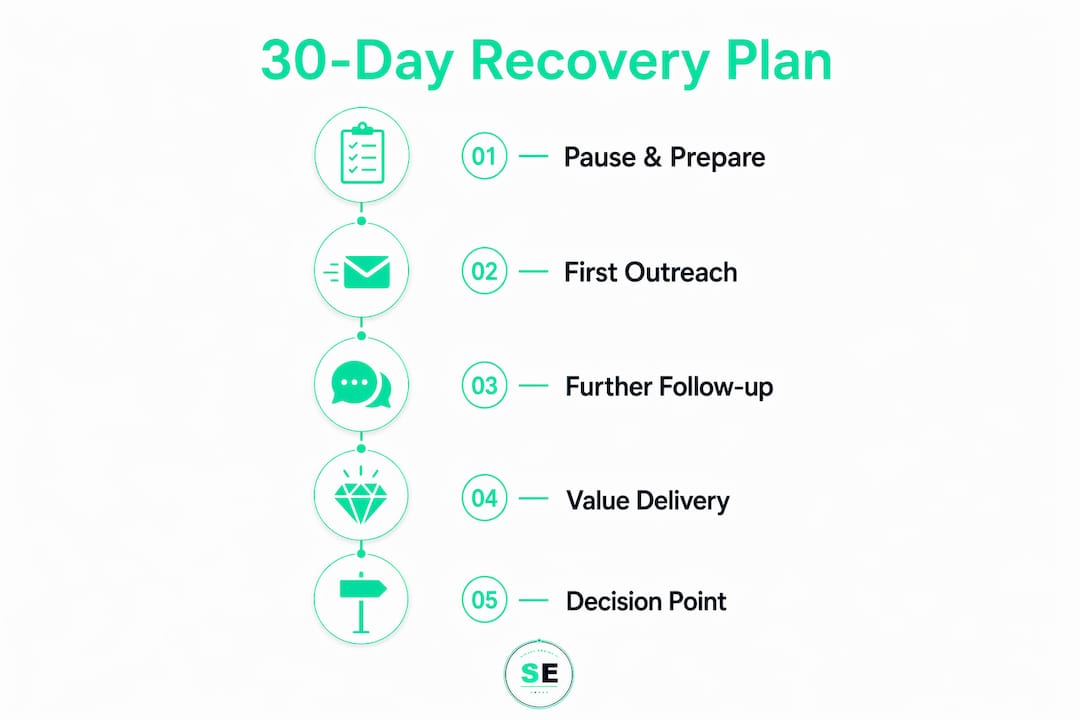
The 30-day window is not a suggestion. Companies acting within 30 days of a client departure have 70% higher recovery rates than those who delay. Here is how to use every day of that window.
Days 1–3: Pause and prepare
Do not reach out immediately. A short cooling-off period signals confidence, not desperation. Use these days to review the exit survey data, confirm account tier, and assign the right owner. For anchor accounts, the CEO or CRO should be briefed and ready to make direct contact.

Days 4–7: First outreach
Send a personalized message that acknowledges the departure without being defensive. Lead with a specific improvement your company has made since the client left. Avoid discounts as your opening offer. Clients who left over service issues do not want a price cut. They want proof that the problem is fixed.
For anchor accounts, CEO and CRO level contact within the first seven days achieves a 32% save rate, versus 8% when managed by lower-level staff. That difference is too large to ignore. Executive involvement is not optional for your biggest accounts.
Days 8–14: Multi-channel follow-up
If the first message goes unanswered, follow up across channels. Email, phone, and LinkedIn each reach different attention states. A client who ignores an email may respond to a LinkedIn message because the context feels different. Keep the tone warm and focused on their specific situation, not a generic pitch.
- Send a follow-up email referencing the original message.
- Make a direct phone call with a voicemail that names a specific value improvement.
- Connect or message on LinkedIn with a brief, personal note.
- Share a relevant case study or testimonial from a similar client.
Days 15–21: Value delivery
Send something genuinely useful with no strings attached. A short audit, a relevant industry report, or a product update that directly addresses why they left. The 30–90 day window post-churn is when buyer's remorse with a new vendor peaks. Your goal is to be present and valuable exactly when that frustration surfaces.
Days 22–30: Decision point
Make a direct ask. Offer a call, a demo, or a trial of the improved product. If the client still does not respond, move them to a long-term nurture sequence and revisit in 90 days. Do not burn the relationship by over-contacting.
Pro Tip: Track response rates by channel and day of outreach. Most recoveries happen between days 7 and 21. If you see zero engagement by day 22, escalate or archive rather than continuing the same sequence.
What mistakes should you avoid in your client retention plan?
Most recovery efforts fail not because the client was unrecoverable, but because the outreach was handled poorly. True service recovery is a proactive, data-driven process, not a reactive apology. These are the mistakes that kill recovery rates.
- Reaching out too soon. Contacting a client within 24–48 hours of cancellation reads as panic. Give the relationship a brief reset before initiating contact.
- Leading with a discount. Price cuts signal that you were overcharging before. Lead with product improvements, new features, or resolved issues instead.
- Assigning anchor accounts to junior staff. Delegating a high-value recovery to someone without authority or relationship capital is a strategic mistake. Executive involvement is the single biggest lever for anchor account recovery.
- Ignoring the emotional barrier for your sales team. Sales teams often avoid closed-lost accounts because re-engagement feels like social rejection. AI-driven signals help by giving reps a clear, data-backed reason to reach out, which removes the guesswork and the awkwardness.
- Misreading engagement data. An email open is not a buying signal. A client who clicks a pricing page link is. Train your team to distinguish between passive and active engagement before escalating.
"Service recovery is more than fixing issues. It is about rebuilding trust through data-driven process improvement and logged complaints. Businesses that treat every churn event as a learning opportunity build recovery systems that get better over time."
When a client shows no engagement by day 30, archive them with a clear tag and a scheduled 90-day review. Do not delete them from your pipeline. Lost clients are a recoverable asset, not a write-off.
How can AI and automation improve your recovery efforts?
Manual recovery works for a handful of accounts. At scale, it breaks down fast. AI and automation solve the two biggest problems in client recovery: timing and personalization.
AI tools that detect win-back signals monitor client behavior in real time. When a churned client visits your pricing page, opens three emails in a row, or engages with your LinkedIn content, the system flags it and triggers an outreach sequence automatically. That kind of signal-driven contact feels relevant rather than intrusive.
Here is how manual and automated recovery approaches compare across key dimensions:
| Recovery dimension | Manual approach | Automated approach |
|---|---|---|
| Outreach timing | Depends on rep availability | Triggered instantly by behavior signals |
| Personalization | High for top accounts | Segmented by exit reason and tier |
| Scalability | Limited to rep capacity | Handles hundreds of accounts simultaneously |
| Engagement tracking | Spreadsheet or CRM notes | Real-time decay scoring and alerts |
| Escalation | Often delayed or missed | Auto-escalates based on engagement thresholds |
Signalengine scores client behavior automatically, flags who is about to leave, and tells your team exactly what to do next. For small businesses without a dedicated customer success team, that kind of revenue intelligence replaces hours of manual monitoring with a single dashboard.
Pro Tip: Set your automation to pause when a human responds. Nothing damages a recovery faster than a client replying to your personal email and then receiving an automated follow-up 20 minutes later. Automation should support human contact, not override it.
Automating churn intervention also creates a feedback loop. Every recovered client teaches the system which signals, messages, and timing patterns work best. Over time, your recovery rate improves without adding headcount.
Key Takeaways
A structured 30-day client recovery plan, executed with the right timing, executive involvement, and AI-driven signals, consistently outperforms ad-hoc win-back efforts by a factor of three or more.
| Point | Details |
|---|---|
| Act within 30 days | Recovery rates drop sharply after 60 days; the first month is your highest-leverage window. |
| Segment before outreach | Exit survey data drives message relevance; one sequence does not fit all churn reasons. |
| Escalate anchor accounts | CEO or CRO contact within 7 days achieves a 32% save rate for high-value clients. |
| Lead with value, not discounts | Clients who left over service issues respond to proof of improvement, not price cuts. |
| Automate at scale, personalize at the top | Use automation for standard accounts and reserve manual contact for your most critical relationships. |
Why most recovery plans never get off the ground
I have watched small business owners build detailed recovery plans and then never execute them. The plan sits in a shared doc, the sales team feels awkward reaching out, and the window closes. The problem is not the plan. It is the gap between knowing what to do and actually doing it under pressure.
The shift that changes everything is moving from reactive to structured. Founders who move from daily doing to overseeing structured systems within 30 days regain control faster and with less chaos. The same principle applies to client recovery. When you have a trigger, a sequence, and a clear owner for every account tier, the plan runs itself. You stop relying on someone remembering to follow up.
The other thing I have seen consistently: businesses underestimate the emotional cost of recovery outreach for their sales reps. Reaching out to a client who left feels personal. AI-driven signals remove that friction. When a rep knows a churned client just visited the pricing page, the call has a reason. It is not a cold ask. It is a timely, relevant check-in.
Lost clients are not failures. They are the highest-intent prospects you will ever have. They already know your product, your team, and your process. The cost to recover them is a fraction of the cost to acquire someone new. Build the system, assign the owners, and let the data tell you when to move.
— Bernard
Signalengine makes your recovery plan run automatically
Building a recovery plan is one thing. Executing it consistently across dozens of churned accounts is another challenge entirely.
Signalengine watches your client list in real time, scores engagement automatically, and fires the right outreach at the right moment, without you having to check a dashboard every morning. Exit survey funnels, segmented sequences, and executive escalation alerts are all built in. You get a clear view of which recovered clients are back in your pipeline and what revenue they represent. AI-powered revenue intelligence starts at $49/month, with setup in under five minutes. No spreadsheets. No guessing. Just a system that works while you run your business.
Ready to Stop the Revenue Leak?
Signal Engine gives small and local businesses 31 AI-powered tools to score leads by buying intent, predict churn before it happens, auto-generate email and SMS campaigns, and recover missed calls automatically — all in one dashboard starting at $49/month.
Start your free 7-day trial — no credit card required. Setup takes 5 minutes.
FAQ
What is a 30-day client recovery plan?
A 30-day client recovery plan is a structured win-back process that targets churned clients within the first month after departure. It uses segmented outreach, executive engagement for key accounts, and automated sequences to maximize re-engagement rates.
How many lost clients can a recovery plan realistically win back?
B2B companies that run structured win-back sequences within 30 days recover 15–25% of lost clients. That rate drops to under 8% when outreach is delayed beyond 60 days.
When is the best time to contact a churned client?
The optimal window is 30–90 days post-churn, when buyer's remorse with a new vendor is at its peak. Reaching out too soon feels desperate; waiting too long means the client has moved on entirely.
Should you offer a discount to win back a lost client?
No. Leading with a discount signals that your original pricing was inflated. Instead, lead with value improvements such as resolved issues, new features, or a service upgrade that directly addresses why the client left.
How does AI help with client recovery?
AI monitors churned client behavior in real time and triggers outreach when engagement signals appear, such as a pricing page visit or email click. This makes contact feel timely and relevant rather than random, which increases recovery effectiveness while reducing the emotional burden on your sales team.