

TL;DR:
- AI identifies at-risk customers by combining behavioral signals, conversational cues, and account context into a health score to predict churn early. This integrated approach detects risk up to 90 days in advance, enabling proactive customer success actions.
AI detects at-risk customers by fusing behavioral data, conversational signals, and account context into a composite health score that flags churn risk weeks before it becomes visible. Traditional methods rely on usage metrics alone, but usage data misses 40–60% of at-risk accounts because engagement is a lagging indicator. The industry term for this multi-layered approach is AI customer health scoring, and it is the most reliable method available for detecting at-risk clients before they decide to leave. This playbook breaks down exactly how the detection works, which signals matter most, and how your team can put it into practice.
How AI detects at-risk customers through behavioral signals
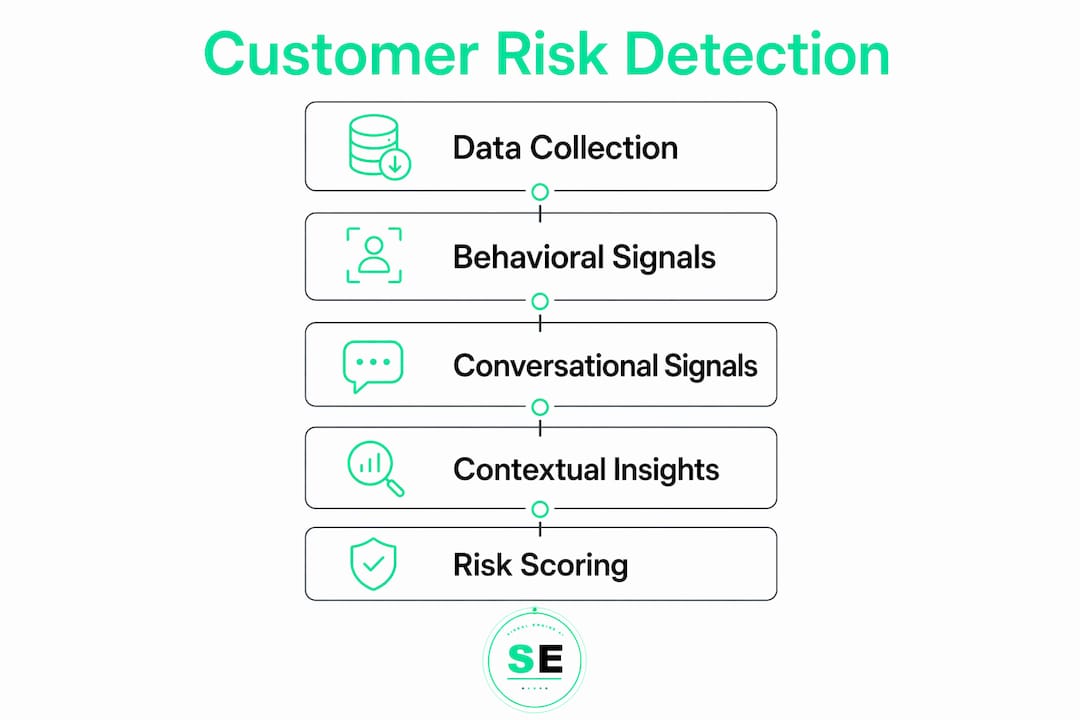
Behavioral analytics form the first detection layer in any AI customer risk assessment. The most reliable tripwire is a 30%+ usage decline measured against a 12-week baseline over a 4-week trailing average. When an account crosses that threshold, AI flags it automatically without waiting for a customer success manager to notice.

Usage data has a critical blind spot, though. It tells you what happened, not why. A customer can maintain steady login counts while quietly evaluating alternatives, making engagement metrics a poor sole predictor of churn.
Account concentration is another behavioral risk factor AI tracks. When 80% of activity in an account concentrates in a single user, that account becomes fragile. If that person leaves the company or changes roles, the entire relationship is at risk.
AI also monitors support ticket frequency, payment delays, and feature adoption rates as secondary behavioral signals. A spike in support tickets combined with declining feature usage creates a compound risk pattern that no single metric would catch alone.
Pro Tip: Combine product telemetry with support ticket sentiment scores. A customer filing three tickets in one week while usage drops is far more at-risk than one filing three tickets while usage holds steady.
What conversational signals reveal that usage data cannot
Conversational AI analysis is the layer that catches churn intent before behavior changes. AI-moderated interviews achieve 30–40% completion rates, compared to just 8% for traditional NPS surveys. That gap means you get real signal from real customers instead of a thin slice of the most engaged ones.
Five conversational signals predict churn most reliably. AI systems trained on natural language processing (NLP) detect each one across tickets, emails, call transcripts, and check-in interviews:
- Sentiment shift: A customer who previously used positive language starts using neutral or negative phrasing.
- Hesitation language: Phrases like "we're still evaluating" or "we'll see" signal wavering commitment.
- Competitor mentions: Any unprompted reference to an alternative product is a high-priority alert.
- Deferral phrasing: "Let's revisit this next quarter" often means the customer is buying time before canceling.
- Sponsor changes: When a champion leaves and no new internal advocate emerges, risk spikes immediately.
These conversational signals predict churn 30–90 days before renewal decisions, compared to 2–3 weeks of lead time from telemetry alone. That extra window is the difference between a save and a lost account.
| Signal type | Detection lead time | Data source |
|---|---|---|
| Usage decline | 2–3 weeks before churn | Product telemetry |
| Sentiment shift | 4–8 weeks before churn | Tickets, emails, transcripts |
| Competitor mention | 6–12 weeks before churn | Interviews, support chats |
| Sponsor change | Up to 90 days before churn | CRM, LinkedIn, interviews |
Pro Tip: Run AI-moderated check-ins at the 60-day and 90-day marks after onboarding. Most churn intent forms silently during this window, long before a customer says anything directly.
How account context and strategic signals sharpen AI risk detection
Behavioral and conversational data explain what a customer is doing and saying. Account context explains why the risk exists at a structural level. AI systems that incorporate strategic signals produce far more accurate composite scores.
The most impactful strategic signals include:
- Champion or sponsor changes: Executive turnover triggers vendor consolidation 60–80% of the time. When your primary contact leaves, the replacement often brings their own vendor preferences.
- Stakeholder count: Accounts with fewer internal stakeholders churn 3x more often than accounts with broad adoption. Single-threaded relationships are inherently fragile.
- External events: Funding rounds, mergers, acquisitions, and layoffs all shift a company's vendor priorities. AI systems that monitor LinkedIn webhooks and news feeds can surface these events in real time.
- Contract characteristics: Short contract terms, month-to-month billing, and upcoming renewal dates all increase risk weight in the composite score.
AI platforms that pull from large cross-network data sets can detect risk patterns from day one, even without extensive account history. The intelligence comes from cross-account patterns, not just individual account behavior. This is why AI risk scoring built on broad data networks outperforms rule-based systems that rely solely on internal CRM data.
The practical implication is clear: your AI risk model needs external data feeds, not just internal product data. A customer who just announced a round of layoffs is at elevated churn risk regardless of their current usage metrics.
A practical framework for AI-powered at-risk detection
The most effective implementation follows a five-stage detection framework: Behavioral, Relationship, Sentiment, Strategic, and Confirmation Interview. Each stage adds a layer of signal that the previous stage cannot provide on its own.
-
Behavioral stage: Set automated alerts for the 30%+ usage decline threshold and single-user concentration risk. These run continuously in the background without human input.
-
Relationship stage: Track stakeholder count, champion tenure, and internal adoption breadth. Flag accounts where fewer than two internal users have logged in during the past 30 days.
-
Sentiment stage: Deploy NLP analysis across all customer-facing text channels. Tickets, emails, and chat transcripts feed into a rolling sentiment score that updates weekly.
-
Strategic stage: Connect external data sources to your health scoring model. LinkedIn job change alerts and news monitoring add context that internal data cannot provide.
-
Confirmation Interview stage: When an account triggers alerts in two or more stages, AI-moderated check-ins scale structured conversations across hundreds of accounts simultaneously. AI probes vague responses in real time and synthesizes root causes for your team.
AI customer health scoring that combines all five stages catches 70–85% of accounts that eventually churn, given clean data and at least 12 months of history. That accuracy level requires no dedicated data science team when the right platform handles the model.
The key operational shift is role clarity. AI scales customer success by handling routine identification and pattern detection. Your team focuses on high-judgment interventions where human context and relationship skills matter most. AI does not replace that judgment. It feeds it.
Pro Tip: Calibrate your alert thresholds quarterly. A model that flags too many accounts creates alert fatigue. A model that flags too few misses real churn. Review false positives and missed churns every 90 days and adjust signal weights accordingly.
For a deeper look at how churn prediction works in practice, the mechanics behind the scoring model matter as much as the signals feeding it.
Key Takeaways
AI detects at-risk customers most accurately when behavioral data, conversational signals, and account context combine into a single composite health score updated in real time.
| Point | Details |
|---|---|
| Usage data alone is insufficient | Engagement metrics miss 40–60% of at-risk accounts because they are lagging indicators. |
| Conversational signals detect churn earlier | NLP analysis of tickets, emails, and interviews surfaces risk 30–90 days before renewal decisions. |
| Account context multiplies accuracy | Stakeholder count, sponsor changes, and external events are structural risk factors AI must incorporate. |
| Five-stage framework covers all risk dimensions | Behavioral, Relationship, Sentiment, Strategic, and Confirmation Interview stages work together for full coverage. |
| AI scales the team, not replaces it | AI handles routine detection so customer success managers focus on high-value saves. |
Why most businesses are solving the wrong problem
The companies I see struggle most with churn are not short on data. They are short on signal completeness. They have product telemetry, a CRM, and maybe an NPS survey running quarterly. What they are missing is the layer in between: the conversation where a customer's real sentiment lives.
The uncomfortable truth about AI in customer retention is that the technology is not the hard part. The hard part is convincing teams to act on signals they cannot see with their own eyes. A customer who logs in every day but mentions a competitor in a support ticket is at serious risk. Most teams never see that ticket. AI does.
The other mistake I see constantly is treating AI-moderated interviews as a replacement for human relationships. They are not. They are a triage tool. AI surfaces which accounts need a human conversation urgently and which ones are genuinely healthy. That distinction is what makes predicting churn for service businesses tractable at scale.
The businesses that win at retention in 2026 will be the ones that treat at-risk detection as a signal-completeness problem, not a data volume problem. More dashboards will not save your accounts. Better signals will.
— Bernard
Signalengine watches your customers so you do not have to
Your customers are sending signals right now. Signalengine's AI picks them up automatically, scores each account by churn risk, and tells your team exactly who needs attention and when.
Built for small and mid-sized businesses across HVAC, logistics, dental, real estate, and 8 other verticals, Signalengine combines behavioral scoring, automated campaigns, and AI-driven churn prediction in one dashboard starting at $49/month. No data science team required. No complex setup. Just clear signals and a short list of accounts to act on today. See the full revenue intelligence toolkit and start your free trial.
Ready to Stop the Revenue Leak?
Signal Engine gives small and local businesses 31 AI-powered tools to score leads by buying intent, predict churn before it happens, auto-generate email and SMS campaigns, and recover missed calls automatically — all in one dashboard starting at $49/month.
Start your free 7-day trial — no credit card required. Setup takes 5 minutes.
FAQ
How does AI identify at-risk customers before they churn?
AI identifies at-risk customers by combining usage decline thresholds, NLP sentiment analysis, and account context signals into a composite health score. Accounts that trigger alerts across multiple signal types receive the highest risk priority.
What behavioral signals does AI use for customer risk assessment?
A 30%+ drop in 4-week trailing usage against a 12-week baseline is the primary behavioral tripwire. AI also flags accounts where 80% of activity concentrates in a single user, since those accounts collapse quickly when that user leaves.
How early can AI detect churn risk?
Conversational signals like competitor mentions and sentiment shifts surface churn intent 30–90 days before a renewal decision. Usage-based signals typically provide only 2–3 weeks of lead time.
Does AI replace customer success managers in retention?
AI scales customer success managers by handling routine detection and pattern analysis across hundreds of accounts. Human teams focus on high-judgment conversations where relationship context and empathy drive the actual save.
What data does AI need to predict customer churn accurately?
AI health scoring models perform best with at least 12 months of historical data across usage, support tickets, payment behavior, and engagement. Models that also pull external signals like LinkedIn job changes and news events produce the most accurate composite scores.