

Answer: when a lead hits your inbox, call, text, and email within minutes, not hours. Then run a front-loaded 14-day cadence that tapers into a 90-day nurture, escalating any hot signal straight to a manual phone call.
This works because speed beats polish. A lead who fills out a form is comparing you against whoever else answers first, and NAR data shows most buyers interview only one agent — meaning the agent who shows up first usually keeps the client.
Do this in the next 15 minutes:
- Call the lead. If no answer, leave a 10 to 15 second voicemail.
- Send a short text within 2 minutes of the call asking a yes/no question.
- Send a one-line email confirming you're on it, then let a tool like Signal Engine auto-create your Day 1 through 14 tasks so nothing slips.
Key Takeaways
The single most important fact: leads convert at a far higher rate when agents make first contact within minutes and follow a structured, front-loaded cadence rather than relying on memory or motivation.
| Point | Details |
|---|---|
| Speed decides the deal | Most buyers only interview one agent, so the fastest responder usually wins the relationship. |
| Front-load the first 14 days | Daily multi-channel touches in weeks one and two convert far better than sporadic follow-up. |
| Stack three channels | Combine calls, texts, and emails since each catches leads who ignore the other two. |
| Automate the boring parts | Auto-created tasks and temperature tags stop leads from slipping through the cracks. |
| Signal Engine enforces the system | Signal Engine auto-creates Day 1 through 14 tasks and scores leads by buying intent so hot prospects get a call first. |
Table of Contents
- Why Real Estate Follow Up Matters More Than You Think
- The 0-14 Day Cadence Every Agent Should Run
- Scripts and Templates You Can Use Today
- How to Sequence Calls, Texts, and Emails Together
- Setting Up CRM Automation That Actually Enforces the Cadence
- Common Follow-Up Mistakes and the Metrics That Catch Them
- Legal and Ethical Rules for Real Estate Follow Up
- Handling Objections During Follow-Up
- When to Follow Up: Timing Beyond the First Response
- What the Data Actually Tells Agents to Do Differently
- Ready to Stop the Revenue Leak?
- Sources
- FAQ
Why Real Estate Follow Up Matters More Than You Think
Most agents treat follow-up as a courtesy. It's actually the whole game. Since nearly three-quarters of buyers only talk to one agent, the agent who responds first often becomes that one agent by default, not by superior pitch.
Speed-to-lead studies consistently show that responding within the first five minutes dramatically outperforms delayed replies in terms of contact rate and eventual conversion. Every hour you wait, the odds drop that the lead still remembers filling out your form.
The math is simple: faster first contact means more replies, more replies mean more appointments, and more appointments mean more closings. It's a funnel, and speed sits at the top of it.
- Faster response = higher contact rate
- Higher contact rate = more appointments set
- More appointments = more signed clients
The 0-14 Day Cadence Every Agent Should Run
The first ten minutes decide more than the next ten days combined. Call immediately. If it goes to voicemail, leave one, then text within two minutes, then send an email within five. This "first-touch stack" works because each channel catches a different kind of lead: some people never answer calls but always read texts, others screen calls but check email obsessively.
After that first stack, the schedule matters as much as the message. A structured day-by-day follow-up schedule turns an inconsistent habit into a system your CRM can enforce.
| Day | Channel | Action |
|---|---|---|
| 0 | Call, text, email | First-touch stack within 10 minutes |
| 1 | Text | Ask about timeline or must-haves |
| 2 | Send 2-3 matching listings | |
| 4 | Call | Check in, ask about financing status |
| 6 | Text | Share a market update or new listing |
| 9 | Neighborhood-specific insight or open house invite | |
| 11 | Call | Direct ask: "Want to see this one this weekend?" |
| 14 | Recap value, ask for a 15-minute call |
Beyond day 14, drop to weekly touches for warm leads and monthly for cold ones. Front-loaded sequences that taper into a longer nurture recover more late-stage conversions than agents who give up after two weeks, since some buyers simply take three to six months to act.
- Days 0 to 14: daily or near-daily touches, mixing all three channels.
- Days 15 to 30: two touches per week, shifting toward value content over asks.
- Days 31 to 90: weekly or biweekly touches, mostly market updates and check-ins.
- After 90 days with zero engagement: move to a quarterly "just checking in" cadence or send a breakup message.
Pro Tip: Tag leads "hot," "warm," or "cold" after the first three touches. Hot leads get a phone call every single time. Cold leads can survive on email and text alone.
Scripts and Templates You Can Use Today
Stop staring at a blank compose window. Copy these and adjust the details.
Call opener (minute 0): "Hi, this is [Name] with [Brokerage] — I saw you were looking at [property/area]. Do you have two minutes, or is now a bad time?"
15-second voicemail: "Hey, it's [Name] from [Brokerage]. Got your info on [property] and wanted to grab you before it gets more competitive. Call or text me back at [number], happy to send you a few similar options too."
SMS scripts (yes/no format):
- "Hi [Name], this is [Name] from [Brokerage]. Still looking in [area]? Reply YES and I'll send 2-3 matches today."
- "Quick one, [Name] — are mornings or evenings better for a quick call this week?"
Email subject lines that avoid the automated-drip look:
- "Quick question about [neighborhood]"
- "Found something you'll want to see"
- "Re: your search in [area]"
Keep subject lines under eight words. Personal-sounding subject lines consistently outperform obvious drip formatting in real estate inboxes.
Breakup email: "Hi [Name], I haven't heard back so I'll stop reaching out for now. If your plans change, just reply and I'll pick right back up. Wishing you luck either way."
How to Sequence Calls, Texts, and Emails Together
No single channel carries a full follow-up strategy. Mixing email, SMS, and video with segmentation consistently beats single-channel outreach, because different leads respond to different formats depending on how busy or private they are.

Stack channels in this order for new leads: call first, text within 2 minutes if no answer, email within 5 minutes. After that, space touches by at least a day so you don't read as a bot farm.
Certain behaviors should pull a lead out of automation immediately:
- Viewing the same listing three or more times in a week
- Clicking a "schedule a tour" link
- Opening the same email multiple times without replying
- Replying with a question, even a short one
Personalization is what separates a real note from a blast. Use merge fields for name and search area, but go further: mention a specific closed sale nearby or a fact about the school district they mentioned. Templates that skip specifics read like spam, even when the content is technically accurate.
Pro Tip: The moment a lead replies to anything, stop the automated sequence and switch to manual. Nothing kills trust faster than getting a "did you get my listing update?" email the day after you already spoke to the agent on the phone.
Setting Up CRM Automation That Actually Enforces the Cadence
A schedule only works if something forces it to happen. Manual follow-up plans fail constantly, not because agents don't care, but because a busy Tuesday makes Day 6 of Lead #47 easy to forget. Automation has to auto-create Day 1 through 14 tasks, tag leads by temperature, and log every touch, or the whole system collapses under real-world workload.
Three automations matter more than the rest:
- Auto-task creation: every new lead generates a full 14-day task list the moment they enter your CRM.
- Temperature tagging: behavioral signals (repeat views, clicks, replies) automatically flag a lead hot, warm, or cold.
- Auto-stop on reply: any inbound response pauses the automated sequence so a human takes over.
Signal Engine builds this directly into its real estate business software, scoring leads by buying intent so you know which five leads deserve a call before lunch instead of guessing from a spreadsheet. That behavioral scoring layer is what turns a generic drip tool into something that actually routes your time.
| Point | Details |
|---|---|
| Auto-create tasks | Day 1 through 14 tasks generate automatically the moment a lead enters your pipeline. |
| Temperature tagging | Behavioral signals like repeat views or clicks flag leads hot, warm, or cold without manual review. |
| Stop on reply | Any inbound response should pause automation instantly so a person takes over the conversation. |
Common Follow-Up Mistakes and the Metrics That Catch Them
The same three mistakes sink most follow-up plans: slow first response, messages that read like a mail-merge, and quitting after two or three tries. A fourth, quieter mistake does just as much damage: forgetting to stop the sequence once a lead replies.
Track three numbers weekly:
- Reply rate — percentage of leads who respond to any touch.
- Appointment-set rate — percentage of replies that convert to a scheduled call or showing.
- Conversion rate — percentage of appointments that become signed clients.
If reply rate is low, the problem is usually timing or subject lines. If appointment rate is low, the problem is usually your call script or the offer inside the message. Run small A/B tests: two subject lines, two opening lines, two send times, one variable at a time. Overtly automated-sounding messages are the single biggest drag on open rates in real estate drip campaigns, so start your testing there before touching timing.
Legal and Ethical Rules for Real Estate Follow Up
Speed matters, but so does staying inside the law. The Telephone Consumer Protection Act (TCPA) governs unsolicited calls and texts to consumers, and it requires prior express consent before you send automated or marketed text messages to a phone number. Most lead forms include a consent checkbox, but you should confirm your lead source actually captures that consent rather than assuming it does.
The CAN-SPAM Act sets the rules for email: every marketing email needs a working unsubscribe link, an honest subject line, and your real business address. A subject line like "Quick question about your search" is fine when you genuinely have a question. It crosses into deceptive territory only if the email contains nothing but a hard sales pitch dressed up as a personal note.
Do Not Call Registry rules apply too. If a lead's number is registered and you don't have an established business relationship or explicit consent, cold calling that number carries real regulatory risk. CRM platforms that scrub against the registry before dialing reduce that exposure.
Ethically, the line is simpler than the legal one: never pretend automation is a person typing in real time, and never manufacture urgency that doesn't exist ("this offer expires tonight" on a listing that isn't going anywhere). Buyers and sellers remember agents who respected their time, and referrals dry up fast for agents who didn't.
One more practical habit: log consent and opt-outs inside your CRM, not just in your head. If a lead texts "STOP," that needs to hard-stop every future automated touch, not just the current sequence.
Handling Objections During Follow-Up
Most objections during follow-up aren't rejections. They're stalling tactics from someone who hasn't fully committed to the process yet, and treating them as final answers ends conversations that were still winnable.
"I'm just browsing" usually means the lead isn't ready to admit they're serious yet. Respond with something low-pressure: "Totally fine, most people start there. Want me to just send you anything new that matches [criteria] so you're not searching manually?" That reframes you as a convenience, not a salesperson.
"I'm already working with an agent" deserves a graceful exit, not a hard sell. Ask if they're happy with the experience, and if the answer hesitates even slightly, offer to stay in touch as a backup. Many of these leads come back in 60 to 90 days when the other relationship stalls.
"Send me more info and I'll get back to you" is the most common stall in real estate. Instead of just sending info and waiting, attach a specific next step: "I'll send that over now. While I do, is [Saturday or Sunday] better for a quick 15-minute call to walk through pricing in the area?"
"Why are you calling, I just filled out a form" needs a direct, honest answer: "Fair question. I follow up fast because homes in [area] move quickly, and I didn't want you to miss something you'd actually want to see." Transparency about your process defuses most of the defensiveness behind that objection.
The common thread: acknowledge the objection, don't argue with it, and always offer one small, specific next step rather than a vague "let me know."
When to Follow Up: Timing Beyond the First Response
Getting the first call right solves maybe a third of the problem. The other two-thirds comes down to picking the right moments for every touch after that.
Tuesday through Thursday consistently outperform Monday and Friday for both calls and emails, since Monday inboxes are flooded with weekend catch-up and Friday attention is already checked out toward the weekend. Late morning, roughly 10 AM to 11 AM, and early evening, around 5 PM to 6 PM, tend to get the highest answer rates for calls, since those windows dodge the morning commute crunch and the dinner-hour dead zone.
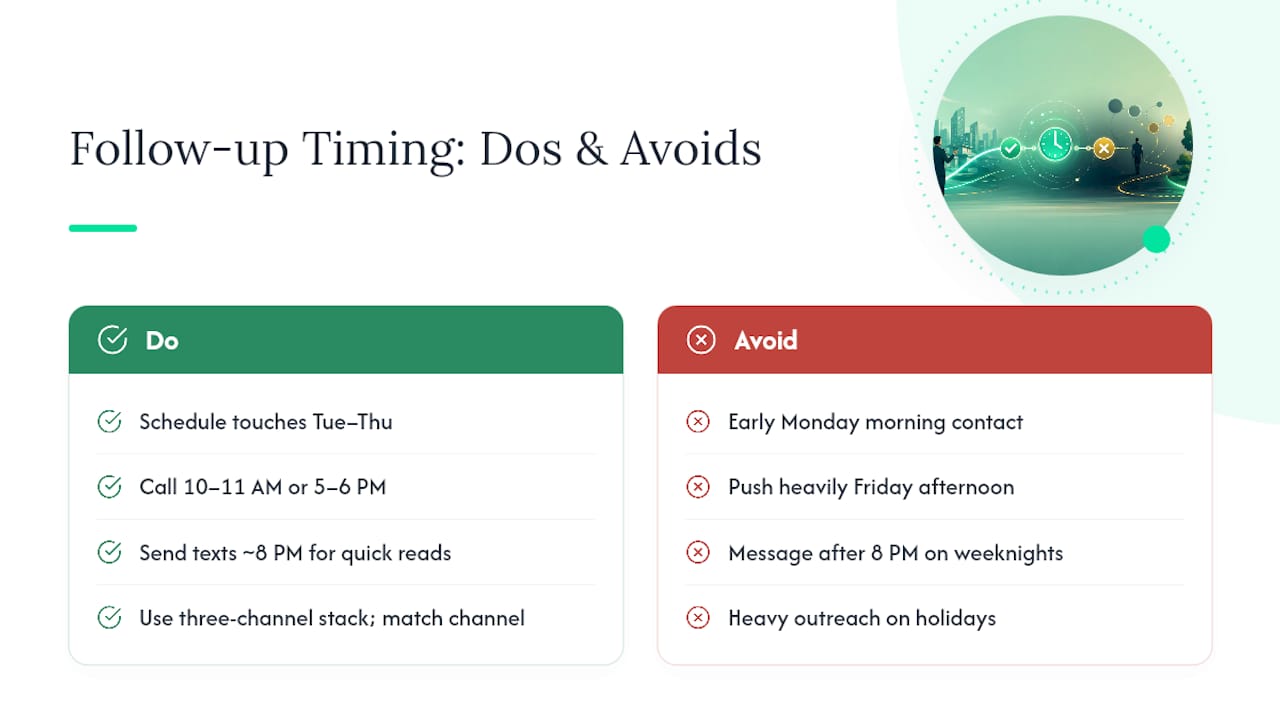
Text messages behave differently than calls. A text sent at 8 PM often gets read within minutes because people scroll their phones on the couch, while an email sent at the same hour sits until the next morning. That's part of why a three-channel stack works better than any single channel: you're covering multiple attention windows instead of betting everything on one.
Avoid the obvious dead zones: early Monday morning, Friday afternoon, and anything after 8 PM on a weeknight unless the lead has explicitly said they prefer late contact. Holidays deserve a lighter touch too, a short check-in rather than a full sales push.
One underused tactic: if a lead opened three emails but never replied, that's not silence, that's a signal. Match your next touch to the channel they've already engaged with instead of switching to a new one and hoping.
What the Data Actually Tells Agents to Do Differently
Most follow-up advice tells agents to "be consistent" without ever defining what consistent means in practice, which is why so many agents nod along and then still let leads go cold. The real lesson buried in the numbers isn't about persistence. It's about front-loading effort into a window most agents underuse: the first ten minutes and the first two weeks.
The conventional wisdom oversells the drip email and undersells the phone call. A slick 12-email nurture sequence means nothing if nobody answers the phone in the first hour. Agents who treat automation as a replacement for the first human call are solving the wrong problem, since the data on speed-to-lead is unambiguous about how much early response rates matter.
What deserves more attention than it gets: the stop condition. Almost every failed sequence I've seen described in follow-up research isn't a case of too little automation, it's a case of nobody remembering to shut the automation off once a human conversation started. That single gap, more than any script or subject line, is what makes automated outreach feel robotic to the people receiving it.
Prioritize the first ten minutes, then the CRM rules that stop and start sequences automatically. Everything else, scripts included, is secondary to getting those two things right.
— Bernard
Ready to Stop the Revenue Leak?
Signal Engine gives small and local businesses 31 AI-powered tools to score leads by buying intent, predict churn before it happens, auto-generate email and SMS campaigns, and recover missed calls automatically — all in one dashboard starting at $49/month.
Every scenario in this article assumes someone remembers to make the call, send the task, and stop the sequence at the right moment. That's exactly the part manual systems break on. Signal Engine Free builds the cadence directly into your pipeline, scoring leads by buying intent so you always know which prospect deserves the next call, and which one can wait for the next scheduled text.
Start your free 7-day trial — no credit card required. Setup takes 5 minutes.
Sources
- NAR profile of home buyers and home sellers
- 8-Step Follow-Up Sequence for Real Estate Agents (2026) | rAIn Automation
- The Real Estate Lead Follow-Up Schedule (Printable Tables) | Serif
FAQ
What Does Follow Up Mean in Real Estate?
Follow up in real estate means the structured, repeated contact an agent makes with a lead or client after the initial inquiry, using calls, texts, and emails on a set schedule until the lead converts or opts out.
What Is the 3-3-3 Rule in Real Estate?
Definitions vary by source, but the common version calls for three touches within the first three hours, then three more within the first three days, front-loading contact the same way the 14-day cadence in this article does.
Can You Give Examples of Real Estate Follow-Up Emails?
Yes. Effective examples include a same-day "here are 3 matching listings" email, a Day 9 neighborhood market update, and a breakup email that offers to pick the conversation back up whenever the lead is ready.
Is Follow Up Boss Good for Realtors?
Follow Up Boss is a widely used real estate CRM for organizing leads and tasks, though agents who want built-in behavioral lead scoring and automated churn signals often pair it with or switch to a platform like Signal Engine.