

The fastest way to reduce abandoned calls is to offer a reliable queue callback, publish a credible estimated wait time, and staff to your actual arrival curve instead of a flat headcount. Do those three things well and most contact centers see abandonment drop within weeks, not quarters. The next action: turn on callback for any wait projected over 60 to 90 seconds, publish live ETA on your queue this week, and run a staffing check against your next predictable peak.
TL;DR:
- Implementing queue callbacks and publishing real-time estimated wait times are the most effective strategies to rapidly lower abandonment rates, often within weeks.
- Providing callers with accurate and regularly refreshed ETAs reduces uncertainty, which is a primary psychological driver of hang-ups, leading to a significant decrease in abandonment.
- Properly configured callback systems that preserve queue position can cut abandonment by 30 to 40 percent once adopted at scale, especially when offered after informing callers of the wait.
- Simplifying IVR menus and routing calls more efficiently shortens the time to resolution, reducing the likelihood of callers abandoning before reaching an agent.
- Small staffing gaps during peak times can cause rapid abandonment spikes, so forecast-driven schedules with overflow agents are crucial to maintaining low abandonment during unpredictable demand surges.
Table of Contents
- What Actually Reduces Abandoned Calls Fastest?
- Does Publishing Wait Time Actually Lower Abandonment?
- How Do Virtual Queue Callbacks Cut Abandoned Calls?
- Should You Simplify Your IVR Menu?
- Why Does a Small Staffing Gap Spike Abandonment So Fast?
- How Does Routing Affect Call Abandonment?
- Can You Make Hold Time Feel Shorter?
- What Should You Track to Catch Abandoned Calls Before They Cost You?
- How Signal Engine's Features Line Up With This Playbook
- Sequencing, Trade-Offs, and What to Expect
- Ready to Stop the Revenue Leak?
- Sources
- FAQ
What Actually Reduces Abandoned Calls Fastest?
Not every fix carries equal weight, and managers who chase all seven tactics at once tend to finish none of them. Start with the changes that touch the caller's experience in the first 30 seconds, then move to the structural work that prevents the problem from recurring.
- Queue callbacks — let callers keep their place in line without holding. Start this week; it's the single highest-impact lever.
- Published wait time — show a credible ETA and queue position. Quick to configure on most modern phone systems.
- IVR simplification — cut menu depth and add self-service for routine requests. A one-to-two-week build.
- Staffing to arrival curves — replace flat schedules with forecast-driven shifts. A structural fix, but the payoff compounds.
- Smarter routing — reduce transfers by routing calls correctly the first time. Medium effort, high return on agent time.
- Productive hold time — capture information or resolve simple tasks while callers wait. Low effort, immediate.
- Abandoned-call follow-up — treat every drop as a lead to recover, not a loss to write off.
Callbacks and ETA transparency deliver the biggest short-term wins because they attack the psychological trigger behind hang-ups: uncertainty. Staffing and routing fixes take longer to build but prevent the problem from resurfacing every peak season.
Does Publishing Wait Time Actually Lower Abandonment?
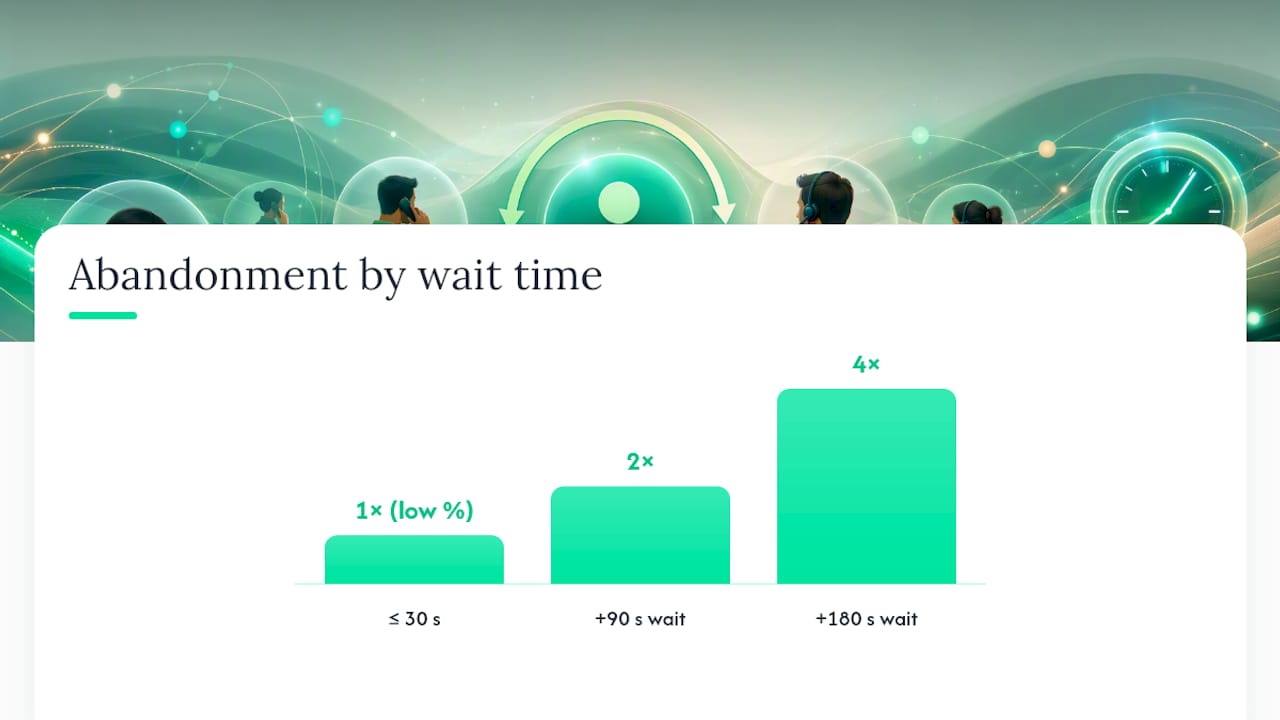
Yes, and the mechanism is more behavioral than technical. Callers don't hang up because they're waiting. They hang up because they don't know how long they'll be waiting, and uncertainty is a documented driver of queue abandonment independent of the actual hold duration. A caller told "you're fourth in line, about 3 minutes" tolerates that wait far better than one hearing generic hold music with no signal at all.
Getting it right:
- Refresh the ETA every 15 to 30 seconds so it tracks reality, not a static estimate set at call start.
- Base the estimate on live queue depth and recent average handle time, not a fixed number pulled from last quarter.
- Never let the estimate run short. Underpromising and beating it feels like a bonus; overpromising and missing it triggers the exact hang-ups you're trying to prevent.
Industry benchmarking shows abandonment tends to roughly double for every additional 90 seconds a caller waits, and centers holding average wait under 30 seconds keep abandonment rates in the low single digits. Track abandonment in buckets before and after you launch ETA, split by how long callers waited before dropping. That split tells you whether the ETA is actually calming callers or just delaying the hang-up by a few seconds.
How Do Virtual Queue Callbacks Cut Abandoned Calls?
A callback that works holds the caller's exact position in line and calls them back the moment an agent becomes free, rather than treating the request as a voicemail to answer whenever convenient. Get that distinction wrong and callback adoption can backfire. Callers who feel bumped to the back of the queue for requesting a callback end up more frustrated than if they'd just waited on hold, according to contact-center platform guidance on preserving queue position.
Rules that make callbacks work:
- Confirm the caller's number and name before releasing them from the live queue, not after.
- Preserve their exact position or priority tier. Don't reset the clock.
- Set a callback window (say, within 10 minutes of reaching their turn) and a retry policy if the first attempt fails.
- Track callback acceptance rate, completion rate, and abandonment among the callback pool separately from the live-hold pool.
Vendor and practitioner data puts the typical abandonment reduction from a properly configured callback in the 30 to 40% range once adoption stabilizes.
Pro Tip: Offer the callback option only after the caller has heard a live ETA. Callers who see the wait first and get offered an exit ramp accept callbacks at far higher rates than callers offered a callback with no context.
Should You Simplify Your IVR Menu?
Almost always, yes. Every extra IVR layer is another moment for a caller to abandon before ever reaching a queue, and pre-queue abandonment rarely shows up in standard abandonment reports because most systems only start the clock once a call enters the queue.
What to fix first:
- Cut menu depth to two layers wherever possible; three or more triggers measurable drop-off.
- Replace numbered menus with natural-language routing ("Tell me briefly why you're calling") where your phone platform supports it.
- Deflect status checks, payment requests, and appointment bookings to self-service or voice AI agents that can resolve them without a human agent.
- A/B test IVR changes against a control group and measure pre-queue abandonment separately from in-queue abandonment.
The goal isn't fewer options. It's fewer steps between "caller picks up the phone" and "caller reaches the right resource," whether that resource is human or automated.
Why Does a Small Staffing Gap Spike Abandonment So Fast?
Abandonment doesn't scale in a straight line with understaffing. It compounds. Queue depth builds faster than agents can clear it, wait times balloon, and each additional minute pushes more callers past their patience threshold simultaneously. That's why a single unplanned peak (a storm, a billing error, a marketing blast) can double or triple abandonment in an afternoon even with a schedule that looked fine on paper.
Run this experiment over one or two weeks:
- Pull call volume by 15-minute interval for the last 60 to 90 days and overlay it against your current schedule.
- Flag every interval where actual volume outpaced scheduled agents by more than 15%.
- Build a simple Erlang-style staffing check for your busiest three intervals, factoring in shrinkage (breaks, training, absenteeism).
- Add an overflow pool of cross-trained agents who can flex into the queue during flagged intervals instead of hiring to the absolute peak.
Forecast-driven staffing consistently outperforms flat headcount for exactly this reason: it matches supply to a curve instead of an average. Small teams that switch from fixed shifts to intraday forecasting with a temporary overflow pool often catch peaks that flat scheduling misses entirely, without adding full-time headcount.
How Does Routing Affect Call Abandonment?
Every transfer adds hold time, and every added minute on hold pushes a caller closer to hanging up. Skill-based routing that sends a caller to the right agent on the first attempt, rather than a generalist who transfers them, cuts both queue load and repeat-call volume at once.
Where to start:
- Route by the reason for the call (captured via IVR or natural-language intent) rather than by whoever's next in a round-robin.
- Widen agent skill profiles so more calls resolve on first contact instead of needing a specialist transfer.
- Use time-based routing to send overflow to a secondary team or callback queue automatically once wait crosses a threshold, rather than letting the queue grow unchecked.
Fewer transfers mean lower average handle time and fewer callers re-entering the queue for a second attempt at the same issue, which is its own hidden abandonment driver.
Can You Make Hold Time Feel Shorter?
Perceived wait time and actual wait time are not the same thing, and closing the gap between them is one of the cheapest fixes available. A caller doing something useful while waiting perceives less time passing than one listening to silence or repetitive hold music, a pattern well documented in research on queue psychology.
Give callers something to do:
- Capture an order number, account ID, or callback number via IVR before they reach an agent, cutting the agent's verification time later.
- Offer pre-authorization or basic form completion (a link sent by text) while they hold.
- Script hold messages to acknowledge the wait honestly, restate the current ETA, and repeat the callback offer partway through.
Pro Tip: Have agents open with the information the caller already provided ("I see you're calling about order 4821") instead of asking again. It shaves 20 to 30 seconds off average handle time and signals the wait wasn't wasted.
What Should You Track to Catch Abandoned Calls Before They Cost You?
An abandoned call isn't necessarily a lost caller if you build a recovery process around it. Most abandonment reporting stops at the drop; the better practice treats every abandon as a lead to follow up on.
- Segment every abandoned call by time-to-abandon (0 to 10 seconds, 10 to 60 seconds, over 60 seconds) and by the IVR node or queue where the drop happened.
- Exclude abandons under 5 to 10 seconds from your core rate. Industry benchmarking treats these as misdials or immediate hang-ups, not intent to reach support, and including them inflates your number without adding insight.
- Build a follow-up queue with rules: who owns the callback, how fast (within the hour for same-day, next business day otherwise), and what script to use.
| Metric | What it tells you |
|---|---|
| Abandonment rate | (Abandoned calls / Total inbound calls) × 100 |
| Time-to-abandon buckets | Where in the wait callers give up |
| Abandon by IVR node | Which menu step or queue is losing callers |
| Callback follow-up rate | Percent of abandons contacted within your SLA |
If you run outbound predictive-dialer campaigns alongside inbound support, monitor those separately. Regulatory thresholds for predictive-dialer abandonment are strict and unrelated to your inbound service metrics, and mixing the two numbers muddies both.
How Signal Engine's Features Line Up With This Playbook
Every tactic above depends on catching the moment a call is missed or dropped and acting on it fast. That's the exact gap Signal Engine's missed-call recovery and auto text-back tools close for small teams without a dedicated recovery desk.
- Missed-call recovery auto-texts callers the moment a call drops, turning an abandoned call into an open conversation instead of a silent loss.
- AI forecasting flags upcoming volume spikes so you can staff or activate overflow before a peak, not after abandonment already climbed.
- Callback automation queues follow-up by priority and timing, matching the "confirm, preserve position, retry" rules covered above.
Start with missed-call recovery in week one. It's the fastest to configure and the one with the most direct revenue impact for local service businesses. Watch callback acceptance rate and recovered-call conversion for the first 30 days before layering in forecasting.
Sequencing, Trade-Offs, and What to Expect
Quick wins first: ETA and callback in week one, IVR trims in week two. Structural fixes (forecasting, routing, cross-training) take a full quarter to show their full effect, and they usually cost more upfront in scheduling complexity or overflow staffing. Expect a modest labor cost bump before abandonment drops meaningfully. Measure weekly, not monthly. Small iterative changes beat one big overhaul that nobody can diagnose if it underperforms.
— Bernard
Ready to Stop the Revenue Leak?
Signal Engine gives small and local businesses 31 AI-powered tools to score leads by buying intent, predict churn before it happens, auto-generate email and SMS campaigns, and recover missed calls automatically — all in one dashboard starting at $49/month.
Start your free 7-day trial — no credit card required. Setup takes 5 minutes.
Every tactic in this playbook, from callback preservation to abandoned-call follow-up, runs better with automation behind it than with a spreadsheet and a hopeful intern. Check the pricing and free tier to see which plan fits your call volume before you commit.
Sources
- Call abandonment rate — JustCall
- Cut call abandonment rates: data‑driven strategies for 2026 — Xima Software
- How does customer-first callback work with place in queue? — PureCloud Help
- The psychology of waiting lines — Columbia University (lecture notes)
FAQ
What Is an Acceptable Call Abandonment Rate?
Most contact centers treat 5% as an acceptable range, while top-performing teams using forecast-driven staffing often hold abandonment under 3%.
How Do You Calculate Abandoned Calls?
Divide the number of calls that hang up before reaching an agent by total inbound calls, then multiply by 100; most benchmarks exclude abandons under 5 to 10 seconds since those usually reflect misdials.
What Are Good Phrases to End a Phone Call?
Close with a clear summary of what was resolved, confirm any next step or callback timing, and thank the caller by name. A simple example: "To recap, we've scheduled your callback for 2 PM. Thanks for your patience today."
How Much Does a Callback Feature Actually Reduce Abandonment?
Vendor and practitioner data consistently shows a 30 to 40% reduction in abandonment once a properly configured callback that preserves queue position is adopted at scale.
Can Software Like Signal Engine Help Recover Calls That Already Abandoned?
Yes. Missed-call recovery tools like Signal Engine's auto text-back contact callers automatically after a drop, turning an abandoned call into a recoverable lead instead of a silent loss.