

Your Amazon Account Health Score, officially called the Account Health Rating (AHR), is a composite metric that measures your seller account's compliance and performance across Amazon's marketplace. It pulls together policy violations, order performance data, and customer service metrics into a single color-coded score. The score falls into three status levels: Green (Healthy), Yellow (At Risk), and Red (Unhealthy/Suspension Risk).
- Green (Healthy): Your account is in good standing with no immediate risk.
- Yellow (At Risk): Warning territory. Violations or declining metrics are pulling your score down.
- Red (Unhealthy): Suspension risk is real. Amazon may restrict or deactivate your selling privileges.
Think of it as your seller report card, updated continuously, and visible to Amazon's enforcement teams at all times.
What is the account health score and where do you find it?
Your Account Health Rating lives inside Amazon Seller Central. Log in, go to the Performance menu, and click Account Health. The dashboard shows your current score, your status color, and a breakdown of every metric and violation contributing to that number.

The score updates on a near real-time basis, which means a new violation or a resolved complaint can shift your number within hours. You don't need to wait for a weekly report. What you see today reflects what Amazon sees today.
A few things to watch on that dashboard:
- Score number and color band: Your first signal of where you stand.
- Policy violations panel: Lists each open violation by severity and type.
- Performance metrics panel: Shows your order defect rate, late shipment rate, and cancellation rate against Amazon's published thresholds.
- Alerts and notifications: Amazon sends email alerts when your score drops or a new violation is detected. Turn on all notification types in your Seller Central account settings so nothing slips past you.
Pro Tip: Bookmark the Account Health page and check it every Monday morning. Sellers who catch violations early resolve them faster and avoid the score cascade that happens when multiple issues stack up.
Key metrics and policy violations that affect your score
Your score is not a single measurement. It's a weighted combination of performance metrics and policy violations, and Amazon treats each category differently.
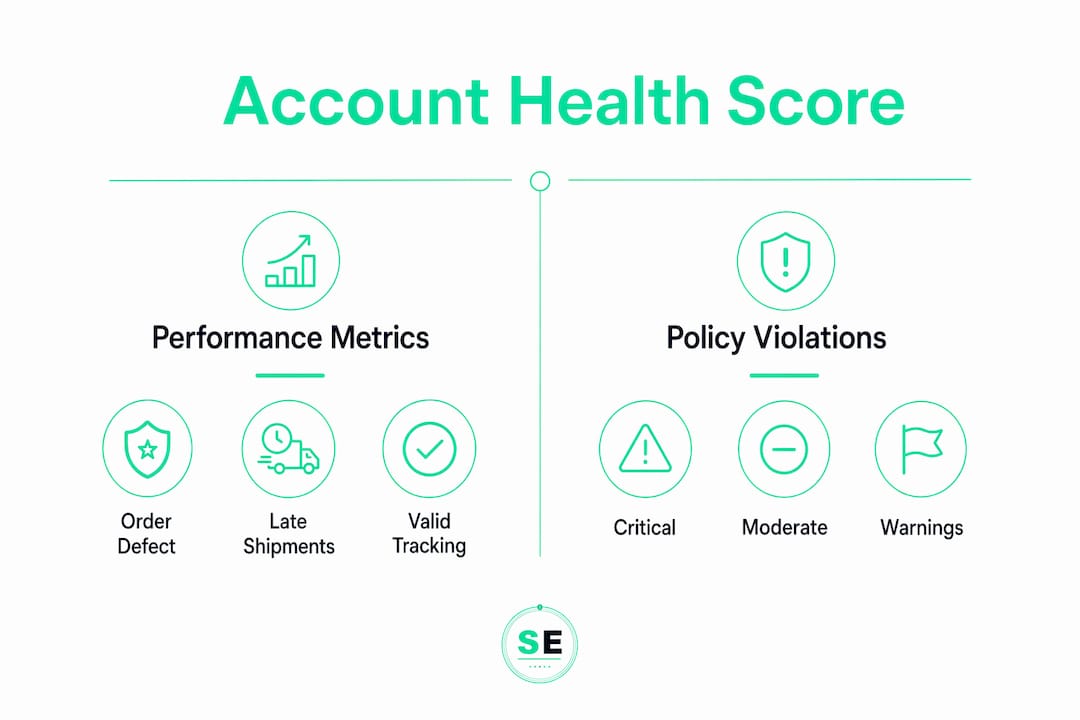
Performance metrics
| Metric | Amazon's Target Threshold | Impact on Score |
|---|---|---|
| Order Defect Rate (ODR) below Amazon's target threshold triggers critical risk. | ||
| Late Shipment Rate below Amazon's target threshold triggers moderate to critical risk depending on severity. | ||
| Pre-Fulfillment Cancellation Rate below Amazon's target threshold has moderate impact. | ||
| Valid Tracking Rate above Amazon's target threshold has moderate impact. | ||
| Customer Service Dissatisfaction Rate below Amazon's target threshold has moderate impact. |
Policy violation severities
Amazon classifies violations into three tiers:
- Critical violations: Product authenticity complaints, intellectual property infringement, and safety issues. These carry the heaviest score penalties and can trigger immediate account review.
- Moderate violations: Unresponsive customer service, repeated late shipments, or listing accuracy problems. These accumulate over time and erode your score steadily.
- Minor violations: Listing errors, missing product information, or isolated policy warnings. These have limited impact individually but compound quickly.
A single critical violation can drop a Healthy account into At Risk status. Three or four moderate violations stacking over 180 days can do the same damage more quietly. Amazon weighs recent violations more heavily than older ones, so a violation from last month hurts more than one from eight months ago.
What happens when your account health score drops
A declining score is not just a number problem. It triggers real operational consequences that can cut your revenue fast.
- Listing removals: Amazon can pull individual ASINs tied to violations, removing your products from search results without warning.
- Selling restrictions: Your account may lose the ability to list in specific categories or add new products.
- Buy Box eligibility loss: A poor account health score signals risk to Amazon's algorithm, and sellers with low scores often lose Buy Box placement even when their price is competitive.
- Amazon Prime ineligibility: Sellers using Fulfillment by Merchant (FBM) can lose Prime badge eligibility if their shipment metrics fall below threshold.
- Account suspension or deactivation: If your score hits the Unhealthy band and violations go unresolved, Amazon can suspend or permanently deactivate your account. Reinstatement requires a formal Plan of Action and is not guaranteed.
Beyond the platform penalties, a low score erodes buyer trust. Shoppers who see negative reviews tied to authenticity or fulfillment problems don't come back. The revenue loss compounds long after the score recovers.
How to improve your account health score
Recovery is possible, but it requires a structured approach. Here's a prioritized action list built for 2026 Amazon policies:
- Resolve open violations immediately. Go to your Account Health dashboard, click each open violation, and follow Amazon's remediation steps. For critical violations, submit a Plan of Action within 72 hours.
- Bring your Order Defect Rate below 1%. Review every A-to-Z claim and negative feedback from the past 60 days. Contact buyers proactively to resolve disputes before they escalate.
- Fix your shipment metrics. If your late shipment rate is above 4%, audit your carrier performance and adjust your handling time settings to reflect reality, not aspiration.
- Respond to every buyer message within 24 hours. Amazon tracks your response time. Slow responses feed your Customer Service Dissatisfaction Rate and signal disengagement.
- Audit your listings for policy compliance. Use Amazon's Listing Quality dashboard to catch restricted keywords, prohibited claims, and missing required attributes before Amazon flags them.
- Appeal resolved violations to get them removed. Some violations can be appealed even after resolution. A successful appeal removes the violation from your score calculation entirely.
- Monitor your Inventory Performance Index (IPI) if you use FBA. A low IPI score limits your storage capacity and signals operational problems that can compound your account health issues.
Sellers who monitor and remediate consistently maintain Healthy scores even through high-volume periods. The sellers who get suspended are almost always the ones who ignored early warnings.

How individual vs. professional sellers are affected differently
The Account Health Rating applies to both Individual and Professional seller accounts, but the practical stakes differ significantly.
Professional sellers face higher scrutiny because they typically have higher sales volume, more listings, and more customer interactions. Amazon's performance thresholds apply equally regardless of plan type, but a Professional seller with 500 orders per month has more opportunities for defects to accumulate. Professional accounts also have access to more Seller Central tools for monitoring and appealing violations, which gives them more levers to pull when the score drops.
Individual sellers operate at lower volume, which means a single bad transaction can spike their defect rate above threshold fast. If an Individual seller has 10 orders in a month and one results in an A-to-Z claim, their ODR hits 10% instantly, well above Amazon's 1% limit. Individual accounts also have fewer appeal options and less visibility into policy violation details. For Individual sellers approaching consistent sales volume, upgrading to a Professional account gives access to better account health tools and more detailed performance data.
Both account types face the same consequences for poor scores: listing removals, restrictions, and potential suspension. The path to recovery is also the same: resolve violations, improve metrics, and document your corrective actions.
Tracking score trajectory is more important than the number itself
A score in the Green band indicates Healthy status with no immediate risk to your selling privileges. What matters most is the direction of your score. A significant drop over 30 days signals a pattern worth investigating immediately, even if your score still shows as Healthy. A score that has held steady for months is less concerning than one that just fell sharply in a short period.
Score velocity—the rate of score change over a defined window—is your early warning system. Set a personal alert threshold below your current score to flag any significant drop as a trigger for immediate review. Review your score weekly, map violations to recent drops, and define responses for each status color band. Playbooks tied to score thresholds convert a number into a decision and help protect your business.
Exporting your Account Health data monthly and plotting it helps you spot patterns and address problems early, before they become violations.
Understanding churn signals before they escalate applies directly here: sellers who catch score velocity shifts early are the ones who never hit the Red band.
Your account health score needs more than a dashboard
Watching your Amazon Account Health Rating manually works until it doesn't. One missed alert, one week of distraction during a product launch, and a critical violation sits unresolved long enough to pull your score into At Risk territory.
Signalengine's revenue intelligence tools are built for exactly this problem. The platform scores customer and account behavior automatically, flags risk signals before they compound, and fires automated alerts so you're never the last to know something is wrong. For Amazon sellers managing multiple SKUs and high order volume, that kind of continuous monitoring is the difference between catching a problem on day two and discovering it on day thirty.
Setup takes five minutes. No data team required. Signalengine watches the signals so you can focus on selling.
Key Takeaways
Your Amazon Account Health Rating is a real-time composite score that determines your selling privileges, and a dropping score trajectory is a stronger warning signal than any single number.
| Point | Details |
|---|---|
| Score range and status | The AHR displays as Green (Healthy), Yellow (At Risk), or Red (Unhealthy/suspension risk). |
| Critical violations hit hardest | Product authenticity and IP violations carry the heaviest penalties and can push a Healthy account into At Risk status immediately. |
| Trajectory beats absolute value | A score dropping from 850 to 720 signals higher risk than a score that has held steady at 650 for months. |
| Individual sellers face faster spikes | One A-to-Z claim in a low-volume month can push an Individual seller's ODR well above Amazon's 1% threshold instantly. |
| Signalengine automates the watch | Signalengine scores account behavior continuously and fires alerts before score drops compound into violations. |
FAQ
What is a good account health rating on Amazon?
A score in the Green band indicates Healthy status with no immediate risk to your selling privileges. The higher your score, the more buffer you have against new violations.
How often does the Amazon Account Health Score update?
The score updates on a near real-time basis, reflecting new violations, resolved complaints, and changes in your performance metrics as they occur.
How do you increase your account health rating?
Resolve open violations immediately, bring your Order Defect Rate below 1%, respond to buyer messages within 24 hours, and appeal resolved violations to remove them from your score calculation.
What is the account health rating?
The Account Health Rating is Amazon's official term for the Account Health Score. It's a color-coded composite metric that reflects your seller account's compliance with Amazon's policies and your performance across key fulfillment and customer service metrics.
Does the account health score affect Buy Box eligibility?
Yes. A low or declining score signals risk to Amazon's algorithm and can reduce or eliminate your Buy Box placement, even when your pricing is competitive.
Ready to Stop the Revenue Leak?
Signal Engine gives small and local businesses 31 AI-powered tools to score leads by buying intent, predict churn before it happens, auto-generate email and SMS campaigns, and recover missed calls automatically — all in one dashboard starting at $49/month.
Start your free 7-day trial — no credit card required. Setup takes 5 minutes.