

TL;DR:
- Pipeline revenue loss is the gap between projected and actual revenue caused by process failures, not bad luck. It costs companies 1% to 5% of EBITDA annually, with leaks often hidden in CRM data and operational flaws. Fixing leaks involves improving response times, automation, clear processes, and regular audits to recover revenue and boost forecast accuracy.
Pipeline revenue loss is the gap between the revenue your sales pipeline projects and the actual income your business collects. It is the industry shorthand for a broader concept Salesforce and others call revenue leakage: money your business already earned or nearly closed that slips away due to process failures, not bad luck. For sales professionals and business owners, understanding what is pipeline revenue loss is the first step toward recovering real dollars. Pipeline leakage costs companies 1% to 5% of EBITDA annually. On a $100M revenue target, a 3% leak equals $3M gone every year.
What is pipeline revenue loss, and why does it matter?
Pipeline revenue loss is the measurable difference between forecasted deal value and closed revenue, caused by leaks at multiple stages of the sales cycle. The term is widely used in sales operations, but the precise industry concept is revenue leakage: uncollected revenue from deals that were already in motion. Revenue leakage differs from revenue loss in one critical way. Leakage is revenue your business had a right to collect but failed to capture due to process gaps. Loss is revenue you never won in the first place.
That distinction matters because the fix is different for each. Revenue loss requires better selling. Revenue leakage requires better operations. Most businesses treat both as a sales performance problem, which means the operational root causes never get addressed.
The median B2B SaaS company carries 4.2 active revenue leaks at any given time. Fixing the top leaks can raise pipeline value 3.2x within 90 days. Pricing errors alone cause roughly 38% of losses in subscription businesses. These numbers show that pipeline revenue loss is not a fringe problem. It is a structural one hiding inside your CRM right now.
What causes pipeline revenue loss in sales organizations?
Pipeline leakage rarely comes from one single failure. It builds from several overlapping problems across people, process, and systems.
The most common causes include:
- Slow lead response times. The median lead response time is 42 hours across B2B sales teams. Industry best practice is a 5-minute response window. That gap alone kills conversion rates.
- Too few follow-ups. Sales reps typically stop after 1 to 2 attempts. Converting a lead requires 5 to 8 touches. Deals die in the silence between attempts.
- Stale and misrouted deals. Deals that sit in the wrong pipeline stage for weeks distort forecasts and waste rep time on opportunities that have already gone cold.
- Unclear stage definitions. When reps disagree on what "qualified" means, deals advance prematurely. Inflated pipelines produce inaccurate forecasts and missed targets.
- Manual CRM maintenance. Reps who spend time logging data instead of selling create gaps in attribution and visibility. Broken attribution means you cannot see where deals are leaking.
- Undersized deals and early rejections. Pipeline leakage includes value erosion at multiple stages before a deal closes or exits, including deals scoped too small and prospects rejected before proper qualification.
Operational design flaws, not rep errors, drive most pipeline leakage. Unclear stage definitions, manual CRM updates, and broken attribution are system problems. Blaming individual reps for systemic failures guarantees the leaks continue.
Pro Tip: Run a monthly CRM audit focused on deals that have not moved stages in 21 days. Flag them for immediate review. Stale deals are the most visible sign of a leaking pipeline.

What impact does pipeline revenue loss have on business performance?
Pipeline leakage does not just reduce revenue. It degrades every downstream business function that depends on accurate pipeline data.
Revenue and productivity losses
Sales reps spend less than 15% of their time on deals that generate revenue. The rest goes to deals destined to fail, administrative tasks, and chasing cold leads. That is a massive productivity drain hiding in plain sight. The table below shows how leakage compounds across different revenue targets.
| Annual Revenue Target | Leakage Rate | Estimated Annual Loss |
|---|---|---|
| $1M | 3% | $30,000 |
| $10M | 3% | $300,000 |
| $50M | 3% | $1,500,000 |
| $100M | 3% | $3,000,000 |
Even at the low end, a $1M business loses $30,000 per year to a 3% leak. That is a full-time employee's salary walking out the door unnoticed.
Forecasting and morale damage
Pipeline leakage degrades forecast accuracy, creates operational drag, and demoralizes sales teams, often leading to turnover. When reps consistently miss targets they believed were achievable, trust in the pipeline breaks down. Leaders make hiring, spending, and capacity decisions based on forecasts that do not reflect reality. The compounding effect is a business that perpetually underperforms its own projections.
Revenue leakage also compresses Net Revenue Retention without appearing as churn. That means your NRR metric looks healthier than it actually is. The gap only surfaces during audits, by which point months of revenue have already slipped away. You can learn more about how NRR connects to leakage in this NRR guide for 2026.
How to measure and identify pipeline revenue loss effectively
Measuring pipeline revenue loss requires tracking specific metrics across your CRM and sales process. Gut feel does not work here. You need data.
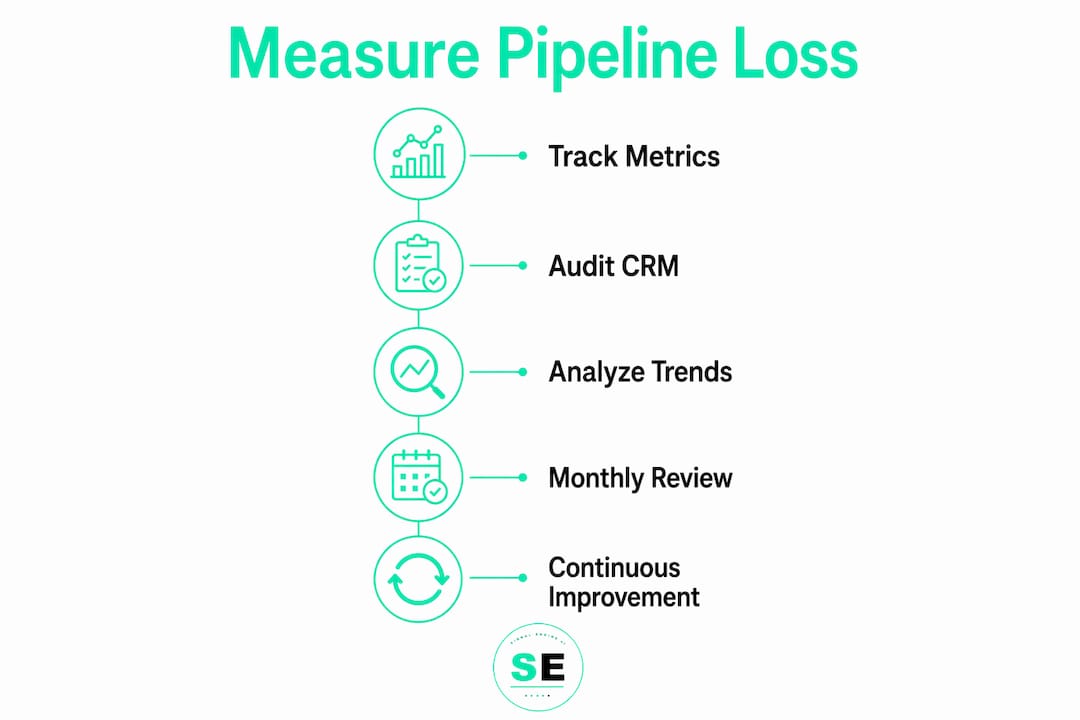
Detection methods include pipeline coverage ratio, conversion rate tracking, CRM data hygiene reviews, and revenue leak audits. Each method catches a different type of leak.
Key metrics to track:
- Pipeline coverage ratio. Divide total pipeline value by your revenue target. A healthy ratio is typically 3:1 to 4:1. A ratio below that signals insufficient qualified opportunities.
- Stage conversion rates. Track the percentage of deals that advance from each stage. A sharp drop at a specific stage points to a process failure at that point.
- Deal velocity. Measure how long deals sit in each stage. Deals stalled longer than your average sales cycle are likely leaking value.
- CRM data completeness. Count deals missing close dates, deal sizes, or contact records. Incomplete data is a direct sign of attribution failure.
| Detection Method | What It Catches | Limitation |
|---|---|---|
| Pipeline coverage ratio | Insufficient pipeline volume | Does not show where leaks occur |
| Stage conversion tracking | Drop-off points in the funnel | Requires clean CRM data |
| Deal velocity analysis | Stale and stuck deals | Needs historical benchmarks |
| Revenue leak audit | Underbilled and misclassified revenue | Time-intensive without automation |
| CRM data hygiene review | Missing fields and broken attribution | Reactive, not real-time |
Revenue leakage is often hidden due to poor CRM data quality and weak attribution. Proactive trend analysis catches leaks before they compound. Reactive loss analysis only tells you what already escaped.
Pro Tip: Set a calendar reminder to run a full pipeline coverage and conversion audit every 30 days. Monthly reviews catch leaks before they become quarterly misses.
Strategies to prevent and plug pipeline revenue leaks
Plugging revenue leaks requires fixing both the process and the systems that support it. Speed, structure, and automation are the three pillars.
-
Enforce lead response SLAs. Set a firm policy: every new lead gets a response within 5 minutes during business hours. Assign backup coverage so no lead waits 42 hours for a reply. Fast response is the single highest-ROI fix for early-stage pipeline leakage.
-
Build a persistent follow-up sequence. Use email and SMS automation to run 5 to 8 follow-up touches after initial contact. Manual follow-up fails because reps get busy. Automation does not forget.
-
Define pipeline stages with exit criteria. Every stage needs a clear, written definition of what qualifies a deal to advance. Subjective stage definitions inflate pipelines and destroy forecast accuracy.
-
Automate CRM data entry where possible. Automation and clear pipeline frameworks reduce leaks by removing the manual steps that create data gaps. Tools that auto-log calls, emails, and meetings keep your CRM accurate without burdening reps.
-
Filter out low-probability deals early. Sales reps spend twice as long on lost deals as on won deals without realizing the drain. Apply a qualification framework like MEDDIC or BANT at the first stage. Remove deals that do not meet minimum criteria before they consume rep bandwidth.
-
Run quarterly revenue leak audits. A structured revenue leak audit reviews underbilled contracts, misclassified deals, and attribution gaps. Most businesses find recoverable revenue in the first audit they run.
Pro Tip: Focus your top reps on the top 20% of deals by probability and deal size. Protecting their time from low-quality pipeline is as valuable as adding new leads.
Key Takeaways
Pipeline revenue loss is a structural problem driven by operational failures, not individual rep performance, and fixing it requires process design, clean data, and automation working together.
| Point | Details |
|---|---|
| Define the problem correctly | Pipeline revenue loss includes both unclosed deals and revenue leakage from process gaps. |
| Operational design is the root cause | Unclear stage definitions, manual CRM updates, and broken attribution drive most leaks. |
| Measure with specific metrics | Track pipeline coverage ratio, stage conversion rates, and deal velocity every 30 days. |
| Speed and automation close early leaks | A 5-minute lead response SLA and automated follow-up sequences recover the most revenue fastest. |
| Audit regularly to find hidden losses | Quarterly revenue leak audits surface underbilled contracts and misclassified deals before they compound. |
The uncomfortable truth about pipeline leakage
Most sales leaders I have worked with frame pipeline revenue loss as a rep problem. The numbers tell a different story. Operational design failures, not sales execution, are the most common root cause of pipeline leakage. When I see a team consistently missing forecasts, the first place I look is not the rep's activity log. I look at the pipeline stage definitions, the CRM data quality, and the lead routing rules.
The hardest part of fixing pipeline leakage is convincing leadership to look inward at their own processes. It is easier to blame a rep than to redesign a broken qualification framework. But the rep-blame approach guarantees the leaks continue, because the system that created them stays intact.
The businesses that recover the most revenue are the ones that treat pipeline management as an operational discipline, not a sales motivation problem. They audit regularly, automate aggressively, and protect rep time like it is their most expensive resource. Because it is.
— Bernard
How Signalengine detects and stops your pipeline leaks
Your pipeline is leaking right now. The question is how much.

Signalengine's AI-powered revenue intelligence platform watches your pipeline automatically, scores leads by buying intent, flags stale deals before they go cold, and tells you exactly where revenue is slipping. It runs 31 tools in one dashboard, built for small and local businesses across HVAC, logistics, real estate, dental, and more. No data team required. No complex setup. You get real-time visibility into your revenue leaks starting at $49/month, so you can act before the quarter ends.
Ready to Stop the Revenue Leak?
Signal Engine gives small and local businesses 31 AI-powered tools to score leads by buying intent, predict churn before it happens, auto-generate email and SMS campaigns, and recover missed calls automatically — all in one dashboard starting at $49/month.
Start your free 7-day trial — no credit card required. Setup takes 5 minutes.
FAQ
What is pipeline revenue loss in simple terms?
Pipeline revenue loss is the difference between the revenue your sales pipeline projects and what your business actually collects. It results from deals that stall, go cold, or slip through process gaps before closing.
How is revenue leakage different from pipeline revenue loss?
Revenue leakage is uncollected revenue from deals already in motion, caused by process failures. Pipeline revenue loss is the broader term covering both leakage and deals never won in the first place.
What percentage of revenue do companies typically lose to pipeline leakage?
Pipeline leakage costs 1% to 5% of EBITDA annually. For a $10M business, even a 3% leak equals $300,000 in lost revenue per year.
What is the fastest way to reduce pipeline revenue loss?
Enforcing a 5-minute lead response SLA and running automated follow-up sequences of 5 to 8 touches are the highest-impact fixes for early-stage pipeline leakage.
How do I know if my pipeline has a revenue leak?
Run a CRM audit looking for deals stalled longer than your average sales cycle, missing close dates, and incomplete contact records. These are the clearest signals of active pipeline leakage.