

Buyer intent data is behavioral evidence, pulled from web activity, content consumption, and search behavior, that shows which specific companies are actively researching a problem you solve right now. The payoff is timing: instead of guessing who to call, you prioritize the accounts already in-market. Platforms like Signal Engine Free turn that signal into routing decisions automatically, which matters most for teams too small to build a data science function around it.
TL;DR:
- Prioritize first-party intent signals, such as website visits and content downloads, which have the highest accuracy and require minimal additional effort.
- Focus on clusters of signals within 2 to 4 weeks, as isolated visits or activity are often false positives and less reliable indicators of buying intent.
- Use a combined fit and intent score to route accounts, with immediate outreach for high-confidence, high-fit accounts showing multiple signals.
- Verify vendor capabilities by evaluating topic coverage, identity resolution, and integration, and avoid platforms that rely solely on broad, unreliable third-party data.
- Act swiftly on high-confidence signals, initiating real-time outreach within hours for new high-fit, high-intent accounts to maximize conversion chances.
Table of Contents
- What Is Buyer Intent Data, Exactly?
- First-, Second-, and Third-Party Intent Data: What's the Difference?
- Which Buying Signals Actually Deserve a Sales Call?
- How Should Sales, Marketing, and CS Act on These Signals?
- What Should You Check Before Buying an Intent Data Platform?
- How Do You Prove Intent Data Is Actually Working?
- What Goes Wrong Most Often With Intent Data?
- How One SMB-Focused Platform Handles This in Practice
- What Actually Moves the Needle for Small Teams
- Turn Intent Signals Into Booked Meetings, Automatically
- Ready to Stop the Revenue Leak?
- Sources
- FAQ
What Is Buyer Intent Data, Exactly?
Firmographics tell you what a company is: industry, headcount, revenue band, tech stack. That data is static and answers "does this account fit our ideal customer profile?" Buyer intent data answers a different question entirely: "is this account actively shopping right now?" It's behavioral, time-bound, and decays fast.
Think of intent data as the raw material and buyer intent as the finished product. Signals, page visits, review-site comparisons, search queries, get collected and scored into an output your team can act on. A single visit means little. A cluster of visits across multiple people at the same company, concentrated in a short window, means something entirely different.
That window matters more than most teams realize. Surges in buying activity typically play out over 2 to 4 weeks, which is the practical horizon for treating a signal as "hot" versus background noise. Wait much longer than that and the buying committee has often already picked a vendor.
The distinction that trips up most revenue teams:
- Firmographic fit answers "should we ever sell to this account?"
- Intent data answers "should we call them this week?"
- Buyer intent score combines both into a single number your CRM can act on.
- Raw engagement (a newsletter open, a random blog visit) is not intent. It's noise until it clusters with other behavior.
First-, Second-, and Third-Party Intent Data: What's the Difference?
Not all intent data comes from the same place, and the source determines how much you can trust it. First-party data comes from your own properties: pricing page visits, demo requests, content downloads tracked through your website and marketing automation platform. It's the most accurate signal you'll ever get because you own the pipe end to end.
Second-party data comes from a partner sharing their first-party data with you directly, think a review site or co-marketing partner passing along engagement from their platform. It carries a trust model built on that direct relationship, which makes it more reliable than anonymous third-party feeds but limited to whatever partnerships you've built.
Third-party intent data aggregates behavior across a network of publisher sites, using cookies, IP resolution, or contributed data pools to identify company-level research activity you'd never see otherwise. The upside is coverage: you catch accounts researching your category before they ever visit your site. The trade-off is accuracy. Third-party data relies on probabilistic identity matching, which can lead to a higher margin of error(https://www.leadfeeder.com/blog/intent-data/complete-guide-buyer-intent-data/), which means more false positives and generally higher cost per account.
- First-party: highest accuracy, narrowest coverage, free if you already have the tracking in place.
- Second-party: moderate coverage, strong trust, dependent on partner relationships.
- Third-party: broadest coverage, probabilistic accuracy, ongoing subscription cost.
A privacy guardrail applies to all three: know where the data originated, whether consent was captured, and whether the vendor supports opt-outs before you build workflows around it.
Pro Tip: Start by mapping which of your own website pages historically correlate with closed deals. Most teams skip this and jump straight to buying third-party feeds, when the highest-signal data they'll ever get is already sitting in their own analytics.
Which Buying Signals Actually Deserve a Sales Call?
Not every signal carries the same weight, and treating them equally is how sales teams burn goodwill chasing accounts that were never serious. A useful mental model ranks signals into three confidence tiers.
High confidence signals involve deliberate comparison behavior. Pricing page visits and review-site activity rank highest because nobody reads three competitor reviews on G2 by accident, that's someone actively building a shortlist. Repeated visits to a specific product feature page also qualify here.
Medium confidence signals show topical interest without clear purchase intent yet. Content downloads, webinar registrations, and search queries for category terms (not your brand name) fall here. They're worth tracking and nurturing but not worth an immediate cold call.
Low confidence signals are single-touch and easily explained by curiosity, a competitor's employee, a student researching for a paper, someone who clicked the wrong link in a newsletter. One blog visit, one social click.
The signal cluster matters more than any individual data point. A true surge looks like:
- Two or more people at the same account visiting pricing or demo pages
- Review-site comparison activity within the same 2 to 4 week window
- A technographic event, like the account dropping a competing tool from their stack
- Search activity for category terms combined with direct site visits
When three or four of these stack up inside a short window, that's a real buying signal, not noise.
How Should Sales, Marketing, and CS Act on These Signals?
The single biggest mistake teams make is treating every intent signal the same way regardless of who owns the account relationship. The right action depends on where the account sits in your pipeline, not just how loud the signal is.
Prioritization should always multiply fit and intent rather than choosing one over the other. A multiplicative score, fit times intent, stops your best reps from getting routed to a surging account that will never buy because it's three sizes too small for your product.
Once fit and intent both clear your threshold, route by scenario:
- New account, high fit, high intent: immediate SDR outreach within hours, referencing the specific topic they're researching (not a generic cold email).
- Existing pipeline account showing renewed activity: alert the AE and add context to the next call, don't restart the sequence from scratch.
- Current customer researching a competitor: flag customer success immediately, this is a churn signal disguised as an intent signal.
A simple SDR playbook: identify the surging account, check fit score against ICP, then send a message that names the specific page or topic they engaged with rather than a templated pitch. A parallel marketing playbook: pull surging accounts into a targeted ad sequence, layer in a case study relevant to their industry, and hand off to sales the moment engagement crosses your threshold.
Pro Tip: If your message doesn't reference the actual page or topic the account researched, you've turned a warm signal into a cold email. Specificity is the entire point of intent data.
What Should You Check Before Buying an Intent Data Platform?
Vendor selection should run on capability, not brand reputation. Before signing anything, run through a checklist that covers technical fit as much as coverage claims.
- Topic coverage: does the vendor track keywords and categories actually relevant to what you sell, or just broad industry terms?
- Publisher network quality: third-party vendors vary wildly in which sites feed their data; ask for the list.
- Identity resolution: how do they match anonymous visits to real companies and contacts? Accuracy here determines everything downstream.
- Data cadence: daily updates versus weekly batches changes how fast you can act on a surge.
- CRM and marketing automation integration: intent data that sits in a separate dashboard nobody checks is worthless.
- Documented SLAs: response time for support, data refresh guarantees, and uptime commitments.
Integration itself follows three steps: map incoming signals to specific CRM fields (account, contact, signal type, timestamp), set score thresholds that trigger action rather than just logging data, and automate the alert so it creates a task or Slack notification instead of requiring someone to check a report.
On pricing, most vendors sell in tiers based on account volume or seat count. Negotiate a shorter initial contract term if you can, since the real test of any intent data platform is whether your team actually acts on the alerts within the first 90 days.
Pro Tip: Ask any vendor for their identity resolution methodology in writing before you sign. "Proprietary AI matching" with no further explanation is usually a red flag for accuracy you can't verify.
How Do You Prove Intent Data Is Actually Working?
Two metrics matter more than any dashboard vanity number: signal-to-meeting rate (what percentage of flagged accounts convert to a booked meeting) and signal-to-close rate (what percentage eventually close). Track both against a baseline of accounts worked without intent prioritization.
The cleanest way to prove causation, not just correlation, is a cohort experiment. Split comparable accounts into an intent-prioritized group and a baseline group, run both for 30 to 90 days, then compare meeting and close rates between the two cohorts. That comparison is what separates a real lift from a story your dashboard tells you.
A simple dashboard should track:
- Signal-to-meeting rate by source (first-party vs third-party)
- Signal-to-close rate by account tier
- Average days from surge detection to first outreach
- Pipeline value generated from intent-flagged accounts vs baseline
Review the numbers at 30 days for early direction and again at 90 days for a decision you can trust.
What Goes Wrong Most Often With Intent Data?
The most common failure is acting on a single weak signal. Single data points are often false positives(https://resources.rework.com/libraries/lead-management/intent-data); real buying intent shows up as a cluster of signals across channels, not one page visit.
The second failure is chasing surging accounts that fail your ICP. A 5-person company binge-reading your enterprise pricing page is not a deal, it's noise wearing a hot-lead costume.
- Require at least two independent signals before routing to sales.
- Set score thresholds high enough to prevent alert fatigue burning out your SDR team.
- Confirm fit score before intent score triggers any outreach.
- Vet vendors on data provenance, consent capture, and CCPA/GDPR opt-out support before signing.
How One SMB-Focused Platform Handles This in Practice
Signal Engine builds intent scoring specifically for teams without a data analyst on staff. The approach favors automation over dashboards nobody checks:
- Prebuilt scoring thresholds that map straight to CRM actions, no manual configuration required.
- Automated task creation the moment an account clears both fit and intent thresholds.
- An easy setup process suitable for small and mid-sized businesses(https://blog.signalengine.solutions/blog/intent-data-small-business) that skips the multi-week onboarding typical of enterprise platforms.
- Integration guidance covered in more depth in how prospect intent data works for revenue teams.
A typical setup: connect your CRM, set a fit threshold, enable the default surge alert, and let the first flagged account trigger an SDR task automatically, often within the first day of setup.
What Actually Moves the Needle for Small Teams
Most guides oversell intent data as a magic list of hot leads. It isn't. It's a prioritization layer, and it only works if someone acts on it within days, not weeks. The teams that win with this start narrow: one or two high-confidence signal types, one clear routing rule, no analytics team required.
Skip the temptation to buy the broadest third-party feed on day one. Start with first-party signals you already own, then layer in outside coverage once you've proven your team will actually respond to alerts. At 30 days, you should see faster response times to warm accounts. At 90 days, a measurable signal-to-meeting lift. By 180 days, intent scoring should be routine enough that nobody remembers doing outreach the old way.
— Bernard
Turn Intent Signals Into Booked Meetings, Automatically
Most intent platforms hand you a dashboard and leave the acting-on-it part to you. That's the gap Signal Engine closes for small teams: instead of another report to check, surging accounts get scored, routed, and turned into an SDR task or nurture sequence without anyone manually reviewing a feed every morning.
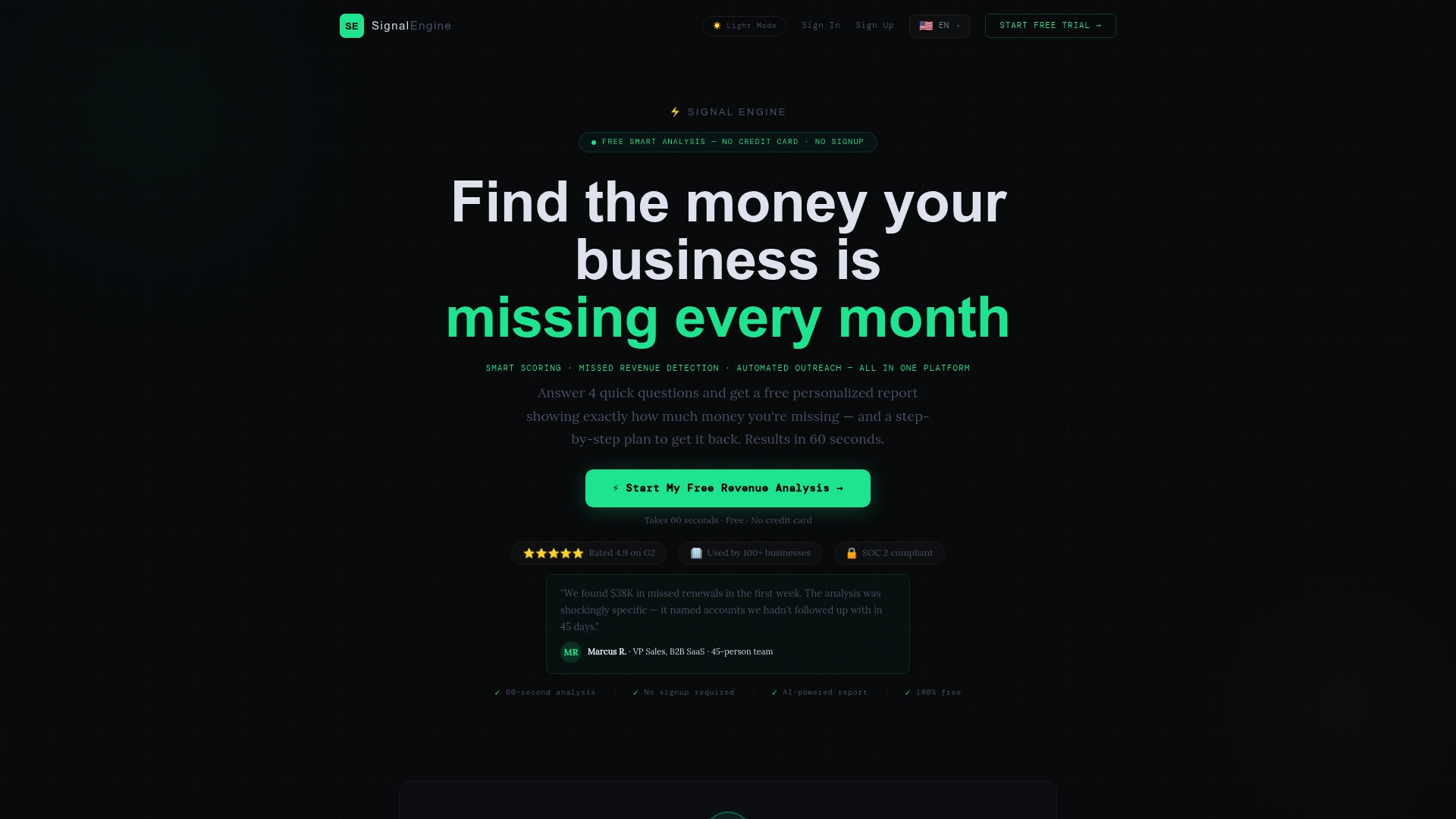
That matters most for teams without a dedicated analyst. You get revenue intelligence built for SMBs, covering intent scoring alongside churn prediction and pipeline analytics, in one dashboard rather than three disconnected tools. If you want to see how the scoring and routing actually looks before committing, book a live demo and walk through a real account setup.
Ready to Stop the Revenue Leak?
Signal Engine gives small and local businesses 31 AI-powered tools to score leads by buying intent, predict churn before it happens, auto-generate email and SMS campaigns, and recover missed calls automatically, all in one dashboard starting at $49/month.
Start your free 7-day trial, no credit card required. Setup takes 5 minutes.
Sources
- Intent Data: What It Is and How to Use It in B2B
- Buyer Intent: The Complete Guide for B2B Marketing Teams | Leadfeeder
- Forrester blog
FAQ
What Is Buyer Intent Data?
Buyer intent data is behavioral evidence, website visits, content downloads, search activity, and review-site engagement, showing that a specific company is actively researching a solution like yours right now.
What Does Intent Data Mean in Practice?
It means turning anonymous or scattered research activity into a scored signal that tells your sales and marketing teams which accounts to prioritize this week rather than which accounts merely fit your profile.
What Is Purchase Intent Data?
Purchase intent data is the subset of intent signals, pricing page visits, demo requests, comparison shopping on review sites, that specifically indicates a buying decision is close rather than early-stage research.
Who Offers the Best Intent Data for Small Teams?
The right platform depends on team size and budget: enterprise tools offer the broadest third-party coverage, but for SMBs without a dedicated analyst, Signal Engine Free pairs intent scoring with automated routing so alerts turn into action without extra headcount.
How Long Does a Buying Signal Stay "Hot"?
Most B2B buying surges play out over a 2 to 4 week window; signals older than that are more likely to reflect a decision that's already been made.