

TL;DR:
- Revenue playbooks organize customer-facing teams around measurable milestones using best practices and role responsibilities. They transform sales processes into repeatable systems, improve pipeline accuracy, and foster alignment across marketing, sales, and customer success. Building and maintaining a living, CRM-integrated playbook based on deal history ensures sustainable revenue growth.
A revenue playbook is defined as a living system of best practices, stage definitions, and role responsibilities that aligns every customer-facing team around measurable milestones. Understanding how revenue playbooks work gives sales and marketing professionals a repeatable framework for growing revenue without depending on star performers or gut instinct. The standard industry term is "revenue playbook," though you may also hear it called a "go-to-market playbook" or "sales motion playbook." All three describe the same core concept: a codified operating system for your revenue function.
How revenue playbooks work: the core mechanics
A revenue playbook acts as an operating system, codifying the revenue function so that intuitive actions become explicit, teachable, and repeatable processes. This breaks your team's dependency on individual star performers. When your best rep leaves, the playbook stays. That is the core value proposition.

The playbook defines who you sell to, how you sell, what you say, and how you measure success. It connects your Ideal Customer Profile (ICP) to your sales motion, your pricing to your messaging, and your pipeline stages to your forecast. Every team member, from a new sales hire to a seasoned customer success manager, operates from the same set of rules.
Playbooks also serve as a feedback mechanism. When a deal stalls, the playbook tells you exactly which stage broke down and why. That specificity turns every lost deal into a lesson rather than a mystery.
What are the essential components of a revenue playbook?
Seven critical pillars form the foundation of any B2B revenue playbook. Skipping any one of them creates an unstable revenue model. Think of them as load-bearing walls: remove one and the structure weakens.
| Pillar | Role | Typical Elements |
|---|---|---|
| Ideal Customer Profile (ICP) | Defines who you target | Firmographics, pain points, buying triggers |
| Value proposition | Explains why you win | Differentiators, proof points, ROI claims |
| Marketing channels | Drives pipeline | SEO, paid ads, outbound, referrals |
| Sales motion | Guides how you sell | Discovery, demo, proposal, close sequences |
| Pricing and packaging | Structures the offer | Tiers, discounts, bundling rules |
| RevOps infrastructure | Connects the data | CRM setup, automation, reporting dashboards |
| Measurement and metrics | Tracks what matters | Win rate, cycle length, pipeline velocity |
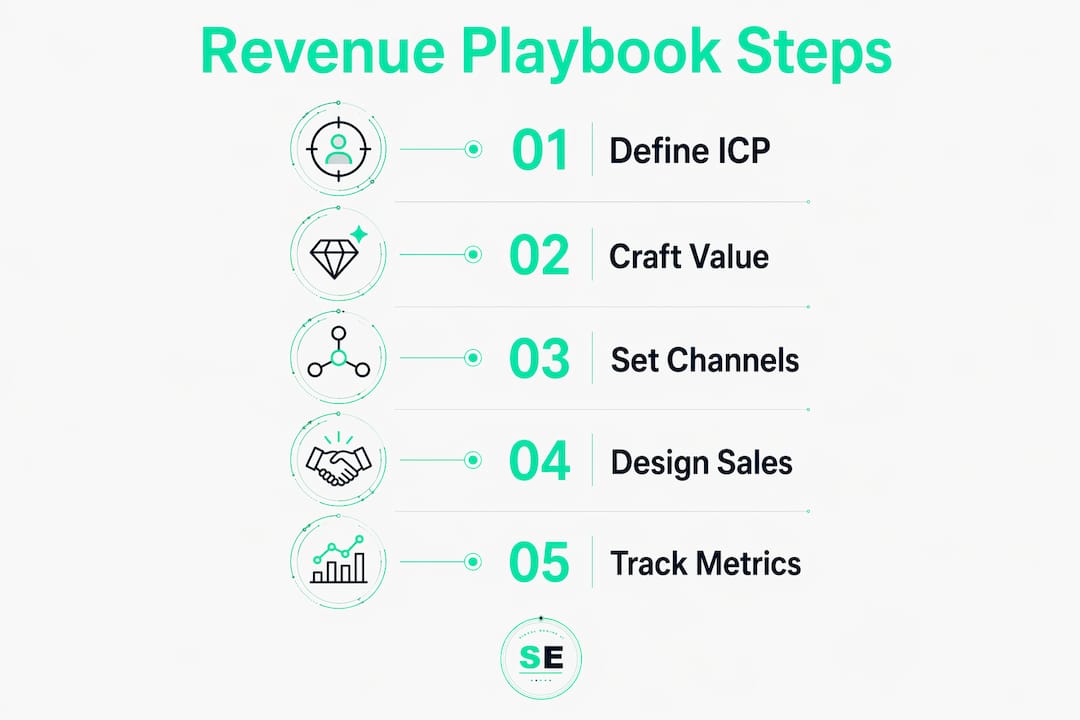
Each pillar feeds the next. A sharp ICP makes your value proposition more specific. A specific value proposition makes your marketing channels more efficient. That efficiency shows up in your metrics. When all seven align, you get predictable revenue growth instead of random wins.
Pro Tip: Map your current playbook against all seven pillars before your next quarterly review. Gaps in RevOps infrastructure or measurement are the most common silent killers of pipeline reliability.
How do deal stages with verifiable exit criteria drive pipeline accuracy?
Most pipeline problems trace back to one root cause: deal stages defined by what the salesperson did, not what the buyer committed to. Exit criteria must be defined by verifiable buyer actions, not activity-based milestones, to improve pipeline reliability.
The difference is significant. "Sent proposal" is an activity. "Buyer confirmed budget and shared a signed Mutual Action Plan" is an exit criterion. One tells you what your rep did. The other tells you what the buyer believes.
Here is a practical example of deal stages built around buyer commitment:
- Discovery complete. Exit criterion: Buyer has articulated a specific business problem and confirmed a timeline for solving it.
- Solution validated. Exit criterion: Economic buyer has attended a demo and asked pricing questions.
- Champion identified. Exit criterion: An internal advocate has agreed to present your solution to the decision committee.
- Decision criteria confirmed. Exit criterion: Buyer has shared the criteria they will use to evaluate vendors in writing.
- Mutual Action Plan signed. Exit criterion: Both parties have agreed to a step-by-step close plan with named owners and dates.
- Verbal commit received. Exit criterion: Economic buyer has confirmed intent to purchase pending legal review.
Each stage advances only when the buyer does something verifiable. That discipline makes your forecast accurate because every deal in your pipeline has earned its stage through buyer behavior, not salesperson optimism.
Pro Tip: During pipeline reviews, ask your reps to name the champion and describe the last verifiable buyer action for every deal over $5,000. If they cannot answer both questions in 30 seconds, the deal is not as far along as it appears.
Are revenue playbooks living systems or static documents?
The most effective revenue playbooks are dynamic operating systems integrated into daily workflows and CRM tools, not static PDFs stored on a shared drive. Static playbooks become outdated within weeks. They get ignored because they do not reflect current market conditions, objections, or competitive dynamics.
A living playbook has four defining characteristics:
- CRM integration. Stage definitions, exit criteria, and talk tracks live inside your CRM fields and deal views, not in a separate document.
- Real-time updates. When your team discovers a new objection or a competitor changes their pricing, the playbook updates within days, not quarters.
- Behavioral guidance. The playbook coaches consultative behaviors, such as asking discovery questions before pitching, rather than just listing product features.
- Co-creation with frontline teams. Collaboratively building playbooks with top reps, customer success managers, and marketers ensures the content reflects real-world conditions and earns buy-in from the people who use it daily.
"A playbook that lives in a PDF is a document. A playbook that lives in your CRM and your coaching conversations is a system."
Pipeline reviews must actively use the playbook to check buyer milestones like champion identification and economic buyer engagement. Ignoring the playbook during pipeline reviews wastes its value entirely. The review becomes the moment where the playbook proves its worth or reveals its gaps.
Pro Tip: Embed your playbook directly into your pipeline review agenda. For each deal, require reps to confirm the exit criterion for the current stage before discussing next steps. This single habit increases forecast accuracy faster than any new tool.
What does an effective revenue playbook rollout look like?
A foundational revenue playbook works best when kept to 10–20 pages for early-stage businesses and rolled out through a structured 30/60/90-day process. Longer documents get skimmed. Shorter ones get used.
The 30/60/90-day framework works like this:
- Days 1–30: Build and align. Draft the playbook with input from sales, marketing, and customer success. Focus on ICP, deal stages, and top three objections. Keep it under 20 pages.
- Days 31–60: Train and embed. Run live training sessions. Load stage definitions and exit criteria into your CRM. Use the playbook in at least two pipeline reviews.
- Days 61–90: Measure and refine. Track win rate, average deal cycle, and stage conversion rates. Collect feedback from frontline reps. Update the playbook based on what the data shows.
Cross-functional collaboration in playbook creation, involving sales, marketing, and customer success, fosters adoption and ensures the playbook captures real-world dynamics. Teams that build the playbook together use it together.
Three common rollout mistakes to avoid:
- Building the playbook before closing 10–20 deals across multiple ICPs. A premature playbook built before sufficient deal history tends to be theoretical and less effective.
- Assigning playbook ownership to one person. Shared ownership across revenue functions keeps it current.
- Treating the rollout as a one-time event. Quarterly reviews and updates are non-negotiable for sustained adoption.
For a detailed checklist on rollout steps, the revenue recovery playbook checklist covers the key milestones for technology-driven teams.
How do revenue playbooks align marketing, sales, and customer success?
Revenue operations playbooks align marketing, sales, and customer success around a single revenue journey. Unified revenue functions prevent the chaotic optimization of isolated activities and provide measurable growth forecasts. Without this alignment, marketing optimizes for lead volume, sales optimizes for close rate, and customer success optimizes for satisfaction scores. None of them optimize for revenue.
| Team | Role in the revenue journey | Key playbook responsibilities |
|---|---|---|
| Marketing | Generates qualified pipeline | ICP targeting, content, lead scoring criteria |
| Sales | Converts pipeline to revenue | Discovery, deal stages, exit criteria, close plans |
| Customer success | Retains and expands revenue | Onboarding milestones, health scores, expansion triggers |
The playbook creates feedback loops between these teams. When sales reports that a certain lead source produces deals that close 40% faster, marketing shifts budget toward that channel. When customer success flags that customers from a specific ICP segment churn at twice the average rate, sales tightens qualification criteria for that segment.
Tracking pipeline health metrics across all three teams gives you a complete picture of your revenue flow. You stop managing three separate funnels and start managing one connected revenue system. That shift alone changes how your leadership team makes decisions.
Key Takeaways
A revenue playbook works because it converts your best sales patterns into a repeatable, measurable system that every team member can follow and every manager can coach against.
| Point | Details |
|---|---|
| Seven pillars structure the playbook | ICP, value proposition, channels, sales motion, pricing, RevOps, and metrics must all be present. |
| Exit criteria replace activity milestones | Buyer-verified actions at each deal stage make forecasts accurate and reliable. |
| Living systems outperform static documents | Playbooks embedded in CRM and pipeline reviews drive daily behavior change. |
| 30/60/90-day rollout drives adoption | Build, train, and refine in structured phases to sustain team-wide usage. |
| Cross-functional alignment multiplies results | Marketing, sales, and customer success operating from one playbook prevents isolated optimization. |
Why most revenue playbooks fail before they start
The most common mistake I see is teams building a playbook before they have enough deal history to know what actually works. A playbook built on theory is just a wish list with headings. The patterns that belong in a playbook come from closed deals, lost deals, and the conversations that happened in between.
The second mistake is treating the playbook as a training artifact rather than a management tool. The teams that get the most value from their playbooks use them in every pipeline review, every coaching conversation, and every new hire onboarding. The playbook is not something you read once. It is something you work from every week.
The third thing I have observed is that playbooks built by one person, usually a sales leader or a consultant, rarely stick. The reps who did not help build it do not trust it. Co-creation is not a nice-to-have. It is the mechanism that makes the playbook credible to the people who need to use it.
My honest recommendation: wait until you have closed at least 15 deals across two or more customer segments before writing a single word of your playbook. Then build it with your top performers, not for them. Treat it as a living document from day one, and schedule a quarterly review on the calendar before you publish the first version. That discipline separates playbooks that drive growth from playbooks that collect dust.
— Bernard
Signalengine gives your playbook real-time intelligence
A revenue playbook tells your team what to do. Signalengine tells you what is actually happening in your pipeline right now.

Signalengine is the revenue intelligence platform built for SMBs that scores customer behavior automatically, flags churn risk before it becomes a lost account, and surfaces expansion opportunities your team would otherwise miss. It watches your pipeline while your team works the playbook. You get 31 AI-powered tools covering lead scoring, churn prediction, automated email and SMS campaigns, and missed call recovery, all in one dashboard. Built for businesses across HVAC, logistics, dental, real estate, landscaping, and more. Priced starting at $49/month.
Ready to Stop the Revenue Leak?
Signal Engine gives small and local businesses 31 AI-powered tools to score leads by buying intent, predict churn before it happens, auto-generate email and SMS campaigns, and recover missed calls automatically — all in one dashboard starting at $49/month.
Start your free 7-day trial — no credit card required. Setup takes 5 minutes.
FAQ
What is a revenue playbook?
A revenue playbook is a documented operating system that codifies your ICP, deal stages, sales motion, and team responsibilities into a repeatable, teachable process. It replaces individual intuition with a shared system every team member can follow.
How do revenue playbooks help consultants and SMB teams?
Revenue playbooks give consultants and SMB teams a structured framework for diagnosing pipeline problems, training new hires faster, and aligning marketing, sales, and customer success around shared milestones. They reduce reliance on any single high performer.
How long should a revenue playbook be?
A foundational revenue playbook for early-stage businesses works best at 10–20 pages. Longer documents reduce adoption. Concise playbooks that focus on ICP, deal stages, and top objections get used daily.
What are verifiable exit criteria in a revenue playbook?
Verifiable exit criteria are specific buyer actions that must occur before a deal advances to the next stage, such as a signed Mutual Action Plan or a confirmed budget conversation. They replace activity-based milestones and make pipeline forecasts reliable.
When should a business build its first revenue playbook?
Build your first playbook after closing at least 10–20 deals across multiple customer segments. Playbooks built before sufficient deal history tend to be theoretical and fail to reflect the patterns that actually drive wins.