

TL;DR:
- SaaS revenue leakage involves earned but uncollected revenue due to billing gaps, not customer churn. Small errors across metering, pricing, and contract data silently cause 1 to 5% annual losses. Automated controls, ownership, and reconciliation are essential to detect and prevent these hidden revenue escapes effectively.
SaaS revenue leakage is defined as earned but uncollected revenue that escapes your billing system through gaps between contracts, usage metering, invoicing, and payment collection. It is not churn. It is not a pricing problem. It is money your customers owe you that your systems fail to capture. Industry analysis from Lago identifies six primary leakage sources responsible for systematic losses of 1 to 5% of annual recurring revenue. For a SaaS company at $10M ARR, that is up to $500,000 disappearing silently every year. Gobanyan and BillingPlatform both confirm that most of this loss accumulates as dozens of small errors rather than one visible failure.
How SaaS revenue leakage occurs across the billing lifecycle
Revenue leakage occurs when any step between contract execution, entitlement provisioning, usage capture, invoice generation, payment collection, and revenue recognition falls out of alignment. The failure is rarely dramatic. It is a plan upgrade that does not update the billing record. A renewal that does not auto-extend. A discount that expired six months ago but still applies. These are the SaaS subscription issues that compound quietly over time.
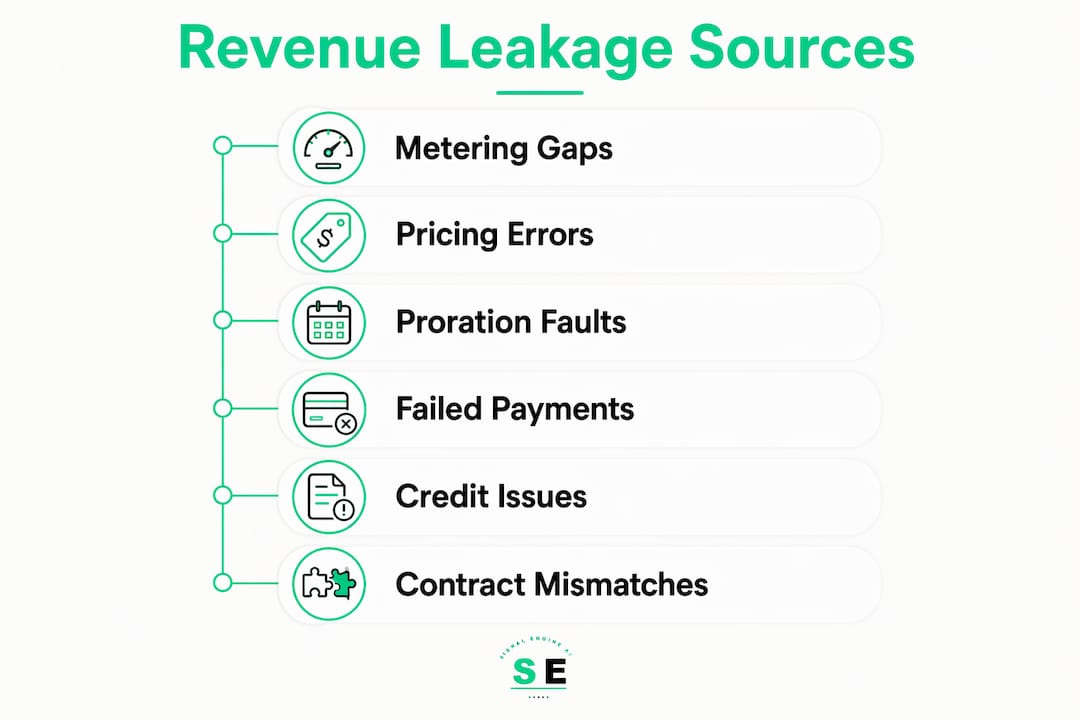
Lago and Gobanyan categorize the six core leakage points as follows:
- Metering gaps: Usage events that are dropped, delayed, or never captured by the billing engine, resulting in underbilling for consumption-based features
- Pricing enforcement failures: Expired promotional discounts, grandfathered rates, or tier boundaries that are not enforced correctly when customers upgrade or downgrade
- Proration errors: Incorrect calculations during mid-cycle plan changes, typically caused by fixed 30-day denominators that do not match actual calendar months
- Failed payment recovery: Payments that fail due to expired cards or incorrect contact details and are never retried with a proper dunning sequence
- Credit and refund miscalculations: Adjustments applied without proper controls, resulting in over-credited accounts or refunds that exceed the original charge
- Contract-to-invoice mismatches: Manually re-keyed contract terms from CRM or CPQ systems that introduce errors in start dates, billing frequency, or included add-ons
Pro Tip: Assign a named owner to each of these six categories. Leakage without ownership stays invisible. Leakage with an owner gets fixed.
Operational causes amplify all six. Manual data entry between systems, version drift in pricing catalogs, and untested billing logic for edge cases each introduce new failure points. The leakage is often invisible in standard dashboards because it does not appear as a lost customer or a disputed invoice. It simply never shows up as collected revenue.
How do metering and usage tracking failures cause revenue loss?
Metering failure is the most technically complex source of SaaS revenue loss. Every usage-based billing system depends on a reliable pipeline of events flowing from your product infrastructure to your billing engine. When that pipeline breaks, you underbill. When it duplicates, you overbill. Both outcomes damage revenue and customer trust.
BillingPlatform identifies the following failure modes in usage event capture:
- Network timeouts: Events fire but never reach the billing system due to transient connectivity failures, leaving usage unrecorded
- Missing acknowledgements: The billing system receives an event but does not confirm receipt, causing the sending service to retry and create duplicates
- Timezone mismatches: Aggregation windows calculated in different time zones produce billing periods that do not align with actual usage periods
- Lack of idempotency keys: Without unique event identifiers, retry logic creates duplicate billing entries that inflate invoices and trigger disputes
A mediation layer solves most of these problems. It acts as a persistent buffer between your product infrastructure and your billing engine, holding events until delivery is confirmed. Without it, any network instability becomes a billing gap.
Diagnosing metering failures requires comparing billed revenue trends directly against product usage logs. If billed revenue drops while usage metrics remain stable, the gap is almost certainly in event capture, not in customer behavior. Fix the metering pipeline before adjusting dunning sequences or discount structures. Chasing collections on top of a broken meter produces misleading data.
Pro Tip: Build a daily reconciliation job that compares raw usage event counts from your product database against events received by your billing engine. Any variance above 0.5% warrants immediate investigation.
What pricing and billing errors commonly cause revenue leakage in SaaS?
Pricing enforcement failures are the most underestimated source of revenue loss in SaaS. They do not generate error messages. They generate invoices that look correct but charge less than the contract requires.

The three most common pricing enforcement failures are expired discounts that continue applying after their end date, grandfathered pricing that persists after a customer upgrades to a new plan tier, and tier boundary misapplication where a customer consuming at a higher tier is billed at the lower rate. Each of these is a configuration problem, not a customer problem. The customer pays what the system charges. The system charges less than the contract specifies.
Proration errors add a second layer of loss. Lago quantifies the impact at $32.26 per incident on a $1,000 per month plan when a fixed 30-day denominator is used instead of the actual days in the billing period. That number scales. At 500 mid-cycle plan changes per month, the annual loss exceeds $193,000 from proration math alone. Testing proration logic must simulate 28-day, 30-day, and 31-day months alongside multiple plan change scenarios to catch systematic errors.
Contract-to-invoice mismatches represent the third major category. Manual re-keying from CRM or CPQ to billing systems introduces errors in add-on inclusion, billing start dates, invoice frequency, and discount terms. The table below maps common errors to their business impact:
| Billing error | Business impact |
|---|---|
| Expired discount not removed | Ongoing revenue shortfall per affected account |
| Proration using fixed 30-day denominator | Systematic under or overbilling on every mid-cycle change |
| CRM add-on not transferred to billing | Unbilled feature revenue for the contract duration |
| Incorrect billing start date | Lost revenue for the gap period between contract and first invoice |
| Wrong invoice frequency (monthly vs. annual) | Cash flow disruption and recognition errors |
Pro Tip: Automate contract term ingestion from your CRM directly into your billing system with a parity reconciliation check on every field. Human re-entry is the single highest-risk step in the billing setup process.
How do failed payments and credit processes create revenue leakage?
Failed payments are not just a collections problem. They are a significant leakage source because 5 to 9% of payment attempts fail in SaaS, and without a structured recovery process, a large share of that revenue is never collected. Industry benchmarks show involuntary churn from unrecovered payments accounts for up to 40% of total churn at SaaS companies. That is revenue lost not because customers chose to leave, but because no one followed up correctly.
The operational failures that turn failed payments into permanent leakage include:
- Expired card data: No proactive card update request sent before expiration, causing the next billing cycle to fail immediately
- Incorrect contact information: Dunning emails sent to a billing address that no longer exists or is not monitored
- Suboptimal retry timing: Retries scheduled at fixed intervals rather than optimized windows based on card network behavior and customer payment patterns
- No escalation path: Failed payments that exhaust automated retries without triggering a manual review or account team alert
Credit and refund miscalculations create a parallel problem. Credits applied without approval workflows, refunds processed above the original charge amount, and adjustments entered manually without audit trails all reduce collected revenue below what contracts specify. Monitoring tools that flag credits above a defined threshold and require secondary approval eliminate most of this exposure. Finance teams that review revenue recovery reports regularly catch these patterns before they compound.
What methods and technologies detect and prevent revenue leakage?
Preventing revenue leakage requires automated controls across every layer of the monetization stack. MGI Research frames leakage as a corporate control deficiency across the Agile Monetization Platform, meaning no single fix resolves it. The solution is system-wide.
The most effective detection and prevention architecture includes these components:
- Automated reconciliation: Schedule daily cross-system checks comparing contracts, usage logs, invoices, and payment records. Lago recommends triggering investigations on any variance that exceeds a defined threshold, such as 1% between expected and billed amounts.
- Real-time metering validation: Deploy a mediation layer that buffers usage events, confirms delivery, and flags dropped or duplicate events before they reach the billing engine.
- Pricing enforcement automation: Implement expiration logic for discounts and promotions at the billing system level, not in spreadsheets or manual calendar reminders.
- Contract ingestion automation: Connect CRM and CPQ systems directly to the billing platform with field-level parity checks. Eliminate manual re-entry entirely.
- Dunning optimization: Use smart retry logic based on card network data, send proactive card update requests 30 days before expiration, and escalate unresolved failures to account teams after three retry attempts.
Pro Tip: Start your leakage audit with metering reconciliation. If your billed revenue and usage data do not match, every downstream fix, including dunning and pricing corrections, will produce unreliable results.
Integrated platforms from providers like BillingPlatform and Lago include many of these controls natively. For companies using point solutions, identifying hidden revenue losses requires building reconciliation logic across systems that were not designed to talk to each other. That integration work is where most leakage prevention programs stall.
Key takeaways
SaaS revenue leakage is a systems control problem that requires automated reconciliation across metering, pricing, billing, payment, and contract data to stop the 1 to 5% of ARR that escapes silently every year.
| Point | Details |
|---|---|
| Six leakage sources | Metering gaps, pricing errors, proration faults, failed payments, credit miscalculations, and contract mismatches each require separate controls. |
| Proration math matters | A fixed 30-day denominator causes $32.26 in losses per mid-cycle change on a $1,000 plan, scaling fast across large customer bases. |
| Failed payments drive churn | Up to 40% of total churn at SaaS companies originates from unrecovered failed payments, not customer dissatisfaction. |
| Automate contract ingestion | Eliminating manual CRM-to-billing re-entry removes the highest-risk human error point in the entire billing setup process. |
| Reconcile before you collect | Fix metering and pricing discrepancies before optimizing dunning, or your collections data will mislead every downstream decision. |
The leakage problem nobody wants to own
I have worked with SaaS finance teams that ran quarterly audits, used reputable billing platforms, and still lost 3% of ARR annually to leakage. The technology was not the problem. The ownership gap was.
Every leakage category needs a named owner with a defined review cadence. Metering reconciliation belongs to engineering. Pricing enforcement belongs to billing operations. Contract-to-invoice parity belongs to revenue operations. Failed payment recovery belongs to finance. When leakage spans all four, it belongs to nobody, and that is exactly when it compounds.
The other thing I have seen consistently: executives underestimate leakage because it does not appear in the metrics they watch. MRR looks stable. Churn looks manageable. But the gap between what contracts specify and what invoices collect is growing every month. You need a separate reconciliation view, not a dashboard that aggregates collected revenue and calls it accurate.
My honest recommendation is to start with a metering audit before touching anything else. If your usage event pipeline has gaps, every other fix produces misleading results. Once metering is clean, move to pricing enforcement, then proration testing, then dunning. That sequence produces the fastest and most reliable recovery.
— Bernard
Plug the leaks before they compound
⚡ Your billing system may look healthy while silently losing thousands every month. Signalengine's AI-powered platform detects exactly where your revenue is escaping, whether that is unrecovered payments, missed renewals, or churn risk building in your customer base.
With Signalengine, you get a full revenue recovery report, real-time churn prediction, and automated outreach campaigns in one dashboard. The average user identifies $38K in recovery potential in the first month. Explore the Signal Engine help docs to see how the detection and recovery tools work, or watch a live demo to see the platform in action. Setup takes five minutes and requires no credit card.
FAQ
What is SaaS revenue leakage?
SaaS revenue leakage is earned but uncollected revenue that escapes through gaps in metering, billing, pricing enforcement, or payment recovery. It differs from churn because the customer relationship is active but the billing system fails to capture all owed revenue.
How much revenue do SaaS companies typically lose to leakage?
Industry analysis from Lago shows SaaS companies lose between 1 and 5% of ARR to billing leakage. On a $10M ARR base, that represents up to $500,000 in annual losses from billing gaps alone.
What is the most common cause of revenue leakage in SaaS?
Contract-to-invoice mismatches from manual CRM-to-billing data re-entry and expired discounts that continue applying are among the most frequent causes, according to Gobanyan. Metering failures in usage-based billing are the most technically complex and hardest to detect.
How do failed payments contribute to SaaS revenue leakage?
Between 5 and 9% of SaaS payment attempts fail, and without structured dunning and retry logic, a significant share is never recovered. Lago data shows involuntary churn from unrecovered payments accounts for up to 40% of total churn at SaaS companies.
How do you detect revenue leakage in a SaaS business?
Automated reconciliation comparing contracts, usage logs, invoices, and payment records is the most reliable detection method. Lago recommends scheduled cross-system checks that trigger alerts when variances exceed defined thresholds, catching leakage before it compounds across billing cycles.
Ready to Stop the Revenue Leak?
Signal Engine gives small and local businesses 31 AI-powered tools to score leads by buying intent, predict churn before it happens, auto-generate email and SMS campaigns, and recover missed calls automatically — all in one dashboard starting at $49/month.
Start your free 7-day trial — no credit card required. Setup takes 5 minutes.