

The fastest pricing levers to reduce involuntary churn are billing cadence optimization (shifting monthly cohorts to annual or quarterly), extending time-to-value before the first charge, structured downgrade and pause paths in the cancel flow, and targeted term discounts paired with save plays. None of those levers work without the operational layer underneath: smart retry windows, network tokenization, account updater, and a failed-payment wall. Pricing design and payment operations are the same problem.
Start here — apply within 72 hours:
- Identify your highest-frequency renewal cohorts (monthly subscribers with 3+ consecutive months) and flag them for an annual-offer test.
- Enable Visa/Mastercard account updater or network tokenization on your billing platform to auto-refresh expired and reissued cards.
- Add a downgrade or pause option inside your cancel flow before the subscription terminates.
- Instrument your decline-code reporting so you can split involuntary churn by cause (insufficient funds, expired card, stolen card).
- Test moving one new-subscriber cohort to a delayed first bill (day 14 instead of day 0) and measure 90-day renewal success.
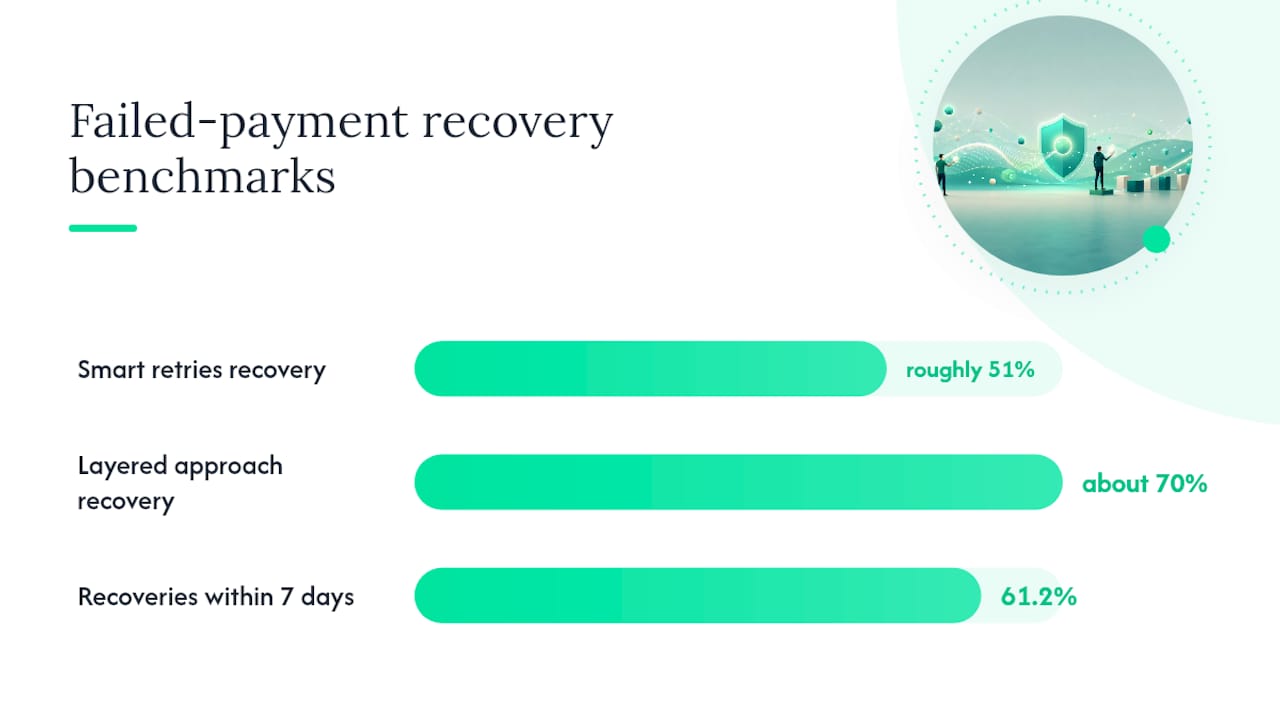
Churnkey's analysis of 5.4 million failed payments shows that layering retries, dunning, and a failed-payment wall recovers the majority of involuntary churn, with a majority of those recoveries happening in the first seven days. That window is where your pricing and ops decisions either pay off or leak revenue permanently.
Table of Contents
- How does pricing design create or prevent payment failures?
- What pricing levers directly lower payment-failure risk?
- What billing operations must you pair with every pricing change?
- How do you test pricing changes and measure their impact on churn?
- What does a realistic implementation timeline look like?
- What should you prioritize first, next, and later?
- How do you measure involuntary churn and recovery metrics?
- What are MCC, BIN filtering, and brand descriptors, and why do they matter?
- Practical checklist to reduce involuntary churn right now
- How do subscription tiers and discounts affect involuntary churn rates?
- How should you communicate pricing changes to protect payment success?
- How do churn prediction models connect to pricing adjustments?
- Key Takeaways
- Ready to Stop the Revenue Leak?
- FAQ
- Ready to Stop the Revenue Leak?
How does pricing design create or prevent payment failures?
Most subscription teams treat payment failure as a billing ops problem. It starts earlier than that. Your pricing structure determines how often a customer faces a renewal event, how large that charge is, and whether the customer has built enough habit to care when it fails.
Billing frequency and failure exposure are directly linked. A monthly subscriber faces 12 renewal events per year. An annual subscriber faces one. Every renewal is a potential failure. Billing cadence changes across defined segments can measurably reduce involuntary churn by shrinking the number of opportunities for a payment to fail.
Time-to-value matters just as much. Billing a customer on day one, before they've logged in twice or completed onboarding, means the charge hits before any habit forms. If the card declines, there's no loyalty holding them in place. Extending the first bill to day 14 or day 30 gives the customer a reason to update their payment method when prompted.
Overage and bill-shock dynamics create a third failure vector. Usage-based charges that spike unexpectedly push the transaction amount above what a customer's card can authorize. That's an insufficient-funds decline that looks like a payment problem but is actually a pricing design problem.
RetentionCheck's diagnostic data shows that pricing is cited as a cancellation reason in 17–22% of exit surveys, but is the true root cause in only 5–9% of cases once feature usage data is considered. That gap matters: if you reprice in response to exit surveys without checking usage, you're solving the wrong problem.
Three metric consequences of pricing design choices:
- Renewal success rate by billing cycle (monthly vs. annual cohorts show measurably different failure rates)
- Cohort LTV shifts when cadence changes reduce failure-driven churn
- Revenue recognition timing changes when customers move from monthly to annual prepay
What pricing levers directly lower payment-failure risk?
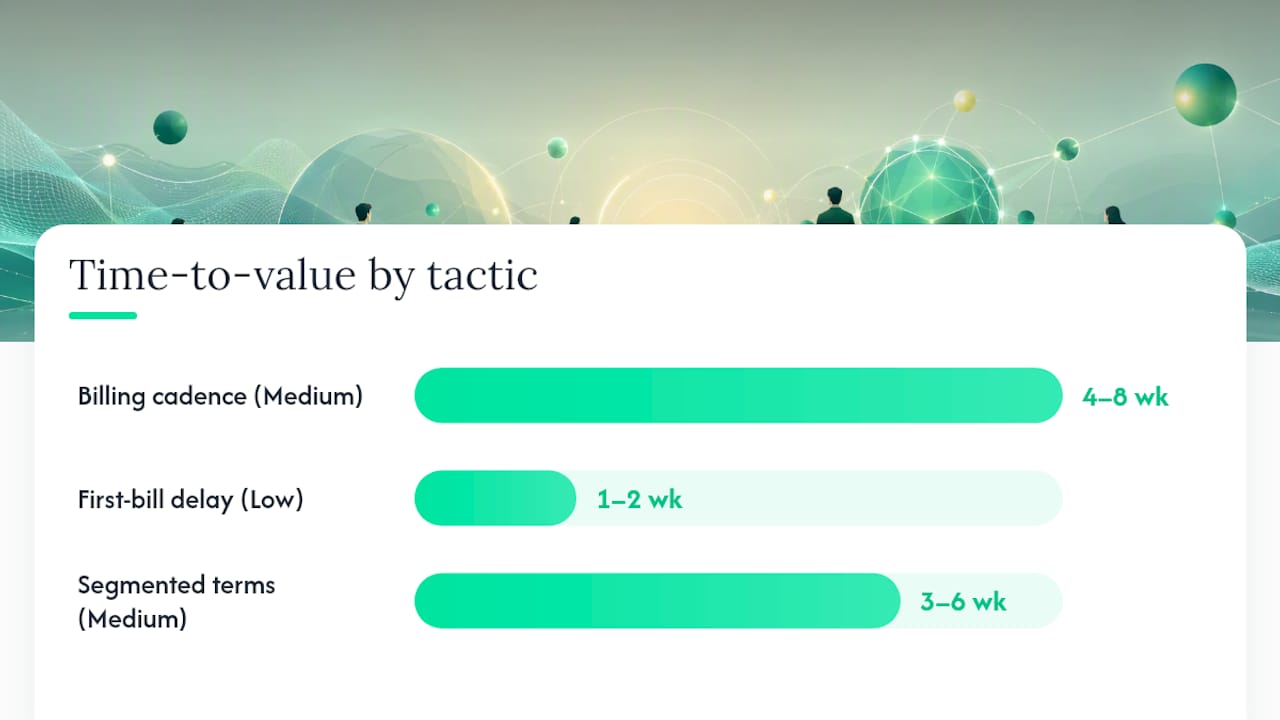
The table below maps each tactic to its mechanism, trade-offs, and realistic time-to-value. Prioritize by effort-to-impact ratio, not by how obvious the tactic sounds.
| Tactic | Why it helps payment success | Trade-offs | Effort / Time-to-value |
|---|---|---|---|
| Billing cadence shift (annual/quarterly) | Fewer renewal events = fewer failure opportunities | Requires upfront cash commitment from customer; may reduce trial-to-paid conversion | Medium engineering; 4–8 weeks to test |
| Extended first-bill delay | Customer builds habit before first charge; more motivated to fix a failed card | Delays revenue recognition; requires trial-abuse guardrails | Low engineering; 1–2 weeks |
| Segmented term offers | Targets low-risk, high-LTV cohorts with annual incentives automatically | Requires cohort scoring and billing-platform hooks | Medium; 3–6 weeks |
| Downgrade / pause paths | Keeps the subscriber active instead of churning on a failed payment | Reduces ARPU short-term; requires cancel-flow redesign | Low–medium; 2–4 weeks |
| Usage right-sizing | Prevents bill-shock overages that trigger insufficient-funds declines | Requires usage monitoring and proactive alerts | Medium; 3–5 weeks |
| Prepaid credits for risky cohorts | Moves payment risk earlier; avoids recurring decline events | Requires UX and billing changes; not all customers accept prepay | Medium–high; 4–8 weeks |
| Targeted annual-discount save plays | Converts at-risk monthly subscribers to annual before they churn | Margin cost; requires save-play automation | Low–medium; 2–4 weeks |
Billing platforms like Chargebee, Recurly, and Paddle each support term changes and dunning hooks. Before designing any of these tactics, check your platform's integration capabilities to confirm you can automate the billing-cycle switch and trigger the right dunning flow at the right moment.
Pro Tip: Combine a low-engagement detection signal with an annual-offer save play. When a customer hasn't logged in for 21 days and their next monthly renewal is within 7 days, trigger an annual offer at a 15–20% discount. You convert a likely-to-fail renewal into a locked annual commitment before the decline ever happens.
Save plays like pause, skip, and cadence change consistently outperform indiscriminate discounting for timing-related churn. The discount costs you margin permanently; the cadence change costs you nothing and reduces future failure exposure.
For A/B testing, track renewal rate by billing cycle and recovery rate after failures as your primary metrics. Run each test for multiple billing cycles to capture durable effects, not just first-month noise.
What billing operations must you pair with every pricing change?
Pricing changes create the conditions for recovery. Operations execute it. Here's the full sequence.
Sample dunning sequence (email + in-app + SMS)
| Step | Timing | Channel | Message intent |
|---|---|---|---|
| Pre-dunning alert | 7 days before renewal | Email + in-app | "Your card on file expires soon — update it now" |
| Failure notice | Hour 1 after decline | Friendly alert; direct link to card update | |
| First retry | Day 1 | Processor | Smart retry (not fixed schedule) |
| Follow-up | Day 3 | Email + SMS | Urgency escalation; offer pause option |
| Second retry | Day 5 | Processor | Smart retry |
| Save-play offer | Day 7 | Email + in-app | Downgrade, pause, or annual offer |
| Final notice | Day 14 | Account suspension warning | |
| Failed-payment wall | Day 14–30 | In-app | Block access; card-update gate |
| Win-back | Day 30+ | Re-engagement with incentive |
Stripe Smart Retries recover a substantial portion of failed payments on their own, and timing-based retries consistently outperform fixed schedules. The reason: smart retries align with customer cash cycles, hitting accounts when funds are most likely available (post-payday windows, for example).
Retry schedule logic
| Attempt | Timing | Rationale |
|---|---|---|
| 1 | Hour 1–4 | Catch transient failures (network errors, temporary holds) |
| 2 | Day 1 | First business-day window |
| 3 | Day 5–7 | Post-payday window for most US consumers |
| 4 | Day 14 | Final attempt before suspension |
Prevention operations to enable first:
- Enable network tokenization or Visa/Mastercard account updater to auto-refresh expired and reissued cards before they decline.
- Add a backup payment method prompt at checkout and in the account settings (ACH, PayPal, digital wallets).
- Rotate processors for high-value accounts when a decline looks issuer-specific rather than card-specific.
- Audit your AVS and BIN filtering settings — overly aggressive filters create false declines on legitimate cards.
Checkout and billing UX improvements:
- Save cards with one-tap wallet options (Apple Pay, Google Pay) at checkout to reduce friction.
- Use a clear, recognizable statement descriptor so customers don't dispute charges they don't recognize.
- Build an inline card-update flow (white-labeled, no redirect to processor) to maximize update completion rates.
- Place the card-update CTA above the fold in the failed-payment wall — don't bury it.
Pro Tip: Route your highest-LTV accounts to a human follow-up queue instead of the automated dunning sequence. A single call from a customer success rep recovers high-touch accounts at rates no email sequence matches. Use an exclusion list in your dunning platform to pull whales out of the automated flow.
Automating dunning and in-app save-play outreach is the operational backbone that makes every pricing lever above actually work at scale.
How do you test pricing changes and measure their impact on churn?
You need a measurement framework before you run any experiment. Without one, you can't tell whether a pricing change reduced involuntary churn or whether a seasonal payment pattern just happened to improve.
Core metrics to instrument:
- Involuntary churn rate — subscribers lost to payment failure as a percentage of total active subscribers per period.
- Recovery rate — dollars recovered from failed payments as a percentage of total failed-payment revenue.
- Renewal success rate by billing cycle — track monthly and annual cohorts separately.
- Cohort LTV — measure 6-month and 12-month LTV for the test cohort vs. holdout.
- Net revenue retention (NRR) attributable to pricing change — isolate the pricing variable from other retention initiatives.
Experiment design steps:
- Select a cohort with a clear shared characteristic (billing cycle, usage tier, acquisition channel).
- Create a holdout group of equal size that receives no pricing change.
- Roll out the pricing change to 10–20% of the target cohort first; expand after 2 billing cycles if metrics hold.
- Set a minimum detectable effect before launch (e.g., a 5-percentage-point improvement in renewal success rate).
- Run the experiment for at least 3–4 billing cycles to capture durable effects.
- Analyze decline-code mix in both groups — a pricing change that reduces bill-shock should shift the insufficient-funds decline rate down.
Dashboard metrics to track:
| Metric | Baseline | Test cohort | Delta |
|---|---|---|---|
| Recovery $ vs. baseline | — | — | Target: positive |
| Decline-code mix (insufficient funds %) | — | — | Target: decrease |
| Retry success by timing | — | — | Target: increase |
| Save-play conversion rate | — | — | Target: increase |
| Annual-conversion lift | — | — | Target: increase |
| Per-cohort ARPU change | — | — | Monitor for margin impact |
Segmenting involuntary churn by decline cause is the single most important analytical step. An insufficient-funds decline calls for a cadence change or prepaid offer. An expired-card decline calls for account updater. A stolen-card decline calls for a backup payment method prompt. Treating all declines the same wastes recovery budget.
For expected benchmarks: smart retries alone recover roughly 51% of failed payments, and a layered approach (retries + dunning + failed-payment wall) can recover about 70% of involuntary churn, with 61.2% of recoveries occurring within the first seven days. Use those figures to set your recovery-rate targets before the experiment starts.
Signalengine's churn prediction software can score cohorts by payment-failure risk before you run a pricing experiment, so you're targeting the right accounts from day one.
What does a realistic implementation timeline look like?
Speed matters. The longer your failed-payment wall stays unbuilt, the more revenue leaks permanently. Here's a phased rollout with owners and time estimates.
| Task | Owner | Time estimate |
|---|---|---|
| Enable account updater / network tokenization | Engineering | 1–3 days |
| Fix statement descriptor | Billing ops | 1 day |
| Add fallback payment method prompt | Product + Engineering | 3–5 days |
| Instrument decline-code reporting | Engineering | 3–7 days |
| Launch failed-payment wall (MVP) | Product + Engineering | 1–2 weeks |
| Build dunning email sequence (3–5 emails) | Marketing + CS | 1–2 weeks |
| Add downgrade/pause option to cancel flow | Product | 2–3 weeks |
| Test one cohort on delayed first bill | Product + Pricing | 2–4 weeks |
| Run annual-offer save-play experiment | Pricing + Engineering | 4–8 weeks |
| Full billing cadence redesign by segment | Pricing + Product | 2–6 months |
Minimal viable scope (start here before anything else):
- Enable account updater on your billing platform (Chargebee, Recurly, or Paddle all support this natively).
- Launch one failed-payment wall that gates access and prompts card update.
- Test one cohort on an annual offer with a 15% discount.
- Instrument decline-code reporting so you can split involuntary churn by cause.
ROI estimate formula: Take your monthly failed-payment volume in dollars, multiply by your expected recovery rate (use 51% for smart retries alone as a conservative floor), and subtract the platform or engineering cost of the change. That's your minimum expected monthly recovered revenue from a single tactic.
What should you prioritize first, next, and later?
Not every tactic deserves equal urgency. Here's the ranked plan.
Quick wins (do this week):
- Enable account updater and network tokenization — zero customer experience impact, immediate decline reduction.
- Fix your statement descriptor so customers recognize the charge and don't dispute it.
- Add a fallback payment method option at checkout and in account settings.
Next stage (weeks 2–8):
- Build the failed-payment wall with an inline card-update flow.
- Deploy smart retries with timing logic (payday-aware windows, not fixed schedules).
- Launch a 5-email dunning sequence with an in-app notice and an SMS touchpoint at day 3.
High-impact investments (months 2–6):
- Redesign billing cadence by segment: move low-engagement, high-LTV accounts to annual with an onboarding value burst.
- Run cohort-level pricing experiments with holdout groups and a 4-cycle measurement window.
- Integrate churn prediction scoring with your pricing and dunning workflows so save plays trigger automatically.
Measure recovery rate and renewal success rate weekly during the first 30 days of any new tactic. Set a rollback trigger: if renewal success rate drops more than 3 percentage points in the test cohort versus holdout, pause the experiment and audit the decline-code mix before continuing.
How do you measure involuntary churn and recovery metrics?
Involuntary churn rate is calculated as the number of subscribers lost to payment failure divided by total active subscribers in the same period. Track it separately from voluntary churn — combining them hides the signal.
Recovery rate measures dollars recovered from initially failed payments as a percentage of total failed-payment revenue. A layered recovery stack (smart retries + dunning + failed-payment wall) gives you the clearest view of which tactic is doing the work. Break recovery rate down by channel (retry vs. email vs. in-app) so you know where to invest next.
Renewal success rate by billing cycle is the leading indicator. When a pricing change is working, this metric moves before LTV does. Track it weekly for monthly cohorts and monthly for annual cohorts.
What are MCC, BIN filtering, and brand descriptors, and why do they matter?
Merchant category codes (MCC) are four-digit codes assigned to merchants by payment networks. They tell card issuers what type of business is charging the card. The wrong MCC can trigger issuer-side fraud filters that decline legitimate subscription charges — especially for SaaS businesses coded under generic retail categories.
BIN filtering lets you route transactions by the first six digits of a card number, which identify the issuing bank and card type. Aggressive BIN filtering blocks high-risk card ranges but can also block legitimate customers. Audit your BIN filter settings quarterly to catch false-decline patterns.
Brand descriptors are what appear on a customer's bank statement. A descriptor that reads "ACME*SVC8823" instead of "Acme Pro Subscription" generates disputes from customers who don't recognize the charge. Disputes trigger chargebacks, which count against your merchant account health and can raise your decline rate across all transactions. Fix your descriptor to match your brand name and product, and include a customer service phone number where your processor allows it.
Practical checklist to reduce involuntary churn right now
Work through this list in order. Each item is independent, so you can assign owners in parallel.
- ☑ Enable account updater or network tokenization on your billing platform.
- ☑ Audit and fix your statement descriptor.
- ☑ Add a backup payment method prompt at checkout and in account settings.
- ☑ Instrument decline-code reporting and split involuntary churn by cause.
- ☑ Build a failed-payment wall with an inline card-update flow.
- ☑ Deploy smart retries with payday-aware timing windows.
- ☑ Launch a 5-step dunning sequence (email + SMS + in-app).
- ☑ Add a downgrade or pause option to your cancel flow.
- ☑ Test one cohort on a delayed first bill (day 14 instead of day 0).
- ☑ Run an annual-offer save play for low-engagement monthly subscribers.
- ☑ Review MCC assignment and BIN filter settings with your processor.
- ☑ Route high-LTV accounts to human follow-up, not automated dunning.
How do subscription tiers and discounts affect involuntary churn rates?
Subscription tier design directly shapes payment-failure risk. A high-priced monthly tier charges a large amount 12 times per year, creating 12 opportunities for an insufficient-funds decline. An annual tier at the same total price charges once, eliminating 11 of those failure events.
Discounts are a blunter instrument than most pricing teams realize. RetentionCheck's data shows that pricing is the true root cause of churn in only 5–9% of cases once usage data is examined. Offering a discount to a customer who churned because of a payment failure, not price sensitivity, costs you margin without solving the problem.
Tiered pricing with a clear downgrade path is more effective than discounting. A customer who drops from a $99/month plan to a $29/month plan stays in your ecosystem, continues building habit, and can be upsold later. A customer who cancels is gone. The downgrade path also reduces the size of the charge that needs to clear, which directly lowers insufficient-funds decline risk.
How should you communicate pricing changes to protect payment success?
Pricing changes that customers don't understand generate disputes, cancellations, and card-on-file removals — all of which increase involuntary churn. The communication strategy is as important as the pricing change itself.
Before a price increase:
- Send a 30-day notice with a clear explanation of the value added since the last price point.
- Offer a lock-in option (pay annually at the current rate before the increase takes effect) to convert monthly subscribers and reduce future failure exposure.
- Segment the notice: high-engagement customers get a value-focused message; low-engagement customers get a downgrade offer alongside the notice.
At the moment of change:
- Update your statement descriptor to reflect the new amount so customers recognize the charge.
- Send a confirmation email the day the new price takes effect — not a week later.
After a failed payment following a price change:
- Your dunning sequence should reference the price change explicitly ("Your card was declined for the updated $X charge"). Customers who don't recognize the new amount are more likely to dispute than update.
Scenario planning that models retention curves before a price increase helps you predict which cohorts will churn voluntarily and which will fail involuntarily, so you can pre-position save plays for each group.
How do churn prediction models connect to pricing adjustments?
Churn prediction models generate a risk score for each subscriber based on behavioral signals: login frequency, feature usage, support ticket volume, payment history, and engagement trends. When that score crosses a threshold, the model should trigger a pricing or billing intervention automatically, not a manual CS review.
The integration works in three steps:
- Act: — The billing platform (Chargebee, Recurly, or Paddle) executes the intervention automatically via API — term change, dunning trigger, or save-play email.
Detecting B2B churn signals before they become cancellations is the upstream step that makes every downstream pricing lever more precise. Without prediction, you're applying save plays to the wrong cohorts and wasting margin on customers who weren't going to churn anyway.
Signalengine's revenue intelligence platform connects behavioral scoring, churn prediction, and automated campaign triggers in one dashboard — so the pricing intervention fires at the right moment without anyone manually pulling a report.
Key Takeaways
The most effective pricing strategy to reduce involuntary churn combines billing cadence optimization, smart retry operations, and churn-prediction-driven save plays — applied to the right cohorts before the decline event occurs.
| Point | Details |
|---|---|
| Billing cadence is the biggest lever | Shifting monthly subscribers to annual reduces failure opportunities from 12 per year to one. |
| 61.2% of recoveries happen in 7 days | Layer retries, dunning, and a failed-payment wall to capture up to 70% of recoverable revenue fast. |
| Decline codes drive tactic selection | Segment involuntary churn by cause before choosing a recovery tactic — insufficient funds needs a different fix than an expired card. |
| Discounts are overused | Pricing is the true churn root cause in only 5–9% of cases; save plays and cadence changes outperform blanket discounts. |
| Signalengine automates the intervention | Signalengine scores churn risk, segments cohorts, and triggers pricing and dunning interventions automatically from one dashboard. |
Ready to Stop the Revenue Leak?
Your pricing changes only recover revenue if you can see which accounts are at risk before the decline hits. Signalengine gives you that visibility automatically.
Signalengine's churn prediction tools score every subscriber by payment-failure risk, segment cohorts automatically, and trigger email and SMS save plays without manual intervention. You get the full picture — decline-code trends, at-risk cohorts, recovery rates — in one dashboard, starting at $49/month. No analyst required, no data team needed.
Book a live demo and see how Signalengine flags your highest-risk renewal cohorts before the next billing cycle runs.
FAQ
What is involuntary churn and how is it different from voluntary churn?
Involuntary churn happens when a subscriber is lost due to a payment failure rather than a deliberate cancellation. Voluntary churn is a customer's active choice to cancel; involuntary churn is recoverable with the right retry, dunning, and pricing tactics.
How much of a failed payment can smart retries actually recover?
Stripe Smart Retries recover roughly 51% of failed payments on their own. Layering dunning and a failed-payment wall on top can recover about 70% of involuntary churn, with 61.2% of recoveries occurring within the first seven days.
Does pricing strategy directly reduce involuntary churn?
Yes. Billing cadence choices (monthly vs. annual), time-to-value extensions, and downgrade paths all reduce the frequency and size of charges that can fail. Billing frequency changes across defined segments are one of the most direct pricing levers for minimizing involuntary churn.
Which billing platforms support the tactics in this guide?
Chargebee, Recurly, and Paddle all support term changes, dunning hooks, and account updater integrations natively. Chargebee's integration libraries are one example of how engineering teams can automate retry hooks and billing-cycle switches via API.
How do I know if pricing or payment failure is causing my churn?
Segment your churn by cause first. Decline-code analysis tells you whether you're losing subscribers to insufficient funds, expired cards, or stolen cards. Exit survey data alone is unreliable — pricing is cited as a reason in 17–22% of surveys but is the true root cause in only 5–9% of cases once usage data is examined.
Ready to Stop the Revenue Leak?
Signal Engine gives small and local businesses 31 AI-powered tools to score leads by buying intent, predict churn before it happens, auto-generate email and SMS campaigns, and recover missed calls automatically — all in one dashboard starting at $49/month.
Start your free 7-day trial — no credit card required. Setup takes 5 minutes.