

What is SaaS renewal rate and why does it drive growth?
Your SaaS renewal rate is the percentage of customers who extend their subscriptions within a measured period. It's the clearest signal of whether your product actually delivers value, and it sits at the foundation of predictable recurring revenue.
A good renewal rate depends on your segment. Top-quartile customer success teams tend to hit very high renewal rates, and 85% is generally seen as a baseline for healthy SaaS businesses. Enterprise contracts above a certain high value warrant investigation if their renewal rate falls below typical healthy levels.
Several factors directly shape where your rate lands:
- Onboarding quality: Customers who never reach their first value milestone rarely renew.
- Customer success involvement: Proactive engagement throughout the year, not just at renewal time, moves the needle.
- Contract terms: Auto-renewals, multi-year deals, and flexible pricing all affect renewal behavior.
- Champion stability: When your internal advocate leaves, the account is at risk even if usage looks healthy.
- Economic signals: Budget cuts, layoffs, and stack consolidation at the customer's company are public churn predictors.
Renewal management is often misunderstood as a late-stage sales task. Experts recommend focusing on value building from day one of the subscription lifecycle, not the final 30 days before contract end.
How to calculate your SaaS renewal rate accurately
Two formulas matter here: customer renewal rate and dollar renewal rate. They tell different stories, and you need both.
Customer Renewal Rate (CRR) measures how many customers renewed, regardless of contract size:
CRR = (Customers Who Renewed ÷ Customers Up for Renewal) × 100
Dollar Renewal Rate (DRR), also called Gross Revenue Retention (GRR), measures the ARR you kept:
DRR = (Renewed ARR ÷ ARR Up for Renewal) × 100
| Metric | Formula | What It Tells You |
|---|---|---|
| Customer Renewal Rate | Renewed customers ÷ Total up for renewal × 100 | Volume of customers retained |
| Dollar Renewal Rate | Renewed ARR ÷ ARR up for renewal × 100 | Revenue health, weighted by contract size |
| Net Revenue Retention | (Renewed + Expansion ARR) ÷ Starting ARR × 100 | Growth from existing customers |
Example calculation: You have 200 customers up for renewal this quarter. 174 renew. Your CRR is 87%. Those 174 customers represent $1.8M of the $2M ARR up for renewal. Your DRR is 90%.
The gap between CRR and DRR tells you something specific. If DRR is higher than CRR, your larger accounts are renewing at better rates than smaller ones. If DRR is lower, your biggest customers are churning or contracting.
CRM data integrity is where most teams fail. Renewal dates, contract values, and auto-renewal flags need to live in one place and sync with your billing system weekly. Manual tracking breaks down between 30–40 customers, and the operational debt compounds fast.
Common challenges that quietly kill your renewal rates
Most SaaS teams don't lose renewals because the product failed. They lose them because of process gaps that compound over time.
- Late engagement: Waiting until 30 days before expiration is the single most common failure mode. Delayed engagement within 15–30 days of contract end increases churn risk by more than twofold compared to outreach at 90+ days.
- Onboarding-seeded churn: 60–70% of annual churn originates in the onboarding phase. Customers who never fully implemented the product arrive at renewal already unconvinced.
- Data inconsistency: Renewal dates exist in three places: the CRM, the billing system, and someone's spreadsheet. They rarely match.
- Missed early warning signals: Usage drops, NPS declines, and champion departures are visible weeks before a customer decides to leave. Without automated detection, CSMs catch them too late.
- Auto-renewal blind spots: A contract that auto-renews on legacy pricing feels like a win. It isn't. You locked in old pricing and missed every upsell opportunity.
- CSM comp misalignment: When CSMs are penalized for flagging at-risk accounts, they stay quiet. The account churns anyway, just without a save attempt.
- Treating renewal as a calendar event: The renewal date field in most CRMs triggers a reminder at day 30. The whole operating model needs to shift to day 120.
Proven workflows to improve SaaS renewal rates
The most effective saas renewal rate improvement workflow starts 120 days before contract end, not 30. Here's how the phases break down:
Day 120: Score every account on usage trend, champion strength, and economic signal. Classify as Green, Yellow, or Red. RevOps reviews the bottom 20% with the CRO in a 30-minute weekly meeting.
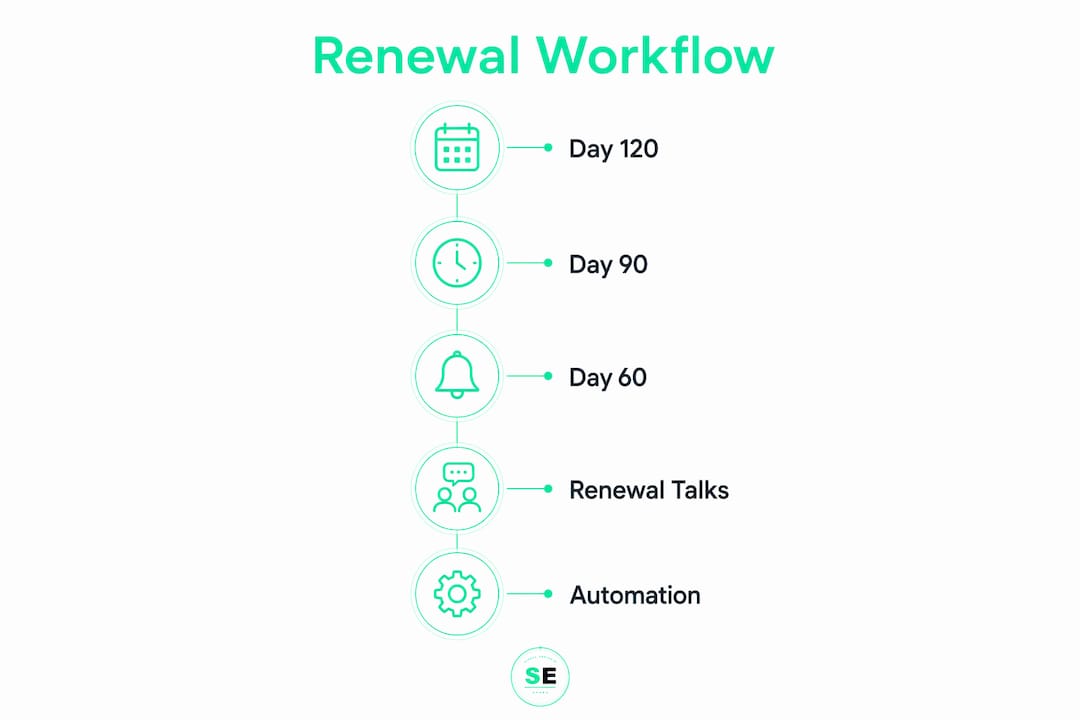
Day 90: Pull success outcomes from the original kickoff. Document what was achieved. Send the economic buyer a "year in review" summary with specific value outcomes, not a feature list. Tracking leading indicators 90 days before renewal increases renewal probability to over 90%.

Day 60: Open the commercial conversation. Renewal (same terms, longer commit), expansion (more seats or modules), and negotiation (pricing, discounts) are three separate conversations. Running them all in one meeting at day 30 is how you end up giving 25% off when a flat renewal was achievable.
Day 30: Paperwork, legal review, and signature. If a deal is still being negotiated here, escalate to the CRO. High-performing SaaS teams close a large majority of renewals before the contract end date.
Best practices summary:
- Start renewal prep at day 120 for accounts above $25K ACV, day 90 for smaller accounts.
- Segment outreach by health score tier, not by account size alone.
- Send the economic buyer a three-paragraph monthly summary throughout the year.
- Build champion redundancy: identify a backup stakeholder at every account.
- Use staged discount reductions across renewal cycles rather than sudden price jumps.
- Treat every auto-renewal as a process failure. Trigger a post-renewal commercial review.
- Multi-year contracts reduce churn risk per renewal cycle avoided, making them a key lever for net retention.
Pro Tip: Structure the renewal conversation around four beats: open with value delivered in the customer's language, address any gaps honestly, present year two as a natural next step, and close with a specific action, not "think about it."
For a deeper look at how revenue playbooks formalize this kind of structured motion, the framework translates directly to renewal management.
How revenue intelligence and automation take renewal rates further
Manual renewal management has a ceiling. Once you pass 40 accounts, the process either gets automated or it gets missed.
The foundation is a unified health score that pulls from product usage, support ticket sentiment, NPS responses, billing history, and stakeholder engagement. Health scores combining these signals predict churn with up to 78% accuracy. That's not a dashboard metric. That's an early warning system.
Automated renewal playbooks that customize messaging and escalation based on account health improve renewal rates by 12% compared to generic sequences. Green accounts get a streamlined auto-renewal flow. Yellow accounts trigger personalized CSM outreach. Red accounts activate a save playbook with escalated resources and executive involvement.

Automation also unlocks expansion revenue that manual processes consistently miss. When an account hits 80% seat utilization or consistent usage of a premium feature outside their current plan, the system should automatically surface an expansion opportunity in the CRM, pre-populated with usage data and recommended pricing.
Key automation advantages:
- Health scoring runs continuously, not just at renewal time.
- ⚡ Day 120, 90, 60, and 30 triggers fire automatically with the right owner assigned.
- Quarterly value reports pull from product analytics and surface dollar-impact numbers.
- Escalation chains activate based on response behavior, not manual judgment.
- Expansion signals trigger multi-threaded campaigns across in-app, CSM, and marketing channels.
For SaaS teams ready to automate churn intervention, the operational shift from reactive to predictive is where the real retention gains live.
Using customer feedback and surveys to identify renewal risk
NPS and CSAT scores are lagging indicators on their own. The signal isn't the score. It's the trajectory.
A customer whose NPS dropped two points over two consecutive quarters is at risk even if their absolute score is still positive. Track the direction, not just the number. Build a quarterly survey cadence that asks one specific question beyond the standard score: "What would need to change for this to be a 10?" That answer tells you exactly what the renewal conversation needs to address.
Exit surveys from churned customers reveal patterns that internal data misses. If three churned accounts in the same industry all cite the same onboarding gap, that's a product or process fix, not a retention tactic problem. Segment feedback by customer size, industry, and contract age to surface those patterns faster.
Support ticket sentiment is an underused feedback signal. A spike in tickets followed by sudden silence is a stronger churn predictor than the tickets themselves. The silence means the customer stopped expecting help. Use a renewal risk checklist to formalize how feedback signals feed into your health score model.
Early warning systems and predictive analytics for churn risk
The strongest churn predictor in most SaaS businesses is a flat or declining usage trend over 90 days. Accounts with declining usage show significantly higher non-renewal rates than accounts with growing usage year over year.
A three-dimensional risk score covers the full picture:
- Usage trend: Is the account using the product more, the same, or less than six months ago?
- Champion health: Is the original buyer still in seat, still using the product personally, and do they have at least one internal advocate?
- Economic signal: Did the company do layoffs? Did the buyer's department budget get cut? These signals are public for most B2B SaaS customers via job postings, LinkedIn headcount data, and earnings calls.
The lowest score across all three dimensions sets the overall risk level. An account with strong usage but a departed champion scores as high risk, full stop. Review this score weekly in a 30-minute meeting with CS, Sales, and RevOps. Any account that drops a level gets a one-page save plan with three fields: reason for the drop, specific intervention, and owner.
Churn prediction software built for smaller teams can automate this scoring without requiring an enterprise customer success platform.
How customer success teams drive proactive renewal management
Customer success owns the renewal outcome long before the renewal date appears on anyone's calendar. The CSM's job isn't to close the renewal. It's to make the renewal decision obvious by the time it arrives.
That means three things in practice. First, the CSM needs to know the original value case. If Sales never documented it at handoff, the CSM is walking into every QBR blind. A one-page document the account executive writes before the deal closes fixes this. Second, the CSM needs to measure against that value case quarterly, not annually. Customers who see their own progress in specific numbers arrive at renewal already sold. Third, the CSM needs to flag at-risk accounts early, which requires a comp structure that rewards honest early flagging rather than penalizing downgrades.
CSM capacity matters too. When renewal management starts pulling founders or managers away from product and growth work for multiple hours per week, it's time to hire a dedicated CSM or invest in automation. The signal is usually a combination of missed renewal dates, last-minute churn surprises, and hours spent on administrative reconciliation instead of relationship work.
Pricing strategy also plays a role in what CSMs are working with. Platforms like Revively offer staged pricing structures that make renewal conversations easier to frame around value growth rather than cost justification.
Key Takeaways
A structured SaaS renewal rate improvement workflow starting at day 120, combined with automated health scoring and proactive customer success, consistently outperforms ad hoc renewal processes on gross retention, expansion revenue, and CSM efficiency.
| Point | Details |
|---|---|
| Start at day 120 | Effective renewal workflows begin 120 days before contract end, not 30. |
| Onboarding drives renewal | 60–70% of annual churn originates in the onboarding phase, making early lifecycle work the highest-impact lever. |
| Health scores predict churn | Scores combining usage, NPS, support sentiment, and champion stability predict churn with up to 78% accuracy. |
| Automate by tier | Green, Yellow, and Red playbooks with conditional branching improve renewal rates by 12% over generic sequences. |
| Track leading indicators | Track leading indicators 90 days before renewal—like usage trends, NPS changes, champion stability, and executive engagement—increases renewal probability to over 90%. Accounts with all five leading indicators green renew at 97%; missing even one drops probability sharply. |
FAQ
What is a good SaaS renewal rate?
A good SaaS renewal rate is 85% or higher for most segments, with top-quartile customer success teams achieving very high renewal rates. Enterprise accounts above $100K ACV warrant investigation if they fall below typical healthy levels.
How do you calculate SaaS renewal rate?
Divide the number of customers (or ARR) that renewed by the total number up for renewal, then multiply by 100. Track both customer renewal rate and dollar renewal rate separately, since they reveal different health signals.
When should renewal conversations start?
Renewal conversations should start 90–120 days before contract end. Starting at 30 days or fewer significantly increases churn risk and leaves no time to address value gaps or run multi-stakeholder approvals.
What causes low SaaS renewal rates?
The most common causes are poor onboarding (which seeds 60–70% of annual churn), late engagement, data inconsistency between CRM and billing, missed early warning signals, and champion turnover without a backup relationship in place.
How does automation improve renewal rates?
Automated renewal playbooks that customize messaging and escalation based on account health improve renewal rates by 12% compared to generic outreach sequences, while also extending churn warning lead time and reducing CSM hours per renewal.
Ready to Stop the Revenue Leak?
Signal Engine gives small and local businesses 31 AI-powered tools to score leads by buying intent, predict churn before it happens, auto-generate email and SMS campaigns, and recover missed calls automatically — all in one dashboard starting at $49/month.
Start your free 7-day trial — no credit card required. Setup takes 5 minutes.