

TL;DR:
- A renewal risk checklist identifies and scores potential hazards in contract renewals to prevent revenue loss. It emphasizes tracking contract clauses, customer signals, operational risks, and using automated alerts for timely action. Implementing the system early improves renewal outcomes and reduces costly surprises.
A renewal risk identification checklist is a structured tool that systematically exposes and prioritizes the most significant risks in contract renewals before they cost you money. Most business leaders treat renewal risk as a budgeting problem. That framing misses the full picture. The real risks sit inside contract clauses, customer behavior shifts, and operational blind spots that standard financial reviews never catch. This guide gives you a practical, field-tested checklist built for 2026, covering contract milestones, weighted risk scoring, conversational signals, and cross-functional workflows that protect your revenue at every renewal.
1. What belongs on a renewal risk identification checklist?
A complete risk assessment checklist tracks three categories: contract mechanics, customer health signals, and operational factors. Most teams only monitor the first. That gap is where renewals quietly go wrong.
Contract mechanics to track:
- Expiration date — the calendar deadline for the contract term
- Notice date — the true point of no return; missing the notice deadline triggers automatic renewal regardless of your intent
- Auto-renewal clause — whether the contract self-renews and under what conditions
- Price escalators — scheduled rate increases baked into renewal terms
- Termination rights — conditions under which either party can exit
- Written notice requirements — auto-renewal clauses typically require written notice 30, 60, or 90 days in advance for lawful cancellation
Customer health signals to track:
- Engagement trends over the last 90 days
- Executive sponsor changes within the last 120 days
- Support ticket volume and unresolved escalations
- Net Promoter Score or satisfaction survey results
- Unprompted competitor mentions in calls or emails
Operational factors to track:
- Unused services or underutilized licenses
- Orphaned accounts and overprivileged access keys that inflate costs and security exposure
- Asset and inventory alignment with contracted services
- Cross-departmental sign-off status from legal, finance, and procurement
Pro Tip: Build your checklist inside your CRM or contract management system so every field auto-populates from existing data. Manual spreadsheets create gaps; connected systems create visibility.
2. How to use a reminder ladder to prevent silent auto-renewals

The 90/60/30-day reminder ladder is the single most effective tactic for avoiding unwanted contract renewals. Most high-risk contracts require written notice 30–180 days before expiration for renegotiation or exit. Without a structured ladder, those deadlines pass unnoticed.
Here is how to structure the ladder:
- 90 days out: Pull the full contract file. Confirm the notice date, not just the expiration date. Flag any price escalators or changed terms. Assign an owner.
- 60 days out: Complete the customer health review. Score the account using your risk matrix. Escalate any account scoring above your action threshold to leadership.
- 30 days out: Send formal written notice if exiting or renegotiating. Confirm receipt. Lock in the renewal decision with all stakeholders.
Each stage should trigger an automated alert, not a calendar reminder someone can ignore. The goal is to make inaction impossible, not just inconvenient.
3. How weighted risk scoring improves renewal prioritization
Effective risk prioritization uses a 1–5 likelihood and impact matrix. Risks scoring 15 or higher require immediate mitigation. That threshold separates urgent action from routine monitoring.
The scoring works like this:
- Likelihood score (1–5): How probable is it that this renewal will fail or renew unfavorably?
- Impact score (1–5): What is the financial or operational cost if it does?
- Combined score: Multiply likelihood by impact. A score of 15 or above demands a time-bound action plan within 3–6 months before renewal.
| Score range | Risk level | Recommended action |
|---|---|---|
| 1–6 | Low | Monitor quarterly |
| 7–14 | Medium | Assign owner, review monthly |
| 15–25 | High | Immediate mitigation plan required |
The scoring system only works if you attach context to the number. Raw scores tell you what is urgent. The "why" and the next step tell your team what to do about it. Contextualizing renewal risk scores with the reason and a clear next action transforms raw data into management intelligence.
Pro Tip: Score every renewal at least 6 months out. Waiting until 60 days before the notice date leaves no room to negotiate better terms or find alternatives.
4. What conversational signals reveal early renewal risk?
Usage data alone misses 40–60% of at-risk accounts. The accounts most likely to churn often maintain normal usage patterns right up until they cancel. Conversational signals catch what the dashboard misses.
The signals that predict churn earliest include:
- Hesitation language in calls or emails ("we're still evaluating," "we need to think about it")
- Unprompted competitor mentions ("we've been looking at other options")
- Sentiment shifts from positive to neutral or neutral to negative across touchpoints
- Deferral phrasing ("let's revisit this next quarter")
- Executive sponsor departures within 120 days of renewal — this single event is one of the strongest predictors of churn
"Teams that capture conversational signals surface risk 60–180 days earlier than usage metrics alone." — Perspective AI research
That 60–180 day head start is the difference between saving an account and losing it. Your customer success team hears these signals in every call. The problem is that without a structured process to log and score them, the signals disappear into meeting notes nobody reads. Build a field in your CRM for conversational risk flags. Review it weekly.
5. Why operational and identity risks belong on your checklist
Treating renewal risk only as a procurement or finance issue misses identity lifecycle risks like orphaned licenses and overprivileged access keys. These inflate costs and create security vulnerabilities that compound over time.
Operational risks to audit before every renewal:
- Unused services: Are you renewing capacity you stopped using 6 months ago?
- Orphaned accounts: Do former employees still hold active licenses tied to this contract?
- Asset misalignment: Does the contracted volume still match actual usage?
- Vendor consolidation opportunities: Could two contracts be merged at renewal for better pricing?
Disconnecting renewal decisions from asset and inventory audits widens your attack surface and drives up hidden costs. The checklist for risk identification must include an operational layer, not just a financial one. This is especially relevant for HVAC, logistics, and SaaS businesses where revenue leakage from unused contracted services is a recurring problem.
6. How to build a cross-functional renewal risk workflow
Centralized contract repositories and AI-driven alerts help organizations proactively manage renewal risk with real-time visibility and automated flagging. A workflow without centralization is just a checklist nobody follows.
The core workflow components:
- Central contract repository: Every contract lives in one system with metadata fields for notice date, expiration date, owner, and risk score
- Automated alerts: Triggered at 90, 60, and 30 days before the notice deadline, not the expiration date
- Cross-functional approval routing: High-risk renewals route automatically to legal, finance, procurement, and customer success for sign-off
- Obligation tracking: Flag any contractual obligations due before renewal, such as audits, certifications, or performance reviews
- Tiered workflows: Low-risk renewals (scores 1–6) follow a lightweight one-owner process; high-risk renewals (scores 15+) require full team review
Automating at-risk account alerts removes the human error that kills most renewal processes. When alerts are manual, they get missed. When they are automated, the process runs whether or not your team remembers. Signalengine's AI scoring layer flags accounts before they reach crisis stage, giving your team time to act rather than react. You can see how automated account alerts work in practice for customer success teams managing contract renewals.
Key takeaways
A complete renewal risk identification checklist combines contract mechanics, customer signals, and operational audits into one scored, time-bound workflow that prevents costly surprises.
| Point | Details |
|---|---|
| Notice date is the real deadline | Missing the notice date triggers auto-renewal legally, regardless of intent or satisfaction. |
| Score every renewal 6 months out | Use a 1–5 likelihood and impact matrix; scores of 15+ require an immediate action plan. |
| Conversational signals beat usage data | Hesitation language and sponsor changes surface churn risk 60–180 days before usage data does. |
| Operational audits prevent hidden costs | Orphaned accounts and unused licenses inflate costs and create security gaps at renewal. |
| Automate the reminder ladder | Alerts at 90, 60, and 30 days before the notice deadline make inaction structurally impossible. |
The case for treating your renewal checklist as a revenue system
I have watched business leaders lose six-figure contracts not because the customer was unhappy, but because nobody tracked the notice date. The contract auto-renewed at a 15% higher rate. The customer was furious. The vendor was embarrassed. And the whole thing was preventable with a single calendar entry.
That story repeats across industries more than most leaders want to admit. The renewal process gets treated as an administrative task when it is actually a revenue system. Every contract that auto-renews unfavorably, every account that churns because nobody caught the warning signs, every license that renews unused — these are not bad luck. They are process failures.
The most underrated element of any risk identification workflow is the conversational signal layer. Finance teams track dollars. Operations teams track assets. Almost nobody formally tracks what customers say in calls six months before renewal. That gap is where churn hides. Plugging it requires a cultural shift as much as a technical one. Your customer success team needs to know that what they hear matters, and that there is a place to log it.
AI tools are changing this fast. Platforms like Signalengine now score customer behavior automatically and flag accounts before the warning signs become obvious. The B2B revenue risk categories that used to require a full analyst review can now surface in a dashboard overnight. The checklist does not disappear. It gets faster and more accurate.
The business leaders who win at renewals in 2026 are not the ones with the most contracts. They are the ones who built a system that catches risk early, scores it honestly, and routes it to the right person with enough time to do something about it.
— Bernard
How Signalengine helps you catch renewal risk before it costs you
Renewal risk management works best when the signals come to you automatically, not after you go looking for them.
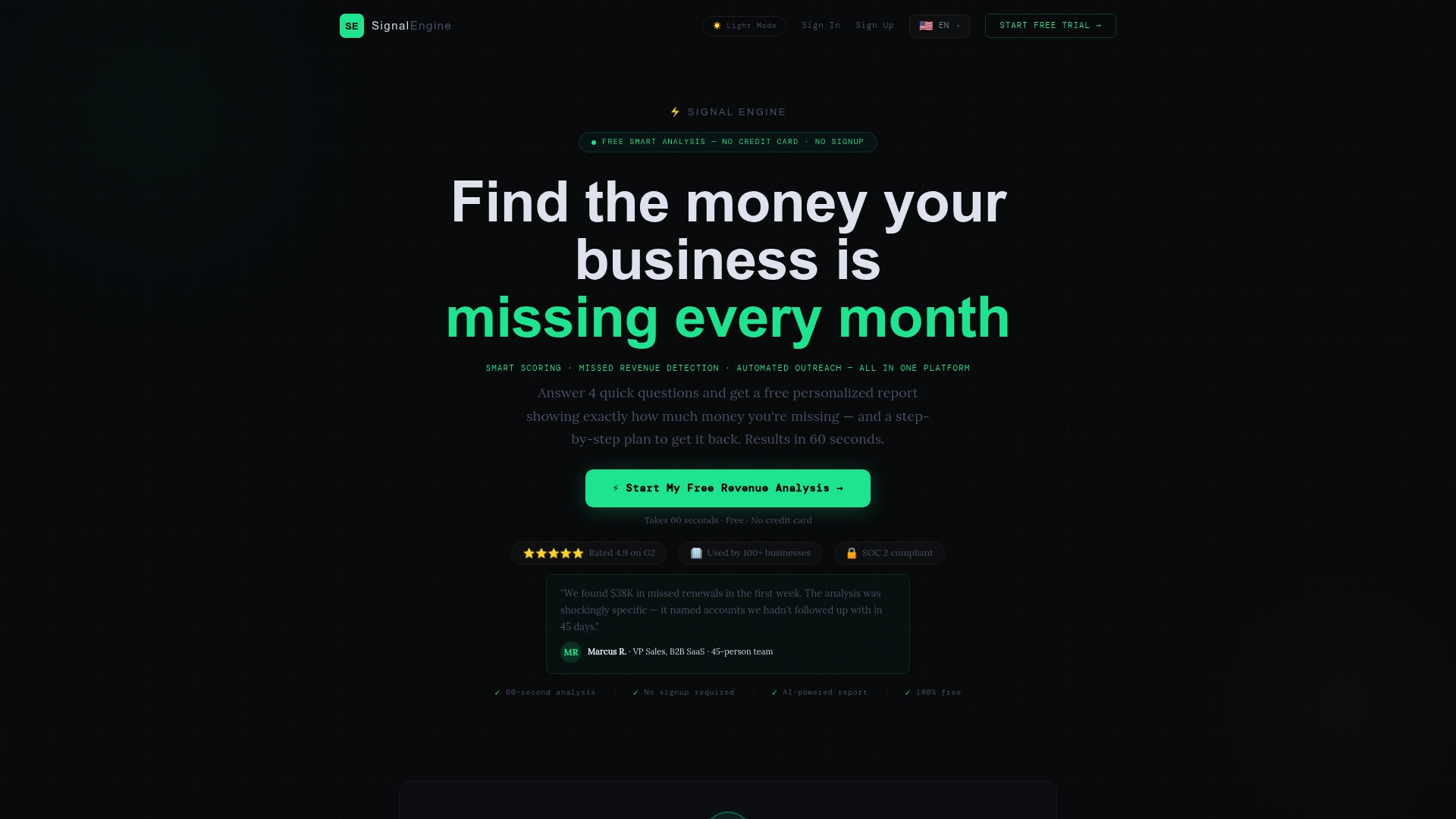
Signalengine watches your customer accounts 24/7, scores behavior with AI, and flags who is at risk before the notice deadline arrives. The platform detects sentiment shifts, tracks engagement drops, and sends alerts timed to your contract milestones — no manual setup required. For SMBs managing renewals across multiple verticals, that kind of AI-powered early warning is the difference between a saved account and a lost one. Explore revenue intelligence tools built for businesses that need results without the enterprise price tag.
FAQ
What is a renewal risk identification checklist?
A renewal risk identification checklist is a structured tool that tracks contract milestones, customer health signals, and operational factors to surface and prioritize risks before a renewal deadline. It replaces reactive, last-minute reviews with a proactive, scored workflow.
What is the most important date in contract renewal risk management?
The notice date is more critical than the expiration date. Missing the notice deadline locks you into an auto-renewal legally, regardless of your satisfaction with the contract or vendor.
How does weighted risk scoring work for renewals?
A 1–5 likelihood and impact matrix produces a combined score for each renewal. Scores of 15 or higher require an immediate mitigation plan, while scores below 7 need only quarterly monitoring.
Why does usage data miss so many at-risk accounts?
Usage data captures activity but not intent. Conversational signals like hesitation language and unprompted competitor mentions predict churn 60–180 days earlier than usage metrics, catching the accounts that look fine on paper but are already shopping alternatives.
How often should you run a renewal risk assessment?
Run a full risk assessment at least 6 months before each contract's notice deadline. High-risk accounts (scores 15+) warrant monthly reviews from that point forward until the renewal is confirmed.
Ready to Stop the Revenue Leak?
Signal Engine gives small and local businesses 31 AI-powered tools to score leads by buying intent, predict churn before it happens, auto-generate email and SMS campaigns, and recover missed calls automatically — all in one dashboard starting at $49/month.
Start your free 7-day trial — no credit card required. Setup takes 5 minutes.