

TL;DR:
- The SaaS dunning process is an automated system that combines smart payment retries with empathetic customer communication to reduce involuntary churn. It treats failed payments as a billing logistics issue, not customer dishonesty, and can significantly improve revenue recovery. Effective dunning balances automation with personalized outreach to enhance customer retention and cash flow.
The SaaS dunning process is an automated workflow that combines payment retry logic with customer communication to recover failed subscription payments and reduce involuntary churn. Most SaaS leaders treat a failed payment as a customer problem. It is not. Involuntary churn from payment failures accounts for 20–40% of all SaaS churn, costing the industry $129 billion globally in 2025. That number means a significant share of your lost revenue has nothing to do with product dissatisfaction. It is a billing logistics problem, and dunning management is the fix.
What is the SaaS dunning process, and why does it matter?
The SaaS dunning process is the structured system your billing infrastructure uses to recover revenue after a subscription payment fails. The industry term is "dunning management," borrowed from centuries-old collections practice, but modern SaaS dunning looks nothing like debt collection. Modern dunning prioritizes service continuity over collections, using empathetic messaging to keep subscribers active rather than threatening them into paying.
The workflow has two parallel tracks. The first is payment retry logic: your system attempts to charge the card again, using timing and decline code data to pick the best moment. The second is customer communication: emails, SMS, or in-app notifications that alert the subscriber and invite them to update their payment method. Both tracks run simultaneously, and neither works as well without the other.
SaaS billing recovery matters because the math compounds fast. A company with 1,000 subscribers and a 2% monthly payment failure rate loses 20 accounts per month to billing errors alone. Recover half of those with a structured dunning sequence and you protect meaningful annual recurring revenue without acquiring a single new customer.
What are the core components of a SaaS dunning process?
A well-built dunning workflow has four distinct components. Each one handles a specific failure point in the subscription payment lifecycle.
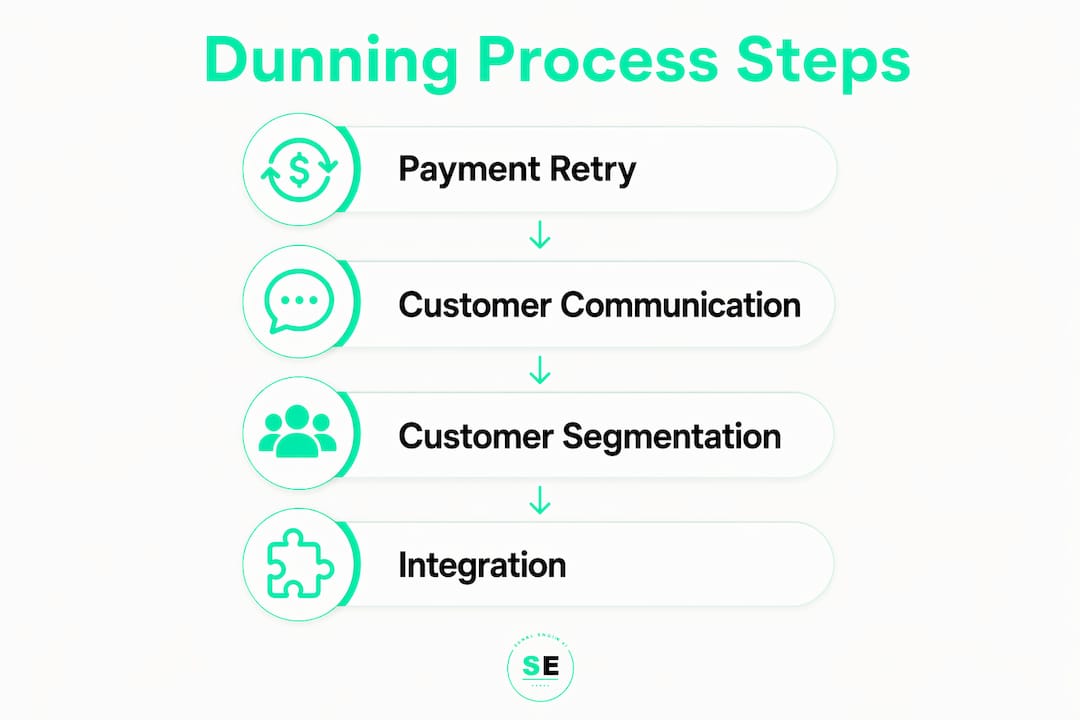
Payment retry logic
Payment failures are logistics problems, not signals of customer intent to cancel. Expired cards, temporary insufficient funds, and bank-side blocks cause the majority of declines. Smart retry logic reads the decline code returned by the payment processor and schedules the next attempt based on that signal. A soft decline (temporary issue) warrants a retry within 24–48 hours. A hard decline (card closed or fraud flagged) requires a different path: direct customer outreach to update payment details.
Customer communication channels
Email is the primary channel for dunning notifications, but it works best when paired with SMS and in-app alerts. A subscriber who misses an email will often catch an SMS. In-app banners catch users who are actively logged in. The goal is to reach the customer through whichever channel they actually check, not just the one that is easiest to send.

Customer segmentation
Not every failed payment deserves the same response. Segmenting customers by lifetime value and tailoring dunning approaches materially improves recovery and retention outcomes. A high-value enterprise account with a $5,000 monthly contract warrants a personal call from a customer success manager. A $49/month SMB account is better served by a fully automated email sequence. Mixing these approaches wastes resources and risks damaging relationships.
Integration with payment processors and subscription platforms
Your dunning system must connect cleanly to your payment processor and subscription management platform. This integration feeds real-time decline codes into your retry logic and triggers communication sequences automatically. Without it, your team is manually chasing failed payments, which is slow and inconsistent.
Pro Tip: Set up webhook listeners on your payment processor to trigger dunning sequences within minutes of a failed charge, not hours. Speed in the first retry window significantly improves recovery rates.
How does the SaaS dunning process improve payment recovery?
Structured dunning sequences combining smart retries and customer communications can increase failed payment recovery rates from 30–40% up to 70–80%. That gap represents the difference between a reactive billing team and a proactive dunning system. The improvement comes from three specific mechanisms: better retry timing, multi-channel outreach, and empathetic messaging that reduces subscriber anxiety.
"The most effective dunning systems treat a failed payment as a service interruption to fix, not a debt to collect. When customers feel helped rather than hounded, they update their payment details faster and churn less often."
The table below shows how basic retry logic compares to a structured, multi-channel dunning approach across key outcomes.
| Metric | Basic retry only | Structured dunning |
|---|---|---|
| Recovery rate | 30–40% | 70–80% |
| Customer communication | None | Email, SMS, in-app |
| Retry logic | Fixed schedule | Decline code-based |
| Involuntary churn impact | High | Significantly reduced |
| Customer experience | Abrupt service loss | Guided resolution |
The communication side of dunning carries more weight than most financial managers expect. A subscriber who receives a clear, friendly email explaining that their card was declined and offering a one-click update link is far more likely to act than one who simply loses access. Framing matters. The message should read like a helpful service alert, not a collections notice.
You can read more about how SaaS revenue leakage compounds over time and what systems stop it before it becomes a cash flow problem.
What are best practices and common pitfalls in SaaS dunning workflows?
Getting dunning right requires both a solid sequence design and an awareness of the mistakes that undermine recovery rates. The most common errors are easy to avoid once you know what to look for.
Recommended sequence timing
The optimal dunning email sequence for mid-market SaaS involves three emails sent over 7–14 days. Sending more than three emails does not increase revenue recovery. It increases unsubscribes. Structure your sequence like this:
- Day 1: Immediate notification that the payment failed. Keep it short, factual, and include a direct link to update payment details.
- Day 4–5: A follow-up reminder with a slightly warmer tone. Acknowledge that things get busy and make updating easy.
- Day 10–14: A final notice before service suspension. Be clear about the consequence but avoid threatening language. Offer a support contact for customers who need help.
Avoiding conflicting retry schedules
Manually scheduled retries can disrupt the machine-learning models that payment processors use to optimize their own smart retry logic. This is one of the most overlooked pitfalls in dunning design. The best practice is to let your payment processor handle retry timing while your SaaS platform manages the communication sequence. Combining both without coordination creates conflicts that reduce recovery rates.
Proactive pre-dunning tactics
The best dunning is the dunning that never has to happen. Pre-dunning alerts sent before a card expires give subscribers time to update their payment method before a charge fails. A simple email 30 days before card expiration, followed by a reminder 7 days out, eliminates a significant share of preventable failures.
Additional proactive tactics that reduce failure rates:
- Account updater services: Many payment processors offer automatic card number updates when a subscriber gets a new card. Enroll in this service to silently recover a portion of failures before they trigger dunning.
- In-app payment health banners: Display a non-intrusive banner when a card is approaching expiration. Subscribers who see it in context act faster than those who receive an email.
- High-value account monitoring: Flag accounts above a revenue threshold for manual review when a payment fails. Automated sequences alone are not enough for your most valuable customers.
Pro Tip: Pair your dunning sequence with at-risk account alerts so your customer success team gets notified the moment a high-value account enters a dunning cycle. Human outreach at that moment closes more accounts than any automated email.
How can SaaS companies measure dunning success?
Recovery Rate and Time to Recovery are the two critical KPIs for dunning performance. Recovery Rate measures the percentage of failed payments you successfully collect. Time to Recovery measures how quickly you collect them. A shorter Time to Recovery signals healthier cash flow and a more effective sequence.
Track these additional metrics to get a complete picture of dunning performance:
- Involuntary churn rate: The percentage of cancellations caused by payment failure rather than customer decision. A well-run dunning system drives this number down consistently.
- Email open and click rates by sequence step: Low open rates on your first email signal a subject line problem. Low click rates signal a friction problem in the update flow.
- Retry success rate by decline code: Tracking which decline codes resolve on retry versus which require customer action tells you where to focus automation versus outreach.
- Unsubscribe rate from dunning emails: Rising unsubscribes signal dunning fatigue. Three emails is the ceiling for most audiences.
Continuous optimization means running experiments on retry timing, email subject lines, and channel mix. A change in send time from morning to evening can shift open rates meaningfully. Test one variable at a time and measure against a 30-day baseline. Financial managers who treat dunning as a living workflow rather than a set-and-forget system consistently outperform those who do not. The role of AI in revenue recovery is expanding fast, and automated optimization is becoming a standard expectation rather than a premium feature.
Key Takeaways
The SaaS dunning process is the single most cost-effective revenue recovery lever available to subscription businesses, requiring smart retry logic, segmented communication, and continuous KPI monitoring to work at full capacity.
| Point | Details |
|---|---|
| Involuntary churn is massive | Payment failures cause 20–40% of SaaS churn, making dunning a top financial priority. |
| Structured sequences outperform basic retries | Recovery rates jump from 30–40% to 70–80% with multi-channel dunning workflows. |
| Three emails is the ceiling | Sending more than three dunning emails increases unsubscribes without improving recovery. |
| Let processors handle retries | Avoid conflicting retry schedules; let your payment processor's smart logic run while you manage communications. |
| Pre-dunning prevents failures | Expiring card alerts sent 30 days out eliminate a significant share of preventable payment failures. |
Why dunning is really a customer service strategy
I have reviewed a lot of SaaS billing setups over the years, and the most common mistake I see is framing dunning as a collections function. Teams write dunning emails that sound like final notices. They schedule retries without thinking about the customer experience on the other end. They measure success only in dollars recovered and miss the relationship damage happening in parallel.
The SaaS companies that recover the most revenue treat dunning as a service continuity problem. Their emails read like a helpful alert from a company that wants to keep you as a customer. Their retry logic is invisible to the subscriber. Their high-value accounts get a phone call, not a form letter.
The uncomfortable truth is that aggressive dunning messaging hurts retention even when it recovers a payment. A subscriber who feels hounded will update their card and then cancel the following month. You recovered the payment and lost the customer. That is a bad trade.
The best dunning systems I have seen combine full automation for the long tail of SMB accounts with genuine human outreach for the accounts that matter most. That balance is not complicated to build, but it requires a deliberate decision to treat dunning as a customer experience function, not just a billing function. When you make that shift, recovery rates go up and churn goes down at the same time.
— Bernard
How Signalengine helps you catch payment risk before it becomes churn
Dunning works best when you see payment risk coming before a charge fails. Signalengine watches your customer behavior in real time, scores accounts by churn risk, and flags the ones most likely to hit a billing problem before your dunning sequence ever fires.

With Signalengine's AI-powered revenue intelligence, you get automated alerts the moment an account shows early warning signals, plus the tools to act on them fast. No digging through dashboards. No manual monitoring. The platform tells you who is at risk and what to do next. For SaaS teams that want to close the gap between payment failure and recovery, Signalengine is built for exactly that. See it in action with a live demo and find out how fast you can put it to work.
FAQ
What is the SaaS dunning process?
The SaaS dunning process is an automated system that combines payment retry logic with customer communication to recover failed subscription payments and reduce involuntary churn. It runs in parallel tracks: smart retries on the billing side and email, SMS, or in-app outreach on the customer side.
How many dunning emails should I send?
Three emails over 7–14 days is the proven best practice for mid-market SaaS. Sending more than three emails increases unsubscribes without improving revenue recovery.
What causes most subscription payment failures?
Most payment failures stem from logistics issues like expired cards or temporary insufficient funds, not customer intent to cancel. Treating them as technical problems rather than customer decisions leads to better recovery outcomes.
What KPIs measure dunning success?
Recovery Rate and Time to Recovery are the two primary KPIs. Recovery Rate tracks the percentage of failed payments collected. Time to Recovery measures how quickly collection happens, with shorter times indicating healthier cash flow.
How is dunning different from debt collection?
Dunning focuses on service continuity and empathetic customer communication to resolve billing issues before service is interrupted. Debt collection happens after service termination. The tone, timing, and goal are fundamentally different.
Ready to Stop the Revenue Leak?
Signal Engine gives small and local businesses 31 AI-powered tools to score leads by buying intent, predict churn before it happens, auto-generate email and SMS campaigns, and recover missed calls automatically — all in one dashboard starting at $49/month.
Start your free 7-day trial — no credit card required. Setup takes 5 minutes.