

TL;DR:
- A sales pipeline gap analysis workflow measures the difference between current pipeline value and revenue targets, then diagnoses and assigns recovery actions. It emphasizes early, accurate data analysis to distinguish volume from quality gaps and cuts through flawed metrics like pipeline volume.
A sales pipeline gap analysis workflow is a structured process that measures the difference between your current weighted pipeline value and your revenue target, then diagnoses why that gap exists and assigns specific recovery actions to close it. The industry standard, established by ORM Tech, calls for a quarterly baseline with a mid-quarter refresh that incorporates actual won and lost deals. The most important distinction in any gap analysis is whether you face a volume problem or a quality problem. Those two gap types require completely different responses, and confusing them is the single most common reason recovery plans fail.
What is a sales pipeline gap analysis workflow?
A sales pipeline gap analysis workflow is the repeatable sequence of steps a sales leader uses to calculate pipeline deficits, classify their root cause, and build owner-assigned recovery plans. The term "gap analysis" comes from standard business process methodology, but in sales operations it has a specific meaning: you are measuring the shortfall between your pipeline coverage ratio and the historical benchmark needed to hit quota. Most teams run this process quarterly, with a mid-quarter refresh to account for deals that closed or were lost since the baseline was set.

The workflow matters because forecasting accuracy depends on it. A pipeline full of stale deals or rep-estimated probabilities produces a false sense of security. By the time the quarter ends, the miss is obvious but no longer fixable. Running the workflow early gives you time to act.
What data do you need before running a pipeline review?
The quality of your gap analysis is only as good as the data feeding it. Before you run a single calculation, your CRM records must meet four criteria.
| Data Element | Role in Analysis |
|---|---|
| Deal stage accuracy | Determines which stage conversion rates apply to each deal |
| Next step completeness | Confirms active progression and filters out stale deals |
| Stakeholder engagement logs | Identifies single-threaded deals at high risk of stalling |
| Historical close rates by stage | Provides the benchmark for weighted pipeline calculations |
Deal stage accuracy is the most critical field. If reps move deals forward based on optimism rather than verified exit criteria, your weighted pipeline value will be inflated. That inflation makes a real gap invisible until it is too late to recover. Cleaning your CRM before the analysis is not optional. It is the prerequisite that makes every downstream calculation trustworthy.
Historical close rates by stage give you the denominator for your coverage ratio. Without them, you are comparing your pipeline to a quota number without knowing how much pipeline you actually need. Most revenue teams that track this data find their required coverage ratio is higher than they assumed.
Pro Tip: Run an audit of deals with no next step logged and no activity in the past 14 days before you start any gap calculation. Remove those deals from your weighted pipeline value. Including them inflates your coverage ratio and masks the real deficit.
How do you execute a step-by-step gap analysis workflow?
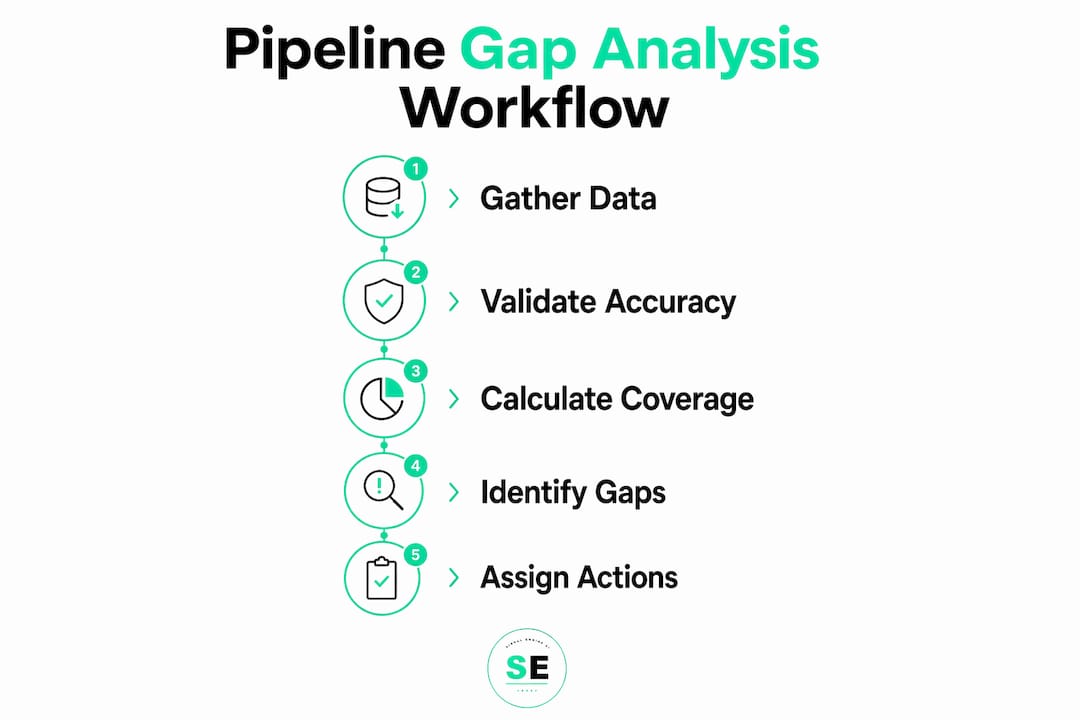
The workflow has five distinct steps. Each one builds on the previous, and skipping any step produces an incomplete picture.
- Calculate your weighted pipeline value. Multiply each deal's value by its historical stage close rate. Sum the results. This is your real pipeline, not your nominal pipeline.
- Calculate your pipeline deficit. Subtract your weighted pipeline value from your quota. The result is your gap in dollars.
- Calculate your coverage ratio. Divide your total pipeline by your quota. Compare this ratio against your historical benchmark. A ratio that looks healthy on paper can still signal a quality problem if your stage conversion rates have declined.
- Run four diagnostic checks. Review deal age, next step completeness, stakeholder engagement, and single-threading status. These four checks separate volume gaps from quality gaps.
- Build owner-assigned recovery plans. Every recovery action must have a single owner, a deadline, and an estimated revenue impact. Recovery plans without ownership fail because accountability is diffuse.
The table below maps diagnostic findings to the correct recovery response.
| Diagnostic Finding | Gap Type | Recommended Action |
|---|---|---|
| Pipeline below coverage ratio | Volume | Add new qualified opportunities; accelerate top-of-funnel |
| Deals aged beyond average cycle | Quality | Reassess deal viability; apply multi-threading |
| No next steps on 30%+ of deals | Quality | Require next-step updates before review; coach reps |
| Single-threaded deals above 50% | Quality | Introduce additional stakeholders; expand contacts |
| Stage conversion rate declining | Quality | Review exit criteria; inspect MEDDPICC compliance |
Pro Tip: When you find a quality gap, resist the instinct to generate new pipeline. Adding new leads late in the quarter rarely closes on time if your average sales cycle is longer than the days remaining. Accelerate and multi-thread existing deals instead.
How do focused pipeline reviews surface real deal risk?
Pipeline reviews are not discovery sessions. They are triage sessions that confirm what automated inspection already flagged. High-performing revenue teams separate pipeline inspection, which is automated analysis run before the meeting, from intervention, which is the strategic discussion that happens during it.
The most effective reviews follow a tight structure:
- Limit the session to 30–45 minutes and cover only 3–5 high-priority deals.
- Pre-flag deals where CRM data contradicts the rep's narrative before the meeting starts.
- Evaluate behavioral signals like preparation quality, objection handling patterns, and closing discipline rather than accepting verbal status updates.
- Use MEDDPICC to verify that each deal meets the exit criteria for its current stage.
- Never update CRM records during the review. Reps should update CRM before the meeting so the session stays focused on decisions, not data entry.
The shift from rep narratives to behavioral evidence is where most sales leaders find the biggest improvement in forecast confidence. A rep who says a deal is "on track" but has not sent a proposal, has not engaged the economic buyer, and has not logged a next step is telling you a story. The behavioral data tells you the truth.
Pro Tip: Move all problem-solving out of the review meeting and into 1:1 coaching sessions. The review identifies risk. The coaching session fixes it. Mixing the two turns a 40-minute review into a two-hour slog.
What are the most common mistakes in pipeline gap analysis?
Most pipeline gap analysis failures trace back to five repeatable mistakes. Recognizing them early saves a quarter.
- Using rep-estimated close probabilities. Reps are optimistic by nature. Stage-based historical rates are objective. Always use historical rates for weighted pipeline calculations.
- Treating a quality gap as a volume problem. Generating new pipeline when your conversion rates are broken just adds more deals that will also stall. Fix the conversion problem first.
- Running the analysis too late. A gap identified in week 11 of a 13-week quarter has almost no recovery window. The quarterly cadence with a mid-quarter refresh exists precisely to create enough runway for recovery actions to work.
- Including stale deals in coverage calculations. Deals with no activity and no next step are not pipeline. They are noise. Including them overstates your coverage and delays the moment you recognize the real gap.
- Assigning recovery actions without accountability. A recovery plan that says "the team will pursue expansion opportunities" is not a plan. It is a wish.
The most dangerous pipeline is one that looks full but is full of the wrong deals. Volume without quality is not coverage. It is a forecast that will miss, and you will not know it until the quarter is already over.
Sales leaders who identify sales process gaps early and assign credible, measurable recovery actions consistently outperform those who rely on pipeline volume alone. The workflow is not complicated. The discipline to run it consistently is what separates teams that hit quota from teams that explain why they missed.
Key Takeaways
A sales pipeline gap analysis workflow produces accurate revenue forecasts only when it separates volume gaps from quality gaps and assigns owner-accountable recovery actions before the quarter runs out of time.
| Point | Details |
|---|---|
| Run the analysis early | Use a quarterly baseline with a mid-quarter refresh to preserve recovery runway. |
| Clean your CRM first | Remove stale deals and verify stage accuracy before calculating weighted pipeline. |
| Separate gap types | Volume gaps need new pipeline; quality gaps need conversion fixes, not more leads. |
| Use behavioral signals | Evaluate prep scores and engagement data, not rep narratives, to assess deal health. |
| Assign recovery ownership | Every action needs one owner, a deadline, and a measurable revenue impact estimate. |
Why pipeline volume is the wrong thing to celebrate
I have sat in pipeline reviews where the number on the screen looked great and the quarter still ended in a miss. That experience taught me something that took longer to accept than it should have: pipeline volume is a vanity metric if you have not stress-tested the quality underneath it.
The teams I have seen execute this workflow well share one habit. They treat the gap analysis as a diagnostic tool, not a performance review. The moment it becomes about judging reps, the data gets managed. Reps start sandbagging or inflating deals to look good in the meeting. The numbers stop reflecting reality, and your forecast becomes fiction.
The other thing I have learned is that separating inspection from intervention is not just a process preference. It is the structural change that makes reviews worth having. When automated pre-meeting inspection surfaces the flagged deals before anyone walks into the room, the conversation starts at a different level. You are not discovering problems. You are deciding what to do about problems you already know exist.
The revenue recovery workflow only works when the recovery plans are real. Specific owners. Real deadlines. Estimated impact in dollars. Anything less is theater.
— Bernard
How Signalengine powers your pipeline gap analysis
Running a disciplined gap analysis manually is possible. Running it consistently, every quarter, with clean data and pre-flagged behavioral signals, is where most teams fall short.
Signalengine's revenue intelligence tools automate the inspection layer. The platform scores customer and deal behavior automatically, flags mismatches between CRM stage data and actual engagement signals, and surfaces which deals need attention before your review meeting starts. You get owner-assigned recovery workflows built in, so accountability does not slip through the cracks. Signalengine serves 12 verticals and is priced for SMBs starting at $49/month. You get the pipeline visibility that enterprise teams pay far more to build.
Ready to Stop the Revenue Leak?
Signal Engine gives small and local businesses 31 AI-powered tools to score leads by buying intent, predict churn before it happens, auto-generate email and SMS campaigns, and recover missed calls automatically — all in one dashboard starting at $49/month.
Start your free 7-day trial — no credit card required. Setup takes 5 minutes.
FAQ
What is a sales pipeline gap analysis workflow?
A sales pipeline gap analysis workflow is a structured process that calculates the difference between your weighted pipeline value and your revenue quota, then classifies the gap as a volume or quality problem and assigns specific recovery actions to close it.
How often should you run a pipeline gap analysis?
The industry standard is a quarterly baseline with a mid-quarter refresh. The mid-quarter update incorporates actual won and lost deals to recalibrate your recovery plan with current data.
What is the difference between a volume gap and a quality gap?
A volume gap means you do not have enough pipeline to cover your quota at historical close rates. A quality gap means you have enough pipeline on paper but your conversion rates are broken, so existing deals are unlikely to close as expected.
How long should a pipeline review meeting last?
Pipeline review meetings should run 30–45 minutes and focus on 3–5 high-priority deals. Longer meetings that cover the entire funnel produce less focused decisions and lower accountability.
Why should CRM updates happen before a pipeline review, not during it?
Updating CRM records during the meeting shifts the session from strategic decision-making to administrative work. Reps should update all deal data before the meeting so the review focuses entirely on risk identification and recovery decisions.