

TL;DR:
- Sales process gaps cause revenue leaks and account for 30 to 40 percent of lost leads in small and medium-sized businesses. Fixing common handoff and follow-up issues, especially at discovery-to-demo and proposal-to-close stages, can significantly improve sales outcomes. Regularly auditing CRM data and identifying process deviations prevent forecasts from becoming unreliable and ensure sales teams execute with clarity.
Sales process gaps are specific breakdowns in your sales workflow that cause leads to stall, deals to die, and revenue to leak before it ever reaches your bank account. SMEs typically lose 30–40% of leads due to preventable gaps, with post-proposal follow-up being the single most common failure point. The industry term for this is "sales execution gap," and it shows up at every stage of the funnel. Knowing the exact sales process gap examples in your pipeline is the first step to fixing them. This article gives you the concrete examples, the data behind them, and the fixes that actually move the needle.
1. Sales process gap examples every SME should know
Six gaps account for the majority of revenue leakage in small and mid-size sales teams. Each one is preventable once you know where to look.
Gap 1: First response latency
Speed kills deals when you are slow. Leads that do not receive a response within the first hour drop off at a rate that makes every other gap look minor. Your prospect contacted three competitors at the same time they contacted you. Whoever responds first wins the conversation.

Gap 2: Qualification abandonment
Reps move leads forward without confirming budget, authority, need, or timeline. The result is a pipeline full of deals that look healthy but will never close. Poor qualification is the root cause of most late-stage stalls.
Gap 3: Proposal delivery delays
A prospect who asks for a proposal is at peak interest. Every day you wait to deliver it, that interest cools. Competitors who deliver faster win the deal, even when your offer is stronger.
Gap 4: Post-proposal follow-up gaps
Structured follow-up after a proposal can improve close rates by 2–3 times. Most reps send one email and wait. That single touchpoint is not a follow-up sequence. It is a missed opportunity.
Pro Tip: Build a five-touch follow-up sequence for every proposal: email on day one, call on day three, value-add email on day five, LinkedIn message on day eight, and a final "closing the loop" email on day twelve.
Gap 5: Decision stall from lack of final-step support
Buyers freeze when they do not know what happens next. If your rep cannot clearly explain the onboarding process, contract terms, or implementation timeline, the deal stalls at the finish line. This gap is almost always a training problem.
Gap 6: Post-win onboarding gaps
Closing the deal is not the end of the sales process. Weak onboarding creates buyer's remorse, reduces product adoption, and accelerates churn. The sale you just won becomes a cancellation within 90 days.
2. Where sales funnel gaps stall most often
About 70% of B2B pipeline stalls happen at two specific handoffs: discovery to demo, and demo to proposal. That concentration tells you exactly where to focus your audit.
The discovery-to-demo gap happens when reps book demos without confirming that the prospect has a real, urgent problem. They fill the calendar. They do not fill the pipeline. A demo with an unqualified prospect wastes everyone's time and inflates your activity metrics while your conversion rate quietly collapses.
The demo-to-proposal gap is a handoff problem. The demo ends without a booked next step. No confirmed date for the proposal review. No agreed-upon decision timeline. The prospect goes quiet, and the rep marks the deal as "in progress" for another 30 days.
- Missing booked next steps after every meeting is the single most common root cause of funnel stalls.
- Unclear buyer urgency lets deals drift. If the prospect has no deadline, your deal has no deadline.
- Missed commitments from either side signal low deal health. Track them as a leading indicator.
- Handoff ambiguity between reps or between sales and delivery creates confusion that kills momentum.
| Funnel stage | Most common gap | Primary signal |
|---|---|---|
| Discovery to demo | Unqualified prospects booked | Low demo-to-proposal conversion |
| Demo to proposal | No next step confirmed | Long time-in-stage |
| Proposal to close | Weak follow-up sequence | Proposals sent but not reviewed |
| Close to onboarding | Unclear next steps | Early churn within 90 days |
Pro Tip: End every sales call with a confirmed date and time for the next meeting. Write it in the calendar before you hang up. This one habit eliminates the majority of handoff stalls.
3. How sales problems get misdiagnosed
Low conversion rates are often misread as pricing problems when the actual issue is a trust gap. Dropping your price does not fix distrust. It just makes you cheaper and less credible.
Sales leaders make this mistake constantly. The prospect says "your price is too high," and the team responds by discounting. The real message was "I do not trust that your product will deliver what you promised." Price was the excuse, not the reason.
The second most common misdiagnosis is confusing a traffic problem with a conversion problem. If your pipeline is thin, you might assume you need more leads. But generating more meetings when your funnel leaks accelerates revenue loss. You pour more leads into a broken process and lose them faster.
Fixing symptoms without diagnosing root causes is the most expensive mistake a sales leader can make. You can double your lead volume and still watch revenue decline if the funnel itself is broken.
- Symptom: Low close rate. Misdiagnosis: Bad leads. Real cause: Weak qualification or poor follow-up.
- Symptom: Long sales cycles. Misdiagnosis: Complex buyers. Real cause: No urgency established at discovery.
- Symptom: High churn. Misdiagnosis: Product fit. Real cause: Post-win onboarding gap.
- Symptom: Stalled proposals. Misdiagnosis: Competitor pricing. Real cause: Trust not established before the proposal was sent.
The fix is tracking exact funnel-stage conversion rates, not just top-level revenue numbers. When you know that your demo-to-proposal rate is 60% but your proposal-to-close rate is 12%, you know exactly where to intervene.
4. How to audit your sales process for hidden gaps
The Process-Reality Gap (PRG) is a metric that measures how far your documented sales process has drifted from what your reps actually do. A PRG value above 0.30 means your playbook is fiction. Your reps have invented their own process, and your forecasts are built on assumptions that do not match reality.
Running a PRG audit requires three data points for each CRM stage: average time-in-stage, stage-to-stage conversion rate, and average deal value at each stage. When those numbers diverge significantly from your documented benchmarks, you have found a gap.
Steps to run a quarterly sales process audit
- Pull your CRM stage data for the last 90 days. Export time-in-stage, conversion rate, and deal value by stage.
- Compare to your documented playbook. Every stage where actual behavior differs from the playbook by more than 30% is a candidate for rebuild.
- Interview three to five reps about what they actually do at each stage. Their answers will not match the playbook. That gap is your data.
- Identify the two stages with the lowest conversion rates. Those are your highest-priority fixes.
- Rebuild broken stages with specific entry criteria, required activities, and exit criteria. Vague stages produce vague results.
- Retrain the team on the rebuilt stages before moving to the next audit cycle.
| Metric | Healthy range | Warning signal |
|---|---|---|
| Time-in-stage (discovery) | 3–7 days | Over 14 days |
| Demo-to-proposal conversion | 50–70% | Below 35% |
| Proposal-to-close conversion | 25–40% | Below 15% |
| PRG index | Below 0.20 | Above 0.30 |
High PRG values invalidate your forecasts and require stage redefinition and rep retraining before any other intervention will work. Fix the process before you fix the people.
5. Effective ways to close sales funnel gaps
The highest-ROI fix in any sales process is a structured post-proposal follow-up sequence. Doubling or tripling your close rate on proposals already delivered costs nothing except discipline.
The second most impactful fix is clarifying the buyer's business problem before the demo. Deals without a clearly defined problem are fragile. They appear healthy in your pipeline but stall silently when the prospect cannot justify the purchase internally. Ask "what happens if you do not solve this by Q3?" before you ever open a slide deck.
- Structured follow-up sequences after proposals: minimum five touches over 12 days.
- Qualification gates at discovery: no demo booked without confirmed budget and urgency.
- Booked next steps at the end of every call: confirmed date, time, and agenda before you hang up.
- Behavioral lead scoring to prioritize which prospects get your attention first. Signalengine scores buyer behavior automatically and flags who is ready to move.
- Stage-specific conversion tracking in your CRM: measure each handoff, not just total pipeline value.
Pro Tip: Before increasing your meeting volume, run a revenue leak analysis on your current funnel. Fixing one leaking stage will outperform adding 20 new meetings every time.
89% of organizations have a defined sales process, but only 36% of reps follow it. That 53-point execution gap is not a motivation problem. It is a process design problem. When stages are vague, reps improvise. When stages are specific, reps execute.
Key takeaways
The most impactful sales process gaps sit at the discovery-to-demo and demo-to-proposal handoffs, not at the closing stage, and fixing them with structured follow-up and clear qualification gates delivers the fastest revenue recovery.
| Point | Details |
|---|---|
| Post-proposal follow-up is the top fix | Structured sequences of five or more touches can double or triple your close rate. |
| 70% of stalls happen at two handoffs | Discovery-to-demo and demo-to-proposal transitions cause most pipeline failures. |
| PRG above 0.30 means your playbook is fiction | Audit CRM stage data quarterly and rebuild any stage that deviates by more than 30%. |
| Misdiagnosis costs more than the gap itself | Confusing trust gaps with pricing problems leads to discounting that destroys margin. |
| More meetings do not fix a leaking funnel | Diagnose stage conversion before scaling activity or you accelerate the loss. |
What I have learned from watching sales teams bleed revenue
Sales leaders almost always look at the wrong end of the funnel. They obsess over closing techniques, objection scripts, and discount authority. The real money is at the front. Every deal that stalls at proposal was already broken at discovery. You just did not know it yet.
The most uncomfortable truth I have found is that execution gaps are almost never a rep performance problem. They are a process design problem. When you give reps a vague playbook with undefined stage criteria, they fill the gaps with guesswork. Some guesses work. Most do not. The variance in your team's results is not talent. It is process clarity.
I have also watched teams spend months optimizing their pitch decks while their proposal follow-up rate sat at one email per deal. That is like repainting a car with a flat tire. The pitch is not your problem. The follow-up is. Fix the boring stuff first.
The other mistake I see constantly is treating a quarterly audit as a one-time project. Sales processes drift. Buyers change. Markets shift. A process that worked in january will have measurable gaps by april if you are not checking. Build the audit into your calendar the same way you build in your revenue review. They are the same meeting.
My recommendation: start with your pipeline forecasting accuracy. If your forecast is consistently off by more than 20%, you have a PRG problem. Fix the process reality gap first, then address individual stage performance. Everything else is noise until the foundation is solid.
— Bernard
Signalengine spots your revenue leaks before they cost you
Your sales process has gaps right now. The question is whether you find them before your revenue does.
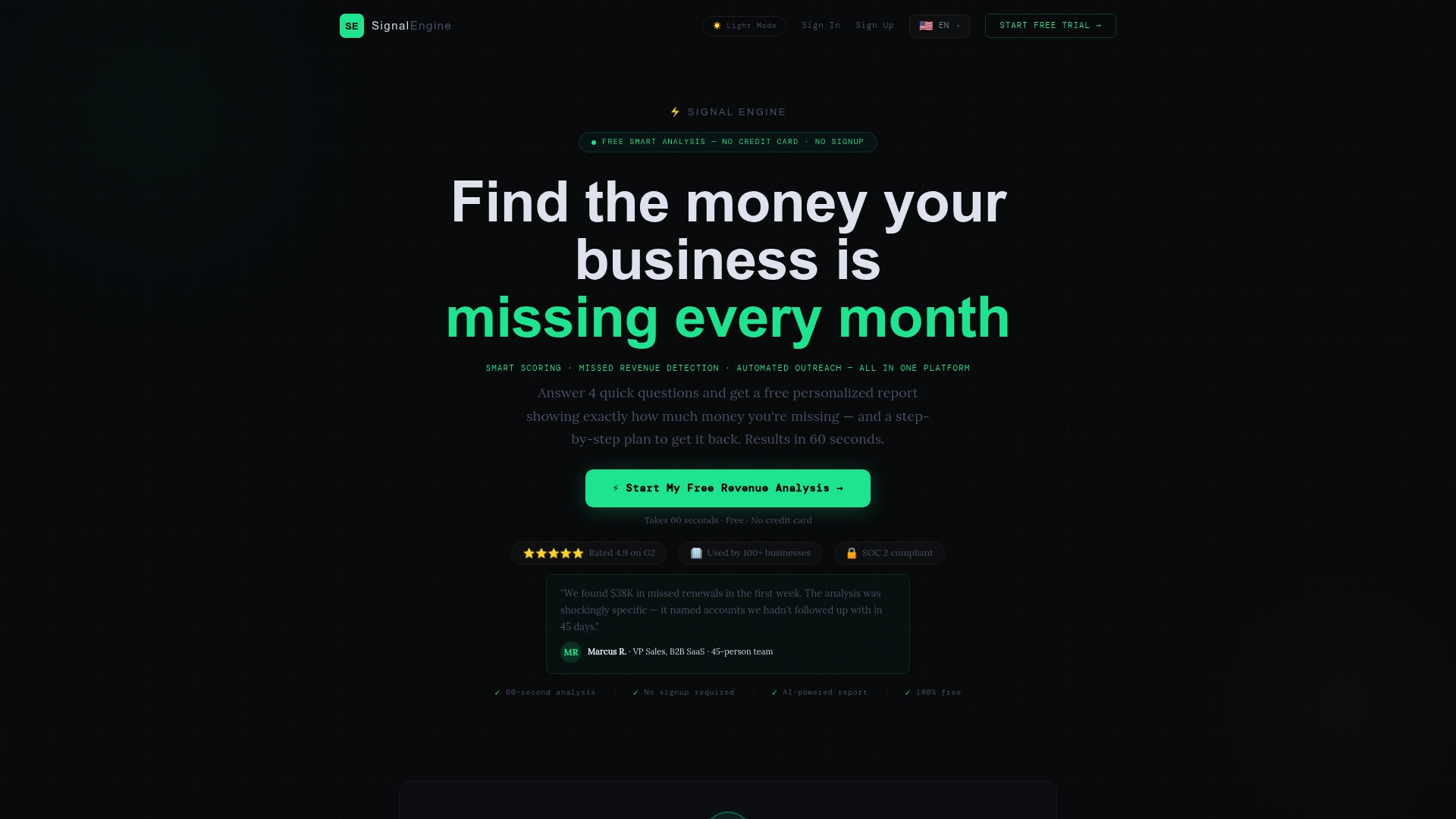
Signalengine is built for sales leaders and business owners who need answers fast. It watches your pipeline, scores buyer behavior automatically, and flags exactly where deals are stalling. No manual audits. No spreadsheet archaeology. The platform's revenue intelligence tools cover 31 AI-powered functions, from lead scoring to churn prediction, all in one dashboard starting at $49/month. You can also see it live before you commit. Setup takes five minutes. The gaps it finds on day one will pay for the subscription before the week is out.
FAQ
What are the most common sales process gap examples?
The six most common gaps are slow first response, poor qualification, proposal delivery delays, weak post-proposal follow-up, decision stall from unclear next steps, and post-win onboarding failures. Each one causes measurable revenue leakage.
How do I identify sales process flaws in my pipeline?
Pull your CRM stage data and calculate time-in-stage and conversion rate for each handoff. Any stage with a conversion rate below your benchmark or a PRG index above 0.30 is a confirmed gap requiring a fix.
Why do most sales funnel gaps go undetected?
Most teams track total pipeline value instead of stage-by-stage conversion. Gaps hide inside healthy-looking aggregate numbers until a missed quarter forces a closer look.
How does structured follow-up improve close rates?
A five-touch follow-up sequence after proposal delivery can improve close rates by 2–3 times compared to a single follow-up email. Consistency and timing matter more than the content of each message.
What is the Process-Reality Gap and why does it matter?
The Process-Reality Gap (PRG) measures how far your actual sales behavior has drifted from your documented playbook. A PRG above 0.30 means your forecasts are unreliable and your stages need to be rebuilt before any other fix will hold.
Ready to Stop the Revenue Leak?
Signal Engine gives small and local businesses 31 AI-powered tools to score leads by buying intent, predict churn before it happens, auto-generate email and SMS campaigns, and recover missed calls automatically — all in one dashboard starting at $49/month.
Start your free 7-day trial — no credit card required. Setup takes 5 minutes.