

A sales stage is a named checkpoint that tells you where one deal stands between first contact and a signed customer. A good definition has two parts: what the stage means, and the proof a deal must show before it moves on. That proof is the exit criterion. Without it, stages turn into opinions, deals sit in the wrong column, and revenue leaks out where nobody is looking. This guide gives you the standard stages, a plain definition of each, exit criteria you can copy, and a way to adapt them to your business.
TL;DR
- A sales stage marks where a deal is in your process. It does not say how likely the deal is to close.
- Most pipelines run between four and 10 stages. Seven is the common default.
- Each stage needs an exit criterion: one observable fact, ideally from the buyer, that a manager can check in seconds.
- Keep two or three criteria per stage. More than that and reps stop using them.
- Adapt stage names to your business, but keep the same number and meaning of stages across every rep and service line so reports stay comparable.
Table of Contents
- What a sales stage is, and what it is not
- The standard sales stages, defined
- Exit criteria: the part most teams skip
- Add a time limit to every stage
- Adapting stages to your business without breaking your reports
- Using stages to find stalled deals and revenue leaks
- How Signal Engine fits in
- Our perspective
- FAQ
- Sources
- Ready to Stop the Revenue Leak?
What a sales stage is, and what it is not
People use "stage," "step," "process," "cycle" and "pipeline" as if they were the same thing. They are not, and mixing them up is how reporting gets muddy.
- Sales stage: one checkpoint a deal passes through, such as qualification or proposal.
- Sales process: the repeatable set of stages and actions your team follows to turn a prospect into a customer.
- Sales cycle: the time-based journey of a single deal from first contact to close.
- Pipeline: the inventory of every open deal, sorted by stage. TechTarget notes that the term is sometimes used for the whole sales journey and sometimes for the narrower set of deals tracked in a CRM from qualification to closing. Decide which one your team means.
- Forecast category: how likely a deal is to close this period. This is a separate label from the stage.
The last point matters most. A deal in the proposal stage is not automatically a likely deal. A proposal sent to a contact who has gone quiet is still a proposal-stage deal, and it should carry a low forecast weight. If you want to go deeper on that split, our piece on separating pipeline from forecast walks through it.
The standard sales stages, defined
The most common model has seven stages. Shopify's list runs: prospecting, lead qualification, demo or full meeting, proposal, negotiation and commitment, opportunity won, and post-purchase. TechTarget's version swaps in initial contact and ends on customer retention. The names differ, the logic is the same: find, qualify, understand, offer, agree, close, keep.
Here is a working set of definitions and exit criteria. Treat the third column as a starting point and edit it to fit what your buyers actually do.
| Stage | What it means | Exit criterion (proof to advance) |
|---|---|---|
| 1. Prospecting | You have identified a person or company that might need what you sell. | A named contact with a working email, phone number or form submission. |
| 2. Qualification | You and the buyer have checked whether there is a real fit. | The buyer has described the problem in their own words and confirmed a timeframe. |
| 3. Discovery or demo | You understand the need and have shown how you solve it. | A second person has joined, or the buyer has named who else decides. |
| 4. Proposal | The buyer has a written price and scope. | The buyer has acknowledged receipt and a review date is on the calendar. |
| 5. Negotiation | You are agreeing on final terms. | The buyer has requested specific changes, or sent back marked-up terms. |
| 6. Closed won | The contract is signed or the job is booked with a deposit. | Signature, payment or confirmed start date. |
| 7. Post-sale | The customer is onboarded and being retained. | First service delivered, first invoice paid, or onboarding complete. |
Also keep a closed lost status with a required reason. A lost deal with no reason teaches you nothing.
Stage 1: Prospecting
Prospecting means building a list of people who could buy. At this point nobody has agreed to anything. The mistake is counting raw names as pipeline. A name only becomes a deal when someone responds. Keep this stage for outreach and move a contact forward only on a real reply or inbound request.
Stage 2: Qualification
Qualification is a mutual check. You are asking whether the buyer has a problem you can solve, a budget in the right range and the authority or access to decide. The buyer is asking whether you are credible. A rep's feeling that the lead "seems interested" is not an exit criterion. The buyer saying, in their own words, what is wrong and when they need it fixed, is.
Stage 3: Discovery or demo
Here you dig into the situation and show the solution. For a small business, this may be a 20-minute call, a site visit or a walkthrough. The strongest signal that a deal is real at this stage is breadth: more than one person on the buyer's side knows about it. A deal that depends on one friendly contact can vanish the day that contact gets busy.
Stage 4: Proposal
A proposal is a written price and scope. Sending one is easy, so do not treat sending as progress. Progress is the buyer engaging with it: opening it, asking questions, or booking a time to review.
Stage 5: Negotiation
Negotiation covers the back-and-forth on price, scope, timing and terms. It is also where deals stall quietly. Set a rule for how long a deal can sit here before someone must follow up or move it back.
Stage 6 and 7: Closed won and post-sale
Closed won should require evidence: a signature, a payment or a confirmed start date. Post-sale matters because retention is revenue. A customer who churns in month three cancels out much of what the sale was worth, so give onboarding and the first renewal their own stage or status.
Exit criteria: the part most teams skip
Definitions tell reps what a stage is called. Exit criteria tell them when a deal may leave it. Without criteria, reps move deals forward on hope, and the pipeline looks healthier than it is.
Good exit criteria share four traits:
- Observable. Someone other than the rep can see the evidence: a CRM field, a calendar invite, an email, a signed document.
- Binary. The answer is yes or no. "Good conversation" is not binary. "Budget range confirmed in writing" is.
- Buyer-side. Evidence comes from the buyer's actions, not yours. You can send a proposal any day. You cannot make a second stakeholder join a call.
- Few. Two or three per stage. Long checklists get ignored or ticked without thought.
A quick test: could a manager verify this criterion in ten seconds without asking the rep how they feel about the deal? If not, rewrite it.
Weak versus strong criteria
| Stage | Weak (opinion) | Strong (evidence) |
|---|---|---|
| Qualification | "Lead seems serious." | Buyer stated the problem and a target date in an email or call note. |
| Discovery | "Great demo." | Decision-maker identified by name; next meeting booked. |
| Proposal | "Sent quote." | Buyer replied or review call scheduled. |
| Negotiation | "Close to done." | Buyer sent edits or a list of open items. |
| Closed won | "Verbal yes." | Signed agreement, deposit or confirmed start date. |
Enforce them in your CRM
A criterion nobody checks is decoration. Where your CRM allows it, make the evidence a required field before a deal can change stage: a date, a contact role, an uploaded document. Then review stage changes in a weekly deal meeting. Our pipeline hygiene checklist lists twelve checks you can run on every open deal.
Add a time limit to every stage
Exit criteria stop deals moving forward too early. Time limits catch deals that stop moving at all. Set an expected number of days for each stage based on your own closed deals, and flag anything that sits at double that number for review. Use your own history, not generic benchmarks, because a $400 service call and a $40,000 contract do not behave alike.
Sales cycles vary widely by deal size and customer type. If you want a primer on how funnels differ across channels and segments, see multi-channel funnels and sales growth. To measure how fast your own deals move, our pipeline velocity example shows the calculation with real numbers.

Adapting stages to your business without breaking your reports
The standard seven stages were written with B2B software in mind. A plumber, a dental practice or a church does not run a proposal-and-negotiation cycle. You still need stages, but you can rename and merge them. The rule is simple: change the labels and the evidence, never the structure that your reports depend on.
Keep these fixed across the whole business:
- The number of stages and the order they run in.
- The meaning of each stage, written in one sentence.
- The exit criterion for each stage.
- The definition of closed won and closed lost.
You may change these to fit your trade:
- The names, so reps recognize them.
- The specific evidence, such as a booked estimate instead of a signed proposal.
- Time limits, which should reflect your typical job size.
Examples by business type
| Business | Stage names | Key exit criterion |
|---|---|---|
| HVAC or plumbing | Inquiry, Estimate booked, Estimate delivered, Follow-up, Job booked, Job complete | Estimate delivered: written quote sent and a follow-up date set. |
| Dental or medical practice | New inquiry, Consult booked, Consult attended, Treatment plan presented, Accepted, Treatment started | Consult booked: date and time confirmed by the patient. |
| Real estate agent | Lead, Conversation, Showing or valuation, Offer or listing agreement, Under contract, Closed | Under contract: signed purchase agreement. |
| Cleaning or landscaping | Quote request, Walkthrough, Quote sent, Trial service, Recurring route, Renewal | Recurring route: scheduled visits on the calendar. |
| Church or ministry | First visit, Follow-up, Connected, Serving or giving, Committed member | Connected: attended a small group or event a second time. |
Notice the pattern. The labels change, but each row still has an entry, a checkpoint of real buyer action, a commitment and a retention phase. That is what lets you roll a mixed business into one report.
If you sell more than one kind of thing
If you offer one-off jobs and recurring contracts, resist building a separate pipeline for every offer. Use one set of stages and tag the deal type. You can then compare conversion by type without rebuilding the report each time. Only split the pipeline when the buying process is genuinely different, for example, residential versus commercial accounts.
Using stages to find stalled deals and revenue leaks
Once stages have definitions, exit criteria and time limits, your pipeline becomes a diagnostic tool. Three patterns show up quickly:
- Pile-ups. A stage holding far more deals than the one before it is usually a bottleneck, or a stage where reps park deals they have not worked.
- Aging. Deals that stay in a stage past the limit are likely stalled. Contact them or close them out.
- Skipped stages. Deals that jump from qualification to closed won with no evidence in between often mean a stage is being logged after the fact.
When you clean up a pipeline for the first time, expect the total value to shrink. That is not a loss. The deals were never really at that stage. For a structured way to find where deals leak out, see our sales pipeline gap analysis workflow and our notes on why deals slip.
How Signal Engine fits in
Writing stage definitions is the easy part. Keeping them honest across dozens of open deals every week is where small teams fall behind. Signal Engine is built for small service businesses. It scores every customer on buy-readiness, flags who is about to churn, and drafts the next action, with everything held for your one-click approval before anything reaches a real customer. It comes with modes for 17 industries, plus a Church/Ministry mode, and an onboarding AI builds a custom mode if your business does not fit. Our Growth plan is $149 per month and Scale is $297 per month, with no per-seat pricing and all features in every plan.
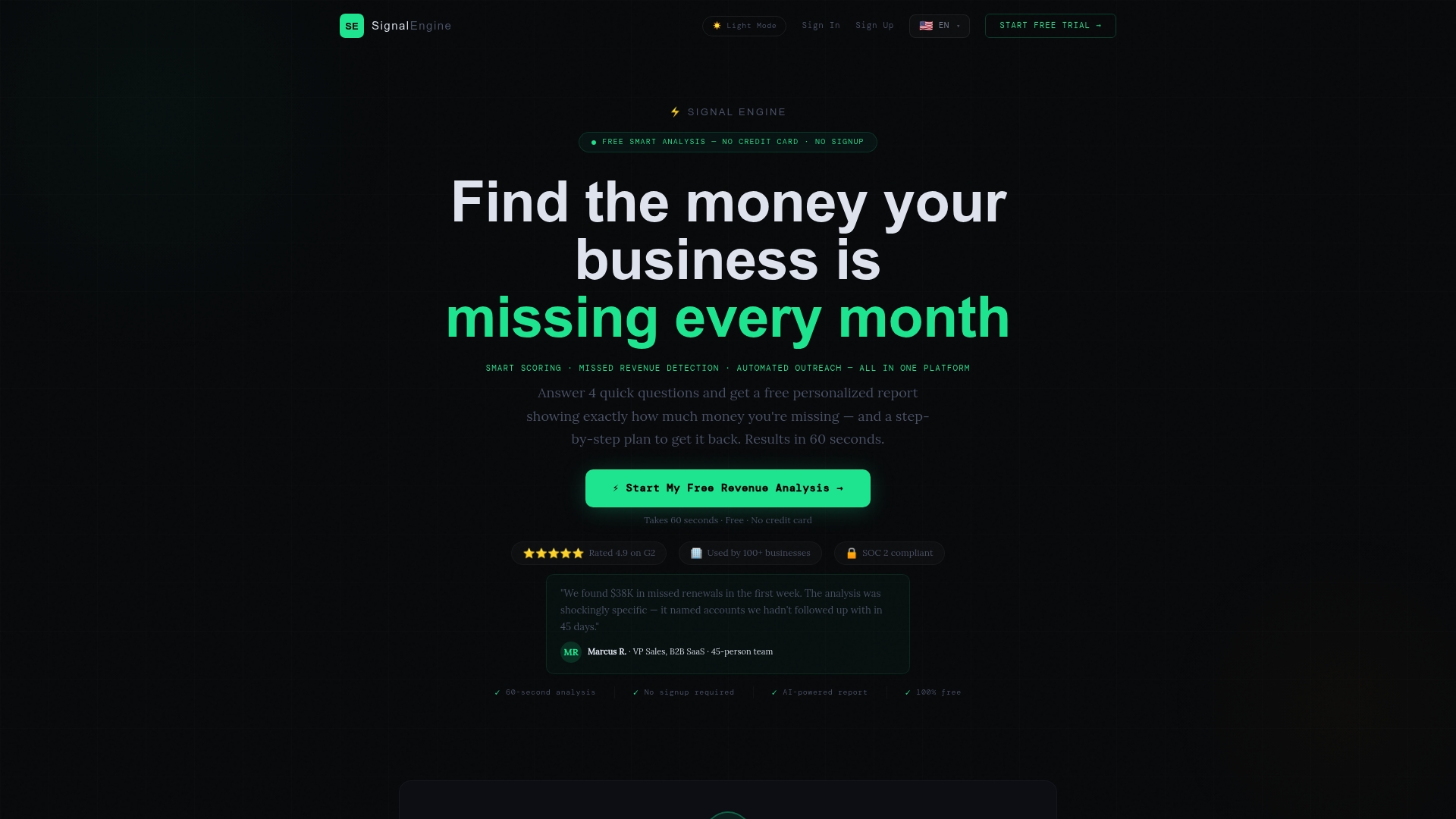
See how lead scoring built for small business works, or compare plans on our pricing page.
Our perspective
We built Signal Engine around one observation: small businesses rarely lose revenue in one big moment. They lose it in small gaps. A quote nobody followed up on. A customer who stopped booking. A call that went to voicemail.
Stage definitions are how you see those gaps. When every stage has an exit criterion and a time limit, a stalled deal stops hiding. It shows up as aging, as a pile-up or as a skipped step. That is why we score buy-readiness and flag churn risk instead of leaving it to gut feel.
Our view is that a business your size should not need an analyst to get there. Define the stages, set the evidence, and let the software watch them every day and draft the next move for you to approve.
Bernard
FAQ
What are the standard sales stages?
The most common model has seven: prospecting, qualification, discovery or demo, proposal, negotiation, closed won and post-sale. Many teams use fewer, and a typical pipeline has four to 10 stages. Pick the number that matches how your buyers really decide, and keep it the same for every rep.
What are sales stage exit criteria?
Exit criteria are the proof a deal must show before it moves to the next stage. Good ones are observable, yes-or-no facts, ideally from the buyer, such as a confirmed meeting, a named decision-maker or a signed agreement. Two or three per stage is enough.
What is the difference between a sales stage and a sales process?
A stage is one checkpoint. The process is the full repeatable set of stages and actions that moves a prospect to a customer. The process is the map, and stages are the marked stops along it.
How many stages should a small business have?
Use as few as it takes to show real progress. For quick-turn service work, five or six stages is often enough. Add stages only when you find that two very different situations are being lumped into one.
Sources
- Sales Pipeline Stages: 7 Key Stages Explained
- What are the 7 stages of the sales pipeline? (TechTarget)
Ready to Stop the Revenue Leak?
Signal Engine gives small and local businesses 31 AI-powered tools to score leads by buying intent, predict churn before it happens, auto-generate email and SMS campaigns, and recover missed calls automatically — all in one dashboard starting at $49/month.
Start your free 7-day trial — no credit card required. Setup takes 5 minutes.