

TL;DR:
- A service gap recognition checklist compares current performance to targets, assigns ownership, and prompts timely actions. Proper classification, root cause analysis, and structured KPIs improve service delivery and prevent unresolved gaps. Regular audits and AI tools like Signalengine enhance early detection and faster resolution of service issues.
A service gap recognition checklist is a structured tool that compares your current service performance against a defined target state and converts every discrepancy into an owned, time-bound action. The industry standard framework behind this approach is the Gap Model of Service Quality, developed by Parasuraman, Zeithaml, and Berry, which identifies five distinct gap types from misread customer expectations to broken delivery. Businesses that run structured service gap analysis close problems faster, retain more customers, and spend less time guessing where revenue is leaking. This article walks you through building and using a practical checklist, applying diagnostic models like SERVQUAL, and scoring your results with real metrics.
1. How to build a service gap recognition checklist in 5 steps
A gap analysis checklist works only when it documents reality, not assumptions. Each step below produces a specific output that feeds the next.
Step 1: Document current service performance. Pull actual data. Record the metric, the date it was measured, and the source. "Customer wait time averages 8 minutes on Tuesdays based on POS logs from march 2026" is defensible. "Wait times feel long" is not. Field audits must document observed conditions against baseline standards rather than rely on memory.

Step 2: Define the target service state. Set a specific future outcome with a deadline and the assumptions behind it. "Reduce wait time to under 4 minutes by June 30, 2026, assuming current staffing levels hold" gives your team something to aim at. Vague targets like "improve wait times" produce vague results.
Step 3: Name the gap type. Every gap falls into one of four categories: performance gap (you know the standard but miss it), tracking gap (you lack the data to know), definition gap (the standard itself is unclear), or strategy gap (the target conflicts with business direction). Naming the type tells you where to intervene.
Step 4: Run a root cause analysis. Use the five whys technique. Ask "why does this gap exist?" five times in sequence. A complaint resolution rate of 60% might trace back to: no escalation path, then no escalation training, then no training budget, then no training owner. The fifth answer is where your fix lives.
Step 5: Assign a closing plan with one owner. One gap, one owner, one action, one check-in date. Ownership over gap-closing actions that control the metric is the critical differentiator between actual closure and wasted effort.
Pro Tip: Never assign a gap to a team or a department. Assign it to the individual who controls the metric. Shared ownership is no ownership.
2. Applying the Gap Model of Service Quality and SERVQUAL
The Gap Model of Service Quality identifies five gaps that explain why customers receive less than they expect. Understanding which gap you face tells you exactly where to intervene.
- Gap 1: Management misunderstands what customers actually expect.
- Gap 2: Service standards don't match management's understanding of expectations.
- Gap 3: Employees deliver below the written service standards.
- Gap 4: Marketing promises more than operations can deliver.
- Gap 5: The customer perceives a difference between what they expected and what they received.
Gap 5 is the only gap customers can directly report. The other four gaps are internal failures that produce Gap 5. Start your diagnosis with customer perception data, then work backward through Gaps 1–4 to find the root cause inside your business.
SERVQUAL operationalizes this model through matched-pair surveys covering five dimensions: tangibles, reliability, responsiveness, assurance, and empathy. Customers answer 22 expectation items and 22 perception items separately. The score difference on each dimension shows you exactly where your delivery falls short of what you promised. This matters because expectations and perceptions must be treated separately to diagnose whether gaps stem from unrealistic promises or genuine delivery faults.
A business that scores low on reliability but high on empathy needs process fixes, not staff training on friendliness. SERVQUAL prevents you from fixing the wrong thing.
3. Customer experience audit checklist items that reveal delivery failures
A customer experience audit targets measurable touchpoints, not impressions. Every item on your audit checklist needs a number, a standard, and an observable condition.
Greeting and first contact:
- Customer greeted within 30 seconds of entry or first contact
- Staff member makes eye contact and uses the customer's name if known
- Phone answered within 3 rings during peak hours
Wait time and queue management:
- Peak-hour queue wait time measured and logged (target: under 5 minutes)
- Off-peak wait time measured separately (target: under 2 minutes)
- Queue abandonment rate tracked weekly
Complaint handling:
- Complaint acknowledged within 2 minutes of report
- Resolution offered within the same interaction (first contact resolution target)
- Escalation path documented and tested quarterly
Environment and navigation:
- Signage matches intended customer path (audit against floor plan baseline)
- Cleanliness scored against a written standard, not a general impression
- Payment process steps counted and compared to minimum viable flow
Product knowledge and follow-up:
- Staff answers 3 product knowledge test questions correctly
- Post-purchase follow-up sent within 48 hours and tracked for open rate
| Audit Area | Measurable Standard | Frequency |
|---|---|---|
| Greeting speed | Within 30 seconds | Every visit/shift |
| Peak queue wait | Under 5 minutes | Daily log |
| Complaint resolution | Same-interaction close | Weekly review |
| Signage accuracy | Matches floor plan baseline | Monthly |
| Post-purchase follow-up | Sent within 48 hours | Per transaction |
4. Metrics and quality scoring for customer service evaluation
Quantifying service gaps requires a blended set of KPIs, not a single number. Combining outcome KPIs with operational metrics and structured QA scorecards gives you both the "what" and the "why."
Key metrics to track:
- First Contact Resolution (FCR): The industry baseline sits around 70%. Below that, customers are calling back, and your team is doing the same work twice.
- Customer Satisfaction (CSAT): A typical average runs near 78%. A score below 75% signals a systemic gap, not a one-off complaint.
- Abandon Rate: A 6% abandon rate is a common reference point. Above that, your queue or response time is actively pushing customers away.
- Average Handle Time (AHT): Measures efficiency. Too high signals training or process gaps. Too low can signal agents cutting corners on resolution quality.
Structured QA scorecards add a layer of consistency that raw metrics miss. Standardized scorecards produce evaluator agreement rates near 89%, which means your managers are measuring the same thing. Without a scorecard, two managers auditing the same interaction will reach different conclusions.
Pro Tip: Pick 4–5 KPIs and own them completely. Tracking 15 metrics produces reports, not decisions.
A focused KPI set tied to a QA scorecard gives you a prioritized gap list. The gaps with the largest score deviations and the highest customer impact get fixed first. That is how you conduct a revenue audit that actually changes outcomes.
5. When to run a service improvement audit
Gap analyses should be conducted at regular intervals tied to specific business triggers, not on a fixed calendar alone. Waiting for an annual review means you are always closing last year's gaps.
Run a service improvement audit after launching a new service or product, when a KPI drops below its target threshold, after a significant competitive shift in your market, and at the start of each strategic planning cycle. These triggers catch gaps while they are still small. A complaint rate that climbs 3% over six weeks is fixable. The same problem ignored for six months becomes a churn event.
Auditing journey stages and tagging findings to specific gap types prevents the most common mistake: lumping a delivery failure, a training gap, and a communication problem into one vague action item. Each gap type needs a different fix. Mixing them produces a plan that addresses none of them fully.
Build a recurring audit cadence into your operations calendar. Quarterly is the minimum for most SMBs. Monthly is better for high-volume service businesses like HVAC, dental, or logistics where customer touchpoints are frequent and failure costs are high.
Key takeaways
A service gap recognition checklist closes gaps reliably only when each item carries a named owner, a measurable target, and a fixed check-in date.
| Point | Details |
|---|---|
| Anchor in real data | Document current performance with dates and data sources, never from memory. |
| Name the gap type | Classify each gap as performance, tracking, definition, or strategy before acting. |
| Use SERVQUAL for diagnosis | Separate expectation and perception scores to find whether the problem is a promise or a delivery failure. |
| Score with blended KPIs | Track FCR, CSAT, abandon rate, and AHT together; a single metric misleads. |
| Assign one owner per gap | Shared ownership produces no closure; one person must control the metric being fixed. |
What I've learned about service gap recognition after years in the field
Most businesses treat a service gap checklist as a documentation exercise. They fill it out, file it, and move on. The gap stays open.
The real failure is not identifying gaps. It is assigning them to the wrong person. I have seen managers hand a complaint resolution gap to a customer service team that has no authority to change the escalation policy. The team works harder, the policy stays broken, and the gap never closes. Ownership must sit with the person who controls the process, not the person who feels the pain.
The second mistake is vague future states. "Improve customer satisfaction" is not a target. "Reach a CSAT score of 82% by September 30, 2026, assuming no staffing changes" is a target. The deadline and the assumptions create accountability. Without them, every review meeting becomes a conversation about why the goal is still "in progress."
The third thing I have found is that cadence beats intensity. A business that runs a focused 30-minute service audit every month will outperform one that runs a two-day audit once a year. Frequency catches drift early. Intensity catches problems that have already compounded.
If I were advising a business owner starting from scratch, I would say this: run your first audit this week, pick your worst-scoring gap, assign it to one person with a 30-day deadline, and check in on day 15. That single cycle will teach you more about your service operation than any framework document.
— Bernard
How Signalengine helps you spot and close service gaps faster
Running a service gap analysis manually takes time your business may not have. Signalengine's AI-powered revenue intelligence watches your customer data continuously, scores behavior automatically, and flags who is at risk of leaving before they go.
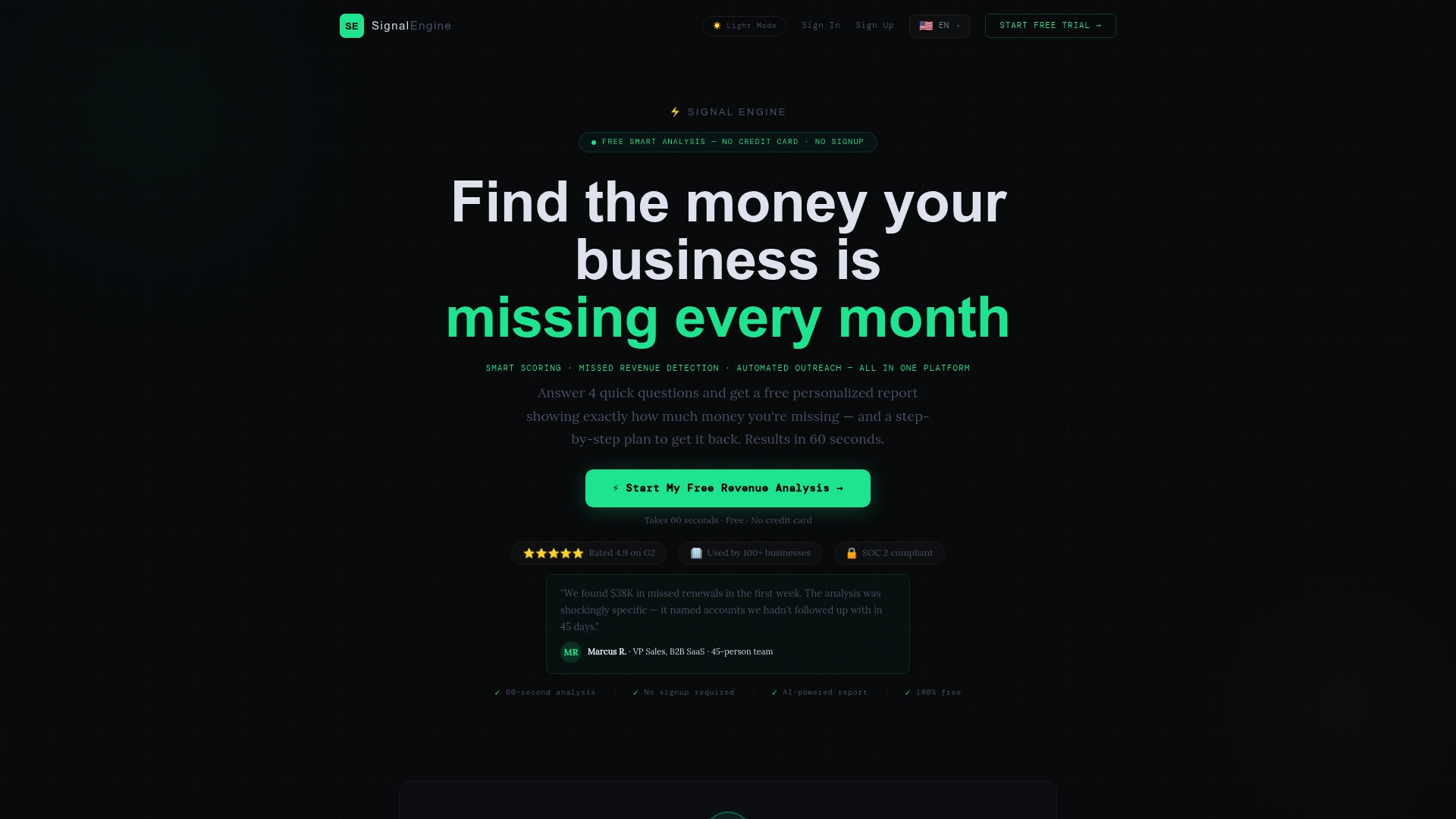
You get a clear picture of where your service is leaking revenue, which customers need attention now, and what to do next. Signalengine serves 12 verticals including HVAC, dental, logistics, and real estate, and it is built for SMBs at a price that fits. No data team required. No complex setup. Just signals that tell you where your gaps are and who owns fixing them. Pair that with your checklist and you have a system that closes gaps, not just finds them.
Ready to Stop the Revenue Leak?
Signal Engine gives small and local businesses 31 AI-powered tools to score leads by buying intent, predict churn before it happens, auto-generate email and SMS campaigns, and recover missed calls automatically — all in one dashboard starting at $49/month.
Start your free 7-day trial — no credit card required. Setup takes 5 minutes.
FAQ
What is a service gap recognition checklist?
A service gap recognition checklist is a structured tool that compares current service performance against a defined target, names the gap type, identifies the root cause, and assigns a closing action to one accountable owner with a deadline.
How often should I run a service gap analysis?
Gap analyses should run after launching new services, when KPIs drop below target, after competitive shifts, and at each strategic planning cycle. Quarterly is the minimum for most service businesses.
What is the difference between SERVQUAL and the Gap Model?
The Gap Model identifies five structural gaps between customer expectations and delivery. SERVQUAL is the survey instrument that measures Gap 5 by collecting separate expectation and perception scores across five dimensions: tangibles, reliability, responsiveness, assurance, and empathy.
What metrics should I use for customer service evaluation?
Track First Contact Resolution (baseline near 70%), CSAT (average near 78%), abandon rate (reference point of 6%), and Average Handle Time together. A blended KPI set with a QA scorecard gives you both the gap size and its likely cause.
Why do service gaps stay open even after they are identified?
The most common reason is misassigned ownership. A gap assigned to a team with no authority over the process will not close. Assign each gap to the individual who controls the metric, set a deadline, and schedule a mid-point check-in to catch drift before the due date.